Alterations, Fit & Preservation
Adding Sleeves to a Wedding Dress: Options, Cost & Timeline
Detachable vs. sewn-in, illusion vs. lace, strapless bodice conversions, and the seamstress skill that separates a flawless result from a costly mistake — everything a bride needs to know before committing.
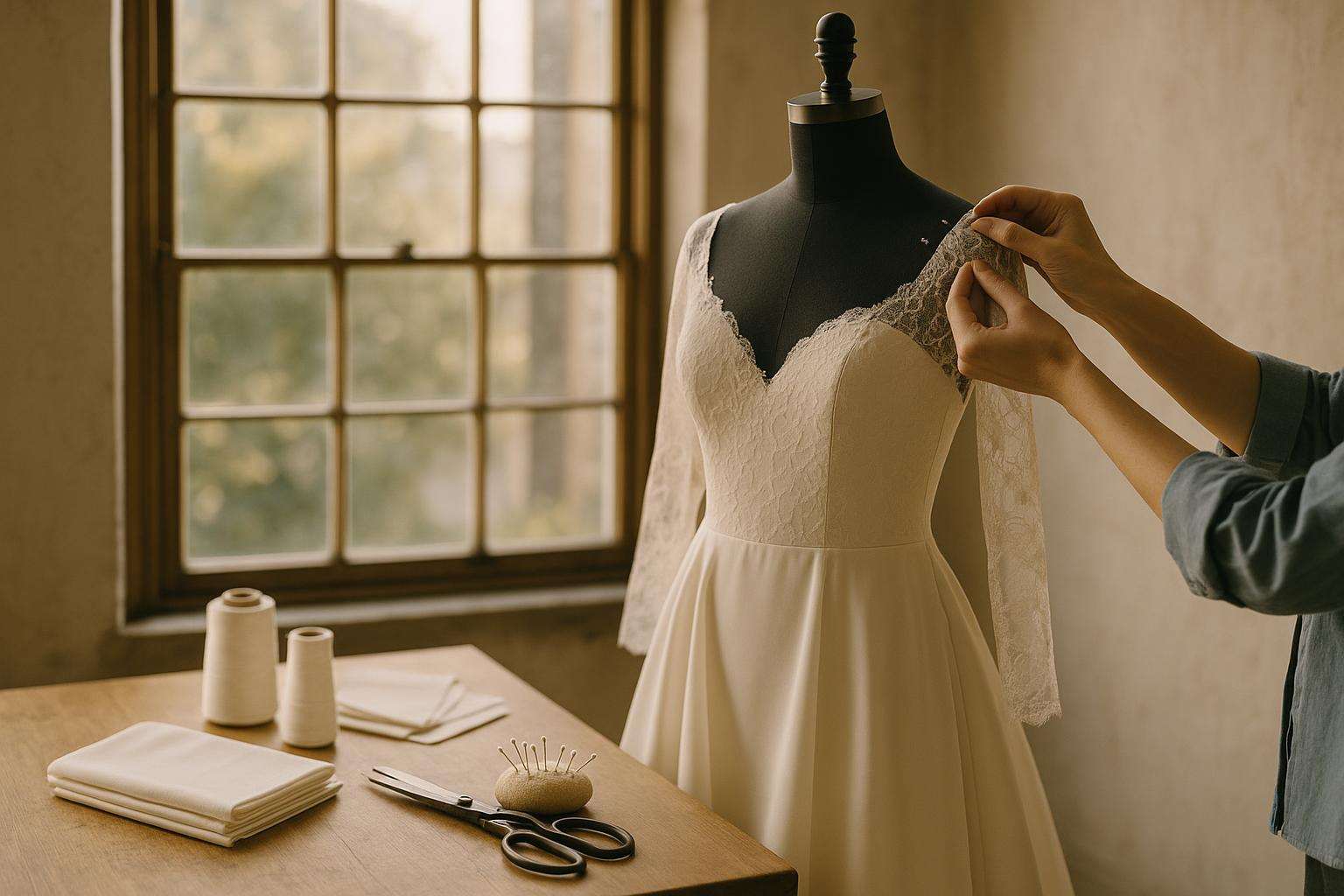
Adding sleeves to a wedding dress is possible on almost any gown, but cost and complexity range enormously: detachable accessories from Pronovias or Maggie Sottero start around $150–$400 with no structural alteration required, while bespoke sewn-in illusion or Chantilly lace sleeves on a strapless bodice can run $350–$700 and require eight to twelve weeks of specialist fitting time.
The decision to add sleeves rarely arrives in isolation. A bride falls for a strapless ballgown at Kleinfeld Bridal, then pictures herself walking down an aisle that calls for something more covered, more heritage, more her. Or she finds the perfect silhouette at BHLDN — and the ceremony is in a cathedral with a dress code. Whatever the reason, sleeve addition is one of the most-requested bridal alterations, and also one of the most technically variable. Getting it right means understanding the options before you walk into a salon, so the conversation with your seamstress starts in the right place.
What Are the Different Types of Sleeves You Can Add to a Bridal Gown?
The sleeve landscape divides cleanly into two streams — accessories you attach yourself, and sleeves permanently integrated by a skilled seamstress — with several fabric styles running across both.
Detachable sleeves
Detachable sleeves attach via concealed snaps, hook-and-eye closures, poppers, or elastic loops sewn at the shoulder seam, and come away in seconds — producing two distinct looks from one gown. Multiple major houses have formalised this into product lines. Allure Bridals sells puff, bell, off-the-shoulder, and chiffon cape-style detachable sleeves with pearl embellishments, each designed to attach and remove without an alteration appointment. Pronovias, the Barcelona luxury house with stockists across the US, carries lace, satin, tulle, and voluminous puffy options as standalone accessories; the authorised US retailer Rituals of Love Bridal lists Pronovias sleeve accessories starting at $182. Grace Loves Lace sells the Delilah Sleeve — ruched ivory tulle with an extra set of poppers included for hand-stitching to a compatible bodice. Olivia Bottega stocks puff, lantern, satin, and sheer lace styles at accessible price points. And Maggie Sottero / Sottero & Midgley offer named pieces including the Narissa Detachable Sleeves in Chantilly lace, the Brennan Cape in stretch Mikado, and the Sigourney Cape in beaded illusion flutter.
For brides who want the widest possible price range, the Etsy marketplace lists handmade Chantilly lace, tulle flutter, and embellished detachable options from independent artisans from approximately $25–$150+, with production times of 3–20 days per listing. BHLDN (Anthropologie's bridal line) also carries gowns sold with removable sleeves as a design feature, useful if the sleeve look is a primary requirement from the outset.
Lace sleeves (detachable or sewn-in)
Lace is the most-requested sleeve material at bridal alteration salons. For a seamless result, many seamstresses source lace directly from the original gown's designer or manufacturer to ensure pattern and dye-lot matching — a step that can add two to four weeks of lead time. Chantilly lace sleeves work particularly well on ball gowns and A-line silhouettes where lace is already a primary design element. When sourcing independently, the lace must match not just the motif but the colorway: ivory, diamond white, and blush all shift with age, so sourcing from the same production lot as the gown fabric is the professional standard.
Illusion sleeves
Illusion sleeves use sheer tulle, silk organza, or stretch mesh so that beading or lace motifs appear to float against the skin. The three most common fabrications are fine illusion tulle (lightest, nearly invisible), stretch illusion mesh (preferred for fitted long sleeves because it moves with the arm), and silk organza (slightly stiffer, used for cap and puffed styles). Kleinfeld Bridal — which employs more than 100 alteration staff and fields three to five fittings per gown — notes that illusion material benefits a gown structurally while creating the look and feel of an incredibly delicate finish. Margo West, a Dallas-based bridal alteration specialist, plans a minimum of two to three dedicated fittings when adding illusion sleeves and conceals all attachment hardware within existing seams.
Tulle flutter sleeves
Flutter sleeves are short, open, romantically fluid sleeves that move with the bride's every step. Justin Alexander Signature's style 9890 — a beaded tulle fit-and-flare — features detachable flutter sleeves explicitly designed for removal at the reception so the bride can dance freely. Flutter sleeves can also be executed in chiffon or satin and are popular for bohemian outdoor ceremonies where a rigid sleeve would feel out of place.
Cap sleeves and off-the-shoulder variants
Cap sleeves cover only the top of the shoulder and are among the least structurally demanding additions, representing the lower end of the sewn-in cost range. Off-the-shoulder sleeves drape from the upper arm rather than anchoring at a set-in armhole, making them more compatible with strapless bodices without requiring full armhole reshaping.
Are Detachable Sleeves Better Than Sewn-In Sleeves for a Wedding?
Neither option is objectively superior — the right choice is determined by your bodice construction, budget, venue, and how you plan to use the gown during the day.
Detachable sleeves are lower cost, faster to source, and carry zero alteration risk to the gown. They offer ceremony coverage followed by a streamlined reception silhouette, all without a single appointment with a seamstress. The trade-off is that no detachable sleeve integrates as seamlessly with the gown's existing construction as a bespoke sewn-in sleeve. Attachment hardware — even when well-concealed — may shift or gap slightly at the shoulder with movement, and the lace or fabric match to the gown is limited to whatever is commercially available.
Sewn-in sleeves, executed by a specialist, integrate fully with the gown's seam structure, move naturally with the body, and allow precise fabric and lace matching. They are the superior long-term result — but only when the seamstress has the skill to execute them. A strapless or corset bodice presents genuine technical complexity: the armhole must be redrawn, the shoulder seam repositioned, and the sleeve head shaped and inserted correctly. Mistakes made at this stage are costly to reverse. The Wedding Dresser in Brooklyn, led by costume designer Susan Ruddie Spring, maintains an extensive sample library of sleeves, laces, and fabrics for brides to try during fittings before any cutting begins — a professional standard that protects against the most common points of failure.
How Much Does It Cost to Add Sleeves to a Wedding Dress in 2026?
Price tracks directly with complexity, fabric, and the skill level required of the seamstress. The table below compiles figures from Zola's 2026 alteration cost report, Sophia's Bridal Tux & Prom's published pricing guide, and Olga Lindsey's alteration price list.
| Sleeve Option | Typical Cost Range | Lead Time | Seamstress Skill Required |
|---|---|---|---|
| Handmade detachable (Etsy / indie artisan) | $25–$150 | 3–20 days | None (no alteration) |
| Designer detachable accessory (Pronovias, Allure, Maggie Sottero) | $150–$400+ | 1–3 weeks | None (no alteration) |
| Custom cap sleeves, sewn-in | $150–$300 | 4–6 weeks, 2 fittings | Intermediate |
| Custom lace or illusion, sewn-in (medium complexity) | $300–$600 | 8–12 weeks, 3+ fittings | Advanced / specialist |
| Full-length sleeves on strapless / corset bodice | $350–$700 | 8–12 weeks, 3–5 fittings | Couture-level specialist |
| Rush surcharge (fittings < 6 weeks before wedding) | +25–50% | — | — |
Overall bridal alteration budgets — inclusive of hemming, bustle, and taking-in — run $80–$800 for typical modifications. A strapless-bodice sleeve conversion combined with other structural changes can push the total above $1,200, per cost data reported by Zola. Zola's 2026 alteration cost guide is the most current publicly available source for regional pricing context.
What Bodice Styles Are Hardest to Add Sleeves To?
Bodice construction is the single largest driver of sleeve-addition complexity. A sleeveless gown's armhole is cut large by design — it does not carry the shaped underarm curve that a set-in sleeve requires. An experienced seamstress must trace and redraw the armhole curve, raise the shoulder seam to a snugger fit, and create a new attachment point before inserting any full sleeve. By Hand London's sewing reference documents this clearly: the existing armhole curve must be redrawn, ease must be built in at the shoulder, and the seam repositioned before the sleeve head can be cleanly inserted.
The Knot's bridal editorial recommends that brides finalise their undergarment choice before the armhole is patterned — because bra or shapewear shifts the fit of the finished sleeve, and a patterned armhole cannot be easily adjusted once the bodice lining has been moved.
The complexity hierarchy, from most to least demanding:
- Structured strapless / full corset bodice — highest complexity; armhole must be reshaped entirely; sleeve requires a new structural anchor point.
- Spaghetti-strap bodice — moderate; existing straps provide some anchor, but the strap must often be removed or repositioned before the sleeve can be set in.
- Square or V-neck bodice with existing shoulder seam — low to moderate; the shoulder seam provides a natural attachment line that reduces structural work.
- Short-sleeved gown (extension or replacement) — lowest complexity; the existing sleeve already establishes armhole shape, ease, and attachment hardware.
How Long Does It Take to Add Sleeves to a Wedding Dress, and When Should You Start?
Timing is where many brides underestimate the process. Ready-to-wear detachable accessories can be ordered and arrive within one to three weeks. Custom sewn-in sleeves — even moderately complex ones — require a minimum of three to four fitting appointments spread across eight to twelve weeks. If the lace must be sourced from the original designer or matched to the gown's existing fabric, add two to four weeks for procurement before the first fitting pin is placed.
Avery Austin Bridal recommends beginning the sleeve conversation no later than four months before the wedding, and treating twelve weeks as the absolute minimum. The practical sequence for sewn-in sleeves: consultation and fabric sourcing (weeks 1–4), mock-up toile fitting on the actual gown (weeks 4–6), first sleeve fitting (weeks 6–8), second fitting with refinements (weeks 8–10), and final press and pick-up (weeks 10–12).
Practical Guidance for Getting the Result Right
Several professional standards separate a seamless sleeve addition from a visible disappointment.
Build a toile first. A skilled seamstress constructs a muslin mock-up of the new bodice-plus-sleeve before cutting into the actual gown fabric. This avoids costly errors on delicate lace or beaded material and lets the bride test mobility before anything is permanent. By Hand London's dressmaking resource makes this non-negotiable for any sleeveless-to-sleeved conversion.
Test mobility at every fitting. At each appointment, sit on a low chair, stand, and practice ascending stairs. If tugging or locking occurs at the underarm, request a micro-gusset or additional ease before proceeding to the next fitting. A sleeve that restricts movement in the fitting room will be far more uncomfortable on the wedding day after hours of wear.
Take care with lace and rings. Kleinfeld Bridal's alteration team advises turning rings inward before slipping on or removing any lace or illusion sleeve — snagging is the most common source of damage to delicate sleeve fabric during the fitting process.
Consider a bolero as an alternative. If the bodice construction makes sleeve addition impractical — or the cost is prohibitive — a Chantilly lace or illusion bolero provides ceremony coverage without any permanent structural alteration. It also ships in days rather than weeks and can be worn over almost any strapless or spaghetti-strap silhouette.
For a deeper look at how sleeve styles interact with bridal silhouettes, see the Bride Atlas guides to long-sleeve wedding dresses and off-the-shoulder gowns. Both cover how established sleeve constructions behave across different body types and fabric weights — useful context before your alteration appointment.
Considered Counsel
Frequently asked
Can you add sleeves to any wedding dress?
Almost any wedding dress can receive some form of sleeve addition, but the complexity and cost vary enormously by bodice construction. A strapless or corset-boned bodice requires the most work: a skilled seamstress must reshape the armhole, raise the shoulder seam, and create a new anchor point before any sleeve can be attached. Square-neck and V-neck gowns with an existing shoulder seam are considerably more straightforward. The safest starting point is a consultation with an experienced bridal alteration specialist — The Wedding Dresser in Brooklyn and Margo West in Dallas both note that every quote is individualized after an in-person fitting, because fabric weight, layer count, and embellishment placement all shift the scope of work significantly. Detachable sleeves are the most universally compatible option, since they attach via snaps or loops rather than requiring structural alteration of the bodice.
How much does it cost to add sleeves to a wedding dress?
The cost ranges from approximately $25 for handmade detachable sleeves purchased on Etsy to $700 or more for full-length custom illusion or lace sleeves sewn into a strapless bodice by a specialist. Ready-to-wear designer detachable accessories — from Pronovias, Allure Bridals, or Maggie Sottero — typically run $150–$400. Custom sewn-in cap sleeves sit at $150–$300; medium-complexity lace or illusion sleeves, $300–$600; and a full strapless-to-sleeved bodice conversion, $350–$700. These figures come from published price guides by Zola, Sophia's Bridal Tux & Prom, and independent seamstress Olga Lindsey. Rush fees — when fittings are scheduled fewer than six weeks before the wedding — typically add 25–50% to the base cost. Combined with other alterations, a strapless bodice sleeve conversion can push the total alteration bill above $1,200.
What is the difference between a detachable and a sewn-in wedding dress sleeve?
Detachable sleeves attach to the bodice via concealed snaps, hook-and-eye closures, poppers, or elastic loops, and can be removed in seconds — giving the bride two distinct looks from one gown without any permanent structural change. Designer houses including Allure Bridals, Pronovias, Grace Loves Lace (the Delilah Sleeve), and Maggie Sottero (the Narissa Detachable Sleeves in Chantilly lace) all sell named detachable sleeve accessories designed to work with their gown collections. BHLDN also carries removable-sleeve wedding dresses as a category. Sewn-in sleeves, by contrast, are permanently integrated into the gown by a seamstress — they require reshaping the armhole, anchoring the sleeve head into the shoulder seam, and finishing all attachment hardware inside existing seam lines. The result is more polished and more structurally secure, but the process is irreversible and demands a seamstress with genuine couture-level skill.
What is an illusion sleeve on a wedding dress, and how is it made?
An illusion sleeve is constructed from sheer tulle, silk organza, or stretch mesh so that beading or lace motifs appear to float against the skin with no visible fabric ground. The three most common fabrications are fine illusion tulle (the lightest, nearly invisible against fair to medium skin tones), stretch illusion mesh (preferred for fitted long sleeves because it moves with the arm without pulling), and silk organza (slightly stiffer, used for cap and puffed styles). Kleinfeld Bridal's alteration team notes that illusion material can benefit a gown structurally while creating the look and feel of an incredibly delicate finish. Margo West, a Dallas-based bridal alteration specialist, plans for a minimum of two to three dedicated fittings when adding illusion sleeves, with all attachment hardware concealed within existing seams. Matching the sheer ground to the gown's lining shade is critical — a mismatched illusion tone is the most common visible flaw in amateur sleeve additions.
How long does it take to add sleeves to a wedding dress?
The timeline depends on whether you choose detachable accessories or custom sewn-in sleeves. Ready-to-wear detachable sleeves from designers like Pronovias or Allure Bridals can arrive within one to two weeks of ordering; handmade Etsy options list production times of 3–20 days. Custom sewn-in sleeves require a minimum of three to four fitting appointments spread over eight to twelve weeks. If lace fabric must be sourced from the original gown's designer or dye-lot matched to the gown's existing lace, add two to four weeks for fabric procurement before the first fitting pin is placed. Avery Austin Bridal recommends beginning the alteration conversation — and certainly locking in your seamstress — no later than four months before the wedding date if sleeves are part of the plan, and twelve weeks at the absolute minimum.
Which bodice styles are hardest to add sleeves to?
Structured strapless and full corset-boned bodices are the most technically demanding for sleeve addition. A sleeveless bodice armhole is deliberately cut large and open — it lacks the shaped underarm curve that a set-in sleeve requires for proper fit and mobility. The seamstress must trace and redraw the armhole, raise the shoulder seam to a snugger position, and create a new insertion point before any full sleeve can be attached. By Hand London's sewing resource documents this process in detail: the existing armhole curve must be redrawn, ease must be added at the shoulder, and the seam line repositioned before the sleeve head can be inserted cleanly. Spaghetti-strap gowns are moderately complex — the existing straps provide some anchor point — while square-neck or V-neck gowns with a defined shoulder seam are the most straightforward conversion. The Knot recommends finalising your undergarment choice before the armhole is patterned, since bra or shapewear alters the fit of the finished sleeve.
Are detachable sleeves better than sewn-in sleeves for a wedding?
Neither is objectively better — the right choice depends on your bodice, budget, venue, and reception plans. Detachable sleeves offer maximum flexibility: ceremony coverage followed by a streamlined silhouette at the reception, with no permanent structural change to the gown. They are lower cost, faster to source, and carry no alteration risk. Justin Alexander's bridal editorial highlights exactly this advantage — style 9890, a beaded tulle fit-and-flare with detachable flutter sleeves, is explicitly designed so the bride can remove them and dance freely. Sewn-in sleeves, however, integrate seamlessly with the gown's existing construction, move more naturally with the body, and can be matched in lace or fabric more precisely than an off-the-shelf accessory. For brides with strapless gowns who want a truly cohesive ceremony look and have the budget for specialist alteration work, sewn-in sleeves are the superior long-term result — if the seamstress has the skill to execute them.