Alterations, Fit & Preservation
How to Steam a Wedding Dress Safely at Home
Fabric-by-fabric steaming temperatures, step-by-step technique, water-spot prevention, and an honest guide to when the professionals should take over.
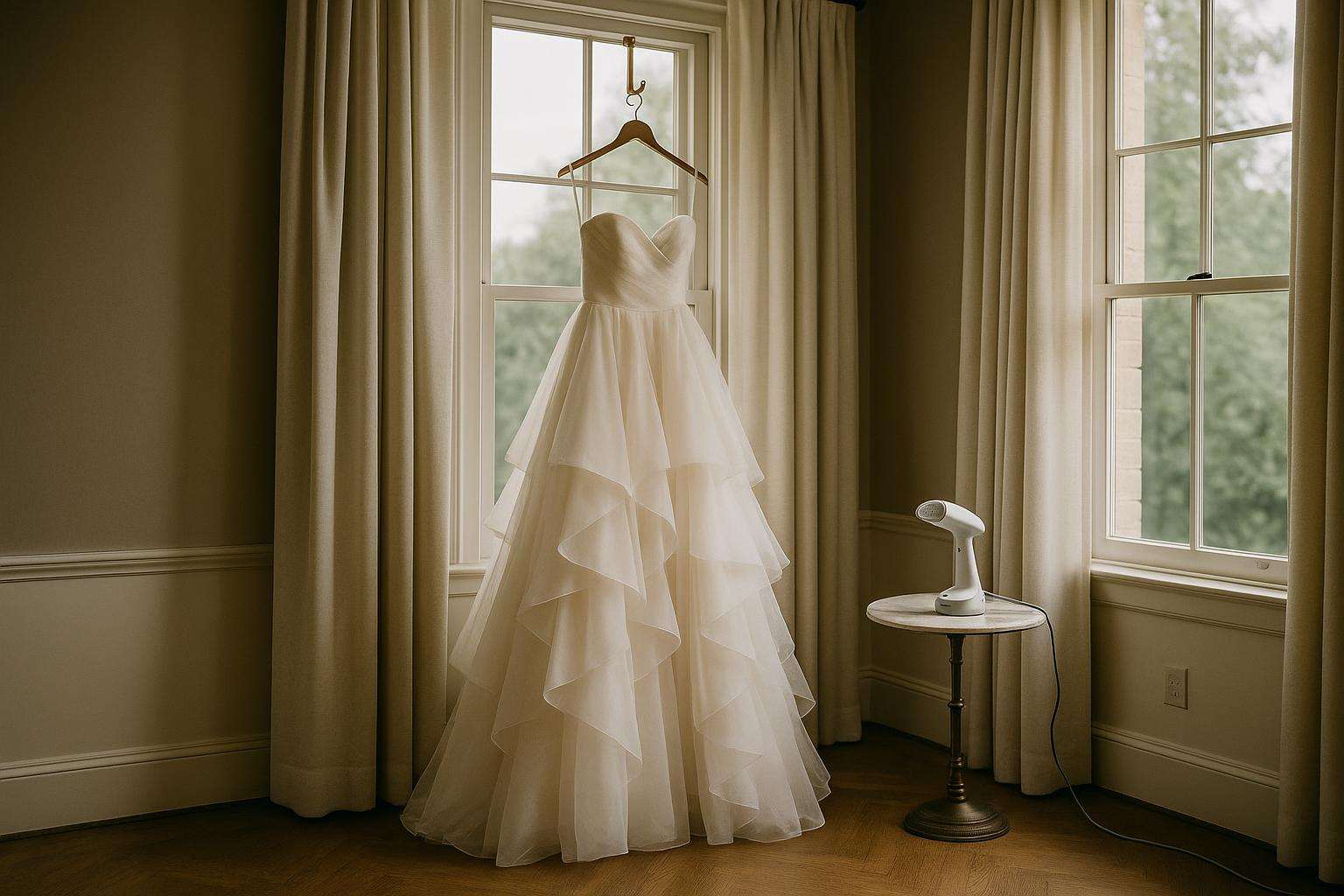
Steaming is the safest way to remove wrinkles from a wedding gown because it delivers moist heat without contact pressure — but tulle, lace, satin, and crepe each need a different temperature and distance. Use distilled water only, hang the gown high, steam from the hem upward, and allow 30–60 minutes of cool-down before packing. Book a professional for silk, heavily beaded, or multi-layered gowns.
Your dress arrived from the boutique or off the delivery truck looking like it spent a week in a suitcase. The good news: steaming is a remarkably effective and fabric-safe way to restore it — provided you match your technique to the cloth. This guide takes you through every major bridal fabric, the exact distances and temperatures that keep each one safe, the step-by-step sequence professional tailors use, and the honest truth about when to hand the task to someone who does this every day.
Should You Steam or Iron a Wedding Dress?
The distinction matters enormously. A conventional iron presses heat and weight directly onto fabric, which can cause permanent shine marks on satin, melt synthetic tulle fibers, loosen embellishment adhesive on beaded overlays, and flatten the dimensional texture of lace. Steaming, by contrast, delivers moist heat from a distance, gently relaxing fiber tension without contact pressure — which is why bridal boutiques like Uptown Bride in Albuquerque, NM steam every gown that comes through their salon as a standard part of their sanitation process.
There are exceptions: taffeta, dupioni, and shantung weaves can actually look more wrinkled after steaming because their tight cross-weave traps moisture unevenly. For these fabrics, a medium-low dry iron on the inside-out with a clean white press cloth is safer. When in doubt, check the care label sewn into the gown — or call your boutique.
One non-negotiable rule before you even plug in a steamer: fill with distilled water only. Tap water carries dissolved minerals that leave white or rust-colored stains on light-colored fabrics — the exact outcome you are trying to prevent on a dress that may represent a significant financial and sentimental investment.
What Temperature Should You Use to Steam Each Bridal Fabric?
Every major bridal fabric has a different tolerance for heat and moisture. The table below is the practical reference — use it as your starting point, test on a hidden interior seam first, and always start at the lowest setting.
| Fabric | Max Steam Temp | Steamer Distance | Key Risk | Pro Tip |
|---|---|---|---|---|
| Tulle / Netting | ~120°F (49°C) | 12+ inches | Warping, stretching | Keep head moving; brief passes only |
| Lace (Chantilly, Alençon) | Low — indirect only | 8–10 inches via cloth | Snagging, adhesive loosening | Always use a press cloth; steam from underside |
| Satin (Duchess, Silk-backed) | Medium-low | 8–10 inches | Watermarks, shine marks | Distilled water; steam the wrong side |
| Crepe / Crepe-back Satin | ~250°F (121°C) | 4–6 inches | Flattening natural drape | Hang overnight first; brief passes |
| Chiffon / Georgette | Low | 6 inches | Over-saturation, drooping | Gentle sweeping strokes; avoid lingering |
| Mikado / Faille | Low-medium | 6–8 inches | Water spotting on dense weave | Rarely wrinkles severely; low passes |
| Taffeta / Dupioni / Shantung | Avoid steam | N/A | Steam worsens wrinkles | Use dry iron, wrong side, with press cloth |
Crepe deserves a special note. Its matte finish and slight inherent stretch make it the fabric of choice for fitted silhouettes — mermaid, sheath, and column cuts that many contemporary designers favor — but crepe wrinkles easily in transit and can be damaged by direct contact. Olivia Bottega, the designer bridal brand, specifically recommends holding the steamer 10–15 cm (4–6 inches) away at a maximum temperature of 121°C / 250°F, allowing natural drape to reassert itself while travel creases disappear. For crepe knits, hanging the gown undisturbed for several hours before steaming reduces the steam time needed significantly.
Satin — whether duchess satin from a structured Vera Wang or Pronovias silhouette, or silk-backed satin in a Maggie Sottero design — is watermark-prone in proportion to how glossy its surface is. J. Major's Bridal Boutique in Charlotte, NC, with over 40 years of bridal expertise, identifies satin and mikado as the fabrics most vulnerable to watermarking, and recommends professional pressing as the default for high-investment satin gowns rather than DIY steaming.
How Do You Steam a Wedding Dress Step by Step?
Sequence matters as much as temperature. Follow this order and you will avoid the most common mistakes — drips on already-steamed sections, moisture pooling at the hem, and new creases from packing too soon.
- Hang the gown high — use the inner cotton support straps sewn into the lining, never the decorative shoulder or spaghetti straps, to prevent stretching the outer fabric under the gown's weight.
- Prime the steamer away from the dress — heat fully, then release the first several bursts of steam into the air to purge any water droplets sitting in the nozzle. Water droplets cause spots; steam does not.
- Test on a hidden area — an interior seam allowance or the hem facing, never a visible panel. Check for watermarks, color change, or texture distortion before proceeding.
- Start at the hem and work upward — working bottom to top prevents moisture from dripping onto sections you have already smoothed and avoids creating new creases in freshly steamed fabric.
- Steam layers from the inside out — for full or ballgown skirts, hold the steamer inside the skirt layers and let steam rise through the fabric naturally. This is especially effective for multi-layered tulle.
- Cover the steamer head — Ette Tailor, a couture bridal alterations studio in Chicago, recommends placing a clean white t-shirt or thin white towel over the nozzle. It catches stray water droplets before they reach the fabric and protects your arm from steam burns during extended sessions.
- Allow full cool-down before packing — never fold or bag the gown immediately after steaming. Let it hang at room temperature for at least 30–60 minutes. The fabric needs time to set; packaging it warm traps moisture and recreates creases.
Timing: Steam one to two days before the wedding when possible, not the morning of. This leaves a buffer for a second pass if needed and allows gravity to finish the job overnight. Cavin Elizabeth, creative director of The White Flower Bridal Boutique in San Diego, advises brides to always steam from underneath the skirt and to resist the urge to wait until wedding morning — steaming the night before gives fabric time to cool fully and lets gravity smooth any lingering creases while you sleep.
What Is the Best Handheld Steamer for a Wedding Dress?
You do not need a professional-grade floor steamer for a single gown. A quality handheld model in the $50–$70 range handles most bridal fabrics effectively. Here are the most-recommended options as of 2026:
- Rowenta Pure Pop (~$49.99–$69.99): The most widely cited recommendation for wedding dress steaming. Its 1,150W output is calibrated for delicate fabrics, it heats up in 15 seconds, and the dual-sided pad — velvet for steaming fragile textiles, lint-removal on the reverse — makes it especially practical for multi-fabric gowns. Available at Amazon, Williams-Sonoma, Wayfair, Dillard's, and QVC.
- Conair Turbo ExtremeSteam (~$60): Higher wattage at 1,875W with roughly 20 minutes of continuous steam per tank — better for heavier satin and crepe where sustained steam output matters. CNN Underscored named it among the best clothes steamers of 2026.
- Rowenta X-Cel Steam+ (~$50–$70): Stronger steam pressure than the Pure Pop, making it the right choice for structured fabrics like mikado and faille that need more penetration.
- Jiffy Esteam (higher-end): A 10.5-ounce tank, durable construction, and continuous steam output make this the professional's choice for salon-level use. If you are steaming multiple gowns or a full wedding party wardrobe, the Jiffy's capacity justifies the cost.
For a tight budget, the no-steamer alternative works for minor surface wrinkles: hang the gown in a bathroom, close the door, and run several hot showers for 15–20 minutes. The humidity relaxes fibers gently, though it cannot match a steamer's precision for deep or set-in creases.
When Should You Leave Wedding Dress Steaming to a Professional?
DIY steaming is appropriate for simple A-line or sheath gowns in polyester chiffon or lightweight crepe when you have practiced beforehand. For everything else, the calculus shifts toward professional steaming — and the cost is usually modest relative to what is at stake.
Always hire a professional if your gown has:
- Silk (charmeuse, silk chiffon, silk satin) — real silk scorches and watermarks far more easily than polyester blends
- Heavy beading, sequins, or embellishment — steam can loosen the adhesive bonding stones to fabric
- A cathedral or chapel train with extensive lace appliqués
- Multiple distinct layers — a layered ball gown with lace, tulle, and satin can take a professional 1–2 hours to steam correctly
- Taffeta, dupioni, or shantung — fabrics that respond better to dry pressing
- Any situation where you have never steamed this fabric before
Cost in 2026: Professional wedding dress steaming runs $75–$250 nationwide, and $150–$300 for on-site or pickup-and-delivery service in major metro areas. Many boutiques — including those carrying Maggie Sottero, Pronovias, and Justin Alexander collections — include a complimentary pre-pickup steam when alterations are completed in-house. Ask your salon before booking separately. Book at least one week in advance during peak season (March–June and September–November), as experienced bridal steamers fill their schedules quickly.
How Do You Steam a Wedding Dress When Traveling?
Destination weddings and travel-day logistics add a specific layer of complexity. A gown folded into a garment bag for a long flight or road trip will arrive with deep, set-in creases that need more steam time than day-of handling allows.
Travel-day de-wrinkling protocol:
- Check the airline's garment bag policy before you fly — many carriers allow garment bags as carry-on overhead items; never check a wedding dress in luggage.
- Hang the gown immediately upon arriving at your accommodation, even before unpacking anything else. Give it at least 3–4 hours to hang freely before steaming — gravity alone resolves lighter travel creases.
- Use the hotel shower method for minor surface wrinkles if you do not have your steamer: run the hottest shower for 15 minutes with the gown hanging in the bathroom (not in the shower stream), then let it hang for an additional hour.
- Steam the evening before the wedding, not morning-of. This allows the full cool-down window and eliminates time pressure.
- Ask the venue — many hotels and event venues have a garment steamer available on request; it costs nothing to ask when you book.
True Society Bridal Shops — with locations across the US and Canada — recommends brides traveling with their gowns pack a compact handheld steamer like the Rowenta Pure Pop in their carry-on rather than relying on destination resources. At roughly the size of a large water bottle, it adds minimal weight and eliminates the uncertainty of whether the venue has one available.
One final note: regardless of fabric or complexity, the assignment of "who steams the dress" should be decided, confirmed, and communicated at least a week before the wedding. The morning of the ceremony is too late to be figuring out technique. Designate your day-of coordinator, maid of honor, or a trusted family member, share this guide with them, and let the morning unfold without a wrinkle.
Considered Counsel
Frequently asked
What temperature should you use to steam a wedding dress?
The right temperature depends entirely on the fabric. Tulle and sheer chiffon require the lowest heat — approximately 120°F (49°C) — with the steamer head held at least 12 inches away. Crepe and lighter satins tolerate up to around 250°F (121°C) at 4–6 inches. Lace should never be steamed directly; always use a thin press cloth to diffuse heat and protect embroidered or beaded motifs. When in doubt, test on an interior seam or hem facing first and start at the steamer's lowest setting, stepping up only if wrinkles persist. If your steamer does not display a temperature gauge, use distance as your safety lever — further away means cooler, safer steam delivery.
Can you steam a lace wedding dress at home?
Yes, but with strict precautions. Real lace — whether Chantilly, Alençon, or Guipure — is made of delicate thread loops that can snag, melt, or permanently deform under direct heat. Always hold the steamer 8–10 inches away and place a clean, thin white cloth between the steamer head and the lace surface to diffuse steam gently. If the lace features beading, embroidery, or adhesive appliqués, steam from the underside of the fabric instead. For heavily beaded or intricately applied lace overlays, most professional bridal tailors — including Ette Tailor in Chicago — recommend a professional steaming to avoid loosening the adhesive or snagging thread motifs. When the lace is bonded to a satin underlayer, the layered fabric also needs extra caution to avoid watermarks on the satin.
How far in advance should you steam a wedding dress?
The ideal window is one to two days before the wedding, not the morning of the event. Steaming one to two days out gives the gown time to hang, cool completely, and allow gravity to smooth any residual creases — which is far more effective than rushing through a steam session an hour before the ceremony. It also leaves a buffer if a second pass is needed. J. Major's Bridal Boutique in Charlotte, NC advises brides to book professional steaming at least one week before the wedding date during peak season, as reputable bridal steamers fill their calendars quickly in spring and fall. For destination weddings or travel, steam the gown the evening you arrive at the venue, after it has hung undisturbed for several hours.
How much does it cost to have a wedding dress professionally steamed?
Professional wedding dress steaming costs between $75 and $250 on average nationwide in 2026, with prices climbing to $150–$300 in major metropolitan areas for on-site or pickup-and-delivery services. Many bridal boutiques include one complimentary steam with alterations or as a pre-pickup service — check with your salon before paying separately. A layered ball gown with a cathedral train and lace appliqués can take a professional steamer one to two hours to complete, which justifies the higher end of the price range. A simple A-line or slip-style gown in chiffon or crepe is usually at the lower end. Always confirm the steamer's experience with your specific fabric, particularly if you have silk charmeuse, shantung, or heavily embellished areas.
Is it safe to use a handheld steamer on a satin wedding dress?
Yes, with care. Satin's glossy, smooth surface is watermark-prone, so two rules apply above all others: use distilled water only (tap water minerals cause white or rust-colored stains), and steam from the reverse or wrong side of the fabric whenever possible. Hold the steamer 8–10 inches from the satin surface and use a clean white press cloth as a buffer. Avoid lingering in one spot — keep the steamer head moving in slow, sweeping passes. J. Major's Bridal Boutique notes that satin and mikado are among the most watermark-prone bridal fabrics. For duchess satin or silk-backed satin gowns from designers like Vera Wang, Pronovias, or Maggie Sottero, a professional steaming is the safer default if you have any uncertainty about the fabric content or construction.
What is the best handheld steamer for a wedding dress?
The Rowenta Pure Pop is widely recommended for wedding gown steaming thanks to its fast 15-second heat-up time, 1,150-watt output suitable for delicate fabrics, and dual-sided pad — velvet on one side for steaming fragile textiles without damage, lint-removal on the other. It is available at Amazon, Williams-Sonoma, Wayfair, Dillard's, and QVC at a price of $49.99–$69.99. For heavier fabrics like crepe and structured satin, the Conair Turbo ExtremeSteam (~$60) delivers more power at 1,875 watts with a larger tank and roughly 20 minutes of continuous steam. For salon-grade capacity and continuous use, the Jiffy Esteam with its 10.5-ounce tank and durable construction is the professional standard used in many bridal boutiques.
Who should steam the wedding dress on the wedding day?
The wedding morning is not the time to learn steaming for the first time. Designate a person in advance and have them practice or at minimum review the fabric care instructions beforehand. A day-of wedding coordinator or planner is the most reliable choice — many travel with a handheld steamer as standard kit. The maid of honor is the natural second choice, provided she has the dress's care label details and knows the fabric type. Many venues keep an on-site steamer; ask when you book your venue. True Society Bridal Shops — with locations across the US and Canada — advises brides to assign the steaming role proactively and confirm the steamer knows to work from the hem upward, in sections, allowing each section to cool before moving to the next.