Alterations, Fit & Preservation
How to Store Your Wedding Dress Before the Wedding
The right garment bag, correct temperature, and a few sheets of acid-free tissue are all that stand between a pristine gown and a yellowed, creased disaster on your wedding morning.
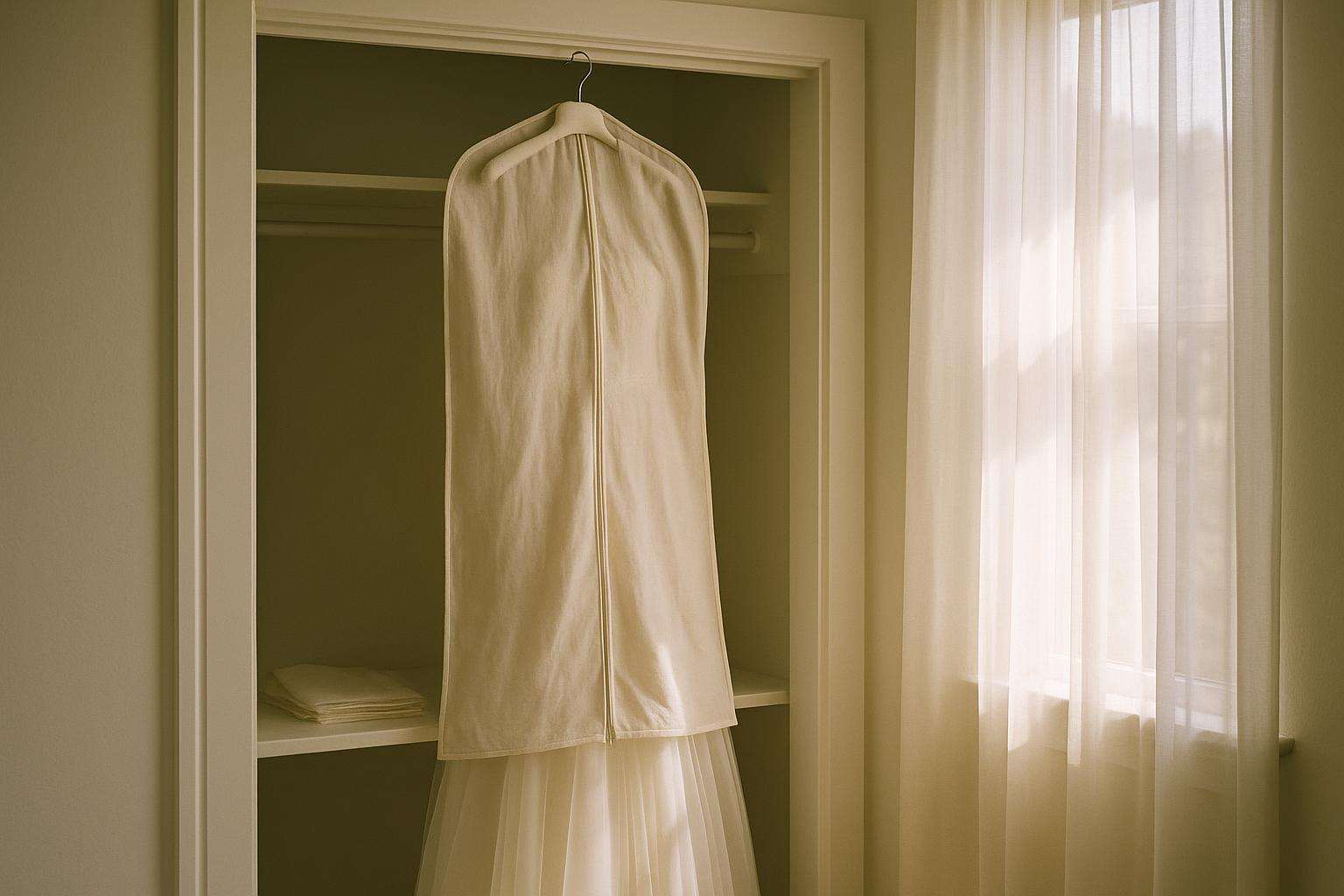
Storing your wedding dress correctly in the weeks between pickup and your wedding day requires a breathable cotton muslin garment bag, acid-free tissue stuffed into every fold, a dark interior closet held at 60–75°F and 45–55% relative humidity, and the right hanging-versus-flat decision for your gown's fabric weight. Get these four things right and your dress will arrive at the altar exactly as it left the salon.
Your wedding dress travels a long road before it reaches you: ordered months in advance, produced in a factory or atelier, shipped to a boutique, tried on in fittings, altered by a seamstress, and finally released into your care 2–4 weeks before the ceremony. Everything up to that handoff point has been managed by professionals. What happens next is on you. Most brides do not realize how quickly the wrong storage decisions can do lasting damage — yellowing that sets in weeks, creases that satin never releases, mildew that begins invisibly in a plastic-wrapped bodice. This guide walks through every decision in the right order, grounded in the same environmental standards that archival textile conservators use.
When Should You Pick Up Your Wedding Dress from the Boutique?
Most bridal boutiques schedule the final fitting and pickup 2–4 weeks before the wedding, once all alterations are complete. Salons such as Darianna Bridal & Tuxedo in Pennsylvania build the final fitting appointment into the alteration timeline specifically to close any last-minute fit issues before the dress leaves their care. If your boutique finishes alterations earlier than that window, ask whether they can hold the gown in their climate-controlled storage until closer to the date — many are willing to do so, and the request is routine for high-volume shops.
For destination weddings, The Knot's bridal editorial team advises picking up the dress at least one month before travel, leaving time to resolve any last-minute issues before departure. When transporting the gown home, keep it off the car floor, never leave it in a hot vehicle, and bring it indoors immediately on arrival. Trunk temperatures can exceed 130°F in summer sun — even a 20-minute exposure can set creases in satin that a steamer will struggle to undo.
What Is the Right Garment Bag for a Wedding Dress — and Why Does It Matter?
The plastic bag the boutique uses for transport should be replaced with a breathable fabric alternative within 24 hours of bringing the dress home. Plastic traps moisture against the fabric, creating the warm, humid microclimate that mildew requires, and standard plastic off-gasses compounds over time that cause white and ivory fabrics to yellow — a discoloration difficult to reverse without professional wet-cleaning. David's Bridal's care editorial makes this explicit: plastic is transport-only.
100% cotton muslin is the gold standard replacement, the same material used by museum textile collections worldwide. Three widely available options:
- Foster-Stephens 70" Acid-Free Muslin Wedding Gown Bag — 100% cotton, acid-free, with a 10" gusset to accommodate full ball-gown skirts. Includes a cotton muslin hanger, starter tissue, and white cotton gloves. Available at foster-stephens.com and Amazon, approximately $46–$100 depending on size and customization options.
- WAWAK Acid-Free Muslin Dress Garment Bag — moth-resistant and breathable, available at wawak.com. Well-suited to standard A-line and sheath silhouettes.
- Hayden Hill Organic Cotton Garment Bag — 100% sustainable cotton, generous enough for full gowns, available on Amazon at approximately $40–$65.
Leave the bottom of the garment bag slightly open for air circulation rather than sealing it closed. Store it away from other garments in the closet — beading and embroidery snag easily on neighbouring fabrics.
Should You Hang or Store Flat — and How Does Fabric Type Change the Answer?
This is the decision most brides get wrong. The intuition is to hang the dress — it is how gowns look their best, and hanging keeps long skirts from folding. But heavier gowns hung for weeks put sustained stress on shoulder seams, bodice boning channels, and beaded straps, causing distortion that can be extremely difficult to correct. The right answer depends on your gown's primary fabric.
| Fabric | Recommended Storage Method | Hanger Type | Key Risk if Method Is Wrong |
|---|---|---|---|
| Silk | Flat / box for >2 weeks; hang short-term only | Wide padded hanger, interior loops only | Shoulder seam distortion; bias stretching |
| Duchess Satin | Flat / box preferred, especially for ballgowns | Wide padded hanger if hanging short-term | Permanent pressure marks; fold-line creases |
| Tulle | Either; hanging works well | Wide padded hanger, interior loops | Compression crushing volume if over-folded |
| Chiffon | Hanging preferred to avoid fold marks | Wide padded hanger, interior loops | Permanent fold lines if boxed without padding |
| Organza | Hanging strongly preferred | Wide padded hanger | Permanent creases — organza holds fold lines |
| Crepe | Either; crepe is forgiving | Wide padded hanger if hanging | Relatively low risk in either method |
| Heavily beaded or lace | Always flat, acid-free tissue around beads | Never hang by straps or beaded elements | Bead-weight pulls seams; bead imprints on fabric |
Regardless of method, always use the sewn-in interior fabric loops — not the dress straps or shoulder seams — if you hang the gown. These loops are engineered to distribute weight across the bodice. Using decorative straps as the hanging point stretches them irreversibly. Karen Willis Holmes's editorial care guidance makes the same point: inner loops exist precisely for storage and should be the only contact point with the hanger.
What Are the Acid-Free Tissue Rules — and Why Do They Matter?
Acid-free tissue is the most important consumable in pre-wedding dress storage. Standard tissue paper, cardboard, and wood surfaces are mildly acidic; over weeks and months of direct contact, their acidity transfers to fabric, causing yellowing and fiber breakdown. The distinction is non-negotiable for silk — even one or two weeks of contact with acidic tissue can begin a discoloration process that is chemically irreversible.
Use acid-free tissue to stuff the bodice and sleeves (loosely, to maintain shape without compressing), to pad every fold in the skirt, to separate layered full-skirt sections, and to individually wrap metal embellishments — buttons, clasps, and beaded closures that can otherwise tarnish onto the adjacent fabric.
One important specification detail: archival conservators recommend unbuffered acid-free tissue specifically for silk and wool gowns. Buffered tissue (pH above 9.5) is intended for paper and cotton preservation; its elevated alkalinity can weaken protein fibers in natural silk and wool over time. For synthetic or mixed-fiber gowns, buffered tissue is fine. Always choose white or colorless tissue — colored tissue contains dyes that transfer.
Foster-Stephens Inc. sells unbuffered archival sheets at approximately $7.10 for 24 sheets (20" × 30") at foster-stephens.com. Complete kits bundling tissue with an acid-free box are sold by HANGERWORLD and Yakucho on Amazon for roughly $25–$60. The Gown Preservation Company and Cleaner's Supply also offer bridal-specific preservation tissue for those who prefer to buy from a specialist supplier.
What Temperature, Humidity, and Light Conditions Does a Wedding Dress Need?
The environmental targets that museum textile conservators use translate directly to home storage. Temperature: 60–75°F (15–24°C). Relative humidity: 45–55%. Light: zero UV exposure — including indirect light through a window in the same room.
Below the temperature floor, natural fibers become brittle and boning channels can crack. Above the ceiling, heat accelerates chemical yellowing in white and ivory fabrics — a process that is faster in polyester blends than in silk but affects all common bridal cloths. Humidity outside the safe band is dangerous in both directions: high humidity (above 65% RH) supports mildew and mold colonization in lace layers and tulle folds that you cannot see until the damage is done; low humidity (below 35% RH) dries fibers, making them prone to cracking under the stress of being worn and moved on the wedding day. UV light — even filtered through a window — fades and weakens fibers cumulatively over weeks.
An interior bedroom closet with stable HVAC is ideal. The following locations should be avoided entirely:
- Attics — summer heat routinely exceeds 100°F in uninsulated attic spaces
- Basements — humidity fluctuations and the risk of moisture intrusion from pipes or flooding
- Garages — wide temperature swings, pest exposure, and airborne particulates from vehicles
- Any room with direct window exposure — UV reaches the dress even when curtains are drawn
If your home runs humid, a dehumidifier in the storage room brings RH into range quickly. In dry climates, a small humidifier prevents brittleness. Silica gel packets placed inside the storage space — not touching the dress directly — manage micro-climate moisture between adjustments.
What Are the Pet, Travel, and Day-Before Hazards Every Bride Should Know?
Four hazards catch brides off-guard in the final weeks before the wedding:
Pets. Cat and dog hair embeds deeply into tulle and lace, claws snag beading and embroidery, and a curious nose pressed against organza leaves oils that attract dust and can set a stain. Store the dress behind a closed door in a pet-free room. This is non-negotiable — even a well-behaved pet can cause significant damage in a moment of unsupervised curiosity.
Car travel. Trunk temperatures can exceed 130°F in summer; never transport the dress in a closed trunk for any period. If you must move the gown to a hotel, venue, or getting-ready location the day before the wedding, lay it flat across the back seat with the car's climate control running, never folded over the seat or compressed in a bag.
Sharing closet space. Sequined and beaded neighboring garments snag delicate lace and tulle. Give the wedding dress its own dedicated hanging space, ideally with a 6-inch gap on each side.
Morning-of steaming. Professional steaming 24–48 hours before the ceremony — not the morning of — is the correct sequencing. Last-minute steaming on a ceremony morning creates time pressure that leads to mistakes, and freshly steamed fabric needs an hour to fully set and cool. Many bridal boutiques and alterations salons offer pre-wedding steaming as a paid service; David's Bridal includes steaming guidance with every purchased preservation kit ($100–$250). Never iron directly on the fabric — always use a pressing cloth and low heat at minimum, or delegate to a professional.
Move the dress to the getting-ready room (not the venue ceremony space) the evening before. Hang it on a padded hanger using interior loops in a clear area away from windows and pets. Remove the muslin bag to let the fabric breathe overnight. Check for any travel creases and arrange for a steamer if needed. Lay out your veil, shoes, and accessories separately so nothing rests against the gown. Assign a trusted bridesmaid or family member as the designated "dress guardian" for ceremony morning — one person responsible, no group decision-making under time pressure.
The Complete Pre-Wedding Dress Storage Checklist
- Remove from plastic immediately upon bringing the dress home — within 24 hours at most
- Stuff the bodice, sleeves, and every skirt fold with white, acid-free tissue (unbuffered for silk)
- Wrap metal embellishments (buttons, clasps, bead closures) individually in tissue
- Transfer to a breathable muslin garment bag (Foster-Stephens, WAWAK, or Hayden Hill) or an acid-free box depending on fabric type
- Use interior sewn-in loops on a wide padded hanger — never hang by straps or decorative elements
- Store in an interior closet at 60–75°F, 45–55% RH, no UV exposure
- Add silica gel packets in the storage space — outside the garment bag, not touching fabric
- Inspect every 2–3 weeks; increase to weekly in the final month before the wedding
- Arrange professional steaming 24–48 hours before the ceremony — not morning-of
- Stage the dress at the getting-ready location the evening before, out of the bag, hanging in a pet-free space
Bridal preservation specialists at the Association of Wedding Gown Specialists (AWGS), the professional certification body for post-wedding preservation, note that the same principles that govern post-wedding conservation apply to pre-wedding storage — the difference is simply the time scale. Most fabric damage attributed to "the wedding" actually accumulates in the weeks of improper home storage before it. Following this checklist removes the risk entirely.
For brides interested in what happens after the wedding, our guide to professional gown preservation covers post-ceremony cleaning and archival boxing in the same rigorous detail. For broader care questions during alterations, see our Alterations & Fit hub. For authoritative preservation sourcing, The Knot's expert storage guide and Foster-Stephens Inc.'s product documentation are the most comprehensive publicly available references on the subject.
Considered Counsel
Frequently asked
How long can you store a wedding dress before the wedding?
Most brides store their gown at home for 2–12 weeks before the wedding. The window opens after the final fitting and closes on the morning of the ceremony. Dresses ordered early — many arrive 3–4 months before the date — may need even longer home storage if alterations finish early. With the correct acid-free tissue stuffing, a breathable muslin garment bag, and a climate-controlled closet held at 60–75°F and 45–55% relative humidity, a wedding dress can be stored safely for up to three months without damage. If your timeline extends beyond that, ask your boutique — salons including Darianna Bridal & Tuxedo are often willing to hold finished gowns in their climate-controlled back rooms until closer to the date, particularly for brides who purchased early or are planning destination weddings.
Should you hang or lay flat your wedding dress for storage?
The correct method depends primarily on your gown's fabric and silhouette weight. Lightweight fabrics — tulle, chiffon, and organza — handle hanging well on a wide, padded hanger using the interior sewn-in loops (never the shoulder straps, which will stretch under sustained tension). Heavier gowns — duchess satin ball gowns, heavily beaded mermaid styles, and dresses with dense lace appliqués — should be stored flat in an acid-free box. Hanging a heavy gown for more than two to three weeks risks distorting shoulder seams and bodice structure, which even skilled alterations seamstresses at boutiques like Karen Willis Holmes cannot always reverse. If you are uncertain, flat storage in an acid-free box with generous tissue padding is always the safer default. Azazie's care guide echoes this: when in doubt, box it.
Can I store my wedding dress in a plastic garment bag?
No — plastic garment bags are for transport only, not storage. The plastic boutiques use for delivery is designed to keep dust off during the short drive home; left on for weeks, it creates two serious problems. First, it traps ambient moisture against the fabric, creating the warm, humid microclimate that mildew and mold require. Second, standard plastic off-gasses low levels of chemical compounds over time that cause white and ivory fabrics to yellow — a discoloration that is difficult or impossible to reverse without professional wet-cleaning. David's Bridal's care editorial explicitly warns against storing a gown in plastic for this reason. Replace the boutique bag with a 100% cotton muslin garment bag within 24 hours of bringing the dress home. The Foster-Stephens 70" Acid-Free Muslin Wedding Gown Bag (~$46–$100) and the Hayden Hill Organic Cotton Garment Bag are two widely available options.
What temperature and humidity should a wedding dress be stored at?
Archival conservators and bridal preservation specialists consistently cite 60–75°F (15–24°C) and 45–55% relative humidity as the safe zone for storing a wedding dress. Below that temperature range, natural fibers become brittle; above it, heat accelerates chemical yellowing in white and ivory fabrics. Humidity deviations are equally damaging in both directions: relative humidity above 65% creates conditions for mildew and mold to colonize lace, tulle layers, and fabric folds invisible to the eye; below 35%, fibers dry out and become prone to cracking and brittleness, particularly in structured boning and stiffened underlayers. An interior bedroom closet with stable HVAC is ideal. Attics, basements, and garages are categorically off-limits — their temperature and humidity swings are too wide to manage safely.
How do you stuff a wedding dress with tissue paper for storage?
Use only acid-free white tissue — colored tissue contains dyes that can transfer, and standard tissue is mildly acidic and will degrade fabric over weeks of contact. For silk and natural-fiber gowns, choose unbuffered acid-free tissue; buffered tissue (pH above 9.5) is acceptable for synthetic gowns but may weaken protein fibers in silk and wool over time. Stuff the bodice loosely so it holds its shape without compressing. Fill each sleeve from shoulder to wrist, padding any hollow sections. Pad every fold in the skirt — creases set permanently in satin and organza if left unpadded under any weight. Wrap any metal components (buttons, clasps, beaded closures) individually to prevent them tarnishing against the fabric. Foster-Stephens Inc. sells unbuffered archival sheets at approximately $7.10 for 24 sheets (20" × 30"), and complete kits from HANGERWORLD and Yakucho bundle tissue with an acid-free box for $25–$60.
What are the biggest hazards to a wedding dress in the weeks before the wedding?
Beyond temperature and humidity, four hazards catch brides off-guard. Pets are a serious threat: cat and dog hair embeds deeply into tulle and lace, claws snag beading and embroidery, and even a curious nose pressed against organza can leave oils that attract dust and set staining. Keep the stored dress behind a closed door in a pet-free room. Direct and indirect light — including light through a window in the same room — UV-fades and weakens fibers over weeks; the dress should be in a dark closet, not draped over a door. Travel in a car trunk is risky: trunk temperatures can exceed 130°F in summer, and a dress folded or compressed for even a short drive can set creases. If you must transport the gown, lay it flat across the back seat with climate control running. Finally, other garments in a shared closet can snag beading — give the dress its own dedicated hanging space.
When should I pick up my wedding dress from the boutique?
Most bridal boutiques schedule the final fitting and pickup 2–4 weeks before the wedding, once all alterations are complete. Some high-volume salons complete alterations earlier; in those cases, ask whether the boutique can hold the gown in their climate-controlled back room until closer to the date — many are willing to do this, and it reduces your home storage burden significantly. For destination weddings, The Knot advises picking up the dress at least one month before travel to allow time for any last-minute issues to be resolved. When collecting the gown, do not leave it in a hot car, do not lay it on the car floor, and bring it indoors immediately. The boutique transport bag should be replaced with a breathable muslin cover within 24 hours of arrival home.