Alterations, Fit & Preservation
Taking In a Wedding Dress: Resizing a Gown That's Too Big
How seamstresses reduce a gown by one, two, or more sizes — seam strategy, bodice architecture, lace and beading complications, real cost ranges, and when DIY becomes a genuine risk.
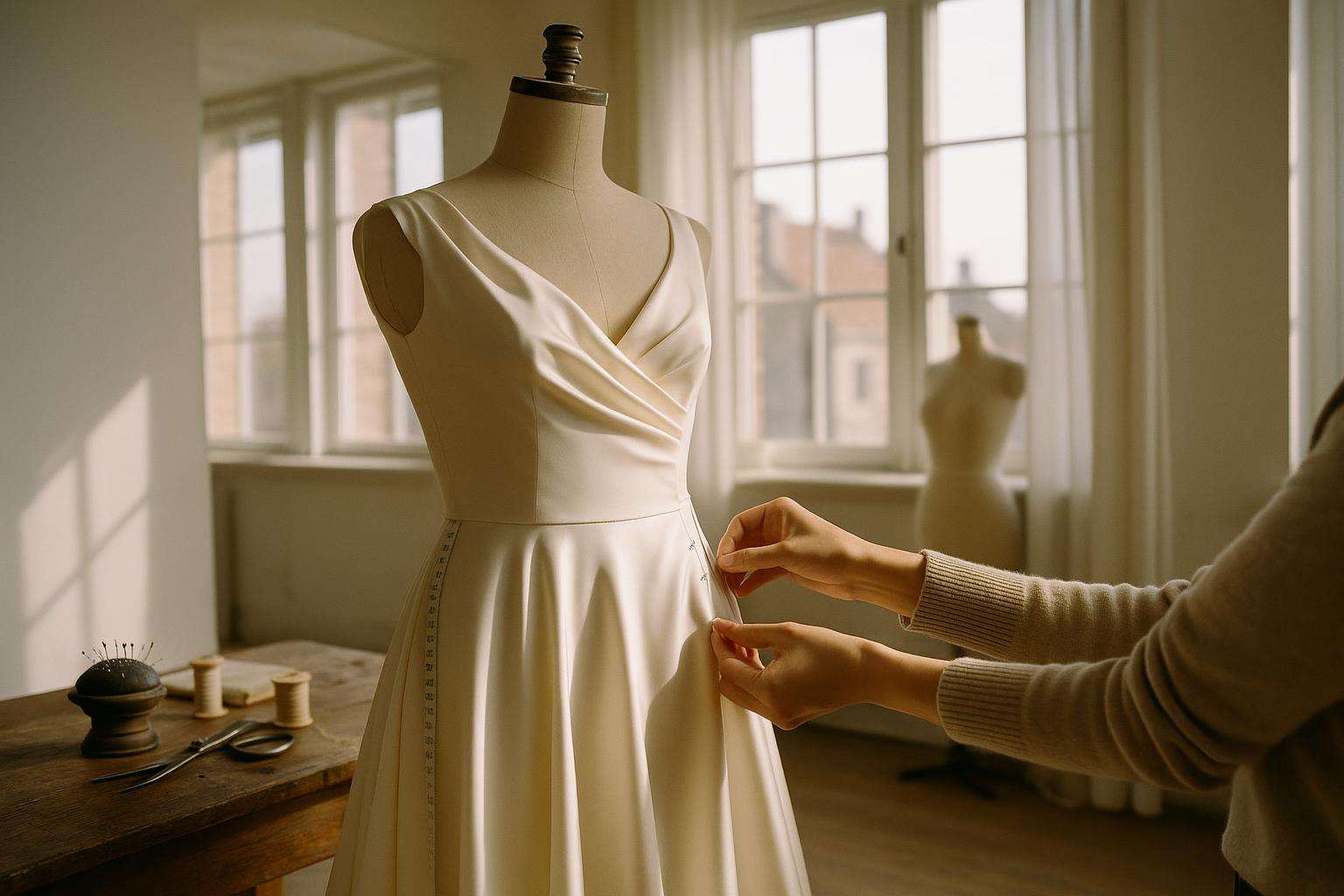
Taking in a wedding dress — reducing it by one or two sizes through side-seam and bodice work — is one of the most reliably achievable bridal alterations. The safe ceiling is two bridal sizes; beyond that lies reconstruction territory with meaningfully higher cost and risk. Lace and beading at the alteration seam substantially increase both complexity and price, and DIY attempts on structured bridal fabrics are genuinely risky.
Bridal sizing is designed to run large. Every major designer — from Maggie Sottero and Pronovias to BHLDN and David's Bridal — publishes size charts calibrated to measurements, and when a bride falls between two sizes, industry advice is almost universally to order the larger. The result is that most brides arrive at their first alteration fitting with a dress that needs to come in, not go out. Taking in a gown is reassuringly common, but the way it is done, and how far it can go, depends on a set of construction realities that are worth understanding before you sit down with a seamstress.
How Many Sizes Can a Wedding Dress Be Taken In?
The bridal industry's standard answer — one to two bridal sizes — is not a marketing hedge. It reflects the physical reality of seam allowances, boning channels, and garment architecture. Within that range, a skilled seamstress works primarily at the side seams, removing consistent amounts of fabric from the natural structural adjustment zones built into every gown by its designer. The reduction is symmetrical, the dress's silhouette remains proportionally intact, and the finished garment bears no visual sign of having been altered at all.
At one size, the work is largely confined to the side seams. At two sizes, the bodice, waist, and hip proportions must be reconciled more carefully, and the zipper or lace-up back may need repositioning. The seamstresses at 3rd Floor Tailors, a specialist bridal and formalwear alterations studio, note that beyond two sizes, the distortion risk rises sharply: the dress's designed silhouette — the calculated ratio of bodice to skirt, dart placement, the positioning of internal boning relative to the outer shell — can shift in ways that make the finished garment look unmistakably altered rather than made-for-you.
Taking a gown down three or more sizes is possible, and experienced seamstresses have done it — reductions from a size 12 to a size 2 exist in the record books. But these are rebuilds, not alterations. They require full deconstruction, additional fittings, and substantially higher investment. If you are contemplating a reduction of that scale, have an honest conversation with your seamstress about whether the result will satisfy you before committing.
The practical rule: if you are split between two bridal sizes, always order the larger. It is far easier — and far less expensive — to remove fabric than to add it.
How Does a Seamstress Take In a Wedding Dress at the Side Seams and Bodice?
Before a seamstress pins a single seam, she performs a diagnostic evaluation of the gown's internal architecture. At shops like Ella's Alterations in Zephyrhills, Florida — with thirty-plus years of bridal tailoring experience — and White Rose Bridal in Newark, New Jersey, the first fitting follows a defined sequence. The bride tries the gown on; the seamstress measures where it is pulling, gaping, or floating; she then opens or examines the existing seam allowances to determine how much working fabric is available. She counts each layer — fashion fabric, interlining, lining — and notes any beading or lace in the alteration zones. White Rose Bridal states explicitly that no estimate is given by phone or photograph: every gown must be evaluated on the body. That is not a bureaucratic policy — it is a construction reality.
Once the evaluation is complete, the seam strategy takes shape. Side seams — running from underarm to hem — are used in approximately 90% of size-reduction alterations, according to The Bridal Finery's alteration guide. They are the natural adjustment zones; taking in here distributes the reduction symmetrically and keeps the work hidden once the dress is on. For larger reductions, an expert seamstress may work all three seams simultaneously — the two side seams and the center back — removing modest amounts at each rather than a large amount at one, preserving the gown's proportional balance and avoiding over-stress at any single seam.
Inside the bodice, the seamstress is working around several structural elements that must move in coordination:
Boning channels — slim channels of spiral steel or plastic sewn inside the bodice lining — shape the waist, support the bust, and keep strapless gowns in place. Spiral steel is the professional standard for gowns with structural demands; plastic boning has no lateral flex and creates fitting problems when altered. When a bodice is taken in, boning channels must relocate with the seam; if they do not, the boning buckles or digs.
Lining layers — most bridal bodices carry an outer fashion fabric, an interlining of crinoline or organza, and a lining — must each be altered in coordination. The more layers, the more labor.
Silhouette type also governs feasibility. A-line and fit-and-flare gowns are the most alteration-friendly because their seam geometry is straightforward. Sheath dresses follow every curve and require extreme precision — a half-inch off is visible. Mermaid and trumpet silhouettes are structurally demanding because the flared hem geometry means even skirt seam angles must be recalculated when the waist is reduced. As Elizabeth Johns, the London bridal designer, notes in her alterations editorial: silhouette conversions — such as turning a ballgown into a sheath — are not practical alterations. They cost $500–$1,000 or more and rarely equal a gown designed that way from the start.
How Do Lace and Beading Complicate Taking In a Wedding Dress?
Lace appliqués and beading that fall at or near the alteration seam are the single largest complicating factor in bridal size work. The logic is straightforward: before the seamstress can move the seam, any embellishment in the alteration zone must come off. After the seam is resewn to its new position, each piece must be reattached so the pattern reads continuously across the new seam line — with no visible break, gap, or asymmetry in the design.
This process can double or triple alteration time and cost compared with the same size reduction on a plain crepe or satin gown. On a densely beaded bodice at a salon such as Kleinfeld Bridal, beading removal and reapplication runs $300–$700 or more; hand-beading labour is typically billed at $75–$150 per hour. A Chantilly or Alençon lace appliqué that straddles the side seam requires not only removal but careful re-matching of the lace motif pattern — one of the more exacting tasks in bridal sewing.
Fabric finish matters here too. On satin, velvet, and other high-sheen materials, removed seam lines leave a permanent impression — sometimes called track marks — where the original stitching compressed the fibre. This is why conservative alterations are especially important on high-gloss gowns: the seamstress has limited ability to undo a mark once it is set. Matte fabrics such as crepe hide stitch lines far more forgivingly.
Pronovias, Vera Wang, and Maggie Sottero gowns with heavily embellished bodices are not impossible to take in — they are simply more expensive and time-consuming to alter than their catalogue photographs suggest. Budget accordingly, and ask your seamstress to inspect the embellishment density at the seam zones before she provides an estimate.
What Are the Real Costs of Taking In a Wedding Dress?
Alteration pricing varies by market, gown complexity, and fabric type. The table below draws on verified 2026 data from The Knot, Zola, and independent bridal seamstresses across the United States.
| Scope of Reduction | Estimated Cost | Notes |
|---|---|---|
| 1 size — side seams, plain fabric (crepe, satin) | $100–$200 | Most predictable; 1–2 fittings |
| 1–2 sizes — structured bodice, waist and hip work | $150–$400 | Boning relocation likely; 2–3 fittings |
| 2 sizes — beaded or lace bodice | $200–$600 | Embellishment removal and reapplication |
| 3+ sizes — major reconstruction | $600–$1,200+ | Full deconstruction; result differs from original design |
| Corset-back addition (as alternative to full reduction) | $100–$300 | Accommodates fit range without full seam work |
| Full silhouette conversion | $500–$1,000+ | Rarely equals a purpose-designed gown; not recommended |
Overall bridal alteration packages — including hem, bustle, and size work — typically run $300–$800, with complex gowns reaching $1,200 or more. Rush alterations booked within four weeks of the wedding typically carry a surcharge of 25–50%. Maggie Sottero and its sister labels Sottero and Midgley and Rebecca Ingram all recommend beginning the alteration process at least eight to ten weeks before the wedding, with two to three fittings spaced two weeks apart. That window is not bureaucratic caution; it is the minimum timeline for structural work to be done without compression.
What Is the Real Risk of DIY Wedding Dress Alterations?
Home sewing has its place. Tacking a hem temporarily, sewing on a button, or hand-stitching a loose appliqué — a skilled home sewer can manage these without professional help. But structural size reduction on a bridal gown is a materially different challenge, and the risks are not hypothetical.
Bridal fabrics are unforgiving of errors in a way that most domestic fabrics are not. Duchess satin and charmeuse show every pin mark. Chiffon and tulle snag on standard sewing machine feet. A misaligned seam in a structured bodice causes the boning to buckle or dig — not at home in a fitting, but at the ceremony, when there is no remedy available. Lace appliqués, once incorrectly removed or reattached, rarely read as seamlessly continuous; the break in pattern continuity is visible in photographs for the rest of the gown's life.
The cost of a professional seamstress is small relative to the cost of the gown and the permanence of the day. A first-consultation fee at a reputable shop — such as Ella's Alterations in Florida or White Rose Bridal in Newark, New Jersey — is typically rolled into the alteration package cost and buys you a written estimate, a layer-by-layer inspection of the gown's seam allowances, and a realistic assessment of what is achievable. That is money well spent on any dress costing more than a few hundred dollars. For brides working with gowns from David's Bridal, BHLDN, or Azazie, where the ticket price is lower, a professional alteration often costs a meaningful fraction of the purchase price — but it is still the right call on a dress you will wear on the most photographed day of your life.
For deeper guidance on how fabric type affects alteration ease and cost, see our wedding dress fabrics guide. For authoritative alteration cost data, Zola's 2026 alteration cost report is the most current publicly available source across the U.S. market.
Considered Counsel
Frequently asked
How many sizes can a wedding dress be taken in?
The industry consensus, shared by bridal seamstresses at shops such as 3rd Floor Tailors and Ella's Alterations, is that one to two bridal sizes is the safe, predictable range for taking in a wedding dress. Within that range, a skilled seamstress works primarily at the side seams and can achieve clean, structure-preserving results without disturbing boning channels, lace appliqués, or closures. Going beyond two sizes is possible — experienced seamstresses have taken gowns from a size 12 to a size 2 — but this is essentially a rebuild: it requires full deconstruction of multiple components, adds substantially to cost (often $600–$1,200 or more), and may alter the designed silhouette in ways that are difficult to reverse. The reliable rule is to order the larger size when split between two, then take in from there.
Is it better to take in a wedding dress from the side seams or the back seam?
Side seams are the first choice for the vast majority of size-reduction alterations — approximately 90% of them, according to bridal seamstresses at The Bridal Finery. Running from underarm to hem, side seams are the structural adjustment zones built into every gown by designers; taking in here distributes the reduction evenly left and right and keeps the alteration concealed once the dress is on. Back-seam or center-back alterations are used when the fit problem is concentrated at the spine or shoulder blades, or when a closure change is involved — converting a zipper to a corset back, for example. For large reductions, an expert seamstress may work all three seams simultaneously, removing small amounts at each rather than a large amount at one, to preserve the dress's proportional balance.
How does lace or beading on a wedding dress complicate taking it in?
Lace appliqués and beading that fall at or near the alteration seam are the single largest complicating factor in taking in a gown. Before the seamstress can move the seam, any embellishment in the alteration zone must be carefully removed; after the seam is resewn, each piece must be reattached so the pattern reads continuously across the new seam line. This process can double or triple alteration time and cost compared with an identical reduction on a plain crepe gown. Beading removal and reapplication on a densely beaded bodice at a salon such as Kleinfeld Bridal can run $300–$700 or more; hand-beading labour is typically billed at $75–$150 per hour. Track marks — permanent impressions from removed seam lines — are also a concern on satin, velvet, and other high-sheen fabrics, making conservative alterations especially important on these materials.
What is seam allowance and why does it matter for wedding dress alterations?
Seam allowance is the strip of fabric between the stitch line and the cut edge — the working material a seamstress draws on when altering a gown. For taking in, the existing seam allowance expands as fabric is folded inward, so there is almost always room to reduce. For letting out (making a dress larger), the available allowance is finite and often inadequate. Cheaper mass-market gowns may carry as little as a quarter inch of seam allowance; better-constructed gowns typically offer closer to one inch. Maggie Sottero gowns vary by style — brides on WeddingWire report allowances ranging from "about 3 inches total" on some styles to "NO seam allowance" on others — confirming that allowance is gown-specific, not brand-wide. Always ask your seamstress to inspect seam allowances at the first fitting before making any alteration decisions.
How much does it cost to take in a wedding dress?
Cost varies by market, scope, and fabric type. For a simple one-size reduction at side seams on a plain fabric, expect $100–$200. A one-to-two-size reduction on a structured bodice with waist work typically runs $150–$400. Taking in two sizes on a beaded or lace bodice, where embellishment must be removed and reattached, ranges from $200–$600 at most U.S. bridal alterations specialists. Major reconstruction involving three or more sizes can reach $600–$1,200 or more. A corset-back conversion as an alternative to full reduction costs $100–$300. Overall bridal alteration packages — including hem, bustle, and size work — typically run $300–$800, with complex gowns reaching $1,200 or more, per The Knot's 2026 alteration cost reporting. Rush alterations booked within four weeks of the wedding typically carry a 25–50% surcharge.
Can a wedding dress be taken in more than two sizes?
Yes, but with important caveats. Going beyond two bridal sizes is a reconstruction project, not a standard alteration. The dress's designed silhouette — the calculated ratio of bodice to skirt, dart placement, the way internal boning sits relative to the outer shell — can shift in ways that make the finished garment look altered rather than made-for-you. The risk rises sharply as the reduction increases: boning channels must be relocated, the zipper or corset back often needs repositioning, and the hem geometry may need recalculation. Experienced seamstresses have achieved three-size or larger reductions, but they typically warn brides that the result is a rebuilt garment that will wear differently from the original design. Budget $600–$1,200 or more and allow additional fitting appointments — three to four fittings spaced two weeks apart is a sensible minimum for a reconstruction of this scale.
Is it safe to attempt DIY wedding dress alterations?
For cosmetic finishing touches on a low-stakes dress, a skilled home sewer might manage minor hand-sewing work such as sewing on buttons or tacking a hem temporarily. For any structural size reduction — moving side seams, adjusting bodice boning, or working around lace and beading — DIY carries real risk and is not recommended. Bridal fabrics are unforgiving: satin, charmeuse, and chiffon show every pin mark, and a misaligned seam in a structured bodice can cause the boning to buckle. Lace appliqués, once incorrectly removed or reattached, rarely read as seamlessly continuous again. The cost of a professional seamstress is small relative to the cost of the gown and the permanence of the day. Reputable alterations specialists such as Ella's Alterations in Florida or White Rose Bridal in Newark, New Jersey offer consultations before committing to a full alteration scope; that initial assessment is worth every dollar.