Alterations, Fit & Preservation
Wedding Dress Bustle Types: American, French, Ballroom & More
The bustle is the alteration that sets your train free — but not all bustles are equal. Here is every style explained, with real costs, fabric rules, and a practical guide to choosing the right one for your gown.
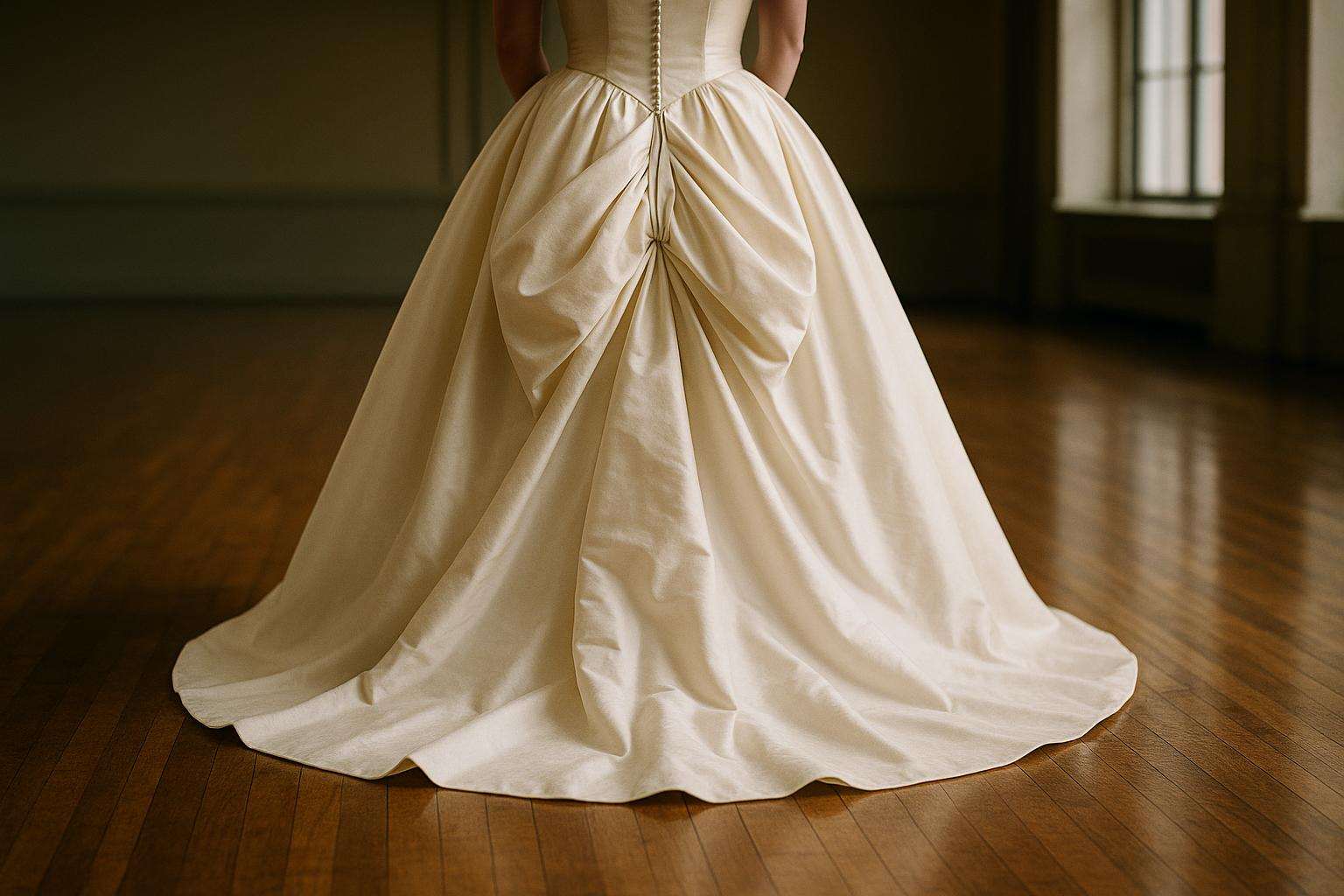
A wedding dress bustle is a tailoring alteration that lifts and secures the train off the floor for the reception — and there are six distinct styles: American (over), French (under), ballroom, Austrian drawstring, Victorian, and wrist. Each behaves differently depending on train length, fabric weight, and silhouette, with costs ranging from under $30 for a wrist loop to $400 or more for a complex ballroom or Austrian bustle on a cathedral-train gown.
A gown that photographs magnificently trailing down a church aisle becomes a liability the moment the ceremony ends. Trains catch heels, collect debris, and exhaust the person carrying them. The bustle is the solution — an alteration sewn into the gown during the fitting process that converts your train into a manageable (and often beautiful) reception silhouette with a series of hooks, ribbons, buttons, or a drawstring. It is, in short, the alteration that sets the dancing free.
What most brides discover only at their first alterations appointment is that not all bustles are alike. The style a seamstress recommends depends on your specific silhouette, train length, fabric weight, and how much work you want whoever fastens it to do in a busy bridal suite. This guide covers every main bustle type — how each looks, how it holds, what it costs, and which gown it was made for.
What is the difference between an over-bustle and an under-bustle?
The most fundamental distinction in bustle design is whether the train travels above or below the skirt when secured. Understanding this split makes every other bustle style easier to place.
The over-bustle (American bustle) lifts the train and fastens it on the outside of the gown, typically near the waistline, so the gathered fabric cascades visibly down the back of the skirt. The hardware — small buttons, pearls, or loops — becomes a decorative element of the design. It suits gowns with beading or lace detail near the waist that the bride wants to keep on display.
The under-bustle (French bustle) folds the train underneath the skirt and secures it with internal ribbons or ties sewn into the lining, creating a seamless exterior with no visible fasteners. The result is a two-layer hem with soft additional volume at the back — understated, smooth, and appropriate for fitted silhouettes where back bulk would distort the line.
Bridal Atelier Montclair — a New Jersey boutique carrying Anne Barge, Savin London, and Jesús Peiró — describes the choice between the two as primarily a question of silhouette: A-line and ball gown brides tend toward the American bustle, while mermaid and trumpet silhouettes benefit from the cleaner interior fold of the French.
What are all the wedding dress bustle types, and how does each look?
American bustle (over-bustle)
The American bustle is the most popular style in the United States. The train is lifted and pinned on the exterior of the gown using hooks, buttons, or loops at one, three, or five attachment points — marked at the final fitting with small pearls or coordinating buttons so the bridesmaid can find them in a dim venue. When fastened, the train forms a layered waterfall of fabric flowing down the back of the skirt. Attachment is straightforward: loops are matched to buttons working outward from centre.
Best for A-line, ball gown, and flowy silhouettes; works especially well on chiffon and lace. Nationally, expect to pay $75–$150 at an independent tailor or salon; $150–$400 in New York City and other major metro markets.
French bustle (under-bustle)
The French bustle is the reverse: the train is folded up inside the gown and secured via colour-coded ribbons or numbered ties sewn onto the lining. From the exterior, the gown looks seamless, with no visible hardware — just a softly tiered hem with extra volume at the back. Alteration Specialists NYC, which operates across Manhattan and Brooklyn, recommends colour-coded ribbons rather than numbered tags to speed up day-of assembly; matching pairs by colour is faster than reading numbers under pressure.
Best for mermaid, trumpet, and sheath silhouettes; preferred for plain satin, crepe, and structured fabrics where external buttons would be conspicuous. Slightly more attachment points than an American bustle, so expect to pay $100–$200 nationally, or $200–$500 in major metros.
Ballroom bustle
The ballroom bustle is the fullest concealment of any style. Multiple hooks, buttons, or ribbons lift the entire train flush underneath the gown so it disappears completely — the reception silhouette appears to be a standard floor-length dress with no train at all. This requires the most attachment points of any bustle type, which increases alteration time and cost, and demands more precision from whoever fastens it on the day.
Best for full ball gown silhouettes; ideal for brides who want to dance freely with zero train management. Cost nationally: $200–$400; $400–$1,000 in the NYC metro for heavily layered or beaded gowns, per Alteration Specialists NYC.
Austrian bustle (drawstring)
The Austrian bustle works via a drawstring mechanism sewn into the train: when the cord is pulled, the fabric gathers into soft vertical ruches — like theatre curtains drawing back — inspired by traditional Austrian drapery. It can be applied symmetrically at centre back or drawn to one side for an asymmetric, sculptural finish. Activating it requires pulling one cord rather than matching multiple loops to buttons, making it one of the more bridesmaid-friendly styles to operate.
The constraint is fabric: Moonlight Bridal's 2026 bustle guide notes that the Austrian drawstring is suitable only for lightweight fabrics — chiffon and organza are ideal — and cannot hold securely on heavy satins, Mikado, or structured brocade. Cost: $150–$300 nationally; $300–$600 in major metros, reflecting the higher sewing labour involved.
Victorian bustle
A close relative of the French bustle, the Victorian style gathers the train and attaches it at multiple points running down the length of the back (rather than only at the waistline), creating a cascading petal effect along the entire back seam. Essense of Australia describes it as elegant and vintage-inspired — well-suited to heritage-influenced A-line silhouettes. Cost: $120–$250 nationally, rising toward the top of that range with more attachment points.
Wrist bustle (loop bustle)
The wrist bustle attaches a small fabric loop to the train so the bride can slip it over her wrist to hold the train off the floor with no permanent alteration to the gown. It is cost-effective — often $0–$30 — and completely reversible, but can cause wrist fatigue during a long reception and offers no hands-free option. Bridal stylists note that the fabric loops found on many gowns were originally designed as garment-bag hanging loops, not as bustle mechanisms, so their durability under reception conditions varies. Best for very light or short trains, or for the first dance specifically.
How do train length and fabric affect which bustle to choose?
| Train Length | Approx. Extension | Complexity | Recommended Bustle Styles | Cost Range |
|---|---|---|---|---|
| Sweep / Brush | Up to 12 in. beyond hem | Minimal | Wrist; any style sufficient | $0–$75 |
| Court | ~24 in. from waist | Low | American (1–3 points) or French | $75–$150 |
| Chapel | 3–4.5 ft. from waist | Moderate | American, French, or Austrian | $75–$200 |
| Cathedral | 6–7.5 ft. from waist | High | French (fitted silhouettes) or American (volume); Ballroom for full concealment | $150–$400 |
| Royal / Monarch | 10 ft.+ | Very high | Ballroom; or detachable train | $250–$1,000+ |
Kleinfeld Bridal — whose New York flagship employs more than 100 alterations staff — notes that a chapel train is the most popular length because it balances ceremony drama with bustling ease. Cathedral and royal trains are heavier and may require twenty or more attachment points for a secure bustle, substantially increasing both alteration time and cost. Essense of Australia advises that two brides wearing the same gown may require entirely different bustle approaches depending on height and how the specific fabric drapes — a reminder that a good seamstress tailors the bustle to the individual, not just the dress.
On fabric weight: the French under-bustle distributes the weight of a heavy train more evenly across the hem than an American over-bustle, which concentrates all the load at the waistline attachment points. This makes the French bustle the more structurally sound choice for very heavy beaded or multi-layer skirts. The Austrian drawstring, by contrast, cannot hold heavy fabrics at all — only chiffon, organza, and comparably lightweight materials.
Wrist loop: $0–$30 nationally. American over-bustle: $75–$150 (up to $400 in NYC metro). French under-bustle: $100–$200 (up to $500 in major metros). Victorian multi-point: $120–$250. Austrian drawstring: $150–$300 (up to $600). Ballroom full concealment: $200–$400 (up to $1,000 in NYC). Overall bridal alteration packages — hem, bustle, and fit — average $500–$700 nationally and $600–$1,500 in New York City, per Alteration Specialists NYC.
Who should learn to bustle the dress — and when?
The bustle is only as useful as the person who can fasten it quickly under pressure. The answer to who that person should be is consistent across every expert and salon consulted: the Maid or Matron of Honor, at the final fitting, with the seamstress demonstrating the exact sequence in person.
Kelly Faetanini — the New York bridal designer recognised as the youngest to show at New York Bridal Fashion Week — explicitly advises bringing the MOH to the final fitting so she can observe and practise the mechanism before the wedding day. Lovella Bridal in Glendale, California (a luxury salon with more than 50 years in business and a 1,000-gown inventory) goes further: they record a video on the bride's phone during the final fitting and share it with the full bridal party so everyone can review it in advance.
Darianna Bridal & Tuxedo in Warminster, Pennsylvania recommends the same approach and publishes a detailed bustle education guide for their brides. The practical standard is that at least two people in the bridal party — the MOH and one backup — should know the mechanism before the day.
Build at least three to five minutes into the timeline between ceremony and reception for a simple American or French bustle. An Austrian or ballroom bustle with many attachment points needs more time; add it to the schedule, not the pressure of the moment. Pack a crochet hook (to ease loops over small buttons) and large safety pins in the bridal emergency kit as backups — they handle both loose hooks and emergency situations when a button pops.
How do you release a wedding dress bustle at the reception?
Releasing a bustle is simply reversing the mechanism: unloop buttons from hooks, untie ribbons, or release the drawstring. For a French bustle with colour-coded ribbons, untying the matched pairs is the fastest release available — the colour system that speeds fastening also speeds unfastening. For an Austrian drawstring, releasing the cord drops the train in a single motion.
Some brides choose to release and re-bustle multiple times across a long reception: detrain after the first dance for formal portraits, re-bustle for the main dancing, and release again for late-night. Whether this is practical depends on the bustle style and who is available to help. According to Darianna Bridal & Tuxedo, the MOH should rehearse releasing as well as fastening at the final fitting so the full cycle is familiar before the wedding day.
One practical note: for an Austrian drawstring, confirm with the seamstress how the train should be held when the cord is released, since the gathered fabric can fall unevenly if released without support. For a ballroom bustle with many attachment points, releasing under time pressure in a busy reception is the main risk — a bridesmaid who has practised the sequence is the single most effective mitigation.
Considered Counsel
Frequently asked
What is the difference between an American bustle and a French bustle?
The American bustle — also called an over-bustle — lifts the train and secures it on the outside of the gown near the waistline, creating a visible cascade of layered folds at the back. The French bustle — or under-bustle — folds the train underneath the skirt and secures it with internal colour-coded ribbons, producing a seamless, smooth exterior with soft volume distributed through the hem. The key practical difference is visibility: the American bustle's attachment points (small buttons or pearls) are part of the exterior design, while the French bustle conceals all hardware inside the lining. American bustles suit A-line and ball gown silhouettes; French bustles are preferred for mermaid and trumpet silhouettes where back volume would distort a fitted line. Cost is roughly comparable: $75–$150 for American, $100–$200 for French, at most bridal salons nationwide.
How much does it cost to add a bustle to a wedding dress?
Bustle alteration costs range from under $30 for a wrist loop to $400 or more for a complex Austrian drawstring or ballroom bustle on a beaded cathedral-train gown. According to Alteration Specialists NYC, which operates multiple Manhattan and Brooklyn locations, most standard bustles fall in the $75–$200 range nationally, with metropolitan market pricing reaching $150–$500 for the same work. A simple American 1–3 point bustle typically costs $75–$150; a French ribbon bustle costs $100–$200; a Victorian multi-point bustle runs $120–$250; an Austrian drawstring costs $150–$300; and a full ballroom bustle typically runs $200–$400. Some shops charge per attachment point at $7–$50 each. Clarify pricing with your seamstress at the first alterations appointment — not the final fitting.
Which bustle style works best for a cathedral train?
For a cathedral train — which extends 6 to 7.5 feet from the waistline — the French under-bustle or the American over-bustle are the most practical choices, depending on gown silhouette. A cathedral train on a mermaid or trumpet gown is best served by the French bustle: the internal ribbons distribute the considerable weight of the train evenly across the hem without adding back bulk, and the colour-coded tie system recommended by Alteration Specialists NYC speeds up day-of assembly. For an A-line or ball gown cathedral train, the American bustle creates a beautiful cascading effect. Very heavily beaded or layered cathedral trains may warrant a ballroom bustle, which conceals the train entirely and provides the most freedom of movement on the dance floor — at a cost of $200–$400 nationally. Kleinfeld Bridal, which handles bustling across its 100-plus alterations staff, advises discussing style at the very first fitting rather than leaving it to the final session.
What is an Austrian bustle on a wedding dress?
An Austrian bustle uses a drawstring mechanism sewn into the train that, when pulled, gathers the fabric vertically into soft, curtain-like ruched folds — an effect inspired by Austrian theatre drapery. It can be applied symmetrically at centre back for a classic look or pulled asymmetrically to one side for an editorial, sculptural effect. Because activation requires pulling a single cord rather than matching multiple loops to buttons, it is actually one of the easier styles for a bridesmaid to operate on the wedding day. However, the Austrian bustle is fabric-specific: it works beautifully on chiffon and organza but cannot hold securely on heavy satins, Mikado, or structured brocade. According to Moonlight Bridal's 2026 bustle guide, it is also among the most labour-intensive styles to sew, which is why cost tends to run higher — $150–$300 nationally, and $300–$600 in metropolitan markets.
What is a ballroom bustle and how is it different from other bustle styles?
The ballroom bustle is the most complete concealment available: multiple attachment points — hooks, buttons, or ribbons — lift the entire train flush underneath the gown so it disappears entirely, giving the illusion of a floor-length dress with no train visible at all. This distinguishes it from the American bustle, which leaves a cascade of fabric visible at the back, and the French bustle, which creates a two-layer hem. The ballroom bustle requires the highest number of attachment points of any style, which increases both alteration time and cost ($200–$400+ nationally), and demands more precision from whoever fastens it on the day. It is the preferred choice for brides who want maximum freedom of movement at the reception without any train management at all — particularly on full ball gown silhouettes with heavy skirts.
Who should learn how to bustle a wedding dress before the big day?
The person who will bustle the gown on the wedding day — almost always the Maid or Matron of Honor — should attend the final alterations fitting so the seamstress can demonstrate the exact sequence in person. Kelly Faetanini, the New York bridal designer known as the youngest to show at New York Bridal Fashion Week, explicitly advises bringing the MOH to the final fitting for this purpose. Lovella Bridal in Glendale, California goes further: they record a video on the bride's phone during the final fitting so the full bridal party can reference it. Darianna Bridal & Tuxedo in Warminster, Pennsylvania recommends the same practice. Build at least five minutes into the reception-entrance timeline for bustling — more for Austrian and ballroom styles with many attachment points — and pack a crochet hook and large safety pins in the bridal emergency kit as backups.
Can you bustle a chiffon or lace wedding dress?
Yes, but the choice of bustle style matters considerably. Chiffon is one of the most bustle-friendly fabrics: it is lightweight and drapes naturally, making it well-suited to the American over-bustle, the Austrian drawstring, and a simple French bustle. Heavy lace presents more of a challenge — lace has structure and weight, and the French bustle is generally preferred because it distributes weight more evenly across the hem than an American over-bustle, which concentrates it at the waistline. Essense of Australia advises that the same gown may require entirely different bustle approaches on two different brides depending on body height and how the fabric drapes. Always ask your seamstress to demonstrate the bustle on the actual gown at your fitting rather than relying on a generic style guide — real-world drape varies significantly by fabric weight, and a skilled seamstress may propose a hybrid or custom approach.