Alterations, Fit & Preservation
What Alterations Can (and Can't) Do to a Wedding Dress
The realistic envelope of bridal customization — resizing limits, neckline and back changes, what is structurally impossible, and when to choose a different gown instead.
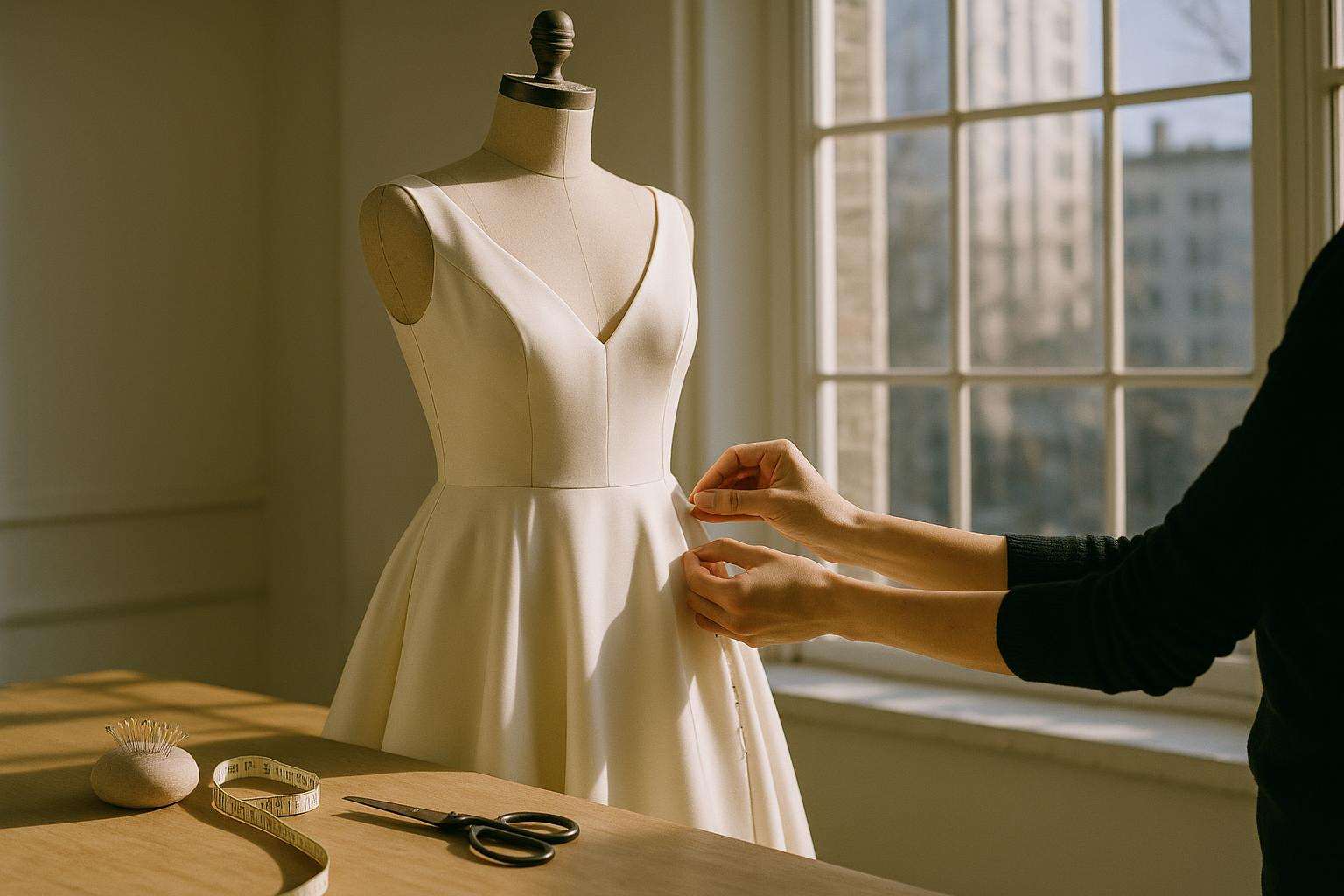
Nearly every wedding gown requires tailoring before it truly fits — bridal designers size to a standardized chart, not your body. A skilled seamstress can resize a gown one to two bridal sizes in either direction, reshape a neckline, add sleeves, insert a bustle, and adjust the waistline seam — but she cannot convert a ball gown to a mermaid silhouette, conjure seam allowance that was never there, or make fabric memory disappear. Understanding that envelope before you shop, not after you say yes, is what separates a confident alteration process from a stressful one.
Alterations are not an afterthought. They are a budgeted, time-scheduled phase of the wedding dress journey — one that Maggie Sottero, one of the world's largest bridal manufacturers, describes plainly on its brand blog as "an expected part of the bridal process." Kleinfeld Bridal, the flagship New York salon that stocks more than 1,500 gowns and has fitted tens of thousands of brides, maintains an in-house couture alterations department staffed by over 100 seamstresses — precisely because off-the-rack fit is the exception, not the rule. This guide maps what that department can and cannot do, at what cost, and within what timeline — so you arrive at your first fitting with the right expectations.
How Many Sizes Can a Wedding Dress Be Taken In or Let Out?
The most-cited industry standard is one to two bridal sizes in either direction. Bridal sizing runs larger than ready-to-wear — a bridal size 10 corresponds roughly to a US 6–8 in street clothes — so "two bridal sizes" is a meaningful amount of fabric. That said, the direction of the change matters enormously.
Taking in (making smaller) is the more forgiving direction. One size is considered routine; two sizes involves repositioning closures, adjusting structural boning, and potentially re-hemming as the waist drops. Go beyond two sizes and a seamstress is effectively reconstructing the garment — the original seam lines and design elements may be visibly distorted, and the silhouette you fell in love with on the rack may no longer be recognizable on your body.
Letting out (making larger) is harder, because it depends entirely on the seam allowance the manufacturer built into the gown. Budget bridal labels often construct with as little as one-quarter inch of seam allowance; better-constructed gowns may offer up to one inch. Once that allowance is exhausted, there is no additional fabric — a seamstress must insert new panels, add a corset back, or use lace inserts to gain any circumference, all of which alter the gown's original aesthetic. Most gowns can accommodate a one-to-two-inch circumference increase before reaching that threshold. There is also a fabric-memory caveat: taffeta, silk satin, and similar structured materials retain needle marks, meaning original stitch lines can remain faintly visible even after seams are let out — a near-irreversible cosmetic issue that a specialist will flag in advance.
The practical rule, endorsed by White Rose Bridal in Newark, New Jersey, is to order to your largest measurement and size up when between sizes. Taking in follows the gown's existing seam lines and is reliably predictable. Letting out runs against the construction and is constrained by a figure — seam allowance — you cannot know without a specialist examining the inside of the dress.
What Alterations Are Routinely Achievable?
The following modifications are well within the range of any experienced bridal alterations specialist:
| Alteration | What It Involves | Typical Cost (2026) | Complexity |
|---|---|---|---|
| Hemming (simple) | Single-layer straight hem adjusted to shoe height | $150–$300 | Low |
| Hemming (lace/cathedral train) | Multi-layer hem with lace border removal and re-sew | $300–$400 | Medium–High |
| Bodice/waist/hip adjustment | Panel removal, re-sewing; boning and beading repositioned if needed | $100–$400 | Low–Medium |
| Bustle addition | Hidden buttons or loops to lift the train for the reception | $75–$300 | Low–Medium |
| Sleeve addition | Lace, fabric, or detachable sleeves attached at the armscye | $200–$500 | Medium |
| Neckline reshape | Boning, facing, and internal cups restructured; sweetheart or V-neck precision-cut | $200–$450 | Medium–High |
| Corset back conversion | Zipper replaced with lace-up corset; adds fit flexibility | $150–$300 | Medium |
| Built-in cups | Sewn-in bra cups for support and smoothness | $30–$60 | Low |
| Strap shortening or addition | Shorten existing straps or add new straps to a strapless design | $30–$250 | Low–Medium |
| Pocket addition | Hidden pockets in skirt panels of A-line or ballgown silhouettes | $80–$150 | Low–Medium |
Source: cost data aggregated from Zola Expert Wedding Advice, The Knot, and David's Bridal alteration studios, 2026.
Hemming
The most universal alteration. Designers build extra length into gowns to accommodate varying heel heights; your seamstress measures with the exact shoes you will wear on the day. A multi-layer lace or cathedral-train hem costs more because each layer must be addressed separately, and a lace border often needs to be carefully hand-removed and re-sewn to keep the motif continuous.
Neckline Reshaping
Raising, lowering, or converting a neckline involves restructuring the bodice's entire support system — boning placement, internal cups, and facing must all be addressed simultaneously. Bridal and Tuxedo Gallery documents that halter tops can become sweetheart necklines, high necks can become V-necks, and strapless designs can receive lace illusion additions — all handled routinely by experienced bridal tailors. The precision required (particularly for a symmetrical V-neck or sweetheart) is why this sits in the medium-to-high complexity range.
Sleeve Addition
The Bridal Finery in Orlando has documented real-world examples: lace sleeves added to a clean crepe Ines Di Santo gown, and off-the-shoulder fabric attached to a strapless Theia Couture design. Detachable sleeves — which can be removed after the ceremony — are increasingly popular because they preserve the original strapless look for ceremony photographs while adding coverage and warmth for an evening reception. David's Bridal lists sleeve addition as one of its most-requested in-salon services nationally.
Bustle Addition
A sweeping cathedral train is stunning on the aisle; it becomes a liability on the dance floor. Bustles use hidden buttons or loops to lift and anchor the train. An American over-bustle (the most common style) sits at the lower end of the cost range; a French under-bustle or multi-point ballroom bustle — with four to seven pick-up points — sits at the higher end and requires more time to install and for the wedding party to learn how to fasten.
What Alterations Cannot Fix: The Structural Limits
Understanding the limits is as important as knowing the possibilities. Several categories of change are either practically impossible or carry risks serious enough that most experienced seamstresses will counsel against them.
Silhouette Conversion Is Off the Table
Transforming a ball gown into a mermaid, or a fit-and-flare into an A-line, is not an alteration — it is a rebuild. It requires stripping the gown to its underlining and reconstructing the skirt from scratch. Jovani's bridal guide explicitly flags "drastically changing the skirt's fundamental shape" as a modification that "may not maintain the intended look" and should be avoided. If you want a different silhouette, the answer is a different dress, not a reconstruction that will cost more than the gown and produce an uncertain result.
Lace and Beading Raise the Complexity (and Cost) Ceiling
Lace-covered gowns cannot be altered with a straight machine seam. A specialist must hand-remove individual lace appliqués, adjust the underlying fabric, then re-sew each motif so the pattern reads as uninterrupted across the new seam line. This work is time-intensive and expensive, and misaligned appliqués are visible in photographs. Heavily beaded gowns present a parallel challenge: every bead near a seam must be removed by hand before a machine can pass through, then re-applied by hand afterward. In some cases — particularly when the seam allowance inside the beading is less than one-quarter inch — an experienced seamstress will decline to proceed rather than risk damage.
Fabric Memory and the Needle-Mark Problem
Structured fabrics — duchess satin, taffeta, heavily interlined bodices — retain needle marks and fold lines. If a gown is let out and the original stitch line becomes visible at the surface, it can rarely be hidden without re-dyeing the fabric, which introduces its own color-consistency risks. This is particularly relevant for ivory and blush gowns, where subtle color differences are most apparent. Color-matching added panels or sleeves to an existing gown is also an imprecise art; slight dye-lot or weave differences are often visible in natural light photographs even when they look perfectly matched under salon fluorescents.
The Hidden Variable: Seam Allowance
The single greatest constraint on any letting-out alteration is how much seam allowance the manufacturer built in — and a bride cannot know this figure before purchase without a specialist examining the inside seams. Budget bridal labels and many online retailers often construct with the minimum legal margin, leaving almost no room to expand. Ira's Bridal Studio in Hoboken, New Jersey — whose founder Ira Lysa brings over 15 years of bridal tailoring experience — notes that checking seam allowance is the first thing her team does when a bride brings in a gown from another retailer, because it determines whether letting out is even possible before a single pin is placed.
When Should You Choose a Different Dress Instead of Altering?
Alterations are powerful, but they are not magic. There are specific circumstances where the economically and aesthetically rational decision is to return to the sample floor rather than attempt a reconstruction:
- You need a different silhouette. If the gown you love is a ball gown and you have decided you want a mermaid fit, no alteration will get you there without a complete rebuild. Return and try mermaid-cut gowns.
- The size gap exceeds two bridal sizes. Beyond that threshold, distortion risk is high and reconstruction cost often approaches or exceeds the gown's original price.
- The gown has insufficient seam allowance for any letting out. If the specialist finds less than one-quarter inch of allowance and you need to go larger, a new gown in the correct size is the only clean option.
- You dislike the neckline, back, and silhouette simultaneously. One targeted change is an alteration. Three structural changes in different regions of the gown begins to exceed what alterations can cost-effectively deliver.
- The alteration quote approaches 50% of the gown's price. Complex structural work can reach $1,200–$1,500; if your gown cost $1,500 and alterations will cost $900, a better-fitting gown at $2,000 may represent better value and a better outcome.
What Does the Alteration Timeline Look Like?
Most brides should plan for three to four fittings spread over six to twelve weeks. The standard professional guidance — consistent across David's Bridal, Kleinfeld Bridal, and Maggie Sottero — is to begin alteration appointments three to four months before the wedding, with a final fitting four to six weeks out. This window accommodates multiple rounds of refinement, bead or lace re-application where needed, and any unexpected complications without triggering rush fees.
Rush alterations — anything completed in under four weeks — typically carry a 25–50% surcharge. If you are purchasing from a designer with a longer production lead time (Maggie Sottero gowns, for example, typically ship in four to six months), factor alteration time into your overall dress timeline from the moment you say yes, not after the gown arrives at the salon.
Total budget for a typical alteration package — hem, bustle, and bodice adjustment — runs $300–$800 at most bridal salons in 2026. Complex structural work or extensive lace and beadwork can reach $1,200–$1,500. As a planning rule of thumb, budget 10–20% of the gown's purchase price for alterations from the start, and set that money aside before you fall in love with a dress at the top of your range.
Approaching alterations with realistic expectations — knowing what your seamstress can deliver, what the seam allowance inside your chosen gown will permit, and at what point a different starting point is the wiser investment — is what turns the fitting process from stressful to satisfying. A skilled bridal tailor is one of the most important professionals in the wedding dress journey. Give her the right canvas to work with, the right timeline, and the right budget, and she can make a very good dress fit you perfectly.
Considered Counsel
Frequently asked
How many sizes can a wedding dress be taken in or let out?
The widely accepted industry standard is one to two bridal sizes in either direction. Taking in by one size is considered routine; two sizes involves repositioning boning and closures. Letting out depends entirely on the seam allowance built into the gown — budget labels often leave as little as one-quarter inch, while better-constructed gowns offer up to one inch of allowance. Beyond two sizes in either direction, a seamstress is effectively rebuilding the garment, and the original silhouette and seam lines may be visibly distorted. If your measurements place you more than two bridal sizes away from any available gown size, shopping for a closer starting size — or a made-to-measure option — is a wiser investment than a major reconstruction.
What is the average cost of wedding dress alterations in 2026?
A typical alteration package covering a hem, bustle addition, and basic bodice adjustment runs $300–$800 at most bridal salons in 2026, according to pricing data from Zola and The Knot. Individual services break down roughly as follows: hemming ($150–$400 depending on layers and lace trim), bodice or waist adjustment ($100–$400), bustle addition ($75–$300), neckline reshape ($200–$450), and sleeve addition ($200–$500). Heavily beaded or lace-covered gowns sit at the top of every range because each seam requires manual bead or appliqué removal before a machine can pass through. Rush alterations — anything completed in under four weeks — typically carry a 25–50% surcharge. A practical rule of thumb: budget 10–20% of the gown's purchase price for alterations from the outset.
Can you add sleeves to a wedding dress after you buy it?
Yes, sleeve addition is one of the more common post-purchase customizations. The Bridal Finery in Orlando has documented real-world examples including lace sleeves added to a clean crepe Ines Di Santo gown and off-the-shoulder fabric attached to a strapless Theia Couture design. The key requirements are a compatible fabric that can be matched or deliberately contrasted, structural attachment points at the armscye (armhole), and sufficient support in the existing bodice to carry the sleeve's weight. Costs run $200–$500 for standard constructed sleeves; detachable sleeves — a popular choice that preserves the strapless look for ceremony photos while adding coverage for the reception — are slightly less expensive and offer the most versatility. David's Bridal lists sleeve addition as one of its most-requested in-salon alteration services nationally.
What wedding dress alterations are impossible or inadvisable?
Silhouette conversion is the clearest impossibility: turning a ball gown into a mermaid, or a fit-and-flare into a sheath, requires stripping the gown to its underlining and rebuilding from scratch — it is not a practical alteration, and Jovani's bridal guide explicitly cautions against it. Beyond silhouette, there are practical limits rather than hard impossibilities: fabrics with strong needle memory (duchess satin, structured taffeta) may retain visible stitch lines if a seam is let out, which cannot be easily hidden. Color-matching added panels or sleeves to an existing gown is imprecise — dye lots and weave differences often show in photographs under natural light. Any alteration on a gown with no remaining seam allowance is also effectively impossible without visibly inserting new fabric. If a bride faces multiple of these constraints simultaneously, a different gown is usually the cleaner solution.
How long does it take to alter a wedding dress?
The standard timeline involves three to four fittings over six to twelve weeks. Bridal professionals, including those at David's Bridal and Kleinfeld Bridal, consistently recommend beginning alteration appointments three to four months before the wedding date, with a final fitting four to six weeks out. This window allows for multiple rounds of adjustment, bead or lace re-application where needed, and any unexpected complications without triggering rush fees. If you are purchasing from an independent designer with a longer production lead time — Maggie Sottero gowns, for example, typically ship in four to six months — factor alteration time into your overall dress timeline from the moment you say yes to the dress, not after it arrives.
Should you order a wedding dress bigger or smaller if you are between sizes?
Order to your largest measurement and size up. White Rose Bridal in Newark advises all brides who fall between sizes to order the larger option because taking in fabric is always easier, less risky, and less costly than letting out. Taking in works with gravity: a seamstress removes fabric and follows existing seam lines. Letting out runs against the gown's construction — the result is constrained by how much seam allowance the manufacturer left inside the dress, a figure you cannot know without a specialist examining the seams. Budget bridal labels often construct with the legal minimum margin, leaving almost no room to expand. Ordering up and taking in is the lower-risk, lower-cost path in virtually every scenario.