Bridal Accessories
Best Bridal Veils by Length & Style
A ranked rundown of every major veil length — blusher to cathedral — with the gown formality, train, and silhouette each pairs with best, real designer picks, and the honest caveats your stylist will mention at the first accessory appointment.
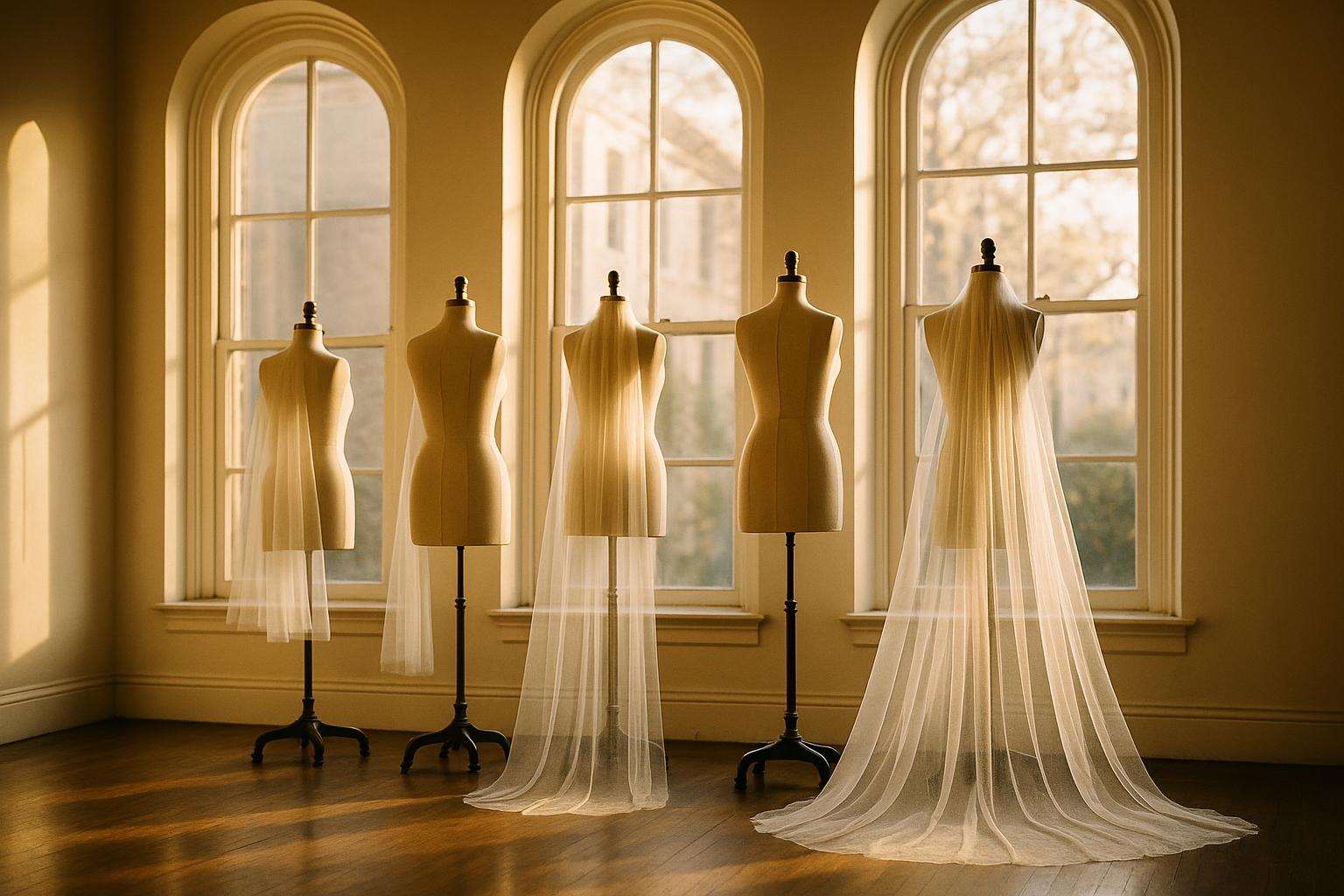
FingertipCathedralChapelBlusherMantillaBirdcage
The quick verdict
A ranked guide to every major veil length — from the versatile fingertip to the ultra-formal cathedral — with the gown silhouette, train, and formality each pairs with best, plus real designer picks and honest tradeoffs.
- Best overall
- Fingertip Veil — The most popular bridal veil length worldwide — versatile across nearly all silhouettes, easy to manage without an attendant, and available from David's Bridal through Maggie Sottero at every price point.
- Best value
- Elbow Veil — The most affordable entry into the category ($20–$150 at BHLDN and Etsy), light and wind-resistant for outdoor ceremonies, and the cleanest option for sheath and column gowns.
- Best for Black-tie ceremony with a cathedral-train ball gown
- Cathedral Veil — The Maggie Sottero Sonoma cathedral veil (114 in, 3D lace edge) delivers the scale and formality that matches a cathedral-train gown at a ready-to-wear price point, with attendant management built into the plan.
How we evaluated
Rankings reflect versatility breadth: how many gown silhouettes and formality levels each veil length flatters, practical manageability during the ceremony, and real-world availability at mainstream retail price points. We reviewed guidance from Kleinfeld Bridal, Maggie Sottero, Pronovias, Britten Weddings, and The Knot, and cross-referenced designer-editorial matching guides from Calily Bridal, Tulip Bridal, and Twigs & Honey. Pricing reflects 2026 retail ranges at authorized U.S. retailers.
- Versatility breadth. How many distinct gown silhouettes (A-line, ball gown, mermaid, sheath, fit-and-flare) and formality levels the veil length flatters without caveats.
- Practical manageability. Whether the veil can be worn and managed by the bride alone, or requires a dedicated attendant — a real day-of logistics consideration, particularly for longer lengths.
- Silhouette-to-train alignment. How cleanly the veil length coordinates with the most common train lengths (sweep, chapel, cathedral) used with its target gown silhouettes.
- Real-gown availability at price. Whether the veil style is available at mainstream retail price points (under $600) from established labels, not only at couture or custom price points.
Rating scale: 5.0 = works beautifully across virtually all silhouettes and formality levels; 4.0–4.9 = broadly versatile with minor pairing caveats; 3.0–3.9 = excellent for specific silhouettes or aesthetics, narrower appeal; below 3.0 = specialist style with a defined ideal bride.
Last verified .
At a glance
| # | Name | Rating | Best for | Pricing |
|---|---|---|---|---|
| 1 | Fingertip Veil (~45 in) | 5.0 | A-line, mermaid, fit-and-flare, and sheath gowns; sweep or chapel trains; semi-formal to formal ceremonies | $80–$600 (David's Bridal and BHLDN at the accessible end; Maggie Sottero embellished styles mid-range at Kleinfeld Bridal) |
| 2 | Cathedral Veil (108 in+) | 4.6 | Ball gown and princess silhouettes; cathedral and royal trains; formal indoor ceremonies with long aisles; black-tie weddings | $400–$1,850+ (Kleinfeld Bridal, Maggie Sottero Sonoma at $600–$900 ready-to-wear; couture and heavily embellished styles scale higher) |
| 3 | Chapel Veil (~90 in) | 4.4 | Ball gown and A-line silhouettes; chapel and cathedral trains; formal and semi-formal venues; outdoor ceremonies where full cathedral length is impractical | $150–$900 (David's Bridal entry-level to Pronovias and BHLDN mid-range) |
| 4 | Blusher Veil (~30 in) | 4.2 | Any gown silhouette; traditional, heritage, and romantic ceremonies; brides who want a ceremonially distinct processional and reception look | $30–$200 (David's Bridal, BHLDN, Vera Wang Bride at accessible price points) |
| 5 | Mantilla Veil (any length) | 3.9 | A-line, sheath, and mermaid silhouettes; lace gowns (contrast edge); sweep or chapel trains; heritage, garden, and destination ceremonies | $60–$500 (Calily Bridal and Tulip Bridal; intricate Alençon lace styles at the upper end) |
| 6 | Elbow Veil (~25 in) | 3.7 | Sheath, column, and casual A-line gowns; outdoor, garden, beach, and destination ceremonies; no train or sweep train only; brides who want to transition to a headpiece post-ceremony | $20–$250 (BHLDN and Etsy at entry level; Britten Weddings handmade boutique styles at the upper end) |
| 7 | Birdcage Veil (face only) | 3.2 | Any gown silhouette; vintage, cocktail-length, and civil ceremonies; brides who want a fashion-forward editorial look rather than traditional bridal drama; no train | $45–$300 (Twigs & Honey: plain styles from $78, Swarovski pearl options from $195, pillbox combinations from $248) |
Fingertip Veil (~45 in)
The most popular length in bridal — long enough for drama, short enough to manage solo
Editor's pick
The fingertip veil ends at the fingertips when the bride's arms rest naturally at her sides — approximately 45 inches from comb to hem. It is consistently the single most popular bridal veil length in the U.S. market, according to The Knot's editorial team, because it sits in a rare sweet spot: long enough to create genuine bridal drama in photographs and during the processional, yet short enough that the bride can manage it alone without a dedicated attendant. It works across nearly every gown silhouette: on an A-line, it falls near the widest point of the skirt and lets the hem be the focal point; on a mermaid, it clears the flare entirely and sits in the flattering mid-back zone; on a sheath, it adds length without bulk. For 2026, the fingertip veil is appearing with raw-cut edges for a bohemian, unfussy effect and with intricate Alençon lace borders for a more formal reading — the same length serves two completely different aesthetics depending on the trim. David's Bridal and BHLDN carry accessible fingertip veils from approximately $80 onward; Maggie Sottero's embellished fingertip options run $200–$600 at authorized retailers including Kleinfeld Bridal. The honest limitation: if your gown has a cathedral train, a fingertip veil will end well above the train hem and the two layers won't connect visually — in that case, stepping up to chapel length creates a more cohesive silhouette.
Strengths
- Works across A-line, mermaid, fit-and-flare, and sheath silhouettes without caveats
- Short enough to manage solo — no dedicated attendant needed during the ceremony
- Available in every trim style from raw-cut boho to Alençon lace formal, serving multiple aesthetics
- Most widely stocked veil length — easiest to find and try at salons including Kleinfeld Bridal and David's Bridal
Weaknesses
- Pairs less naturally with cathedral-train gowns, where the veil ends well above the train hem and the two pieces read as disconnected; chapel or cathedral length creates better visual flow with a long-train ball gown
- Best for
- A-line, mermaid, fit-and-flare, and sheath gowns; sweep or chapel trains; semi-formal to formal ceremonies
- Pricing
- $80–$600 (David's Bridal and BHLDN at the accessible end; Maggie Sottero embellished styles mid-range at Kleinfeld Bridal)
Source: The Knot — 11 Wedding Veil Styles & Veil Lengths · Visit Fingertip Veil (~45 in)
Cathedral Veil (108 in+)
The ultra-formal statement piece — breathtaking behind a ball gown, and a two-person accessory
The cathedral veil begins at 108 inches from comb to hem and extends significantly beyond the gown's train — Kleinfeld Bridal defines it as 108 inches or more, with "royal" veils exceeding 120 inches for the most formal state and royal occasions. It is the most high-maintenance of all veil lengths and the most visually commanding: spread across the full aisle, a cathedral veil turns the processional into a genuine architectural moment. It pairs naturally with ball gowns and princess silhouettes on cathedral or royal trains, amplifying the formality of both pieces; on an A-line with a cathedral train it reads equally powerful but with more fluid movement. Maggie Sottero's Sonoma cathedral veil measures 114 inches and features scalloped edges with 3D floral lace appliqués — a ready-to-wear option at approximately $600–$900 at authorized retailers. At Kleinfeld Bridal, cathedral veils begin around $400 for plain-edge styles and scale to several thousand dollars for heavily embellished Alençon or Chantilly lace constructions. The honest reality: a cathedral veil requires a dedicated bridesmaid or personal attendant to spread it before the processional and manage it at every transition — down the aisle, at the altar, and during the reception entrance. If your venue has a short aisle or a tight ceremony layout, this veil loses much of its impact. For silk tulle in this length, the drape is unparalleled — Tessa Kim's bridal label documents silk tulle's superiority over nylon at long lengths — but silk adds significant cost.
Strengths
- The most visually dramatic veil length — turns the processional into a moment that photographs powerfully from every angle
- Pairs perfectly with ball gowns and princess silhouettes on cathedral trains, creating a cohesive top-to-floor formal statement
- Available at a ready-to-wear price point via Maggie Sottero's Sonoma veil ($600–$900), not only at couture levels
- Silk tulle versions (Tessa Kim) offer unmatched drape and fluid movement at cathedral length
Weaknesses
- Requires a dedicated attendant to manage throughout the ceremony and reception entrance — a real day-of logistics cost that should be discussed with your wedding party well in advance
- Loses visual impact in venues with short aisles or intimate layouts where the full length cannot unfurl
- Best for
- Ball gown and princess silhouettes; cathedral and royal trains; formal indoor ceremonies with long aisles; black-tie weddings
- Pricing
- $400–$1,850+ (Kleinfeld Bridal, Maggie Sottero Sonoma at $600–$900 ready-to-wear; couture and heavily embellished styles scale higher)
Source: Kleinfeld Bridal — Veils 101 · Visit Cathedral Veil (108 in+)
Chapel Veil (~90 in)
Floor-grazing drama with half the management overhead of a cathedral
The chapel veil runs approximately 90 inches from comb to hem, grazing the floor and extending a few inches past the gown's hem — enough to pool gently at the back without the full spread of a cathedral length. It is the choice for brides who want genuine floor presence and formality without committing to the attendant management that a cathedral veil demands. A chapel veil can be managed by the bride with some care; it does not require a dedicated carrier in the way a 108-inch-plus veil does. It pairs most naturally with chapel-length trains and A-line or ball gown silhouettes at formal venues, and it is the formality step between fingertip and full cathedral. For mermaid gowns at formal settings, a chapel veil in light illusion tulle is a strong choice: it extends the vertical line past the flare and adds sweep without adding bulk to the fitted silhouette. Pronovias advises matching the edge treatment to the gown — a heavily lace-appliquéd chapel veil on a minimalist gown can compete rather than complement; a plain or pencil-edge chapel veil on a lace-embellished gown creates clean contrast. BHLDN and Pronovias both carry chapel-length veils in the $200–$900 range; David's Bridal offers entry-level chapel-length options under $200. For outdoor ceremonies, the chapel length is a practical compromise: it drapes beautifully in still air but is far more wind-manageable than a cathedral veil.
Strengths
- Floor-grazing presence and formality without the attendant-management requirements of a full cathedral veil
- Pairs cohesively with chapel-length trains, creating a seamless length match from gown to veil
- Works for both indoor formal ceremonies and outdoor garden weddings where full cathedral length would be impractical
- Available at accessible price points from David's Bridal (under $200) through Pronovias mid-range ($400–$900)
Weaknesses
- Requires careful movement management — while not a two-person accessory like a cathedral veil, a chapel veil will catch on chairs, cobblestones, and outdoor surfaces if the bride moves quickly without awareness
- Best for
- Ball gown and A-line silhouettes; chapel and cathedral trains; formal and semi-formal venues; outdoor ceremonies where full cathedral length is impractical
- Pricing
- $150–$900 (David's Bridal entry-level to Pronovias and BHLDN mid-range)
Source: Pronovias — How to Choose a Bridal Veil · Visit Chapel Veil (~90 in)
Blusher Veil (~30 in)
The face-covering tier that delivers the cinematic reveal — and it's back in a big way for 2026
The blusher is less a length category and more a placement style: it is a short tier, approximately 30 inches from the comb, worn over the bride's face during the processional and lifted at the altar. It is the piece most directly associated with the ceremonial "reveal" moment — the frame for the first look at the altar that fills every wedding photographer's portfolio. In 2025–26 it is experiencing a notable revival, with Britten Weddings citing a generational rediscovery of ceremony ritual and old-world romantic tradition as the driver. Brides who previously dismissed the blusher as overly traditional are returning to it as a meaningful ceremonial gesture rather than a dated obligation. In plain illusion tulle, the blusher reads contemporary and minimal; with a lace or floral appliqué edge it leans traditional or heritage. The blusher works with any gown silhouette because it is the face covering, not the length, that defines it — it can be worn as a standalone short veil at a casual or civil ceremony, or layered over a longer tier for a full bridal effect. The most classic combination is a single-tier fingertip veil with a blusher attached at the comb: one purchase, two distinctly photographable moments (over the face during the processional, swept back over the crown during the reception). David's Bridal, BHLDN, and Vera Wang Bride all carry blusher options from approximately $30 to $200 at the accessible end.
Strengths
- Delivers a cinematic processional reveal moment that photographs memorably at every focal length
- Can be worn as a standalone short veil or layered over any longer tier — maximum flexibility for one purchase
- Available in minimalist plain tulle (contemporary) and lace-edged (heritage) finishes for two distinct aesthetics
- Revival trend in 2025–26 makes it feel fresh rather than dated at modern ceremonies
Weaknesses
- Some brides find the face covering uncomfortable or obscure visibility during the processional — this is worth a rehearsal walkthrough before the wedding day to confirm comfort and sight lines
- Best for
- Any gown silhouette; traditional, heritage, and romantic ceremonies; brides who want a ceremonially distinct processional and reception look
- Pricing
- $30–$200 (David's Bridal, BHLDN, Vera Wang Bride at accessible price points)
Source: Britten Weddings — Wedding Veil Guide 2026 · Visit Blusher Veil (~30 in)
Mantilla Veil (any length)
The flat-draping Spanish lace style that frames the face with heritage and a single fluid curve
The mantilla is a Spanish-heritage veil style cut from lace — typically Alençon, Chantilly, or Guipure — into a circular or oval shape that frames the face and drapes over the shoulders and back without gathers or layers. Unlike the layered tulle veils that dominate the category, a mantilla lies flat in a single fluid curve from crown to hem, giving it a completely different silhouette: it is a frame, not a cloud. It is available in fingertip, chapel, and cathedral lengths. Calily Bridal, a specialist online retailer, offers at-home try-on kits for mantilla veils in Alençon and Chantilly lace trims; Tulip Bridal is another specialist with a dedicated mantilla collection. Modern updates for 2026 include blush-tinted lace, pearl embellishments at the edge, and embroidered initials or dates sewn into the hem — a meaningful personalization that standard tulle veils cannot replicate. The mantilla suits A-line, sheath, and mermaid silhouettes particularly well because its flat drape reads beautifully against both clean satin and lace gowns — it adds lace drama without adding volume. It is less suited to heavily embellished ball gowns, where the richness of the lace mantilla can compete with an already-detailed gown. The practical note: because a mantilla is a single flat piece rather than a gathered tier, it must be pinned or combed at exactly the right angle or it will shift; most brides use a tucked comb plus bobby pins for security. The lace is also more delicate than illusion tulle and requires careful handling.
Strengths
- Unique flat-draping silhouette that frames the face and neck in a single fluid lace curve — a completely different aesthetic from any layered tulle veil
- Heritage and romantic appeal with genuine craft — Alençon and Chantilly lace mantillas are heirloom-quality pieces
- Personalizable with embroidered initials, wedding dates, or meaningful motifs sewn into the hem (Calily Bridal, Tulip Bridal)
- At-home try-on programs (Calily Bridal) allow brides to test the style at home before committing
Weaknesses
- Securing a mantilla correctly requires practice — a single flat lace piece placed at the wrong angle or without sufficient pinning will shift during the ceremony, and lace is less forgiving to re-place mid-processional than gathered tulle
- Best for
- A-line, sheath, and mermaid silhouettes; lace gowns (contrast edge); sweep or chapel trains; heritage, garden, and destination ceremonies
- Pricing
- $60–$500 (Calily Bridal and Tulip Bridal; intricate Alençon lace styles at the upper end)
Source: Calily Bridal — The Ultimate Guide to Mantilla Veils · Visit Mantilla Veil (any length)
Elbow Veil (~25 in)
The lightest, most wind-resistant option — perfect for outdoor and destination weddings
The elbow veil falls to roughly the elbow when the bride's arms hang naturally, approximately 25 inches from the comb. It is the most lightweight and practical of the standard veil lengths, which makes it disproportionately popular for outdoor, garden, beach, and destination weddings where longer fabric would catch on grass, cobblestones, or ocean breezes. It is also the easiest veil to remove: short enough to pin out and replace with a hair accessory for the reception without ceremony. On a sheath or column gown, it adds a softening layer at the back without disrupting the sleek profile; on an A-line, it sits comfortably above the widest point of the skirt. The honest caveat for the elbow veil: it does not work well with mermaid or fit-and-flare silhouettes, where ending at the torso cuts the visual line at exactly the wrong point, visually shortening the figure and interrupting the gown's primary design logic. It also reads as semi-formal or casual, so brides planning black-tie or cathedral ceremonies may find it underscaled for the occasion. BHLDN and Etsy both offer elbow-length veils from approximately $20–$150; Britten Weddings in Bath, England — who hand-make their veils using lace from an eighth-generation English supplier established in 1858 — produces embellished elbow styles at the boutique end of the range.
Strengths
- Most wind-resistant and practical veil length — the go-to for outdoor, beach, and destination ceremonies
- Easy to remove and replace with a headpiece for the reception without disrupting hair or the overall look
- The most affordable entry point in the veil category, from $20 at BHLDN and Etsy
- Works well with sheath, column, and casual A-line silhouettes without adding bulk or management complexity
Weaknesses
- Does not suit mermaid or fit-and-flare silhouettes — ending at the torso interrupts the gown's visual line at its most flattering point and visually compresses the figure
- Reads as semi-formal or casual in formality register — not well-suited to black-tie or cathedral ceremonies where greater scale is expected
- Best for
- Sheath, column, and casual A-line gowns; outdoor, garden, beach, and destination ceremonies; no train or sweep train only; brides who want to transition to a headpiece post-ceremony
- Pricing
- $20–$250 (BHLDN and Etsy at entry level; Britten Weddings handmade boutique styles at the upper end)
Source: Britten Weddings — Wedding Veil Guide 2026 · Visit Elbow Veil (~25 in)
Birdcage Veil (face only)
Vintage Hollywood's calling card — Russian or silk netting that covers only the upper face
The birdcage veil — also called a cage — covers only the top portion of the face in netted veiling: Russian netting or silk net fixed by comb, clip, or headband. It was introduced in the 1940s during World War II fabric shortages and is synonymous with vintage Hollywood glamour, rockabilly bridal, and cocktail-length wedding aesthetics. It is shorter than a blusher and is the most fashion-forward of the styles on this list, adding a strong editorial quality to any look. Twigs & Honey, the leading specialist brand for birdcage veils, handcrafts their entire collection in-studio with styles ranging from plain Russian veiling headbands (Style #2350, approximately $78) to Swarovski pearl–adorned options (Style #2165, approximately $195) to pillbox-hat combinations (Style #2650, approximately $248). Twigs & Honey veils are also stocked by Anthropologie, making them more widely accessible than most specialty bridal accessories. The birdcage is a statement rather than a silhouette completer — it works with any gown because it is entirely face-focused and does not interact with the gown's body or train at all. This makes it unusually flexible as a style choice: it works equally well on a vintage tea-length gown, a modern sleek sheath, and even a traditional A-line when the bride wants an unexpected editorial contrast. The honest limitation is the opposite of its strength: because the birdcage is entirely a face accessory, it provides no veil-length drama at the back of the dress. Brides who want the traditional processional moment — the flowing veil trailing behind as they walk down the aisle — will not find it here.
Strengths
- Twigs & Honey (the category leader) handcrafts every piece in-studio with styles from plain Russian veiling ($78) to Swarovski pearl-adorned options ($195), available through Anthropologie
- Uniquely versatile in gown pairing — because it is entirely face-focused, it works with any silhouette without interacting with the gown's body
- Strong editorial and vintage Hollywood quality — the most fashion-forward choice on this list
- The most affordable way to wear a veil aesthetic at a cocktail or destination wedding
Weaknesses
- Provides no back-of-dress drama — there is no flowing veil visible during the processional, which is the primary ceremonial and photographic moment most brides are imagining when they think about a veil
- Best for
- Any gown silhouette; vintage, cocktail-length, and civil ceremonies; brides who want a fashion-forward editorial look rather than traditional bridal drama; no train
- Pricing
- $45–$300 (Twigs & Honey: plain styles from $78, Swarovski pearl options from $195, pillbox combinations from $248)
Source: Twigs & Honey — Birdcage Veils Collection · Visit Birdcage Veil (face only)
Frequently asked
What is the most popular bridal veil length?
The fingertip veil — approximately 45 inches from comb to hem — is consistently the most popular bridal veil length in the U.S. market. The Knot's editorial team reports it is the top choice among today's brides because it sits in a versatile sweet spot: long enough to create genuine bridal drama during the processional and in photographs, yet short enough that the bride can manage it solo without a dedicated attendant. It works across A-line, mermaid, fit-and-flare, and sheath silhouettes, and is the most widely stocked length at salons including Kleinfeld Bridal, David's Bridal, and BHLDN. If you can only try one length at your first appointment, the fingertip is the one to start with.
Do I need a veil to match my dress train length?
Not exactly, but proportional alignment makes a significant visual difference. The general principle is that a veil should extend 20–30 cm (roughly 8–12 inches) beyond the gown's hem for the most flattering silhouette — creating a layered flow rather than a hard cutoff. A chapel veil pairs most cohesively with a chapel train; a cathedral veil creates the most unified look behind a cathedral-train ball gown. A fingertip veil on a sweep-train gown is a perfectly proportioned combination. The combinations to avoid are those where the veil ends significantly above the gown's train hem — such as a fingertip veil behind a cathedral-train ball gown — which can make the two pieces look mismatched rather than intentional. Your stylist at Kleinfeld Bridal or your local salon will be able to lay the veil behind the dress at your appointment to test the visual relationship.
How do I wear a mantilla veil without it slipping?
A mantilla veil is a single flat lace piece rather than a gathered tulle tier, which means it has less inherent grip than a voluminous veil and must be secured carefully. The standard approach is a tucked comb at the crown (placed slightly back from the hairline, not at the very top) plus four to six bobby pins along the edge of the lace where it frames the face and crown. Many brides also add a second comb mid-back for longer mantilla styles. Calily Bridal, a specialist mantilla retailer, recommends practicing the placement and pin pattern with your hairstylist at the hair trial — not discovering the grip issue on the wedding day. If your hair is fine or slippery, a light texture spray on the root area under the comb dramatically improves hold. Avoid placing the comb too far forward, which causes the veil to tip backward during the processional.
What is the difference between a blusher and a regular veil?
A blusher is a short tier — approximately 30 inches from the comb — specifically designed to be worn over the bride's face during the processional and lifted at the altar. A regular veil refers to any of the standard length tiers (elbow, fingertip, chapel, cathedral) that hang from the comb at the back of the head and are never worn over the face. The two are not mutually exclusive: the most classic combination is a two-tier veil with a blusher as the front tier and a longer tier (usually fingertip) as the back tier — one accessory purchase that delivers two distinct looks, the face-covered processional and the hair-down reception reveal. Standalone blushers are also worn at civil and casual ceremonies by brides who want a lightweight veil moment without trailing length.
Can I wear a cathedral veil with a mermaid dress?
Yes — but it requires planning and the right fabric. Maggie Sottero's editorial guidance recommends that a mermaid bride choosing a cathedral veil opt for illusion tulle rather than English net or organza, because lighter fabric moves with the fitted skirt rather than adding bulk or resisting the gown's natural drape. A cathedral-length illusion veil behind a mermaid gown creates an elongated, sweeping effect that photographs beautifully down a long aisle — the veil continues the vertical line of the fitted bodice and extends it far past the flare. The practical consideration is the same as for all cathedral veils: you need a dedicated attendant. For a mermaid bride, ensure your attendant knows to hold the veil away from the skirt during any tight turns, as the fitted hem of a mermaid can catch and tension the veil's comb.
Where is the best place to buy a wedding veil in 2026?
For in-person selection with a full range of styles and lengths, Kleinfeld Bridal in New York is the benchmark — veils start around $400 and the selection spans every major designer. For authorized designer options nationwide, Maggie Sottero, Pronovias, and Essense of Australia are all available at their respective authorized retailer networks (locatable on each brand's website). For accessible price points with good quality, BHLDN (Anthropologie's bridal line) and David's Bridal both stock fingertip, chapel, and blusher options from $30–$200. For specialist styles, Twigs & Honey (birdcage veils), Calily Bridal, and Tulip Bridal (mantilla veils) are the category leaders. The secondary market — Stillwhite, PreOwned Wedding Dresses, and Etsy — offers 30–50% discounts on gently used veils and is a strong first stop for brides on a budget.