Bridal Accessories
Bridal Garter Guide: Tradition, Style & Whether to Wear One
The honest history behind the wedding garter, how to choose between a keepsake and toss set, what every bride needs to know about sizing and placement, and why more modern couples are skipping — or reimagining — the toss entirely.
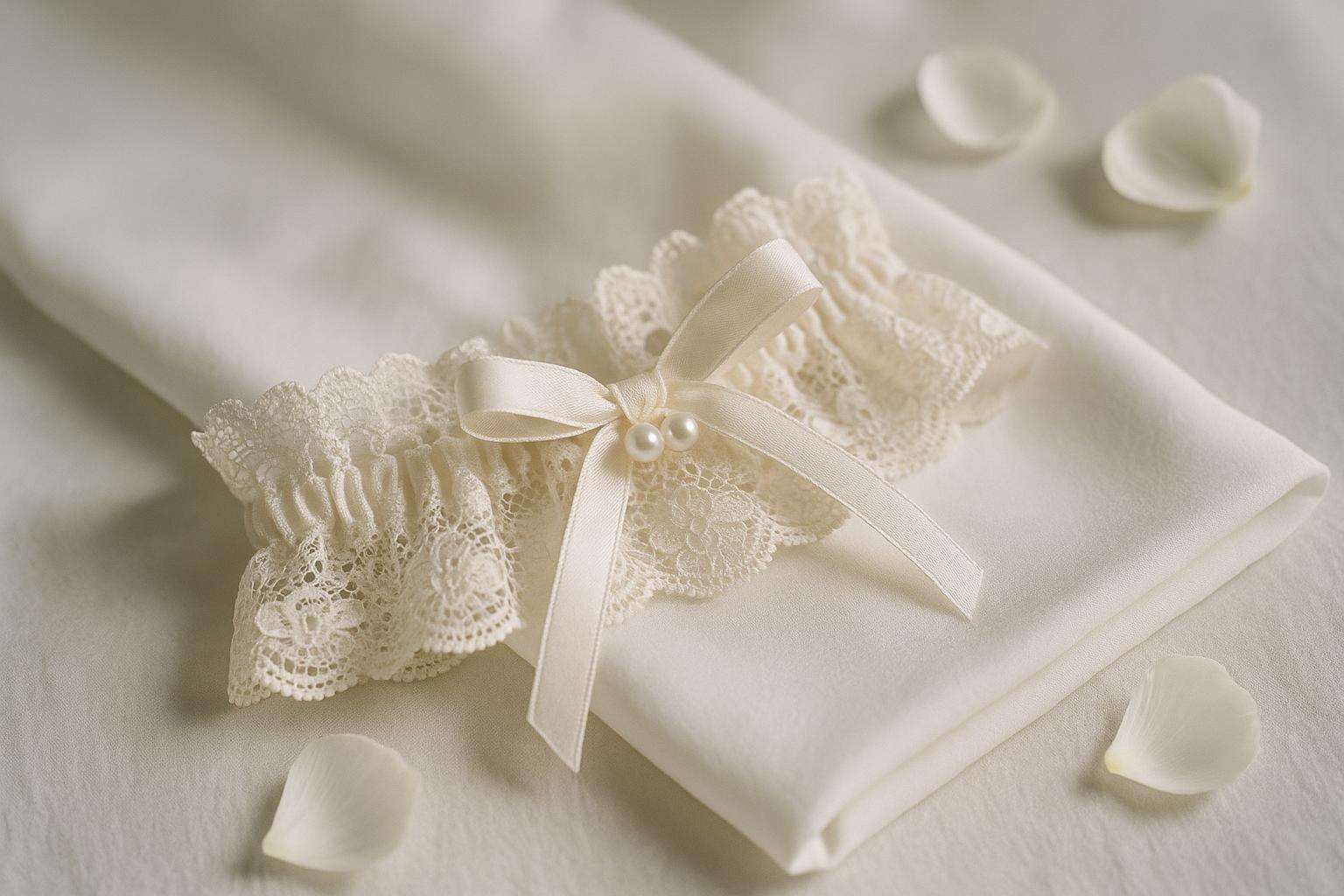
The wedding garter is a centuries-old bridal accessory — most commonly worn as the “something blue” — that today comes in two forms: a beautiful keepsake piece the bride keeps and a simpler toss garter for the reception tradition. You are never obligated to do the toss; wearing a garter at all is entirely optional. If you choose to wear one, sizing by thigh circumference and ordering 6–8 weeks ahead gives you the best range of options from specialist makers like The Garter Girl and Britten Weddings.
Of all the accessories a bride considers, the garter may carry the most historical baggage. It is older than the white wedding dress. It predates the diamond engagement ring. And its origins — which most retailers wisely omit from their product descriptions — are genuinely unsettling, involving medieval crowds and the tearing of the bride’s clothing for luck. What survived into the twenty-first century is a delicate lace-and-satin band that most brides never see until they are deep into accessory planning, and which prompts an immediate set of practical questions: Do I have to wear one? Which style? How do I size it? And do we really have to do the toss?
This guide answers all of it, grounded in real designer expertise and verified pricing from the market’s leading retailers.
What Is the History Behind the Wedding Garter Tradition?
The garter’s origins are medieval and far darker than the ivory lace aesthetic suggests. In pre-modern Europe it was considered genuinely lucky to possess a piece of the bride’s clothing, so wedding guests would follow newlyweds toward the bridal chamber and physically tear at the wedding dress for fabric tokens. To protect the gown — and herself — the practical solution that emerged was a loosely fastened garter the bride could surrender quickly to appease the crowd. Britten Weddings, whose handmade garters are crafted in Bath, UK from genuine French lace, documents this history in full on their site.
By the Renaissance the garter had become openly associated with fertility and romantic luck; men who retrieved one would pin it to their hat to display their fortune. The 1700s introduced “Fling the Stocking,” a parlor game in which unmarried guests removed stockings from the newlyweds and tossed them — landing on the couple supposedly guaranteeing the thrower a successful marriage. The 1800s saw the “Race for the Garter,” in which single groomsmen sprinted from the church to the bridal home, with the winner claiming the garter as a lucky token.
The choreographed reception moment that modern couples recognize, however, is recent. Fashion historian Kimberly Chrisman-Campbell, cited by The Knot, found no evidence of a formally staged garter toss at a wedding reception before the mid-1950s. It was being described as a tradition in mainstream American magazines only by the 1960s. The “ancient tradition” framing that appears in countless bridal articles is, in this light, marketing — but the garter itself is genuinely old.
What Does the Bridal Garter Symbolize Today?
Its most durable contemporary meaning is as the “something blue” in the Victorian rhyme “something old, something new, something borrowed, something blue” — a color long linked to purity, fidelity, and love. Many brides order specifically blue garters, or sets with a blue satin ribbon woven through ivory lace, to satisfy both the symbolism and their aesthetic in a single purchase. The Garter Girl’s editorial archive documents dozens of something-blue approaches across every price point, from pale sky-blue satin ribbon to deep navy velvet at the fashion-forward end of the market.
Beyond the something-blue function, brides today invest meaning in the garter as a private keepsake — a personal token worn only for the bride and groom, distinct from the public bouquet or the ceremony itself. The rise of keepsake-quality garters from designers like Twigs & Honey and Britten Weddings reflects this shift: the garter has moved from crowd-participation prop to intimate, heirloom-grade accessory.
What Are the Most Popular Bridal Garter Styles in 2026?
| Style | Best For | Key Designers / Retailers | Price Range |
|---|---|---|---|
| Lace (French or English) | Classic, romantic, traditional brides; pairs with most gown silhouettes | Britten Weddings, The Garter Girl | $30–$160 |
| Satin with lace overlay | Budget-conscious brides; last-minute shoppers; photography-friendly | David’s Bridal, Galina Signature (at David’s Bridal) | $10–$40 |
| Crystal-embellished | Brides who want close-up photography impact; black-tie receptions | Twigs & Honey (Myra Callan), David’s Bridal Embellished Crystal Set | $35–$150+ |
| Pearl-accented | Old-money aesthetic; pairs with vintage or heritage gowns | Twigs & Honey, Kleinfeld (Nestina Accessories) | $50–$175+ |
| Velvet or mixed-texture | Fashion-forward and non-traditional brides; autumn and winter weddings | The Garter Girl (“Soul Mate” black velvet style) | $75–$130 |
| Custom embroidered | Personalized keepsakes; name + date; something-blue with a personal message | Etsy independent makers, Britten Weddings custom orders | $20–$75 |
Lace remains the most popular garter material by volume. Britten Weddings handcrafts every piece from genuine French lace or English lace with scalloped edges backed by smooth satin so the textile feels gentle against skin. The Garter Girl, founded in 2004 by Julianne Smith, works with the finest imported laces and satins; her “Lace Wedding Garters” collection starts around $75 for ready-to-ship styles and rises to $160 for fully made-to-order luxury sets.
Crystal-encrusted garters have grown in popularity as close-up photography has become a wedding staple. Twigs & Honey’s Crystal and Opal Blossom Garter (Style #423), created by Myra Callan, features hand-wired Austrian rhinestones and opal-colored crystals on imported metallic elastic, available in S/M (16–20” thigh) and M/L (21–25” thigh). David’s Bridal carries the Galina Signature “Deco Crystal Encrusted Lace Garter Set” and its own “Embellished Crystal Garter Set” at accessible mass-market price points.
Fashion-forward and maximalist options have expanded significantly at specialty studios. The Garter Girl’s “Soul Mate” style layers lace, satin, and soft velvet in black — a statement piece for brides who want a fashion-forward keepsake rather than a traditional accessory. On Etsy, which lists more than 5,000 handmade and custom garter options, bestsellers include personalized embroidered sets featuring the bride’s new surname and wedding date, commonly priced under $25.
How Do You Measure for the Right Bridal Garter Size?
Garters are sized by thigh circumference measured while standing, at the point where the garter will be worn — typically 3 to 6 inches above the knee. Use a soft measuring tape held snug but not tight against the skin. The Garter Girl’s size guide and Britten Weddings’ measurement instructions map thigh circumference to the following standard bracket used across specialist retailers:
| Size | Thigh Circumference | Fit Note |
|---|---|---|
| XS | 14–17 inches | Petite frames; order promptly as XS is less stocked |
| S | 17–20 inches | Most common size in made-to-order studios |
| M | 20–23 inches | Widest ready-to-ship selection across retailers |
| L | 23–26 inches | Size up if at the boundary; adjustable styles recommended |
| XL / Custom | 26+ inches | Commission a custom size; Britten Weddings and The Garter Girl both accommodate |
When a measurement falls at the top of a size range, both The Garter Girl and Britten Weddings explicitly recommend sizing up. A slightly loose garter is easier to wear through a full reception — and far easier to remove during a garter toss — than one that cuts into the thigh during dancing. Brides outside standard ranges should look for adjustable garters with snap closures or tie-back ribbons, or commission a custom piece. Britten Weddings offers bespoke sizing as standard, with complimentary international shipping and a 45-day return window for US orders.
One frequently missed detail: measure the leg you plan to wear the garter on. The garter traditionally sits on the left leg, but placement is entirely a matter of personal preference and comfort. If you plan to wear a two-garter set — one keepsake, one toss — both garters can sit on the same leg or on opposite legs; there is no rule.
Where Should You Buy a Bridal Garter, and What Will It Cost?
The bridal garter market spans from mass-market chain retailers at under $15 to couture studio commissions over $175. The right choice depends on how much the garter matters to you as a keepsake, your timeline, and your budget.
David’s Bridal — The largest US bridal chain carries a broad garter assortment covering all major styles (lace, crystal, satin, novelty embroidered) at historically accessible prices from approximately $10 to $40 per set, including the Galina Signature label and the brand’s own DB Exclusive range. Best for last-minute shoppers and brides who want an in-store experience without specialist pricing.
The Garter Girl (thegartergirl.com) — Founded in 2004 by Julianne Smith; made-to-order from finest imported laces, satins, and beads. Free US shipping and gift box included. Ready-to-ship styles from around $75; luxury made-to-order sets from $107 to $160. The clear best option for brides who want a genuine heirloom-quality keepsake with a wide editorial range and helpful sizing guidance.
Twigs & Honey (twigsandhoney.com) — Myra Callan’s US studio produces entirely handmade crystal and pearl garters using Austrian rhinestones and luxury stretch ribbon. Positioned at the premium end alongside their headpiece and veil collections; ideal for brides who want their accessories to coordinate as a couture set.
Britten Weddings (brittenweddings.com) — Founded in 2009 by Sarah Jane in Bath, UK. Garters handmade to order from French lace and silk satin with optional personalized embroidered tags; ships to the US in 7–10 business days with complimentary international shipping and no hidden customs fees. The 45-day return window for US orders makes this a lower-risk option for international orders.
Etsy (etsy.com) — Aggregates thousands of independent makers; strongest for custom embroidered “something blue” sets and personalized name-and-date garters. Most individual garters priced under $25; sets typically $25–$60 depending on complexity. Check individual shop reviews carefully and confirm production timelines before ordering.
Kleinfeld Bridal (kleinfeldbridal.com) — The New York flagship carries garters as part of its full accessories offering, including pieces from designer Nestina Accessories; accessories are selected during a consultant appointment. Specific garter prices are disclosed in-store.
Is the Garter Toss Still Done at Weddings — and Do You Have to?
The short answer: it is declining, and you do not have to do it. The Knot’s 2023 Real Weddings Study found that only 31 percent of couples performed the bouquet toss — down 13 percentage points from 2019 — and the garter toss tracks a similar trajectory. An earlier Maggie Sottero survey placed garter toss adoption at approximately 37 percent in 2018, meaning the tradition has shed roughly a third of its practitioners in under a decade.
The most common reasons couples skip: discomfort with the tradition’s historically gendered dynamic (the groom retrieving the garter from the bride’s thigh in front of assembled guests sits uneasily with many modern couples), a preference for reception pacing, and the growing desire to keep the garter as a private keepsake rather than a crowd-participation prop. None of these reasons require justification. The garter toss is optional.
If you want to preserve the spirit of the moment without the literal toss, planning guides from The Garter Girl and Zola document several alternatives that have gained traction:
- The anniversary dance — couples exit the dance floor by years married; the longest-married couple receives the bouquet or another token. This consistently generates more genuine emotion than the traditional toss.
- Boutonniere toss — the groom tosses his boutonniere to single male guests, as a gentler and more symmetrical substitute.
- Charity mini-auction — in lieu of a toss, couples auction a token item with proceeds to a cause the couple supports.
- Keep it private — the garter is retained as a personal keepsake, sometimes preserved alongside the wedding dress or later converted into a brooch by a local jeweler.
The keepsake-and-toss two-piece set — sold by The Garter Girl, Britten Weddings, and David’s Bridal among others — exists precisely because many brides want the beautiful garter as a personal item and a separate, simpler piece to throw. Buying a set is significantly more economical than purchasing two individual garters, and it resolves the anxiety of handing over the piece you actually care about to a crowd.
What Is a Keepsake Garter vs. a Toss Garter?
The keepsake garter is the piece the bride intends to keep permanently. It is typically the more elaborate and more expensive garter in a two-piece set — crafted from fine lace, silk satin, or Austrian crystal, often with personalized embroidery (the wedding date, a new surname, or a short phrase) sewn into the band. This is the piece worn closest to the skin, often on the left leg by tradition.
The toss garter is a simpler, less expensive companion designed to be thrown into a crowd. Its construction prioritizes aerodynamics and cost over craft — usually a basic stretch band with a small lace or satin overlay and a bow. Most brides feel no attachment to the toss garter, which is exactly the point: you surrender the one you don’t love, and keep the one that means something.
David’s Bridal toss-only garters start as low as $10–$15. The Garter Girl’s two-piece keepsake-and-toss sets — which pair a handmade luxury keepsake with a simple coordinating toss piece — start around $107 and represent genuine value compared to buying two separate quality garters. Britten Weddings similarly offers sets; their personalization options extend to the toss garter as well, for couples who want both pieces to feel deliberate.
Considered Counsel
Frequently asked
What is the history behind the wedding garter tradition?
The garter's origins are medieval and decidedly darker than the ivory lace aesthetic suggests. In pre-modern Europe it was considered lucky to possess a piece of the bride's clothing, so guests would follow newlyweds and tear at the wedding dress for fabric tokens. To protect the gown, brides began surrendering a loosely fastened garter. By the Renaissance the garter was associated with fertility and romantic luck; men who retrieved one wore it pinned to their hat. Fashion historian Kimberly Chrisman-Campbell, cited by The Knot, found no evidence of a formally staged garter toss at a reception before the mid-1950s — meaning the choreographed moment couples recognize today crystallized in the postwar era and was being called a tradition in mainstream magazines only by the 1960s.
What is the difference between a keepsake garter and a toss garter?
A keepsake garter is the piece the bride intends to keep — it is typically the more elaborate, more expensive garter in the set, crafted from fine French lace, satin, crystals, or freshwater pearls, and often features personalized embroidery with the wedding date or new surname. A toss garter is a simpler, less expensive companion piece designed to be thrown to the crowd during the garter toss. Specialist retailers including The Garter Girl, Britten Weddings, and David's Bridal all offer paired sets at a discount compared to buying both separately. The Garter Girl's ready-to-ship keepsake sets start around $75; David's Bridal toss-only garters can be as low as $10–$15.
How do you measure for a bridal garter?
Measure your thigh circumference while standing, at the point where the garter will sit — typically 3 to 6 inches above the knee. Use a soft measuring tape held comfortably snug (not tight) against the skin. The Garter Girl and Britten Weddings both recommend sizing up if your measurement falls at the top of a size bracket, as a slightly loose garter is far easier to wear — and to remove — than one that cuts in during a full evening of dancing. Brides outside standard size ranges should look for adjustable styles with snap closures or tie-back ribbon, or commission a custom size; Britten Weddings offers both options as standard, with international shipping included.
Is the garter toss still common at modern weddings?
It is declining. The Knot's 2023 Real Weddings Study found that only 31 percent of couples performed the bouquet toss — down 13 percentage points from 2019 — and the garter toss tracks a similar downward trajectory. An earlier Maggie Sottero survey placed garter toss adoption at roughly 37 percent in 2018. The most common reasons couples skip it: the tradition's historically awkward gendered dynamic, a preference for reception pacing, and a desire to keep the garter as a private memento rather than a crowd-participation moment. Skipping is entirely normal, and most modern wedding planners will not raise an eyebrow if neither toss appears on the reception timeline.
What does wearing a bridal garter symbolize?
Across its many historical iterations the garter has represented luck, fertility, and romantic intimacy. Its most durable contemporary meaning is as the 'something blue' in the Victorian rhyme 'something old, something new, something borrowed, something blue' — a color long linked to purity, fidelity, and love. Many brides today order specifically blue garters or sets with a blue ribbon woven through ivory lace to satisfy both the tradition and their aesthetic simultaneously. The Garter Girl's blog documents dozens of something-blue styling options, from pale sky-blue satin ribbon to deep navy velvet accents, across every price point in their collection.
Where can you buy a handmade bridal garter?
Several specialist studios lead the handmade bridal garter market. The Garter Girl (thegartergirl.com), founded in 2004 by Julianne Smith, offers made-to-order garters from fine imported laces and satins; ready-to-ship styles start around $75, with full luxury made-to-order sets from $107 to $160, and free US shipping with a gift box. Britten Weddings (brittenweddings.com), a Bath, UK studio established in 2009, handcrafts each garter from French lace and silk satin with optional personalized embroidered tags; international shipping is complimentary and the studio offers a 45-day return window for US orders. Twigs & Honey (twigsandhoney.com), founded by Myra Callan, produces entirely handmade crystal garters using Austrian rhinestones and luxury stretch ribbon at couture pricing. Etsy aggregates thousands of independent makers, with custom embroidered personalized sets commonly priced under $25.
Can you wear a garter without doing the garter toss?
Absolutely. The two are entirely separate choices. A bride can wear a garter as a personal something-blue keepsake, as a private romantic token, or simply because she loves the lace-and-satin aesthetic — with no obligation to incorporate it into the reception program at all. Many brides who do a modified reception skip the toss but keep the garter for personal sentiment, sometimes having it preserved alongside the wedding dress or transformed into a keepsake brooch by a local jeweler. The modern consensus from planners and bridal journalists alike is that traditions serve the couple, not the other way around — wear the garter if it means something to you, and skip the toss if it doesn't.