Bridal Accessories
Bridal Gloves: The Return of an Elegant Classic
Opera vs. wrist length, fabric choices, the 2026 revival, neckline pairing logic, and the ring-ceremony logistics every bride needs to know — a complete guide to bridal gloves with real designers and real price ranges.
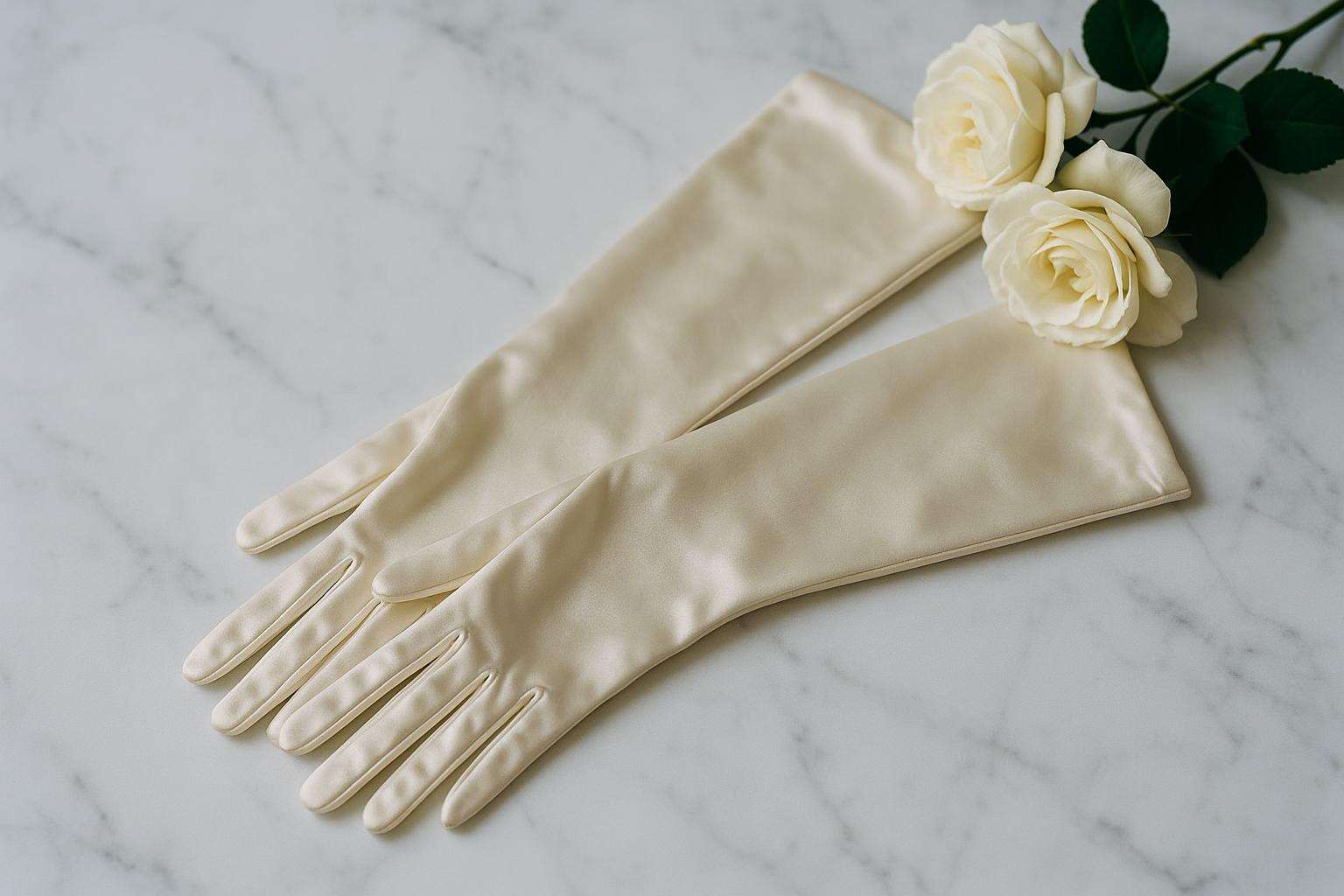
Bridal gloves are experiencing a genuine, data-backed revival in 2026 — driven by Gen Z nostalgia for mid-century glamour and runway endorsement from designers including Berta, Leah Da Gloria, and Zuhair Murad. The key decisions are length (opera vs. wrist), fabric (satin vs. lace vs. tulle), neckline pairing, and ring-exchange protocol. This guide covers all four, with real designers, real price ranges, and practical advice for the altar moment every gloved bride needs to plan in advance.
There is a particular kind of photograph from the 1950s that appears in every vintage bridal magazine archive: a bride in a column gown, elbow-length satin gloves, a pearl necklace, and an expression of composed, unhurried elegance. For several decades, that image was nostalgic. In 2026, it is aspirational again.
According to Bridebook's Gen Z Wedding Index 2026, searches for lace wedding gloves increased 1,319% year-on-year — a number that is not a rounding error but a signal. At New York Bridal Fashion Week Spring 2025, fingerless bridal gloves appeared on the runways of Lee Petra Grebenau and Justin Alexander Signature. Los Angeles boutique Lovella Bridal, whose stylists cover NYBFW each season, reported sheer tulle gloves by Berta, long satin gloves by Zuhair Murad, and lace styles by Leah Da Gloria — confirming that gloves have crossed from niche accent to mainstream bridal category.
This is not a trend that requires explanation. Gloves have always been elegant. What is new is that a generation of brides is giving itself permission to wear them.
What Are the Different Lengths of Bridal Gloves — and Which Is Right for You?
Glove length is measured in button lengths (BL), a unit equal to approximately one inch — a holdover from the era when buttons ran up the inner seam. The number gives you a precise vocabulary for shopping, fitting, and communicating with your bridal stylist.
| Name | Button Length | Approx. Inches | Ends At | Best For |
|---|---|---|---|---|
| Wrist / Shortie | 2BL | ~2 in | Just above the wrist | Daytime, semi-formal, covered necklines, long-sleeve gowns |
| Below-the-Elbow | 8BL | ~8 in | Just below elbow joint | Short-sleeve or strapless; flattering on shorter arms |
| Elbow Length | 12BL | ~18–19 in | At or just over the elbow | Strapless, square neckline, off-the-shoulder; versatile formal |
| Opera Length | 16BL | ~22–23 in | Mid-bicep | Formal evening, strapless, sweetheart — the classic bridal length |
| Ultra-Long | 21BL | ~27–29 in | Near underarm | Strapless dramatic evening; rare at modern weddings |
The opera-length glove (16BL) is what most people picture when they imagine bridal gloves — the silhouette associated with Old Hollywood glamour, Grace Kelly, and formal evening tradition. It pairs most naturally with strapless and sleeveless gowns, where it serves as the visual equivalent of a sleeve. Cornelia James (established 1946 in Sussex, England) and Dents (established 1777 in Wiltshire, England) — two of the oldest English glove makers still active — both confirm that the 16-button is their most frequently ordered bridal length.
The wrist-length (2BL) glove, by contrast, is the most versatile option in the range. It works with almost any neckline, any sleeve configuration, and any formality level. The 2BL style rose to popularity in the 1940s and has never fully disappeared from the bridal market. For brides who want the aesthetic gesture of a glove without the commitment of a dramatic opera length, this is the practical starting point.
A useful rule of thumb from vintage gown authority VintageGown.com: the longer the dress sleeve, the shorter the glove. Full-sleeve gowns call for at most a wrist glove — or no glove at all. The glove is compensating for exposed skin; if the sleeve covers the arm, the glove has no structural job to do.
What Fabrics Are Bridal Gloves Made From — and Which Should You Choose?
Fabric determines the formality, the visual weight, and the compatibility of a glove with any given gown. The current bridal market offers five primary options, each with a distinct aesthetic register.
Satin is the historical default and still the most popular choice for formal bridal gloves. Lightweight, versatile, and available in every shade of white and ivory, satin works with nearly any gown fabric. Dents, whose bridal range includes the bestselling “Bella” satin opera glove in 17 shades and over 100 five-star reviews, notes that satin accounts for the majority of bridal inquiries. A pairing note from Cornelia James: pair silk gloves with satin gowns, and satin gloves with silk gowns — matching the same fabric against itself creates a sheen clash that reads as unintentional.
Lace is the category driving the current revival, spanning Chantilly, guipure, and embroidered mesh. Lace gloves range from wrist to opera length and coordinate naturally with lace-bodice gowns — though the combination works best when the lace patterns differ slightly in scale, to avoid a monotone effect. Cornelia James offers the Anastacia Lace Opera Glove at $202 USD; budget-entry lace wrist styles are available at Anthropologie's BHLDN line around $87.
Sheer tulle is the fastest-growing fabric category in 2026. Tulle gloves — particularly those with pearl embellishment or embroidered florals — photograph well without visually weighing down the arm, which makes them a practical choice for warmer venues and brides concerned about proportion. Olivia Bottega's made-to-order full-length tulle gloves dispatch ready-to-ship styles in one to three days; made-to-order styles ship within five weeks. BHLDN at Anthropologie stocks fingerless ruched tulle options at approximately $87.
Silk and silk charmeuse offer a drape-heavy, luxurious alternative for editorial or couture bridal aesthetics. Carolina Amato — a New York accessory designer from a third-generation Italian textile family with over 30 years of experience — produces the Viviana Silk Gloves (17 inches) and Principessa Silk Gloves (with button detail), both widely stocked at Anthropologie and at boutiques including House of the Bride and Gracyn Elizabeth Bride.
Velvet is the season-specific option, most appropriate for winter weddings. Cream or ivory velvet in wrist-to-elbow lengths photographs strikingly against snow and coordinates with velvet evening wraps. It is not a warm-weather fabric and tends to read as awkward at spring or summer ceremonies.
Which Bridal Glove Length Pairs With Which Neckline?
The structural principle behind neckline pairing is straightforward: glove length should rise as neckline coverage falls. A strapless neckline exposes the maximum amount of skin above the gown; an opera glove fills that visual space. A bateau neckline provides maximum coverage; a wrist glove adds a detail without competing with the clean horizontal line.
| Neckline | Recommended Length | Rationale |
|---|---|---|
| Strapless / Sweetheart | Opera (16BL) | Glove functions as the visual “sleeve”; maximum drama and proportion |
| V-neck | Wrist (2BL) or 8BL | Mirrors the elongating vertical line without competing |
| Square | Elbow (12BL) | Harmonizes with the structured horizontal neckline |
| Off-the-shoulder | Elbow (12BL) or wrist | Accentuates collar and shoulder without duplicating the fabric |
| Bateau / Boat neck | Wrist (2BL) | Preserves the clean horizontal line |
| Halter / High neck | Opera (16BL) | Elongates the arm and adds visual interest below the chin |
These pairings are not rigid rules — they are proportion logic. A bride with a strong sense of personal style may deliberately break the pairing (a long opera glove with a covered neckline, for example, worn as a fashion statement rather than a structural decision) and carry it off beautifully. The table above is the framework for brides who want a starting point, not a ceiling.
How Do You Exchange Rings When You Are Wearing Bridal Gloves?
This is the question every glove-wearing bride eventually arrives at — and the answer has more practical solutions than most people expect.
The mousquetaire method is the original solution. Opera- and elbow-length gloves almost always include a mousquetaire: a small buttoned opening, typically three inches long, at the inner wrist that allows the wearer to slide her hand free while the glove sleeve remains on the arm. Cornelia James explains that the mousquetaire originated in Edwardian dinner etiquette — allowing a lady to remove her hand without removing her glove — and transitions directly into wedding-ceremony use. When shopping for opera or elbow-length gloves, confirm that a mousquetaire is included; budget-tier styles sometimes omit it.
The ring-finger slit is a lesser-known but historically documented alternative. A small slit is cut between the last finger joint and the knuckle on the left ring finger, allowing only that finger to emerge for ring placement. The slit can be sewn closed after the ceremony. European museum collections include period gloves with ring slits sewn by their original owners, confirming that this was a standard practice in formal wedding culture. Lovella Bridal recommends rehearsing whichever ring-exchange method you choose at the wedding rehearsal — the altar is not the place to discover that the maneuver needs more practice.
Full removal and handoff is the cleanest logistics option. Remove both gloves at the altar and hand them to the maid of honor along with the bouquet. The gloves can then be worn again through the receiving line — etiquette holds that ladies do not remove gloves when shaking hands — and removed before being seated for the meal. The Etiquette Sleuth notes that eating and drinking while wearing gloves is universally considered improper, so the pre-dinner removal is the standard protocol regardless of which ring-exchange method was used.
Fingerless gloves are the zero-protocol solution. The ring finger is already exposed, framing the ring rather than concealing it. BHLDN's Fingerless Ruched Tulle Gloves at Anthropologie (approximately $87) are a widely available example. Fingerless styles are also the most practical choice for warmer venues or longer event days where wearing and removing full gloves across multiple parts of the celebration becomes logistically awkward.
One point of formal etiquette is unambiguous: rings should never be worn over gloves. Only bracelets are considered acceptable over a gloved hand. If you arrive at the ceremony already wearing your engagement ring, the ring needs to come off (transferred to the right hand, or removed entirely) before the ring exchange.
Who Are the Real Designers Making Bridal Gloves in 2026?
Cornelia James (Sussex, England; est. 1946) is the most frequently cited heritage bridal glove maker. The atelier handcrafts gloves in a small Sussex workshop and held a Royal Warrant as Glovemaker by Appointment to HM Queen Elizabeth II from 1979 until 2022. Key bridal styles: the Ophelia Satin Opera ($241), the Anastacia Lace Opera ($202), and the India wrist glove with bow. Made-to-measure pairs are available on request at corneliajames.com.
Dents (Wiltshire, England; est. 1777) is one of the longest-continuously-operating glove makers in the world — each pair passes through up to 32 manufacturing steps. The bridal range includes the “Bella” satin opera (17 shades, 100+ five-star reviews), the “Tiana” sheer tulle long glove, and the “Daphne” vintage-inspired satin-button style. Available at us.dentsgloves.com with free UK delivery on orders over £75.
Carolina Amato (New York) brings third-generation Italian textile heritage to a contemporary New York aesthetic. Over 30 years of accessory design. Key bridal pieces: the Viviana Silk Gloves (17 inches, opera-adjacent), the Principessa Silk Gloves with button detail, and a tailored bow wrist-length style in silk charmeuse. Stocked at Anthropologie, House of the Bride, and Gracyn Elizabeth Bride, as well as amatonewyork.com.
Olivia Bottega is an online-first bridal brand offering made-to-order full-length tulle gloves, with ready-to-ship styles dispatching in one to three business days and free worldwide shipping on orders over $550. A practical choice for brides outside major metropolitan areas with limited boutique access.
Safiyaa (London) positions at the luxury end: the Avalla Ivory Gloves ($631) and Astin Embroidered Gloves ($758) are editorial pieces designed for couture bridal aesthetics or destination weddings with a fashion-forward brief.
BHLDN at Anthropologie is the most accessible US point of entry, with embroidered tulle and fingerless ruched styles starting around $87. For brides trying gloves for the first time or working within a tight accessories budget, BHLDN's range offers a low-risk, high-quality starting point that photographs well at every formality level.
On the runway, the names to track are Berta and MUSE by Berta (sheer tulle with floral appliqué and satin ribbon bow tie respectively, both shown at NYBFW Spring 2025), Leah Da Gloria (London, long lace styles), and Zuhair Murad (Beirut/Paris, classic satin opera length). These runway references are the best evidence that bridal gloves have re-entered the mainstream creative conversation — not as a retro novelty, but as a considered accessory with genuine longevity in the current bridal aesthetic.
Considered Counsel
Frequently asked
Are bridal gloves back in style for 2026?
Yes — measurably so. According to Bridebook's Gen Z Wedding Index 2026, lace wedding glove searches increased 1,319% year-on-year. That spike is backed by runway validation: fingerless bridal gloves appeared at New York Bridal Fashion Week Spring 2025 from Lee Petra Grebenau and Justin Alexander Signature, while sheer tulle gloves by Berta, long satin gloves by Zuhair Murad, and lace styles by Leah Da Gloria were all shown in the same season. Los Angeles boutique Lovella Bridal, which covers NYBFW each season, reported that gloves have crossed from niche accessory to mainstream bridal trend. The appetite is driven partly by nostalgia for 1950s-era elegance and partly by high-profile celebrity styling moments that have given brides a clear contemporary reference point.
What length bridal gloves should I wear with a strapless dress?
Opera-length gloves — the 16-button style at approximately 22 to 23 inches, ending at mid-bicep — are the traditional and most proportionate choice for strapless and sweetheart necklines. The reasoning is structural: a strapless gown removes the visual anchors of a sleeve or strap, leaving the arms bare. Opera gloves fill that visual space, functioning as the "sleeve" the gown doesn't have. Heritage makers Cornelia James (Sussex, England, established 1946) and Dents (Wiltshire, England, established 1777) both confirm that the opera glove's natural pairing is with strapless or sleeveless formal gowns. If opera length feels too dramatic, an elbow-length 12-button glove is a proportionate alternative for the same necklines.
What is the difference between opera-length and elbow-length wedding gloves?
The difference is measured in button lengths (BL), a traditional unit equal to approximately one inch. Elbow-length gloves are the 12-button style, running 18 to 19 inches and sitting at or just above the elbow joint. Opera-length gloves are the 16-button style, measuring 22 to 23 inches and ending at mid-bicep. Opera gloves are the longer and more formal of the two. A third step up — the 21-button ultra-long style at 27 to 29 inches — is reserved for the most dramatic strapless looks and is rare at modern weddings. The 16-button opera glove is the standard at formal evening and bridal events and almost always includes a mousquetaire wrist opening, the small buttoned slit that allows the hand to slip out without removing the glove entirely.
How do you exchange rings when wearing bridal gloves?
There are four accepted methods. First: the mousquetaire — a small buttoned wrist opening on opera and elbow-length gloves that lets the wearer slide her hand free while the glove sleeve stays on the arm. Cornelia James explains that this opening originated in Edwardian dinner etiquette and carries directly into ceremony use. Second: a ring-finger slit — a small cut between the last knuckle and finger joint on the left ring finger, allowing only that finger to emerge for ring placement. Third: full removal — both gloves off at the altar, handed to the maid of honor. They can be worn again through the receiving line and removed before the meal. Fourth: fingerless gloves — the simplest protocol, since the ring finger is already exposed. BHLDN's Fingerless Ruched Tulle Gloves at Anthropologie are a widely available option.
What fabric are bridal gloves made from?
The most popular formal fabric is satin, praised for its versatility, lightweight feel, and ability to coordinate with virtually any gown. Dents, operating since 1777, offers its bestselling "Bella" bridal satin style in 17 shades. A refined pairing rule from Cornelia James: wear silk gloves with satin gowns and satin gloves with silk gowns, to avoid a matchy sheen clash. Lace — from Chantilly to guipure — is the fastest-growing category and provides a vintage-romantic aesthetic that coordinates naturally with lace-bodice gowns. Sheer tulle is close behind, particularly embellished styles with pearl or floral embroidery that photograph well. Silk charmeuse offers luxurious drape for editorial looks. Velvet in wrist-to-elbow lengths is the season-specific choice for winter weddings. Each fabric has an appropriate length range and formality level that the guide covers in full.
Can you wear bridal gloves with a V-neck wedding dress?
Yes, with a length calibration. The pairing rule for V-neck gowns is wrist length (2BL) or below-the-elbow (8BL). A V-neckline creates an elongating vertical visual line; a shorter glove mirrors and reinforces that line without competing with it. An opera-length glove on a V-neck can overload the look with two dominant vertical elements and tends to read as imbalanced. Wedding Sparrow's bridal styling guide confirms this neckline-to-length logic: the general principle is that glove length should rise as neckline coverage falls, and the V-neck sits at a middle-coverage point that calls for a moderate, not maximum, glove length. A wrist glove in silk or satin at a V-neck is a clean, proportionate combination that works across formal and semi-formal ceremonies.
Where can I buy bridal gloves in the United States?
BHLDN at Anthropologie is the most accessible US retailer, stocking embroidered tulle styles and fingerless ruched options starting around $87. Carolina Amato's Viviana Silk and Principessa styles are carried by Anthropologie and boutiques including House of the Bride and Gracyn Elizabeth Bride, as well as the brand's own site amatonewyork.com. Olivia Bottega ships worldwide with free shipping on orders over $550 and a 5-week made-to-order window. For heritage English makers, Cornelia James (corneliajames.com) and Dents (us.dentsgloves.com) both ship to the US. For luxury editorial pieces, Safiyaa (safiyaa.com) offers the Avalla Ivory Gloves at $631 and the Astin Embroidered Gloves at $758. Budget-entry tulle and sheer styles are widely available on Amazon and similar marketplaces under $15.