Bridal Accessories
Bridal Headpiece Guide: Tiaras, Combs, Vines & Crowns
Every headpiece silhouette explained — tiara, crown, Juliet cap, floral crown, hair vine, comb, and bandeau — with formality mapping, hairstyle-matching rules, metal and stone coordination, and when to leave the veil off entirely.
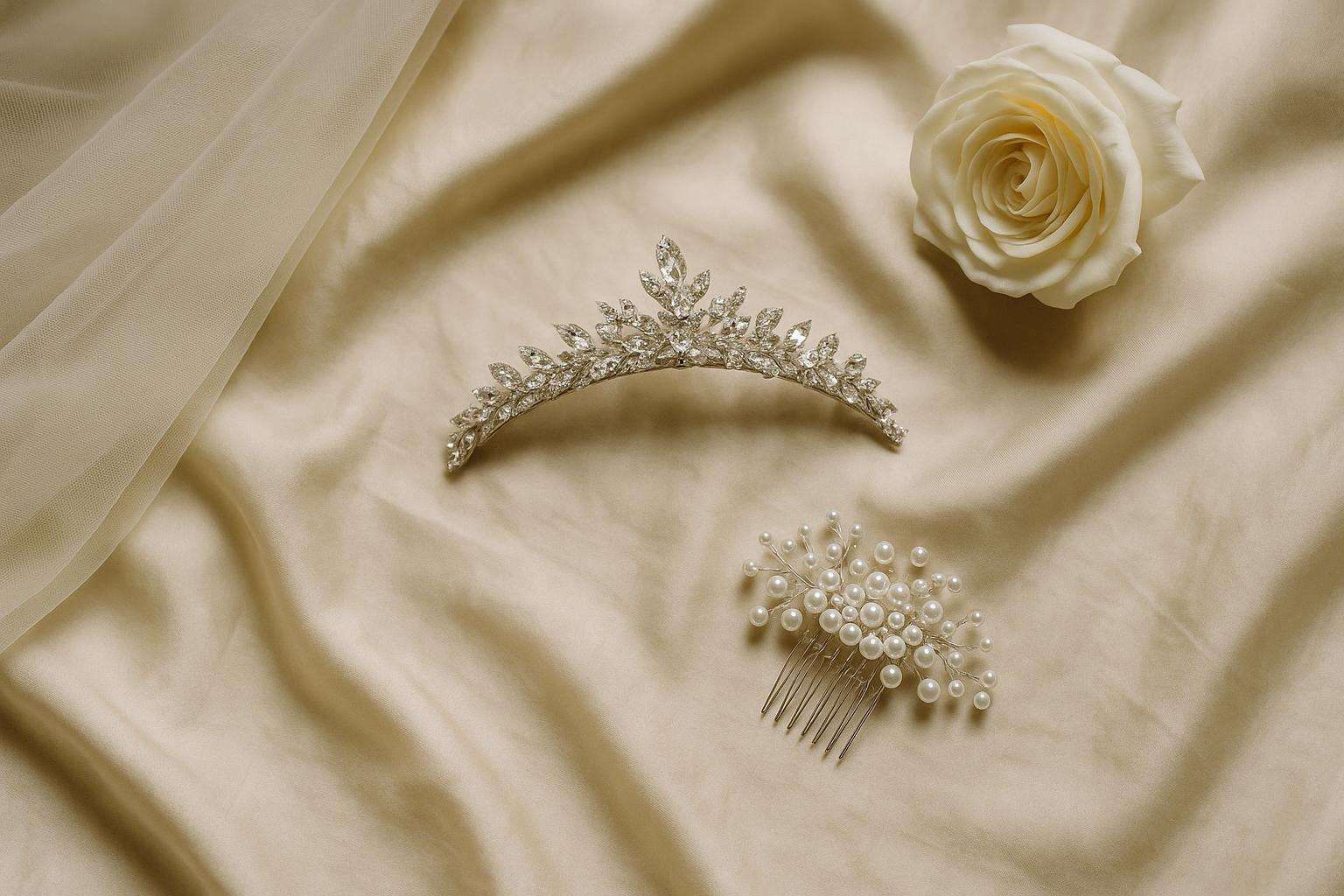
A bridal headpiece is any decorative hair accessory worn above the neck on the wedding day — from a single crystal comb pinned into a chignon to a full jewelled crown circling the head. The right choice is determined by three interlocking decisions: wedding formality, hairstyle structure, and whether the piece accompanies a veil or replaces it entirely.
The headpiece is the last accessory most brides choose and the one that most often trips them up — not because the options are confusing, but because the vocabulary is. Tiaras, crowns, Juliet caps, bandeaus, hair vines, combs, and floral wreaths are not interchangeable terms for the same thing. Each describes a distinct silhouette with its own formality register, hairstyle requirements, and relationship to the veil. Get the language right first, and the choice becomes considerably cleaner.
What Are the Main Bridal Headpiece Styles — and How Do They Differ?
Tiara. A semi-circular band that sits on top of the head with embellishment concentrated toward the front and open at the back. Unlike a crown, it does not wrap fully around the head, making it lighter and easier to wear through a long day. Tiaras span a wide formality range: crystal-and-diamond designs with Swarovski rhinestones suit formal church ceremonies and grand ballrooms; minimalist metalwork or delicate pearl-cluster tiaras translate beautifully to semi-formal settings. Eden Luxe Bridal's styling guide notes that a gown with significant sparkle or intricate lace needs a headpiece that creates cohesion — matching the gown's opulence above the neck rather than competing with it.
Crown. A full-circle headpiece with embellishment wrapping entirely around the head, sitting taller and creating a more regal silhouette than a tiara. Crowns are the recommended choice for white-tie and black-tie receptions, where the formality of the headpiece must match the gown. Eden Luxe Bridal organises their crown inventory into four price tiers — $60–$200, $201–$350, $351–$500, and $500-plus — all handcrafted with Swarovski, Czech, and Austrian crystals, cubic zirconia simulated diamonds, and freshwater or faux pearls.
Juliet Cap. A close-fitting skull cap that frames the crown of the head; the veil attaches from the cap itself rather than a separate comb. The style traces its modern bridal identity to the 1920s–1930s Art Deco era and its contemporary revival to Kate Moss's 2011 wedding, which brought the silhouette back into mainstream consciousness. Britten Weddings, a leading Juliet cap specialist, identifies a 2025–2026 shift toward "Quiet Luxury" iterations in single-layer silk tulle with minimal crystal detailing. The Juliet cap pairs naturally with low-profile hairstyles — soft finger waves, a low chignon, natural curls at the nape — and conflicts proportionally with high topknots or ultra-modern sleek ponytails.
Floral Crown / Wreath. A circular headpiece — full-round or half-crown — composed of flowers, foliage, or botanical elements. Fresh-flower crowns coordinate with the bridal bouquet but risk wilting in warm outdoor conditions. Silk and preserved or dried flower crowns are more durable; artisan retailer Magaela notes that preserved botanical crowns can retain their form for up to 10–15 years when stored in a dark, dry environment. The floral crown is the defining headpiece for bohemian, garden, and outdoor ceremony aesthetics. Key 2025–2026 trend directions include oversized full-head halos in vivid blooms, minimalist greenery-only bands in eucalyptus or olive leaf, and metallic-and-dried-flower hybrid crowns.
Hair Comb. A toothed base into which decorative elements — crystals, porcelain flowers, pearls, fine metalwork — are wired or set. Combs are the most versatile headpiece because they anchor at the side, back, or top of any hairstyle, and can double as the veil attachment point when placed at the nape. Eden Luxe Bridal's WHITNEY comb (handwired Austrian crystals, 6 inches by 2 inches) works equally as a chignon accent, side-of-head focal point, or Old Hollywood side-swept wave detail. The ADDISON Comb Set — two combs with handmade porcelain blossoms, bejewelled leaves, and delica beading — exemplifies the current trend toward botanical, textural designs.
Bandeau / Headband. A decorative band sitting across the forehead or crown of the head, running temple to temple or entirely around. Styles range from pearl-encrusted satin bands and Art Deco crystal arrangements to polished satin-covered elastic. Jennifer Behr — a New York luxury hair accessories atelier founded in 2005, trained in sculpture and art history — is best known for her signature coronet headbands, using complex handmade wiring techniques to set crystals and pearls into curved band forms. The Adorned Bridal Collection is priced from approximately $150 to $900 and stocked at Neiman Marcus and specialist boutiques. For 2025–2026, the bandeau is trending toward pearl formats and polished minimal gold bands, aligned with the broader "quiet luxury" direction across bridal fashion.
Hair Vine. A long, flexible wire strand set with crystals, freshwater pearls, or enamel florals, woven into braids, coiled as a halo, or pinned across a loose chignon. Kleinfeld Bridal identifies hair vines as one of the most popular bridal accessories in recent seasons, specifically for their ability to adapt to virtually any hairstyle — the same piece works threaded through a braid, scattered across a chignon, or traced along the hairline for half-up styles.
How Do I Match a Bridal Headpiece to Wedding Formality and Hairstyle?
Formality is the first filter. Before thinking about aesthetics, locate your wedding on the formality spectrum below — every recommendation flows from that starting point.
| Wedding Style | Best Headpiece(s) | Avoid |
|---|---|---|
| White Tie / Black Tie | Full jewelled crown, crystal tiara, embellished coronet headband | Casual floral crowns, simple satin headbands |
| Formal Church / Ballroom | Pearl crown, elaborate tiara, structured bandeau | Wildflower wreaths, boho hair vines |
| Semi-Formal / Hotel | Delicate tiara, pearl comb, Jennifer Behr coronet | Full crowns (can overpower mid-scale settings) |
| Garden / Romantic Outdoor | Floral crown, fresh or preserved botanical wreath, hair vine | Heavy crystal crowns |
| Bohemian / Rustic | Juliet cap, wildflower crown, hair vine, dried-flower hybrid | Formal crystal tiaras |
| Courthouse / Intimate | Hair comb, simple pearl headband, delicate clips | Full crowns or elaborate tiaras |
Hairstyle is the second filter. Structured updos and chignons give a headpiece both support and framing, opening up the widest range of options — tiaras, combs, hair vines, and even full crowns all land well when the hair is pinned and stable. A comb placed at the nape doubles as a veil attachment point, making it the most efficient choice for brides wearing a veil. Half-up, half-down styles are the most flexible: tiaras, floral crowns, combs, and hair vines are all compatible, with the aesthetic of the wedding determining which reads best. Loose waves or hair fully down suit Juliet caps, floral crowns, pearl headbands, and delicate coronets; heavy crowns tend to overpower unstructured hair and are best avoided.
Kleinfeld Bridal's stylists offer a useful face-shape framework: headpieces with height — tall tiaras or elevated crowns — elongate round faces; delicate headbands or low-set combs soften square faces; halo hair vines draw focus to the eyes for heart-shaped faces; oval faces suit every silhouette and require no adjustment. The balance rule applies universally: when wearing statement earrings, choose a simpler headpiece (an elegant comb, a minimal pearl band); when wearing minimal jewellery, a crown or embellished tiara fills the visual register above the neck.
How Do Metal Tone and Stone Choice Coordinate with the Gown?
Metal tone should mirror the dominant metal in the rest of your jewellery — engagement ring, wedding band, earrings. A rose-gold engagement ring calls for a rose-gold headpiece or one with warm pearl and ivory stone settings; white gold or platinum rings pair most naturally with silver-toned pieces set in rhodium-plated metal. Yellow gold, which has returned strongly in bridal jewellery for 2025–2026, pairs beautifully with ivory, champagne, or blush gowns and can introduce warmth into an otherwise cool-toned look.
Stone choice maps to gown decoration. Crystal-heavy gowns — significant Swarovski or rhinestone beadwork — call for a headpiece that continues the crystal language rather than introducing a conflicting texture. Pearl gowns and those with pearl appliqué suit pearl-set headpieces; lace gowns with minimal beading suit either delicate crystal pieces or botanical and enamel designs. Eden Luxe Bridal organises their entire headpiece inventory by metal tone (silver, gold, rose gold) precisely to make this matching step efficient.
The one reliable shorthand: match the weight of the gown's embellishment, not its exact components. A heavily beaded ballgown needs a headpiece that reads at the same register — a delicate single-comb would disappear. A minimalist crepe column gown needs a headpiece with restraint — a full Swarovski crown would overpower it.
When Does a Bridal Headpiece Replace the Veil Entirely?
The veil is tradition, not a requirement. A headpiece worn alone is a complete and entirely modern choice, and there are three situations where it is the better one.
The first is ceremony aesthetic. Bohemian, garden, and intimate weddings rarely call for a cathedral or chapel-length veil — a floral crown or hair vine reads as the intentional, finished look rather than an omission. The second is gown complexity. When the dress is heavily embellished — significant beadwork, intricate lace, or sculptural structure — a veil adds visual noise. An elegant comb or pearl bandeau provides the moment above the neck without competing. The third is reception practicality. Many brides who wear a veil for the ceremony remove it at cocktail hour and move through the reception with only their headpiece. Choosing a headpiece designed to stand alone from the beginning removes this logistics question entirely.
The hybrid solution is the Juliet cap: the cap functions as the identity piece while a veil (blusher-length, elbow-length, or fingertip) attaches directly from it, giving both the processional moment and the artistic statement in one construction. Britten Weddings notes that Juliet cap veils are increasingly ordered with the veil detachable — attached for the ceremony, removed for dancing.
Which Bridal Headpiece Designers Are Worth the Investment?
Jennifer Behr (jenniferbehr.com) is the most consistently cited name in the US designer headpiece market. Founded in New York in 2005 by a designer trained in sculpture and art history, the atelier is best known for its Adorned Bridal Collection and signature coronet headbands, using complex handmade wiring techniques to set crystals and pearls into curved band forms. Priced $150–$900; stocked at Neiman Marcus, Over The Moon, and Brides by Lola Dre.
Eden Luxe Bridal (edenluxebridal.com) offers couture-quality bridal adornments — tiaras, crowns, combs, and veils — organised by metal tone and price tier from $60 to $500-plus. All pieces are made to order and handcrafted with Swarovski, Czech, and Austrian crystals; allow approximately 3–5 weeks for delivery. The WHITNEY and ADDISON combs are standout pieces for brides seeking botanical or crystal comb designs.
Jane Taylor London (janetaylorlondon.com) is a Knightsbridge couture millinery atelier established in 2004, specialising in formal and fashion-forward bridal headpieces including the Bia Halo (double-wool crepe with pearls and flowing veil), the Electra Halo, and the signature Halo Pillbox. Best suited to formal weddings and brides who want a headpiece that functions as a piece of couture craft.
Tania Maras (taniamaras.com) is an Australian designer handcrafting bridal headpieces and veils in Canberra since 2009, offering a bespoke customisation service with worldwide delivery and virtual appointments for international brides.
Dareth Colburn (darethcolburn.com) is a direct-to-consumer retailer offering nature-inspired tiaras and crowns — including the Juliet Floral Bridal Tiara in silver, gold, and rose gold — at accessible mid-range price points, making it an excellent starting point for brides building a broader accessories budget.
For brides shopping at major retailers: Kleinfeld Bridal carries 25-plus jewellery, headpiece, shoe, and veil designers with in-house stylist guidance on headpiece selection; BHLDN (Anthropologie Weddings) offers a well-curated mid-range headpiece range that coordinates with its gown collection; and David's Bridal provides accessible entry-level tiaras, combs, and bandeaus for brides prioritising budget flexibility.
Considered Counsel
Frequently asked
What is the difference between a bridal tiara and a crown?
The key difference is geometry. A tiara is semi-circular — it arcs across the top and front of the head with embellishment concentrated at the front and open at the back, making it lighter and less imposing. A crown is a full-circle headpiece that wraps entirely around the head, sitting taller and creating a more regal, formal silhouette. In practical terms, tiaras are the more versatile choice: they work across formal, semi-formal, and even garden weddings depending on the design. Crowns are best reserved for white-tie and black-tie receptions where the formality register genuinely warrants them. Eden Luxe Bridal organises their crown and tiara inventory by price tier ($60 to $500-plus), with both styles crafted in Swarovski, Czech, and Austrian crystals, cubic zirconia, and freshwater or faux pearls.
What bridal headpiece works best with an updo or chignon?
An updo or chignon is the hairstyle that gives a headpiece the most support and framing, so it opens up the most options. Tiaras and combs are the classic choices — a comb placed at the nape of a chignon anchors the style and can double as a veil attachment point. Elaborate updos benefit from dramatic headpieces because the structured hair provides both height and visual grounding. The balance rule from Kleinfeld Bridal's stylists applies here: when wearing statement earrings, choose a simpler headpiece such as an elegant comb or a delicate bandeau; when wearing minimal jewellery, a crown or embellished tiara fills the visual register above the neck. Hair vines are also excellent for updos — they can be threaded through braids or pinned across a chignon for a scattered-crystal effect without the full weight of a crown.
What is a hair vine and how is it worn at a wedding?
A hair vine is a long, flexible wire strand set with decorative elements — crystals, freshwater pearls, enamel florals, or a combination — that does not clip or comb into a fixed position but is instead woven, coiled, or pinned to work with virtually any hairstyle. For a braided updo, the vine threads between the plaits; for a loose chignon, it coils around the bun or fans across it; for a half-up style, it traces the hairline. For loose waves or hair-down styles, it can be pinned as a single accent or wound as a soft halo. Kleinfeld Bridal identifies hair vines as among the most popular bridal accessories in recent seasons precisely because of this adaptability — one piece works across half a dozen different hairstyle choices and requires no specific hair density or length to succeed.
Is a Juliet cap veil right for a bohemian or vintage wedding?
Yes — the Juliet cap is the defining headpiece for brides drawn to 1920s and 1930s Art Deco aesthetics, as well as those planning bohemian or intimate ceremonies. The style is a close-fitting skull cap from which the veil (when worn) attaches directly, rather than being inserted separately via a comb. Its modern revival is widely credited to Kate Moss's 2011 wedding, which brought the look back into mainstream bridal consciousness. Britten Weddings, one of the UK's leading Juliet cap specialists, notes a 2025–2026 trend toward 'Quiet Luxury' iterations featuring single-layer silk tulle with minimal crystal detailing. Style-wise, the Juliet cap pairs naturally with low-profile hairstyles — soft finger waves, a low chignon, natural curls at the nape — and is stylistically incompatible with high topknots or ultra-modern sleek ponytails, which create proportion conflicts with the cap's close silhouette.
How do I match a bridal headpiece to my hairstyle and face shape?
The best starting framework is to match the headpiece's visual weight to the structure of your hairstyle. Highly structured updos and chignons can carry heavier pieces — full crowns, elaborate tiaras, layered pearl combs. Loose waves and hair-down styles are overwhelmed by heavy crowns and work best with Juliet caps, floral wreaths, pearl headbands, or delicate coronets. Half-up styles are the most flexible: tiaras, combs, floral crowns, and hair vines all land well depending on the aesthetic. For face shapes, Kleinfeld Bridal's stylists offer this guidance: choose headpieces with height (tall tiaras, elevated crowns) for round faces to elongate; delicate headbands or low-set combs for square faces to soften angles; halo hair vines for heart-shaped faces to draw attention to the eyes; and any silhouette at all for oval faces, which suit every style.
When should a bridal headpiece replace the veil entirely?
A headpiece replaces the veil most naturally in three situations: when the wedding is bohemian, garden, or informal (a floral crown or hair vine is a complete look in itself); when the gown is highly embellished and a veil would add visual clutter (a single elegant comb or pearl bandeau balances without competing); and when the bride simply prefers the freedom of not managing a veil through a reception. The Juliet cap veil is the hybrid solution — the cap itself functions as a headpiece while the veil attaches directly from it. For brides who want some of the veil's romance without its full length, a blusher-only or elbow-length veil paired with a statement headpiece lets the headpiece do the identity work while the veil provides the processional moment. The honest truth is that a veil is tradition, not a rule — any cohesive headpiece worn with intention is complete.
How much does a bridal headpiece cost in 2025–2026?
The range is wide. At the budget end, mass-market hair combs start under $30 and simple tiaras under $60 at retailers including Amazon, Walmart, and David's Bridal. The mid-range — where the vast majority of brides shop — runs $50 to $350 for combs and tiaras, $40 to $200 for bandeaus and headbands. Eden Luxe Bridal's handcrafted Swarovski and Austrian crystal pieces span $60 to $500-plus; Dareth Colburn's nature-inspired tiaras sit at accessible mid-range price points. At the designer level, Jennifer Behr's Adorned Bridal Collection is priced from approximately $150 to $900, stocked at Neiman Marcus and specialist boutiques. Fully bespoke couture headpieces from Jane Taylor London (Knightsbridge) or Tania Maras (Canberra, with worldwide delivery) are priced on inquiry; bespoke pieces from either atelier typically represent a significant but purposeful investment for a bride who wants something entirely her own.