Bridal Accessories
Bridal Jewelry: How to Choose Earrings, Necklace & Bracelet
The three-decision system every bride needs — neckline-to-piece pairing, metal selection, and budget tier — with real brand anchors and the V-neck, strapless, and off-the-shoulder rules.
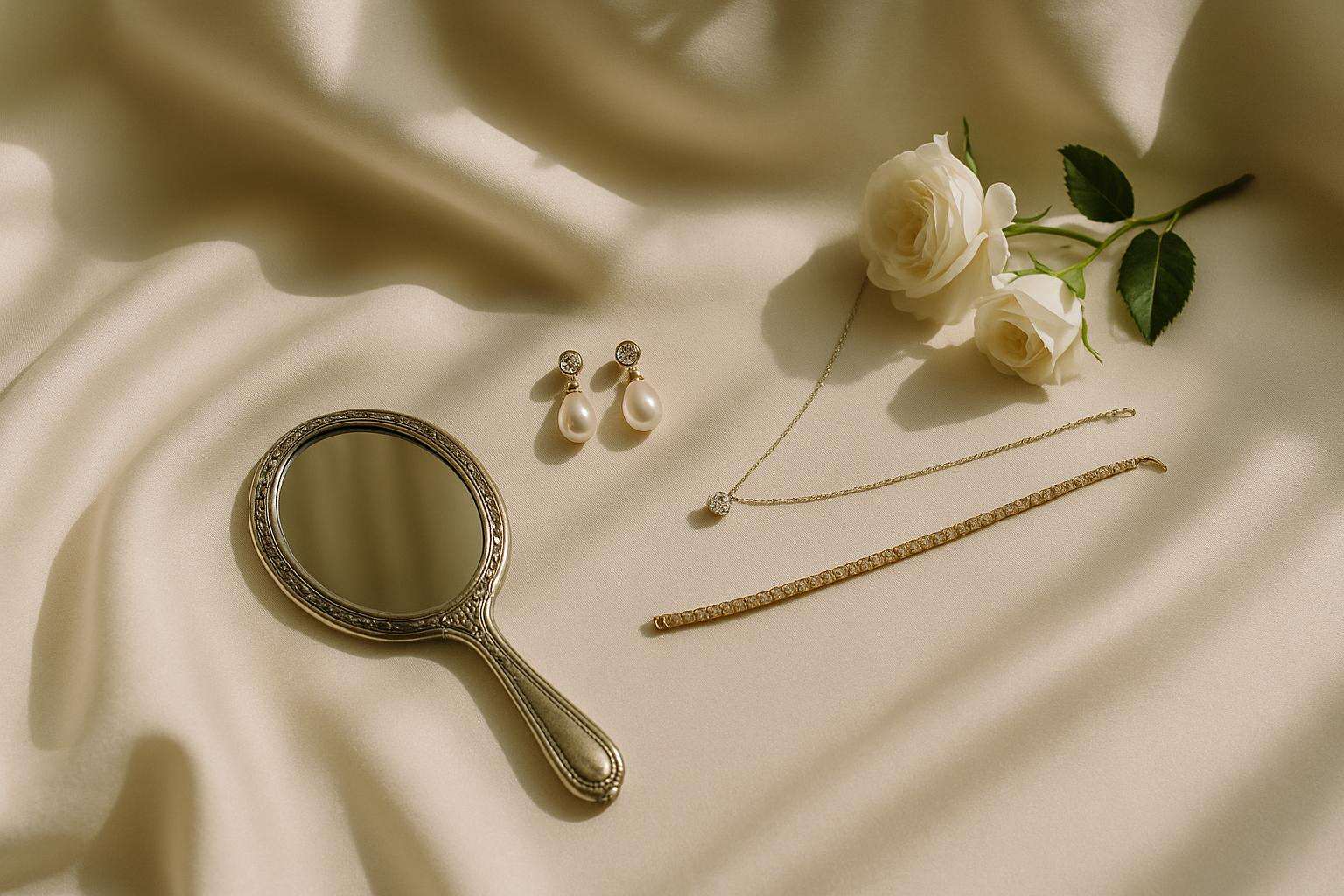
Bridal jewelry comes down to three decisions made in sequence: which pieces your neckline calls for, which metal suits your skin tone and gown colour, and which brands and budget tier will deliver on the look you want. Get the neckline pairing right first — it eliminates half the options and makes the remaining choices obvious.
The moment a bride selects her gown, the architecture of her jewelry is already partially decided. The neckline geometry — where it rises, where it plunges, how much of the collarbone and shoulder it exposes — is the strongest single guide to earring style, necklace length, and whether a necklace belongs in the look at all. Working against the neckline rarely produces the result a bride is hoping for in photographs. Working with it rarely fails. What follows is a practical guide through all three decisions, grounded in real guidance from bridal boutiques and retailers including Tania Maras, La Mariée Boutique, David's Bridal, Brilliant Earth, and Gabriel & Co.
What Jewelry Goes with Each Wedding Dress Neckline?
Strapless and Sweetheart: These necklines offer the most open canvas across the collarbone. A princess-length necklace (17–19 inches) sits naturally in the open space above the bustline; a choker at the clavicle works equally well and reads more modern. Chandelier drop earrings reinforce the elongating vertical line that both neckline shapes invite. For sweetheart specifically, a pendant whose drop mirrors the downward curve of the bodice creates visual harmony that photographs exceptionally well. The strapless silhouette is also the one neckline where a statement necklace can coexist with statement earrings — provided both are in the same metal family.
V-Neck: The consensus from Brilliant Earth's published buying guide and David's Bridal's jewelry-neckline resource is the same: a lariat or Y-drop necklace that follows the plunge line is the correct pairing. The necklace should sit inside the V, not below it — length is critical. Pair this with medium drop earrings or pavé hoop styles rather than chandeliers, which introduce a competing downward line. Skip a necklace if the V is very deep or the bodice is heavily beaded; in that case, statement earrings and a bracelet carry the jewelry interest without visual clutter.
Off-the-Shoulder and One-Shoulder: These necklines make a statement before a single piece of jewelry is added. Bridal accessory designers Tania Maras and La Mariée Boutique give the same directive: skip the necklace and let drop or chandelier earrings do the work. The wide exposure of neck, collarbone, and shoulder provides genuine real estate for earrings that might otherwise be overshadowed. An alternative accent point for brides who want more: a back-drop necklace resting against an open-back gown, invisible from the front and striking in portraits.
Square Neckline: The flat horizontal line is inherently geometric. Gabriel & Co.'s editorial recommends a delicate chain pendant or a thin diamond bar necklace — something that complements the structured shape without mimicking it. Artisan or textured stud earrings in gold pair well here; chandelier drops compete with the horizontal emphasis of the neckline.
Halter, High Neck, and Illusion: These necklines are typically structured or heavily detailed, leaving no visual space for a necklace. The standard recommendation is elegant studs or a single drop earring, with a statement bracelet absorbing the accessory budget otherwise spent on a necklace. A back-drop or body-chain-style necklace can work for illusion or keyhole-back styles.
Bateau (Boat Neck): The wide horizontal line pairs naturally with slim dangling earrings or earrings with a slight drop. A choker or princess-length necklace works because the wide shoulder exposure provides the real estate for a statement piece without competing with a plunge. Avoid very long pendant necklaces, which land awkwardly on the high neckline.
Should Bridal Jewelry Be White Gold, Platinum, Yellow Gold, or Rose Gold?
The four dominant metals in bridal jewelry differ in composition, maintenance requirements, price, and visual effect on skin tone. The choice is not simply aesthetic — it has practical consequences a bride will live with on and beyond the wedding day.
White Gold is gold alloyed with palladium or other white metals, then rhodium-plated to achieve its bright silver-white appearance. The plating wears with regular wear and typically needs re-application every one to three years. Comparable 14k white gold settings run approximately 40–50% less than equivalent platinum pieces, making it the most accessible entry point into the white-metal look. It is the dominant choice at mid-range retailers including Gabriel & Co. and Brilliant Earth's lower tiers.
Platinum contains 90–95% pure platinum and is naturally white — no rhodium plating required, and it will not yellow over decades of wear. It is hypoallergenic, which matters for brides with nickel sensitivity (nickel sometimes appears in white gold alloys). Its density gives pieces a perceptibly heavier feel that many wearers associate with luxury quality. Platinum develops a fine patina over time that most owners prefer to regular polishing. For brides buying fine jewelry intended to become heirloom pieces, platinum's durability and low maintenance justify the price premium. Van Adams Jewelers notes that mixed-metal bridal sets — yellow gold engagement ring paired with a platinum or white gold wedding band — are one of the strongest trends entering 2026.
Yellow Gold (14k or 18k) is warmer, more traditional, and the least maintenance-intensive of the four: no plating, no patina management. It pairs most naturally with warm or olive skin tones and with gown colours in the ivory, champagne, or blush family. Kendra Scott's bridal fine collection executes yellow gold particularly well across earrings, bracelets, and necklaces, with the Michelle 14k Yellow Gold Drop Earrings in White Pearl at $500 as a representative example.
Rose Gold gets its blush tone from a higher copper content in the alloy. Carbon Diamonds and Van Adams Jewelers both note that copper makes rose gold slightly harder and more durable than yellow or white gold at equivalent karat weights — a practical consideration for pieces worn frequently after the wedding. An 18k rose gold piece has less copper than 14k, producing a softer, more delicate pink; 14k reads distinctly blush. Rose gold is widely cited as the most universally flattering metal across diverse skin tones. Kendra Scott's Davis 18k Gold Vermeil Cuff Bracelet in White Diamond ($275) is a strong mid-range option in this family.
Bridal Jewelry Neckline and Metal Pairing Guide
| Neckline | Recommended Necklace | Recommended Earrings | Skip | Metal Notes |
|---|---|---|---|---|
| Strapless / Sweetheart | Princess-length (17–19 in.) or choker; pendant that echoes bodice curve | Chandelier drops or pavé hoops | Nothing is off-limits here | Any metal; statement sets work well |
| V-Neck | Lariat or Y-drop, sitting inside the V | Medium drops or pavé hoops | Chandeliers (compete with plunge) | White gold or platinum; fine gold lariat |
| Off-the-Shoulder / One-Shoulder | Skip necklace; consider back-drop for open back | Statement chandelier or long drops | Front necklace; competing statement pieces | Any; chandelier earrings are the focal point |
| Square Neck | Delicate pendant or thin diamond bar | Textured studs or short drops | Chandelier drops | Yellow or white gold; geometric settings |
| Halter / High / Illusion | Skip necklace (or back-drop / body chain) | Elegant studs or single drop | Front necklaces | Statement bracelet absorbs accessory budget |
| Bateau (Boat Neck) | Choker or princess-length | Slim dangles or short drops | Long pendants (clash with high neckline) | Any; pearls read particularly well here |
Which Bridal Jewelry Brands Deliver at Each Budget Tier?
Under $150 — Accessible: David's Bridal anchors the budget end with rhinestone stretch bracelets, freshwater pearl necklace and bracelet sets, and crystal drop earrings primarily in the $25–$98 range. Their jewelry-neckline pairing guide is among the most widely cited editorial resources in the category. Etsy bridal shops, identified by Budget Savvy Bride as the single most product-rich source for brides at this level, offer pearl and crystal pieces, dainty gold-fill necklaces, and custom initial pendants that are simply not available at chain retailers. GLDN and similar independent fine-gold labels cover delicate everyday-wear styles that work equally well for bridal.
$150–$500 — Mid-Range: Kendra Scott Bridal (kendrascott.com) occupies this tier with a dual-track collection: fashion-forward styles from roughly $50 and fine gold pieces up to $500+. Their in-store Color Bar® experience lets brides select custom gemstones for earrings and necklaces — a genuine differentiator for brides styling coordinated bridesmaid sets. BHLDN (Anthropologie Weddings) carries pearl studs, drop earrings, lariat necklaces, and crystal-accented bracelet sets across a similar price band. Gabriel & Co.'s sterling silver fashion line with conflict-free diamonds is also attainable here for brides who want a fine-jewelry name at a mid-range entry point.
$500–$2,500 — Elevated Fine Jewelry: Brilliant Earth's dedicated wedding jewelry line includes diamond tennis necklaces, hoop earrings, and pavé bangles, with lab-grown diamond options available at meaningful savings versus mined equivalents — a relevant consideration given The Knot's finding that 52% of couples in recent years opted for lab-grown center stones. Their TACORI capsule bridal collection, launched in 2023, targets brides seeking a single cohesive suite. Gabriel & Co.'s full gold and diamond bridal line — including the Bujukan Collection's handcrafted gold-sphere bracelet — sits solidly in this tier. Vera Wang's LOVE Collection at Zales offers accessible designer-name diamond earrings and necklaces in 10k white gold.
$2,500+ — Luxury: Mikimoto (mikimotoamerica.com) is the benchmark for cultured pearl jewelry in the bridal category. Founded after Kokichi Mikimoto perfected the pearl-culturing process in 1893, the brand grades every pearl before use and accepts only the top tier of harvested Akoya and South Sea pearls. Entry-level bridal pieces begin at approximately $590 for stud earrings; an Akoya Cultured Pearl Strand Necklace (16 inches, 18k white gold clasp) starts at $4,500; South Sea Pearl and Sapphire Bracelet pieces begin at $13,000. Vera Wang VOW, launched in March 2025 as an exclusive partnership with Jared Jewelers, features 38 ring styles in 14k gold from $900 to $8,800. For brides who want a complete luxury jewelry suite — earrings, necklace, and bracelet in matched Akoya pearls — a Mikimoto set represents the most coherent single-source option in the category.
How Do You Build a Cohesive Bridal Jewelry Set Without Overspending?
The practical approach used by bridal stylists at boutiques including Tania Maras is to identify the one piece that will register most clearly in photographs — almost always the earrings, because they frame the face — and invest the majority of the jewelry budget there. The necklace, if worn, should support the earrings without competing; the bracelet is a finishing detail that the camera rarely isolates unless the bride intends a ring-shot with wrist-in-frame.
Three rules worth following as you assemble the set: First, stay in one metal family. A yellow gold ear cuff paired with a white gold tennis bracelet creates low-grade visual noise that photographs as inconsistency. Mixed metals can be intentional and beautiful — Van Adams Jewelers cites it as a 2026 trend — but it should be a decision, not an accident. If you haven't settled on a metal yet, matching your gold tone to your ring is the place to start. Second, let the gown's detail level set the ceiling for jewelry complexity. A heavily beaded or lace-appliquéd gown at the level of a Vera Wang or Pronovias design needs quieter jewelry; a clean crepe column or simple satin sheath can absorb considerably more. Third, if you plan to re-wear pieces after the wedding — which makes financial sense for fine jewelry above $500 — prioritise designs that read outside a bridal context. A Brilliant Earth pavé bangle or a Gabriel & Co. diamond pendant will earn their cost across years of wear; a highly elaborate crystal chandelier earring that reads unmistakably bridal will not.
For neckline pairing guidance sourced directly from a bridal retailer, David's Bridal's jewelry-neckline guide is the most practically organised free resource in the category. For metal comparison from a jeweler's perspective, Van Adams Jewelers' white gold vs. yellow gold vs. platinum comparison addresses every axis a bride needs to evaluate. Start with the neckline, choose the metal, set the budget — the pieces fall into place from there.
Considered Counsel
Frequently asked
What jewelry goes with a V-neck wedding dress?
A V-neck calls for a lariat or Y-drop necklace that follows the plunge visually, sitting inside the V rather than below it — this is the consensus from Brilliant Earth's published buying guide and David's Bridal's neckline resource. The necklace drop length matters: too short and it sits awkwardly above the V; too long and it disappears into the bodice. Pair the necklace with medium drop earrings or pavé hoop styles rather than chandeliers, which visually compete with the neckline's downward geometry. In white metal, a fine diamond Y-necklace from Gabriel & Co. or Brilliant Earth in 14k white gold is a reliable choice; in yellow gold, a simple lariat from Kendra Scott's bridal fine collection works well. Skip statement earrings when the necklace is already doing significant visual work.
What earrings work with an off-the-shoulder wedding dress?
Off-the-shoulder and one-shoulder necklines make a strong statement on their own, so the standard advice from bridal boutiques including Tania Maras and La Mariée Boutique is to forgo the necklace entirely and let drop or chandelier earrings do the work. The wide exposure of neck and collarbone provides generous visual real estate for earrings that would be overwhelmed by a competing necklace. Styles to consider: Kendra Scott's Michelle 14k Yellow Gold Drop Earrings in White Pearl ($500), crystal chandelier drops from BHLDN's mid-range collection ($80–$150), and elongated diamond drop earrings from Gabriel & Co.'s bridal-specific line. If you want to anchor your wrist, a diamond tennis bracelet or pearl cuff absorbs the remaining accessory interest without cluttering the neckline.
Should bridal jewelry be yellow gold or white gold?
The choice hinges on three variables: skin tone, gown colour, and engagement ring metal. Yellow gold reads warm and traditional, pairing naturally with warm or olive skin tones and with gown colours in the ivory, champagne, and blush family — colours that carry a warm undertone. White gold produces a bright silver-white appearance from rhodium plating over a gold alloy and pairs well with bright white and cool-toned gowns as well as neutral or cool skin tones. If your engagement ring is yellow gold, matching the bridal jewelry in yellow gold is the cleaner choice; mixed-metal bridal sets — yellow gold engagement ring with white gold or platinum band — are cited by Van Adams Jewelers as one of the strongest styling trends entering 2026. Neither is inherently more formal; both are widely available across every major bridal retailer.
What is the difference between platinum and white gold for bridal jewelry?
The core difference is composition and maintenance. White gold is gold alloyed with palladium or other white metals, then rhodium-plated to produce its silver-white colour; that plating wears with time and typically needs re-application every one to three years. Comparable 14k white gold settings run approximately 40–50% less than equivalent platinum pieces, making it the most accessible white-metal option. Platinum, by contrast, contains 90–95% pure platinum and is naturally white — it requires no plating and does not yellow over time. It is hypoallergenic (relevant for brides with nickel sensitivity, as nickel sometimes appears in white gold alloys), and its density makes a piece feel heavier, which many wearers experience as a quality indicator. Platinum develops a fine patina of micro-scratches over years of wear; many people prefer this lived-in look, while others return pieces for polish. For bridal jewelry worn primarily on the wedding day, the cost difference typically makes 14k white gold the more pragmatic choice.
How much should you spend on bridal jewelry?
Budget Savvy Bride identifies a practical accessible tier under $150, where David's Bridal and Etsy bridal shops offer pearl and crystal pieces, rhinestone drop earrings, and dainty gold-fill necklaces. The mid-range tier from $150 to $500 includes Kendra Scott Bridal, BHLDN, and Gabriel & Co.'s sterling silver fashion line, with diamond studs in 14k gold and freshwater pearl chokers attainable here. The elevated fine jewelry tier from $500 to $2,500 covers Kendra Scott's fine collection, Vera Wang LOVE at Zales, Brilliant Earth's lab-diamond earrings and tennis necklaces, and Gabriel & Co.'s full gold and diamond bridal line. The luxury tier begins above $2,500 and encompasses Mikimoto Akoya pearl strand necklaces (from $4,500), Vera Wang VOW pieces at Jared Jewelers (from $900 for rings, to $8,800), and bespoke high-jewelry suites. The common guidance from bridal stylists is to set the jewelry budget after selecting the gown, because the dress's detail level determines how much accessory weight the look can absorb.
Are pearl earrings appropriate for a modern wedding?
Pearl earrings remain among the most consistently recommended choices for bridal wear and are by no means limited to traditional or conservative aesthetics. Their relevance in 2026 bridal styling is supported by BHLDN listing pearl jewelry as a featured category, Kendra Scott offering pearl bridal earrings in both fashion and fine gold ($275–$500), and Mikimoto's dedicated bridal pearl suite positioning at the luxury tier. The key distinction is pearl type and setting: small, simple pearl studs read classic and quiet; large baroque pearl drops or asymmetric pearl-and-diamond ear climbers read thoroughly modern. For minimalist gowns in crepe or chiffon, a single-strand Akoya pearl drop earring in 18k white gold is one of the most versatile choices a bride can make — it photographs beautifully in all lighting and scales up or down depending on gown detail level.
What bridal jewelry brands offer complete earring, necklace, and bracelet sets?
Several brands offer curated suites that make cohesive set-building straightforward. Kendra Scott Bridal (kendrascott.com) covers earrings, necklaces, bracelets, and rings across both fashion and fine gold tiers, with its in-store Color Bar® customisation available for brides who want matched bridesmaid sets. Gabriel & Co. (gabrielny.com) offers bridal-specific earrings, pendant necklaces, and bracelets — including the Bujukan Collection's signature gold-sphere bracelet — all conflict-free GIA-verified diamonds. Brilliant Earth (brilliantearth.com) built a capsule collection with TACORI specifically for bridal jewelry, covering diamond tennis necklaces, hoop earrings, and pavé bangles. BHLDN carries coordinated pearl and crystal sets at a mid-range price point. At the luxury end, Mikimoto's Akoya pearl suite — earrings, strand necklace, and bracelet — is the benchmark for brides wanting a single coherent pearl look across all three pieces.