Bridal Accessories
Bridal Veil Guide: Lengths, Styles & How to Choose
From the face-framing birdcage to the cathedral sweep that fills an entire aisle, every bridal veil carries its own grammar — a length, a fabric, an edge finish, and a silhouette it was made to follow.
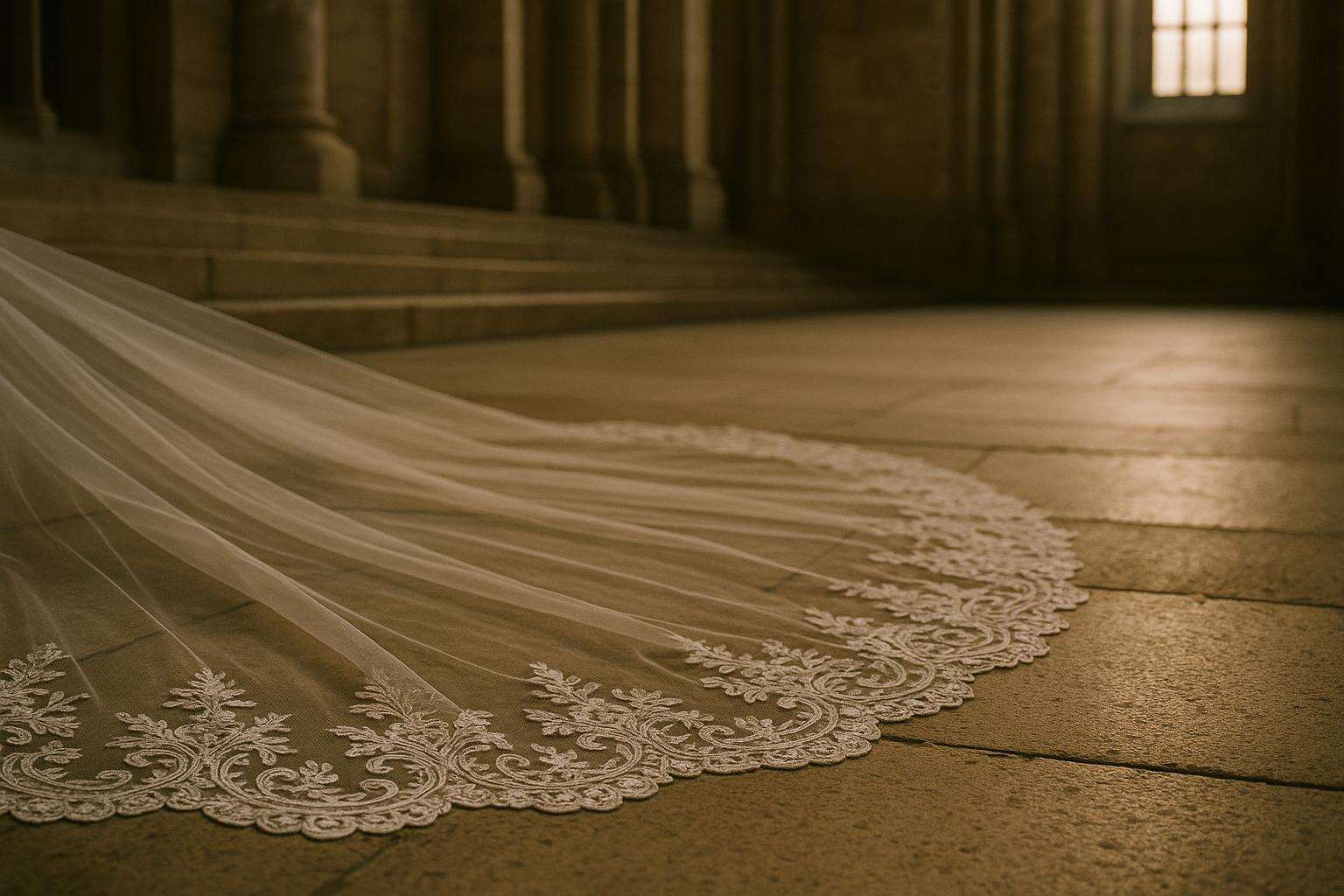
A bridal veil is measured from its comb to its hem and ranges from a face-skimming blusher at 30 inches to a cathedral sweep at 108 inches or more. Choosing the right veil means aligning its length with your train, its fabric with your gown's formality, and its edge finish with your personal aesthetic — guided by real proportioning rules rather than trend alone.
The veil is the one bridal accessory with a genuinely ancient etymology. Worn to mark the transition into married life across Roman, Byzantine, and Jewish traditions, it carries more cultural weight per yard of tulle than almost any other element of wedding dress. That weight, however, does not make it obligatory — nor should it make the selection feel daunting. Once you understand how length, style, fabric, and edge finish interact with your gown's silhouette and your ceremony's formality, the right veil becomes obvious rather than overwhelming.
What follows is a complete reference guide — grounded in guidance from Kleinfeld Bridal, Maggie Sottero, Pronovias, and specialist makers including Twigs & Honey and Britten Weddings — covering every standard length, every significant style, the fabrics and edge finishes that define them, and how to match a veil to the gown you have chosen.
What Are the Standard Bridal Veil Lengths — and How Are They Measured?
Veil length is always measured from the comb or clip that secures the veil to the hair, down to the hem. This is the universal industry standard used by Kleinfeld Bridal, Maggie Sottero, and every major bridal retailer. The measurement does not begin at the top of the head, which means two brides of very different heights wearing identical veils will see that veil fall in different places — a detail worth noting at any fitting.
| Veil Length | Comb to Hem | Formality | Train Pairing | Best For |
|---|---|---|---|---|
| Blusher | ~30 in / 76 cm | Any — traditional symbolism | Any (worn over face, layered) | The altar reveal; layered over longer veil |
| Elbow | ~25 in / 63 cm | Casual to semi-formal | No train or sweep | Outdoor, garden, destination weddings |
| Fingertip | ~45 in / 114 cm | Semi-formal to formal | Sweep, court, or short chapel | Most silhouettes; most versatile length |
| Waltz / Ballet | ~60 in / 152 cm | Formal | Chapel or shorter | Flowing, romantic reception veil option |
| Chapel | ~90 in / 229 cm | Formal | Chapel train | Church, ballroom, estate — long but manageable |
| Cathedral | 108–144 in / 274–366 cm | Very formal / black tie | Cathedral or royal train | Grand church, ballroom, heritage estate |
Blusher (~30 in / 76 cm)
A blusher is a short veil layer worn over the bride's face during the processional and lifted at the altar — the piece behind the cinematic reveal moment. It can be worn as a standalone short veil or as the front tier of a longer two-tier design. Britten Weddings notes a strong revival in blusher styling in 2025–26 as brides return to old-world ceremony traditions. In plain tulle it reads contemporary and minimal; with a lace or floral edge it becomes overtly traditional. The blusher is defined by placement and function, not by a fixed length.
Elbow (~25 in / 63 cm)
Falling to roughly the elbow when arms hang naturally, this length is practical, lightweight, and well-suited to outdoor or garden ceremonies where longer fabric catches on grass. It is the natural choice for beach and destination weddings — present enough to read as bridal in photographs, short enough to require no floor management.
Fingertip (~45 in / 114 cm)
The single most popular wedding veil length, according to The Knot editorial data. It ends at the fingertips when arms rest at the sides — long enough for ceremony presence, short enough to move through a reception without coordination. Its proportioning is nearly universal: it works across A-line, mermaid, trumpet, sheath, and ball gown silhouettes without competing with or truncating any of them.
Chapel (~90 in / 229 cm)
A chapel veil grazes the floor and extends a few inches past the gown's hem. It pairs naturally with a chapel-length train and suits formal church ceremonies, ballroom receptions, and estate weddings where floor presence matters. Manageable without a dedicated attendant — though a second set of hands before the processional is always helpful at this length.
Cathedral (108–144 in / 274–366 cm)
Kleinfeld Bridal defines cathedral as 108 inches or more from comb to trim. At this length the veil sweeps well beyond the gown's train and requires at least one attendant to spread and manage it before the processional. Maggie Sottero's Sonoma veil — 114 inches with a scalloped edge and 3D floral lace — is one of the most recognised ready-to-wear cathedral options, illustrating how the length can carry significant embellishment. Royal veils exceed 120 inches and approach 144; they are the preserve of the grandest ecclesiastical and heritage settings.
A useful proportioning rule from Britten Weddings: a veil should extend 20 to 30 cm beyond the dress hem for the most flattering silhouette. Applied across lengths, this means the veil's hem should trace slightly beyond — never significantly shorter than — the gown's hem.
What Are the Main Bridal Veil Styles — Birdcage, Mantilla, and Beyond?
Birdcage Veil
A birdcage veil covers only the upper portion of the face in Russian netting or silk net — stopping above or at the cheekbones — and is fixed by a comb, clip, or headband. It originated in the 1940s during World War II fabric shortages and became the defining accessory of Old Hollywood and mid-century bridal glamour. Twigs & Honey, the category's specialist brand, produces handmade birdcage styles ranging from plain Russian veiling headbands (Style #2350) to Swarovski pearl–adorned pieces (Style #2165) and pillbox-hat combinations (Style #2650), all available through the brand's own site and at Anthropologie. The birdcage is the right choice for vintage-influenced, non-traditional, or civil ceremony brides; it is the wrong choice over a full cathedral-train ball gown.
Mantilla Veil
A mantilla is a Spanish-heritage veil made from lace cut in an oval or circular shape that drapes flat over the head and shoulders without gathers. It is a single layer — the lace is the veil, not merely the trim — and it lies flush against hair and face with a fluid, architectural curve. Available in fingertip, chapel, and cathedral lengths. Calily Bridal produces mantillas in Alençon and Chantilly lace trim with at-home try-on options; Tulip Bridal specialises in mantillas using both lace types. Modern updates include pearl embellishments, blush and champagne lace, and embroidered wedding dates or initials. A mantilla is ideal for romantics drawn to European heritage aesthetics.
Two-Tier Standard Veil
The most common commercial veil form: a gathered tulle veil with a short front tier (often blusher length) and a longer back tier at fingertip, waltz, chapel, or cathedral length. The short front tier frames the face and creates the reveal moment; the longer back tier drapes for the aisle. Available from every retailer — David's Bridal stocks two-tier styles from under $50; BHLDN and Kleinfeld Bridal offer the same construction in silk tulle and Alençon lace from $150 to $800.
Single-Layer Minimalist Veil
A single tier of illusion tulle with a raw cut, rolled, or pencil edge — no lace, no beading, no embellishment. Most closely associated with contemporary and minimalist bridal aesthetics. Vera Wang and Grace Loves Lace both offer single-layer styles as part of their modern bridal ranges. Photographically clean, especially against intricately beaded gowns.
What Fabric and Edge Finish Should a Bridal Veil Have?
Fabrics
Illusion tulle (bridal illusion) is 100% nylon and the standard for most production veils. Soft, sheer, and the most photogenically transparent option — ideal for blushers and multi-tier styles. Available in widths up to 108 inches from retailers including David's Bridal and BHLDN.
Silk tulle is 100% silk — feather-light with couture drape that nylon cannot replicate. More expensive and more slippery than nylon, requiring extra pinning. Tessa Kim, a specialist bridal veil label, documents silk tulle's superiority in drape and photography; the label's own veils use it as standard. Best suited to chapel and cathedral lengths where the difference in movement is most visible.
English net is heavier and more structured than illusion tulle — semi-transparent rather than fully sheer. Its weight makes it well-suited to cascading or pouf styles and to veils that carry significant lace appliqués. Britten Weddings, which handcrafts veils in Bath, England, sources English lace from a supplier established in 1858 by an eighth-generation family — one of the few remaining English lace workshops of that lineage.
Edge Finishes
Raw cut edge: The tulle is simply cut with no further finishing. Produces a very casual, contemporary look with a slight tendency to shed fine fibres over time. Most budget veils use a raw edge.
Rolled (horsehair or wire) edge: A fine wire or horsehair braid is stitched into the hem, giving the veil structure and a subtle curl. More polished than raw; common in mid-range retail veils.
Pencil (satin) edge: A narrow satin ribbon is sewn around the hem. Clean, slim, and elegant — adds a quiet definition without competing with the gown.
Chantilly lace edge: Delicate bobbin lace with fine floral motifs on a hexagonal mesh ground. Airy, romantic, and lightweight — the most photographically flattering lace trim. Originated in Chantilly, France, in the 17th century.
Alençon lace edge: Needle lace with corded, outlined floral motifs — the cord gives a crisper, more sculptural edge and adds gentle structure. Often called the Queen of Lace; originated in Alençon, France. More photogenic than Chantilly in full-length ceremony shots because the outlined motifs read clearly even at a distance.
Guipure (Venise) lace edge: Heavier motif-linked lace without a mesh ground — more graphic and modern-romantic. A strong contrast detail against a clean, plain gown.
Crystal or pearl scatter: Individual Swarovski crystals or micro-pearls sewn by hand across the tulle or along the edge. Common in boutique and atelier veils; Twigs & Honey uses Swarovski pearls on several birdcage styles. Adds light-catching detail at close range without heavy weight.
How Should You Match a Bridal Veil to Your Dress Silhouette?
The foundational rule from Allure Bridals and Pronovias is the same: the veil should complement the gown, never compete with it. Pronovias also advises matching the veil's edge to the gown's fabric — a lace gown pairs with a lace-trim veil; pearl detailing on the gown calls for scattered pearls on the veil. When an exact white or ivory match between gown and veil is impossible, the veil should always be at least one shade lighter than the gown.
| Dress Silhouette | Recommended Length | Notes |
|---|---|---|
| A-Line | Fingertip, waltz, or chapel | Veil ends near the widest point of the skirt, keeping the flared hem as the focal point below the waist |
| Ball Gown | Chapel or cathedral | Pairs with the gown's natural drama; avoid elbow or fingertip, which create a visual break at the back |
| Mermaid / Fit-and-Flare | Fingertip or chapel to cathedral | Fingertip highlights the curve; avoid elbow length, which truncates the silhouette's vertical line |
| Sheath | Elbow to fingertip | Keep it light and unstructured; English net or poufy styles overpower the sleek profile |
| Heavily embellished gown | Plain or simple veil | Let the gown lead; a plain-edge illusion tulle in fingertip or chapel avoids visual overload |
| Minimalist / clean gown | Lace-edged or embellished veil | The veil provides the detail layer the gown deliberately omits |
| Tea-length / short gown | Birdcage, blusher, or elbow | A cathedral veil over a tea-length gown reads as costume; keep proportion intimate |
Train length and veil length should also relate to each other. A cathedral train and a cathedral veil read as a unified, intentional whole in a grand church setting. A chapel-train gown generally wears a fingertip or waltz veil better than another chapel-length piece, because ending two layers of fabric at exactly the same point creates visual confusion rather than harmony. When in doubt, finish the veil slightly above the train hem. For a side-by-side comparison of every length mapped to ceremony setting and dress train, veil lengths by venue and formality is a useful companion reference.
How Much Does a Bridal Veil Cost in 2026?
The national average for a new wedding veil in the United States falls between $125 and $390, based on data from over 1,200 retailers. Designer Sandra Morales of Ofrenda Studio, quoted by The Knot, puts the typical working range at $100 to $600, with custom and atelier-level options above that.
Budget ($20–$200): single-layer polyester nylon, raw or plain edge, short birdcage in French netting — primarily from David's Bridal and Amazon sellers. Mid-range ($200–$600): lace appliqués, beading or embroidery, silk-tulle fabric, cathedral lengths — BHLDN, Calily Bridal, and mid-tier boutiques. Boutique/designer ($600–$1,850+): hand-beaded cathedral styles, Swarovski crystals, Chantilly or Alençon lace borders, couture construction — Twigs & Honey, Tessa Kim, Britten Weddings, and salon labels at Kleinfeld. Salon tier (from ~$400): Kleinfeld Bridal stocks veils from approximately $400, scaling to several thousand for heavily embellished or royal-length styles. Secondary market (Stillwhite, PreOwned Wedding Dresses, Etsy): 30–50% discounts on gently worn veils.
One practical note: if you are purchasing a gown at a salon — Kleinfeld, BHLDN, or a regional boutique — ask your stylist to pull veils during the same appointment. Veil selection is almost always easier in person, against the actual gown and in a fitting-room mirror, than it is from online imagery. The proportion shift between a fingertip and a chapel veil, while 45 inches on a tape measure, looks entirely different on a standing bride in a structured gown than it does in a product photograph.
Considered Counsel
Frequently asked
What is the most popular bridal veil length?
The fingertip veil — falling to approximately 45 inches (114 cm) from the comb, which places the hem at the bride's fingertips when her arms hang naturally — is the most popular wedding veil length among today's brides. The Knot's editorial team consistently identifies it as the single most commonly chosen length, and it earns that position because it works across nearly every silhouette: it adds ceremony presence without requiring an attendant to manage it, and it transitions from aisle to reception without cumbersome adjustment. It pairs well with A-line, fit-and-flare, sheath, and trumpet gowns, and is stocked at every price point from David's Bridal to Kleinfeld Bridal. If you are undecided between two lengths, the fingertip is the most forgiving starting point.
What is the difference between a chapel veil and a cathedral veil?
A chapel veil extends roughly 90 inches (229 cm) from the comb and grazes the floor, extending a few inches beyond the gown's hem in a clean, floor-level sweep. A cathedral veil begins at 108 inches (274 cm) and typically measures 108 to 144 inches — Kleinfeld Bridal defines 108 inches as the entry point for cathedral classification. The distinction is formality and management: a chapel veil requires no attendant and suits both formal and semi-formal ceremonies, while a cathedral veil demands a dedicated bridesmaid or attendant before the processional and creates the most dramatic aisle presence of any off-the-shelf length. Royal veils — exceeding 120 inches and sometimes reaching 144 inches or more — are the cathedral length's more theatrical cousin, most associated with heritage church ceremonies.
What is a mantilla veil and how is it different from a standard veil?
A mantilla veil is a Spanish-heritage style shaped as a single oval or circular panel of lace that drapes flat against the head and flows over the shoulders without gathers or layers. Unlike a standard two-tier tulle veil — which is gathered at a comb and creates volume — a mantilla lies flush against the hair and face, held in place by a comb or pins. The lace is the fabric, not an edge trim: the entire veil is lace, typically Alençon or Chantilly, which gives it a flat, liquid drape. Calily Bridal and Tulip Bridal both produce mantillas in fingertip, chapel, and cathedral lengths. Modern updates include pearl and crystal embellishments, blush or champagne lace, and custom embroidered initials. A mantilla suits romantic, heritage-leaning aesthetics and photographs beautifully against intricate lace gowns or, by contrast, the cleanest minimalist silhouettes.
What is a birdcage veil and when should you wear one?
A birdcage veil — sometimes called a cage or fascinator veil — covers only the upper portion of the face in Russian netting or silk net, sitting above the cheekbones and fixed by a comb, clip, or headband. Shorter than a blusher, it does not fall past the chin. The style emerged in the 1940s during World War II fabric rationing and became synonymous with Old Hollywood and 1950s bridal glamour. It pairs most naturally with structured, vintage-influenced gowns — tea-length silhouettes, column dresses, suits, or separates — and suits non-traditional or civil ceremony aesthetics. Twigs & Honey, the category's leading specialist brand, produces handmade birdcage styles from plain Russian veiling headbands (Style #2350) to Swarovski pearl options (Style #2165) and pillbox-hat combinations (Style #2650), all stocked at Anthropologie. A birdcage veil is the wrong choice with a heavily embellished ballgown; it is the right choice for a bride who wants bridal symbolism without bridal volume.
How should I match my veil length to my wedding dress train?
The most reliable rule from Maggie Sottero and Pronovias editorial guidance is that veil length should harmonise with — not duplicate — the train. A cathedral-train gown in a grand church setting pairs naturally with a cathedral veil: both fabrics sweep the aisle together and the overall silhouette reads as a unified whole. A gown with a chapel train sits better with a fingertip or waltz-length veil, which ends above or at the train rather than competing with it. Sheath and minimalist gowns without a train wear fingertip or elbow veils most cleanly. Heavily embellished gowns — beaded, sequinned, or layered with lace appliqué — benefit from a simple, plain-edge veil so the gown remains the focal point. The one pairing to avoid: a very short elbow veil over a full ball gown with a long train, which creates a visual break that fragments the silhouette in photography.
What fabric is a bridal veil made from?
Most production wedding veils are made from illusion tulle — a 100% nylon mesh that is sheer, photogenically transparent, and available in widths up to 108 inches. It is the least expensive and most widely stocked veil fabric at retailers including David's Bridal and BHLDN. Silk tulle is the couture alternative: feather-light, with a fluid drape that nylon cannot replicate, but significantly more expensive and prone to slipping at attachment points. English net is heavier and more structured than illusion tulle, suited to pouf styles and appliquéd veils that need to hold shape. Chiffon and organza appear in more architectural or bohemian styles. Lace veils — the mantilla being the purest form — use woven lace panels rather than tulle. Britten Weddings, which handcrafts veils in Bath, England, sources its English lace from a supplier established in 1858 by an eighth-generation lacemaking family, a detail that illustrates how veil fabric heritage spans centuries.
How much does a wedding veil cost?
The national average for a new wedding veil in the United States falls between $125 and $390, based on data from over 1,200 retailers. Budget options begin at $20 to $200 and typically cover single-layer polyester nylon tulle or plain French net birdcage styles. The mid-range of $200 to $600 introduces lace appliqués, beading, silk-tulle fabric, or cathedral lengths. Boutique and designer veils — hand-beaded cathedral styles, Swarovski crystal embellishments, or Chantilly and Alençon lace borders — begin at $600 and scale to $1,850 or more. Kleinfeld Bridal stocks veils from approximately $400 to several thousand dollars. Designer Sandra Morales of Ofrenda Studio, quoted in The Knot, puts the typical working range at $100 to $600, with custom and atelier-level options above that. The secondary market — Stillwhite, PreOwned Wedding Dresses, and Etsy resellers — offers 30 to 50 percent discounts on gently used veils, which is worth considering when the priority is fabric quality over provenance.