Bridal Accessories
Wedding Earrings: Studs, Drops & Chandeliers by Neckline
The complete guide to bridal earring silhouettes — how to pair studs, drops, and chandeliers to your neckline and face shape, when earrings carry the look alone, and how to choose between pearl, crystal, and diamond.
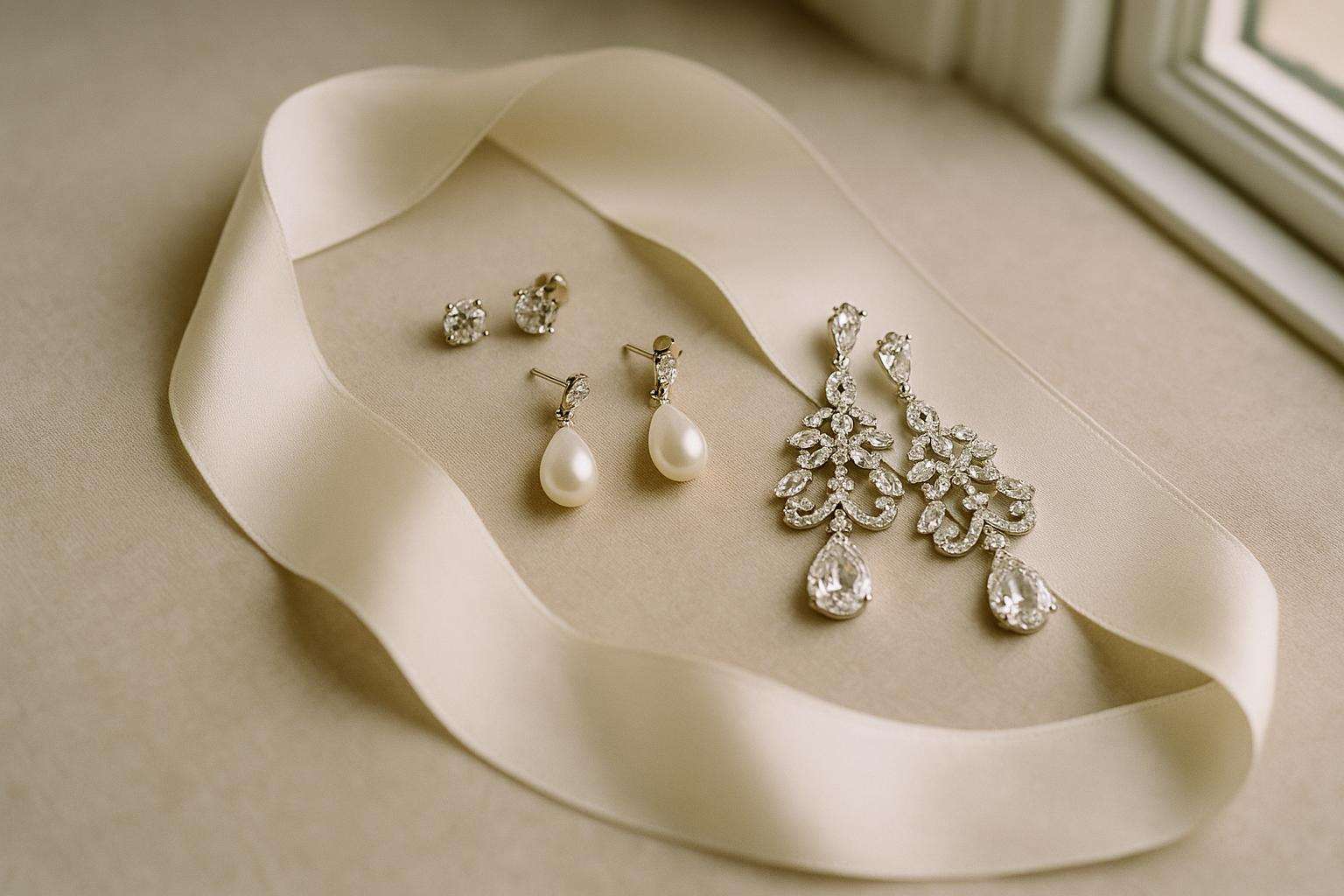
Wedding earrings are chosen by matching the silhouette (stud, drop, chandelier, hoop, climber) to your neckline and face shape first — then layering in material preference and budget. Studs suit busy necklines and hair-down looks; chandeliers need an updo and a clear neck; drops bridge nearly everything. Pearl reads warm and heritage; crystal maximises sparkle for less investment; lab-grown diamond delivers the heirloom finish at 40–60% less per carat than mined.
What are the different styles of wedding earrings, and how do they differ?
Bridal earring taxonomy breaks into six distinct silhouette families, each with meaningful wearability implications across a ten-hour wedding day.
Studs sit flush at the lobe with no dangle. They are the most face-shape-neutral and neckline-versatile option in the bridal wardrobe, and they suit lace-heavy gowns, intricate high necklines, and hair-down styles where longer pieces would tangle. One important practical caveat: Kleinfeld Bridal's accessories stylists advise brides that in a room of 200 to 300 guests, a very small stud may not register in photographs taken from across the room — the recommendation is to go at least one size above your comfort zone so the earring reads clearly in portraits shot at distance.
Drop and dangle earrings hang below the lobe in a single plane and add gentle movement without the architectural complexity of a chandelier. They rank among the most-selected bridal earring styles for 2026, prized by the editorial teams at Verstolo and ADORA by Simona for their versatility across necklines and hair configurations. A teardrop drop, for example, works equally well with a V-neck, off-the-shoulder, or boat-neck gown — a flexibility studs and chandeliers cannot match.
Chandelier earrings are multi-tiered, cascading, and intentionally ornate. They deliver maximum visual impact with minimalist gowns, strapless silhouettes, and sweetheart necklines, but they require a fully clear neck and an updo to show the design in full. Emmaline Bride's editorial on chandelier wedding earrings confirms that the style's architectural depth is wasted when hair falls forward over it.
Hoops received a significant design evolution entering 2026: sculptural, twisted, and diamond-studded versions now read as wedding-appropriate, particularly with V-neck silhouettes that mirror the circular lines. These are no longer an informal option; pavé-set diamond hoops from jewelers such as Valerie Madison (Inside Out Pavé Diamond Hoops at $1,250) are positioned explicitly as bridal.
Ear climbers (also called ear crawlers) originate at the lobe and travel upward along the ear's natural curve from a single piercing. They create the illusion of a curated ear stack while using only one piercing per ear. Montreal atelier Ecksand describes their diamond-set climbers as "bold enough to make a statement but subtle enough for everyday wear" — a combination that makes them a strong choice for minimalist brides who want something more architectural than a stud. They pair especially well with swept-back hairstyles that let the piece run unobstructed.
Convertible or modular earrings attach a detachable drop jacket or chandelier tier to a classic stud post. This allows a bride to wear the stud silhouette for the ceremony and snap on the drop piece for the reception — a practical solution noted in 2026 trend coverage from ADORA by Simona as one of the year's most pragmatic bridal accessory innovations.
How do I choose wedding earrings that suit my face shape and neckline?
Face shape and neckline are the two foundational variables in bridal earring selection. Robinson's Jewelers frames the underlying principle clearly: these are not rigid rules but an understanding of what creates visual harmony between the earring's geometry and your face's proportions.
| Face Shape | Visual Goal | Best Earring Styles | Styles to Avoid |
|---|---|---|---|
| Round | Add length and angular definition | Long angular drops, rectangular dangles, slim vertical chandeliers | Round studs, circular hoops that echo the face shape |
| Oval | Maintain natural balance | Almost anything — teardrops, medium clusters, chandeliers, geometric hoops | Extra-long styles that over-elongate |
| Square | Soften jaw angles | Curved hoops, teardrop drops, pearl rounds, circular designs | Geometric squares or sharp rectangular cuts |
| Heart | Balance wide forehead to narrow chin | Wider-bottomed chandeliers, teardrops, triangular dangles heavier at the base | Styles that widen near the lobe and taper to a point |
| Diamond | Complement high cheekbones without overpowering | Studs, huggies, short drops, ear climbers | Very wide pieces that overwhelm a narrow forehead and chin |
| Long / Oblong | Add width to the face | Chunky hoops, cluster earrings, cuff and ear-wrap styles | Long dangling styles that extend the vertical even further |
Sources: Kay Jewelers face-shape earring guide, Robinson's Jewelers bridal earring editorial, ADORA by Simona styling guide.
Neckline pairing adds a second layer of direction. The guidance from The Knot's earring-and-neckline pairing editorial and Tania Maras's dedicated bridal neckline resource is consistent across most bridal publications:
- Strapless / Sweetheart: The open collarbone canvas is built for chandeliers or dramatic drop earrings. Skipping a necklace entirely lets the earrings command the frame — the most common choice among editorial stylists for this silhouette.
- V-neck: Teardrop drops that mirror the V angle are the consensus recommendation; sculptural hoops also work by echoing the gown's geometry. Chandelier styles can compete with the plunge, so most stylists prefer a medium drop.
- High neck / Halter: Simple studs or a single restrained crystal drop. Long chandeliers can catch on fabrication or compete with the neckline's own detail. A statement bracelet can absorb the accessory investment instead.
- Off-the-shoulder: Drop or chandelier earrings that draw the eye upward; the strong shoulder line means a necklace is typically superfluous or distracting. David's Bridal's neckline guide makes the same recommendation.
- Boat neck (Bateau): Dangling chandeliers or longer drops draw attention upward and balance the wide horizontal cut. A choker-length necklace can pair well here too.
- One-shoulder / Asymmetric: A bold statement earring on the exposed side, or a pair of geometric drops that echo the intentional asymmetry of the gown.
When should earrings carry the look alone — without a necklace?
Several necklines make a decisive argument for earrings as the sole jewelry statement, with no necklace. Off-the-shoulder, one-shoulder, and illusion-neckline gowns all benefit from this restraint. The editorial consensus from Tania Maras, La Mariée Boutique, and David's Bridal is consistent: on these silhouettes, the neckline is doing the decorative work — adding a necklace creates competition rather than cohesion.
Beyond neckline logic, there is a broader styling principle at work. When a bride wears strong chandelier earrings, a necklace often creates visual noise at the most photographed zone of the face and shoulders. Many bridal stylists advise the rule of letting one piece lead and keeping the rest quiet. If the earrings are your statement, the necklace steps back — or disappears entirely.
For brides whose gowns have heavy embellishment, beading, or lace at the collar, studs with no necklace is the cleanest option of all. The dress becomes the statement; the earrings serve as a finishing detail rather than a competing focal point.
Pearl vs. crystal vs. diamond: which earring material is right for a wedding?
Material choice is as much about aesthetic register as budget. Each of the three dominant bridal earring materials reads differently in photographs and carries a distinct cultural weight.
Pearl earrings are the oldest bridal jewelry tradition in the Western canon and have undergone a significant reinvention for 2026. Modern bridal pearls are no longer grandmother-formal: baroque pearls, single floating-pearl drops from fine chains, and pearl-and-diamond mixed compositions represent the direction confirmed by Verstolo and Khush Wedding in their 2026 trend coverage. In terms of quality hierarchy, Mikimoto — the house that perfected cultured pearl cultivation in 1893 — remains the benchmark, with Akoya stud earrings beginning at approximately $590 per pair and South Sea pearl suites reaching well into five figures. For mid-range budgets, freshwater pearl studs from BHLDN and Kendra Scott are available from $50 to $500. Pearl suits ivory, champagne, and blush gown tones especially well; it can appear slightly flat under very white or cool-toned gowns, where crystal or diamond carries more visual energy.
Crystal earrings — including Swarovski-accented designs — maximise brilliance at a fraction of the cost of fine stone. They photograph well under both natural daylight and reception artificial lighting, scattering light from their faceted surfaces in a way that reads as high-wattage in portraits. Eden Luxe Bridal, a specialist in couture-quality simulated-diamond and Swarovski crystal bridal earrings, offers named styles including the EVELYN drop, the ESMÉ chandelier, and the ELLIE marquise-and-pear chandelier at under $200, all built on rhodium-plated, nickel-free settings with hypoallergenic posts. BHLDN also carries a strong crystal and pearl-accented earring range in the mid-tier. The trade-off: crystal lacks the investment value and historical prestige of diamond, and very heavy crystal chandeliers can weigh more than fine-jewelry equivalents built on filigree bases.
Diamond earrings — mined or lab-grown — represent the highest per-piece investment and the longest wear life. Lab-grown diamonds, now available from direct-to-consumer brands such as VRAI, are physically and optically identical to mined diamonds and typically cost 40 to 60 percent less per carat. VRAI's Iconic Diamond Studs in 14k gold are priced at $1,200 per pair; their Semi-Bezel Studs at $1,700. At the fine-jewelry atelier level, Seattle-based Valerie Madison offers conflict-free, Kimberley-Process-compliant diamond studs from $500 and pavé hoops at $1,250, all in 14k gold. Montreal atelier Ecksand crafts all pieces in 100% recycled gold with ethically sourced diamonds and Akoya pearls — their Dynasty bridal earring collection includes Akoya Pearl and Diamond Gold Crawlers for brides seeking a climber in fine materials. Diamond earrings are the obvious choice for brides who plan to wear the piece beyond the wedding day as part of their everyday jewelry rotation.
What should I know about comfort and all-day wearability?
Weight is the engineering challenge of bridal earrings. The primary risk for multi-hour wear is lobe stretch, fatigue, and — in worst cases — micro-tearing of an already-stretched piercing.
Filigree and open-frame construction is the most impactful variable. Many bridal chandeliers are built on open metalwork rather than solid cast backs, which preserves visual scale while dramatically reducing dead weight. Backing choice matters too: screw-back closures are the most secure option for a full day of dancing and movement; butterfly push-backs are faster to remove but can loosen under exertion. Adhesive lobe-support patches — the best-known product is Lobe Wonder — are applied behind the lobe before inserting the post and distribute the earring's load across a larger surface of skin. They are a standard backstage tool at bridal styling sessions.
Hypoallergenic materials are non-negotiable for ten-plus hours of wear: 14k gold and above, platinum, and sterling silver are generally safe. Nickel-containing plated base metals should be avoided for the wedding day. VRAI builds all pieces in 14k or 18k gold specifically to address this. Finally, the trial run: wearing your chosen earrings for two to three hours during the hair and makeup preview session is the single most reliable way to catch any pressure, swing, or allergic reaction before the wedding day itself.
What are the 2026 bridal earring trends worth knowing?
Trend coverage from Verstolo, ADORA by Simona, and Khush Wedding confirms five recurring directions for 2026 bridal earrings:
- Baroque and floating pearls. Organic shapes, single-pearl drops from fine chains, and pearl-and-diamond mixed compositions — modern rather than inherited, warm rather than formal.
- Art Deco geometric cuts. Baguette and emerald-cut multi-stone arrangements in angular settings, delivering what Khush Wedding describes as "architectural sparkle."
- Convertible modular pairs. Stud for the ceremony, drop jacket added for the reception — the practical option that refuses to compromise on either occasion.
- Color accent stones. Aquamarines, cornflower sapphires, and emeralds making inroads into traditionally all-white bridal palettes — a strong option for brides with a gemstone "something blue" brief.
- Intentional asymmetry. Wearing a pearl drop on one ear and a diamond stud on the other is now a deliberate editorial choice in bridal photography, not an oversight — a trend endorsed by the modern-fashion direction covered by Verstolo in their 2026 bridal jewelry roundup.
Considered Counsel
Frequently asked
What are the different styles of wedding earrings?
The six main bridal earring silhouettes are studs, drop or dangle earrings, chandeliers, hoops, ear climbers, and convertible or modular pairs. Studs sit flush at the lobe and suit intricate necklines or hair-down styles. Drops hang in a single plane and work across almost every neckline. Chandeliers cascade in multiple tiers and deliver the most drama with strapless or sweetheart gowns. Hoops have had a significant design upgrade for 2026, with sculptural and diamond-studded versions now reading as thoroughly wedding-appropriate. Ear climbers travel upward along the ear's curve from a single piercing, creating a curated modern look. Convertible earrings use a stud plus a detachable drop jacket — practical for a bride who wants restraint during the ceremony and full glamour at the reception.
How do I choose wedding earrings for my face shape?
The general principle, articulated by Robinson's Jewelers, is not strict rules but understanding what creates harmony between the earring's geometry and your face's proportions. Round faces benefit from long angular drops or slim vertical designs that add length; avoid circular studs or hoop shapes that echo the face. Oval faces are the most versatile — teardrops, chandeliers, clusters, and geometric hoops all work. Square faces soften best with curved hoops, teardrop drops, or round pearl silhouettes; avoid sharp rectangles. Heart-shaped faces need weight at the base — wider-bottomed chandeliers or triangular dangles balance a wider forehead. Diamond faces with high cheekbones suit studs, huggies, and short drops. Long or oblong faces are widened by chunky hoops and cluster styles; avoid very long dangles that extend the face further.
What wedding earrings work best with a strapless or sweetheart neckline?
Strapless and sweetheart necklines offer the most open canvas in bridal fashion — the collarbone is fully exposed and uninterrupted. Both The Knot's neckline pairing guide and Tania Maras's bridal editorial confirm that chandelier earrings or dramatic drop earrings are the ideal match. The exposed neck means there is ample visual real estate for an architectural piece, and the absence of straps means nothing will compete with the earring. With a sweetheart neckline specifically, pairing chandelier earrings without a necklace lets the earrings command the frame entirely — a clean, editorial choice that photographs beautifully from every angle.
Should I wear studs or chandeliers to my wedding?
The choice turns on three variables: your neckline, your hairstyle, and how heavily accessorized the rest of your look is. Studs suit lace-heavy gowns, high necklines, and hair-down styles where longer pieces would tangle or compete. Kleinfeld Bridal's accessories team cautions that small studs can disappear in photos taken from across a large reception room, so they advise going at least one step above your instinctive comfort zone. Chandeliers, by contrast, require a completely clear neck and ideally an updo to show the full design — but they deliver maximum visual impact with minimalist or strapless gowns. When in doubt, a convertible earring covers both needs: stud for the ceremony, drop jacket added for the reception.
Are pearl, crystal, or diamond earrings better for a wedding?
Each material has a distinct visual register and practical profile. Pearls — whether cultured Akoya (Mikimoto starts at approximately $590 per pair), freshwater, or baroque — read as warm, heritage, and romantically timeless; they work particularly well with ivory, champagne, or blush gowns. Crystal earrings, including Swarovski-accented pieces from brands like Eden Luxe Bridal (from under $200) and BHLDN, deliver brilliant sparkle at an accessible price and photograph well under both natural and reception lighting. Diamond earrings — mined or lab-grown — represent the highest investment but also the greatest longevity; VRAI's lab-grown diamond studs start at $1,200 and are physically indistinguishable from mined equivalents at a fraction of the per-carat cost. For most brides, the choice mirrors the overall aesthetic of the gown: pearls for heritage and softness, crystals for maximum sparkle on a budget, diamonds for heirloom investment.
What is the most comfortable type of wedding earring for an all-day event?
Comfort over eight or more hours of wearing is primarily a function of weight and backing type. Many bridal chandeliers are built on filigree or open-frame bases rather than solid cast metal, which preserves visual scale while dramatically reducing dead weight. Screw-back closures are the most secure option for a full wedding day and will not loosen during dancing; push-back butterfly clutches are faster to remove but can work loose under exertion. Adhesive lobe-support patches such as Lobe Wonder, applied behind the lobe before inserting the post, distribute load across a larger skin surface and are widely used by bridal stylists as a backstage tool. Hypoallergenic materials — 14k gold and above, platinum, or sterling silver — become non-negotiable when earrings are worn continuously for ten or more hours. Most importantly, stylists unanimously recommend wearing your chosen earrings for two to three hours during your hair and makeup preview before the wedding day to identify any pressure or allergic response in advance.
When should earrings carry the look without a necklace?
Several necklines call for earrings to carry the jewelry look entirely, with no necklace. Off-the-shoulder gowns make a strong visual statement on their own — the neckline IS the jewelry — so bridal stylists including Tania Maras and the editorial team at David's Bridal recommend skipping the necklace and letting drop or chandelier earrings draw the eye upward to the face. One-shoulder and asymmetric necklines similarly work best with a bold statement earring on the unencumbered side. High necklines and halter styles are typically too detailed to accommodate a necklace without visual clutter; studs or a single restrained drop are the standard recommendation, and a bracelet can absorb the accessory budget that might otherwise go toward a necklace.