Bridal Beauty
Best Wedding Hairstyles by Hair Type & Length (2026)
A ranked styling edit organized by hair length and texture — each with veil-placement notes, product picks, and the honest tradeoffs every bride should know before the trial.
Hair Type GuideVeil PlacementStylist Picks2026 BridalReal Pricing
The quick verdict
Seven hair profiles, one ranked style each — with the hold logic, veil-placement notes, product recommendations, and honest tradeoffs behind every pick.
- Best overall
- Classic Chignon for Long, Straight Hair — The chignon delivers the most reliable combination of longevity, veil compatibility, and photographic elegance across every venue type. It is the style most consistently recommended by bridal specialists including Glamsquad, Samara Beauty, and Elite Bridal Beauty for brides who want structured polish that holds through a full evening without touch-ups.
- Best value
- Half-Up, Half-Down for Long Wavy Hair — At $200–$350 according to The Knot and WeddingWire cost data, the half-up is the most accessible professionally styled bridal look — it works naturally with wavy texture, photographs beautifully from every angle, and requires no extensions or advanced structural techniques that inflate chair time and cost.
- Best for Outdoor, humid, or beach ceremony brides who cannot risk style collapse
- Braided Updo for Long Curly or Wavy Hair — The interlocking structure of a braided updo resists frizz expansion in humidity better than any other style. Beauty Brigade LLC specifically recommends secured styles for outdoor conditions; the braid's structure keeps hair off the neck, reducing sweat contact, and maintains integrity through heat and dancing that would dismantle a loose style within the first hour.
How we evaluated
Rankings are based on the consensus of published guidance from Glamsquad, Studio Bride, Samara Beauty, Elite Bridal Beauty, Beauty Brigade LLC, Izabella Bordignon London, SA Hair Salon, and Lee Graves Salon, cross-referenced with The Knot and WeddingWire 2025 U.S. cost benchmarks and product guidance from Moroccanoil, Olaplex, Redken, L'Oréal, and Oribe. Each style is assessed on four criteria: longevity across a six-to-eight-hour wedding day, compatibility with the target hair profile, veil-placement flexibility, and availability at multiple price points. Weaknesses are included for every entry.
- Longevity across a full wedding day. Can the style hold for six to eight hours through ceremony, cocktail hour, and reception — including heat, humidity, dancing, and embraces — without requiring a mid-event touch-up?
- Hair-type compatibility. Does the style work with the natural character of the hair profile (straight, wavy, curly, fine) rather than fighting it? Styles that require heavy manipulation of natural texture are penalised.
- Veil-placement flexibility. Does the style accommodate a range of veil lengths and attachment methods? Styles with no viable veil placement are noted as a weakness.
- Price accessibility. Is the style achievable across a range of budget tiers, from studio bridal specialists to mobile platforms like Glamsquad? Styles only achievable at the high end of the market are noted.
Rating scale: Ratings are on a 1–5 scale in 0.5 increments. 5.0 = near-universal fit across the hair profile with abundant stylist expertise and product support. 4.0 = very strong with minor caveats. 3.5 = solid but profile-specific conditions apply. Below 3.0 = not listed as a primary pick.
Last verified .
At a glance
| # | Name | Rating | Best for | Pricing |
|---|---|---|---|---|
| 1 | Classic Chignon for Long, Straight Hair | 5.0 | Long, straight-haired brides who want architectural polish, a secure cathedral-veil anchor, and a style that requires no mid-event attention | $300–$450 (bridal specialist studio, per The Knot / WeddingWire 2025); hair trial $75–$150 additional |
| 2 | Half-Up, Half-Down for Long Wavy Hair | 4.5 | Long, wavy-haired brides who want a romantic balance of structure and movement, with fingertip or chapel-length veil compatibility | $200–$350 (bridal specialist studio, per The Knot / WeddingWire 2025); hair trial $50–$100 additional |
| 3 | Braided Updo for Long, Curly or Wavy Hair | 4.5 | Curly or wavy-haired brides planning an outdoor, garden, beach, or humid-climate wedding who want maximum longevity and veil compatibility | $400–$600 (intricate braided updo, per The Knot / WeddingWire 2025); hair trial $75–$150 additional |
| 4 | French Twist for Medium-Length, Straight Hair | 4.0 | Medium-haired brides with straight texture planning a formal indoor ceremony in a ballroom, cathedral, or estate setting who want the most architecturally precise style possible | $300–$450 (classic updo range, per The Knot / WeddingWire 2025); hair trial $50–$150 additional |
| 5 | Loose Curls Down for Long, Naturally Curly Hair | 4.0 | Long, naturally curly-haired brides with indoor or climate-controlled ceremonies who want to wear their curl's natural character without suppression | $200–$350 (styled blow-dry / diffuse range, per The Knot / WeddingWire 2025); note: product cost ($30–$80 for Olaplex No. 9 at Sephora) is additional |
| 6 | Accessorized Style for Short Hair (Pixie to Bob) | 4.0 | Short-haired brides who want a deliberate, accessory-forward style that photographs as intentional rather than limited, compatible with headband or blusher veils | $150–$250 (blowout/finish range for short cuts, per The Knot / WeddingWire 2025); accessory cost separate |
| 7 | Low Chignon with Extensions for Fine or Thin Hair | 4.0 | Fine or thin-haired brides who want a full-looking updo with cathedral-veil compatibility and are willing to invest in an extension consultation before the trial | $300–$450 (chignon base, per The Knot / WeddingWire 2025); clip-in extension set $80–$250 additional depending on length and brand |
Classic Chignon for Long, Straight Hair
The most elegant and dependable bridal updo — structured polish that holds from ceremony to last dance.
Editor's pick
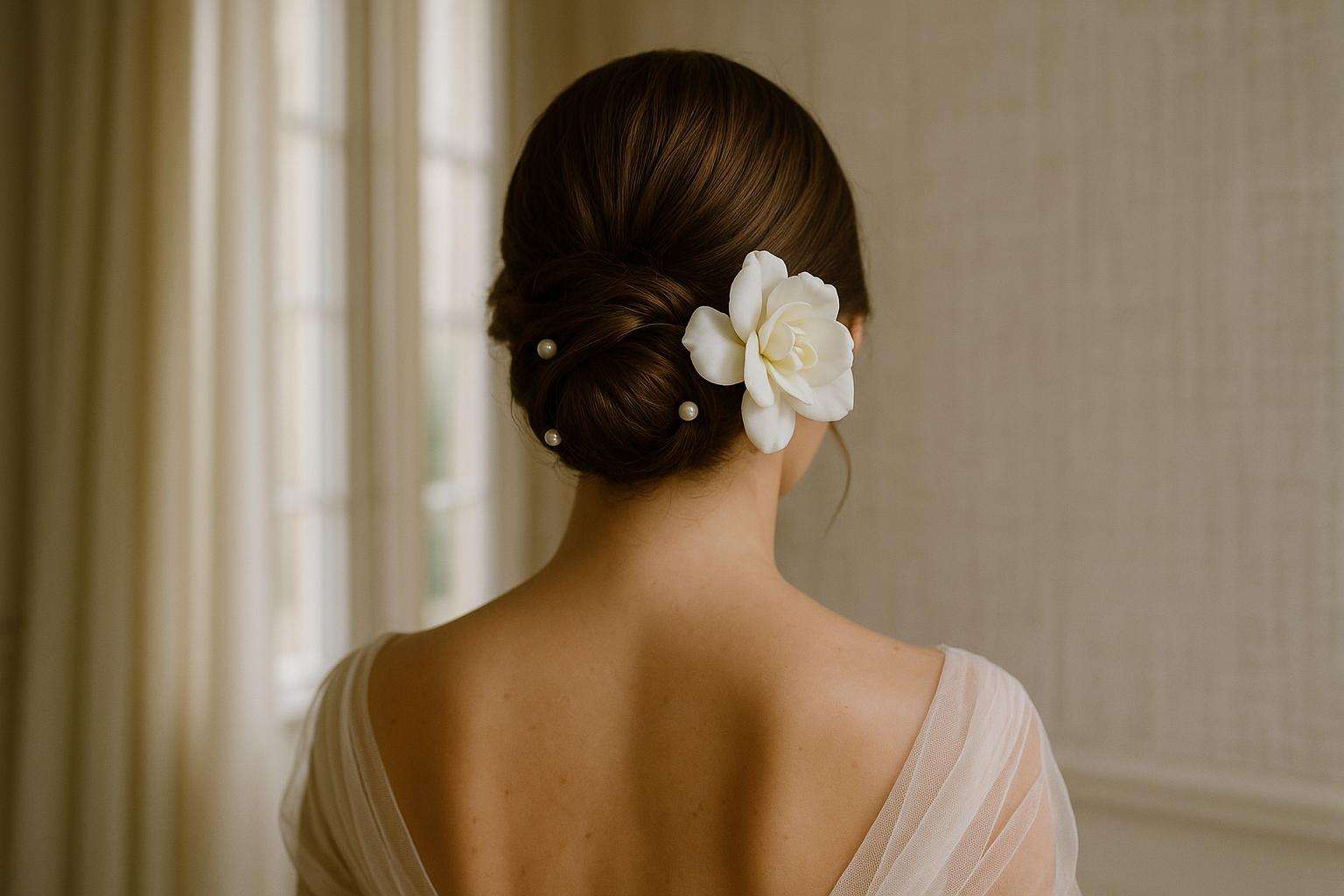
The chignon — a low, twisted knot secured at the nape of the neck — is the benchmark bridal updo for long, straight hair, and for good reason. Straight hair's smooth cuticle holds pins without slipping once the style is set with a texturizing base, and the clean surface of the hair gives the chignon its signature architectural precision. Bridal stylist Nicole Samara of Samara Beauty in Santa Barbara, California, whose studio has completed over 1,000 weddings across 15 years, structures a chignon on a mid-height ponytail base — neither too high nor too low — as the structural key that ensures the style holds through a full day of dancing and embraces without the knot loosening or dropping. The product foundation matters: bridal specialists recommend applying Moroccanoil Treatment as a prep base for frizz control and shine, then layering Moroccanoil Luminous Hairspray Strong — an argan-oil-infused hold spray that blocks humidity while preserving flexibility — over the completed style. For a finishing touch, Moroccanoil Glimmer Shine Spray adds the photo-ready reflective sheen that reads beautifully in both natural and flash photography. Pearl pins, floral combs, or loose face-framing tendrils can personalize the chignon without compromising its structural integrity. Veil placement: The classic chignon is the ideal anchor for cathedral (108-inch) and chapel (72-inch) length veils. The stylist inserts a comb or clip directly into the chignon's base before it is fully secured, then pins over it — the finished knot conceals the attachment completely. A blusher veil (the face-covering layer worn forward during the processional) is pinned into the chignon's crown and falls back over it at the altar. Avoid attaching a cathedral-length veil to a chignon placed too high on the head: the weight of the veil pulls the knot upward over time. Low placement, as Samara recommends, distributes the weight correctly. According to The Knot and WeddingWire's 2025 U.S. benchmarks, a classic chignon at a bridal specialist studio runs $300–$450. Mobile bridal services like Glamsquad — available in 15-plus cities — price a comparable updo style at the lower end of this range and include veil and accessory placement in the trial session.
Strengths
- Holds the longest of any bridal style with correct product layering and mid-height ponytail base structure — minimal touch-up required through a full evening
- Ideal anchor for cathedral and chapel-length veils; the low placement distributes veil weight correctly and conceals attachment hardware
- Compatible with the widest range of necklines — from open-back to high-neck gowns — because it draws attention to the nape without competing with any dress detail
Weaknesses
- Fine or short layers can escape a chignon throughout the day; brides with layers shorter than shoulder length should either extend with clip-in pieces or choose a style that works with their layer structure rather than trying to tuck every strand into a knot
- Best for
- Long, straight-haired brides who want architectural polish, a secure cathedral-veil anchor, and a style that requires no mid-event attention
- Pricing
- $300–$450 (bridal specialist studio, per The Knot / WeddingWire 2025); hair trial $75–$150 additional
Source: Glamsquad — Wedding Hair & Makeup Services · Visit Classic Chignon for Long, Straight Hair
Half-Up, Half-Down for Long Wavy Hair
The most versatile and most-searched bridal style — it works with natural wave texture rather than suppressing it.
The half-up, half-down style is the most searched bridal hair category in 2026, combining a secured upper section — twisted, braided, or pinned into a small chignon — with flowing hair at the back. For brides with long, wavy hair, it is the most natural-feeling option: the secured upper section tames the crown and face-framing area while the lower section benefits from the wave's natural movement and body, producing a romantic, multi-dimensional result without extensive heat styling. The 2026 evolution of this style, as identified by Who What Wear's bridal trend reporting, is a small low chignon at the crown paired with loose waves below — balancing structure with organic movement in a way that reads as effortless but holds all day. Stylist consensus across platforms including SA Hair Salon recommends Oribe Dry Texturizing Spray — a volume product that adds grip and structure without any visible deposit — as the foundational product for this style on wavy hair. It builds the texture needed for the upper section to hold while preserving the wave's natural behavior in the lower half. L'Oréal Elnett Satin Extra Strong Hold hairspray, applied lightly over the finished style, seals the result with a flexible, brushable hold that does not weigh the wave down. Veil placement: The half-up style's most natural veil placement is just below the pinned or twisted upper section — where the secured and loose layers meet at the back of the head. A fingertip or chapel-length veil sits here beautifully, falling through the loose lower waves and appearing as though it is part of the style rather than attached over it. A blusher veil can be anchored into the crown section of the half-up. Avoid cathedral-length veils with this placement if the lower hair is left very loose: the veil's weight can pull the attachment point down over time; use a stronger comb with at least two rows of teeth if a cathedral length is desired. The half-up style runs $200–$350 at a bridal specialist studio according to The Knot and WeddingWire, making it one of the most accessible professionally styled bridal options.
Strengths
- Works with natural wave texture rather than fighting it — minimizes chair time and the risk of heat damage before the wedding day
- Photographs beautifully from every angle: structured at the front and crown, romantic and flowing at the back
- The most accessible price tier among styled bridal looks, at $200–$350 for a full half-up with a loose wave finish
Weaknesses
- In high humidity or outdoor summer venues, the loose lower section can frizz or lose definition more readily than a fully secured updo; brides with a humid outdoor ceremony should request a humidity-resistant finishing spray such as Redken Triple Take 32 and discuss with their stylist whether a braided half-up would hold more reliably
- Best for
- Long, wavy-haired brides who want a romantic balance of structure and movement, with fingertip or chapel-length veil compatibility
- Pricing
- $200–$350 (bridal specialist studio, per The Knot / WeddingWire 2025); hair trial $50–$100 additional
Source: The Knot — Find Your Best Style With Half-Up, Half-Down Wedding Hair Inspo · Visit Half-Up, Half-Down for Long Wavy Hair
Braided Updo for Long, Curly or Wavy Hair
The humidity-proof choice — the interlocking structure that keeps curly and wavy hair intact from the processional to the last song.
For brides with naturally curly or wavy hair, the braided updo is the most structurally sound choice for any wedding where weather, venue, or outdoor conditions introduce humidity. The interlocking braid structure resists frizz expansion because it contains each strand within the pattern — unlike a chignon or smooth updo, where flyaways have room to emerge and spread once humidity hits the surface. Bridal hairstylists consistently recommend pinching and pulling individual braid sections after setting to widen and texture the braid deliberately, giving it a fuller, more intentional appearance that the camera reads as richly detailed rather than unfinished. The crown braid — a French braid wrapping from front to back in a halo — is the most bohemian of the variations and suits outdoor summer and garden ceremonies beautifully. The inverted French braid bun, where the braid begins at the nape and travels upward into a secured bun, reads as the most classically polished and is appropriate for ballroom and formal indoor settings. Olaplex No. 9 Bond Protector Serum — sold at Sephora — is the foundational product recommendation from bridal specialists for curly-haired brides: applied before any heat or manipulation, it protects the curl's structural integrity and reduces frizz without leaving any residue that would make the hair slippery and difficult to braid. Redken Triple Take 32 Extreme High-Hold Hairspray, with 24-hour humidity resistance, is the finishing product consensus choice for braided styles in warm or outdoor climates. Veil placement: The braided updo gives the stylist the most placement flexibility of any fully secured style. A comb can be inserted at the crown for a blusher or elbow-length veil without disturbing the structure beneath. For a halo braid, a thin comb sits neatly behind the braid's arc. For an inverted braid bun, a cathedral or chapel veil slides into the bun's base exactly as it would in a classic chignon. Avoid clipping a heavy cathedral veil into a crown braid: the weight is distributed over a wider area than a single knotted base, and a poorly anchored comb can shift the braid's front section forward. Use two combs at separate points of the braid for heavier veil lengths.
Strengths
- The highest-longevity style in humid, outdoor, or beach conditions — the interlocking structure holds frizz at bay where any smooth style would break down
- Multiple braid variations (crown, inverted French, fishtail, waterfall) allow the style to read bohemian, romantic, or formally elegant depending on the venue and dress
- Compatible with every veil length when correctly anchored; the braid's internal structure is a stronger comb base than a single ponytail knot
Weaknesses
- A braided updo for long, thick curly hair is among the most time-intensive bridal styles, typically requiring 90–120 minutes in the chair and priced at $400–$600 at the top end of the intricate-style range according to The Knot; the investment is real and must be budgeted alongside the trial fee
- Best for
- Curly or wavy-haired brides planning an outdoor, garden, beach, or humid-climate wedding who want maximum longevity and veil compatibility
- Pricing
- $400–$600 (intricate braided updo, per The Knot / WeddingWire 2025); hair trial $75–$150 additional
Source: Beauty Brigade LLC — Wedding Hair that Lasts in Hot, Humid Weather · Visit Braided Updo for Long, Curly or Wavy Hair
French Twist for Medium-Length, Straight Hair
Architecturally elegant and formally precise — the right choice for ballrooms, cathedrals, and traditional indoor ceremonies.
The French twist sweeps all hair to the back and rolls it upward into a smooth vertical column, pinned flat against the head. For brides with medium-length straight hair — typically from the collarbone to just below the shoulder blades — it is the most naturally achievable formally elegant style: medium lengths are long enough to execute the roll but short enough that the stylist can control every surface strand cleanly without managing excess volume. The technique requires grip: stylists recommend applying a texturizing spray or a pomade with hold before rolling the hair, so the twist seats securely into the pins from the first pass. Redken Triple Take 32 Extreme High-Hold Hairspray — a professional salon product with 24-hour control and documented humidity resistance — is the finishing product of choice for smooth styles like the French twist in any venue where the climate might be warm or the evening long. Once set correctly, a French twist should not be touched after the stylist completes it; even slight contact with the pins can begin to loosen the roll's shape. Izabella Bordignon London, a London-based bridal hair specialist whose editorial resources are widely cited in the bridal styling community, recommends the French twist specifically for brides whose aesthetic runs toward structured, couture formality — it pairs naturally with column gowns, high-neck sheaths, and ballgown silhouettes where architectural hair reinforces the gown's geometry. Veil placement: The French twist's vertical column runs up the center-back of the head, which creates one ideal and one limited veil option. The best placement is an elbow or fingertip-length veil attached just below the twist's base with a barrette comb; the veil fans out around the twist's edges and falls symmetrically on both sides. A cathedral veil is technically achievable with a strong comb inserted into the twist's mid-point, but stylists note the weight of a cathedral train can pull the column sideways over time — confirm with your stylist at the trial. The French twist does not support a blusher veil well: the structure of the style at the crown leaves no flat surface for a comb anchor.
Strengths
- The most formally architectural bridal style — pairs with couture and traditional aesthetics at a level no loose or half-up style can match
- Requires no extensions or advanced added-length techniques for medium-length straight hair — the style is achievable in a single appointment
- Holds cleanly all day once set; requires zero touch-ups if correctly pinned and finished with a strong-hold professional spray
Weaknesses
- The French twist reads as over-structured for beach, bohemian, rustic, or outdoor aesthetics — it is a ballroom and cathedral style and should not be chosen simply because it is elegant; it must match the wedding's formality level and venue character
- Best for
- Medium-haired brides with straight texture planning a formal indoor ceremony in a ballroom, cathedral, or estate setting who want the most architecturally precise style possible
- Pricing
- $300–$450 (classic updo range, per The Knot / WeddingWire 2025); hair trial $50–$150 additional
Source: Izabella Bordignon London — Wedding Hair Trial: Everything You Need to Know · Visit French Twist for Medium-Length, Straight Hair
Loose Curls Down for Long, Naturally Curly Hair
The style that works with your curl's natural authority rather than erasing it — correctly executed, it is the most individualistic bridal look.
For brides with long, naturally curly hair, wearing curls down on the wedding day is not simply a stylistic choice — it is frequently the option that best honors the hair's actual character and requires the least structural compromise. The mistake is fighting the curl: trying to elongate, smooth, or reshape naturally curly hair into a bridal wave pattern requires aggressive heat application that risks frizz rebound the moment humidity returns. The correct approach is to enhance what the curl naturally does. Samara Beauty's approach for naturally curly brides begins with a frizz-control base — Moroccanoil Treatment or Olaplex No. 9 Bond Protector Serum, applied to damp hair before any diffusing — then diffuses the curl to set its natural shape before sealing the surface with a humidity-resistant spray like Moroccanoil Luminous Hairspray Strong. The result is a curl that looks polished and intentional in photographs without reading as over-styled. Loose-curl-down styles are the highest-risk category outdoors: humidity, wind, and sweat affect free-hanging hair significantly more than any secured style. Brides committing to a down style for an outdoor ceremony should schedule the hair trial on a day with similar weather conditions to the wedding, and confirm with their stylist that the product layering holds under those specific conditions. Lee Graves Salon, a bridal beauty editorial resource, advises completing both the dress fitting and accessory selection before the trial precisely to address these variables in one session. Veil placement: A comb veil placed at the crown is the most natural attachment for loose-curl-down styles, sitting above the curl mass and falling through it. A blusher veil anchored at the crown works well. Avoid long, heavy veils with loose curls down: the veil rests on the hair and can compress the curl's shape over time, and removing the veil mid-reception can leave a visible flattened section. If a cathedral-length veil is a priority, pair it with a half-up or updo style instead.
Strengths
- Honors the curl's natural character rather than suppressing it — produces the most authentic and individualistic bridal look for curly-haired brides
- Avoids aggressive heat manipulation that risks long-term damage before the wedding; the style's success depends on moisture and humidity protection rather than heat
- Compatible with blusher and shorter comb veils, and with floral or decorative comb accessories that nestle naturally into the curl mass
Weaknesses
- The highest-risk style outdoors — loose curls are significantly more vulnerable to humidity, wind, and sweat than any secured style; brides with outdoor ceremonies in warm or humid climates should honestly assess whether a braided updo or half-up would be more appropriate and revisit the loose-down option only if the venue is climate-controlled
- Best for
- Long, naturally curly-haired brides with indoor or climate-controlled ceremonies who want to wear their curl's natural character without suppression
- Pricing
- $200–$350 (styled blow-dry / diffuse range, per The Knot / WeddingWire 2025); note: product cost ($30–$80 for Olaplex No. 9 at Sephora) is additional
Source: Sephora — Wedding Hair Products · Visit Loose Curls Down for Long, Naturally Curly Hair
Accessorized Style for Short Hair (Pixie to Bob)
Short hair on a bride is not a limitation — it is a canvas for accessories that elongate, define, and make the style wholly intentional.
Short-haired brides — from a close-cropped pixie to a jaw-length bob — face a different styling challenge than every other hair profile: there is no length to anchor, manipulate, or secure into a traditional updo. The correct framework is to treat the hair as a precision cut that is deliberately finished for the wedding and amplified with accessories, rather than attempting to approximate long-hair styles with clip-in additions. A pixie cut benefits from a polished, close-set finish with Moroccanoil Glimmer Shine Finishing Spray — a reflective product specifically designed for photo-ready luminosity — and styled with an embellished headband, a pearl-encrusted barrette, or a jeweled comb placed at the temple. A bob-length cut can be pinned back in a one-sided style with loose waves on the opposite side, using a decorative clip or pearl bobby pins to hold the pinned section cleanly. Who What Wear's 2026 bridal trend coverage specifically identifies a revival of Edwardian-influenced styles — neat, pressed shapes with jeweled ornamentation — that work beautifully on short cuts and are appearing with increasing frequency in editorial spreads and at celebrity weddings. The total chair time for a short-hair bridal style is typically 30–45 minutes, making it the most time-efficient of all the profiles — an advantage on a morning when the entire bridal party needs to be styled. Veil placement: Short hair has limited veil placement options, and this must be addressed honestly at the trial. A headband veil — a veil attached to a headband rather than a hair comb — works for all short lengths and can be worn and removed without disturbing the style. A blusher veil anchored with a small comb at the crown works for bobs and longer pixies where there is enough hair to seat the comb, but stylists at studios like Elite Bridal Beauty advise testing the comb's hold thoroughly at the trial given the reduced anchoring surface. Chapel and cathedral-length veils are generally not compatible with very short cuts: without a substantial hair mass to anchor and conceal the attachment hardware, the comb sits visibly on the scalp and can slide. A fingertip veil is the practical maximum for most short styles.
Strengths
- Short hair requires the least chair time — 30–45 minutes — and produces the most consistently precise result on the day because there are fewer variables to manage
- Accessory-led styling aligns naturally with 2026's Edwardian revival trend in bridal beauty, identified by Who What Wear as one of the dominant directions this season
- A polished, close-finished short style photographs exceptionally well from the front and side angles that portrait photographers favor most
Weaknesses
- Chapel and cathedral-length veils are not compatible with most short cuts; brides who have set their heart on a long veil should discuss at the trial whether clip-in length extensions are appropriate for their hair type and growth stage, or choose a headband-mounted veil as an alternative
- Best for
- Short-haired brides who want a deliberate, accessory-forward style that photographs as intentional rather than limited, compatible with headband or blusher veils
- Pricing
- $150–$250 (blowout/finish range for short cuts, per The Knot / WeddingWire 2025); accessory cost separate
Source: Who What Wear — From Delicate Details to Edwardian Curls: The 13 Bridal Hair Trends in 2026 · Visit Accessorized Style for Short Hair (Pixie to Bob)
Low Chignon with Extensions for Fine or Thin Hair
Fine hair's structural limitation is real — extensions and the right technique transform it into the same architectural foundation long, thick hair takes for granted.
Fine or thin hair — whether at any length — faces a structural challenge that no amount of product alone can fully solve: the individual strands lack the mass to anchor bobby pins securely or fill an updo with the density that photographs as polished. The most effective bridal solution endorsed by stylists across platforms including SA Hair Salon is a low chignon built with clip-in or tape-in extension pieces matched precisely to the bride's natural color, layered in at the nape to create the density required for a stable knot. Oribe Dry Texturizing Spray is the non-negotiable foundational product for fine-haired brides: it adds grip and texture without any deposit, creating the resistance that bobby pins need to seat without slipping. For brides who want to avoid extensions entirely, a braided half-up is the strongest alternative: the braid's interlocking structure creates visual density from the hair's own strands in a way that a smooth updo cannot, and even fine hair can hold a tight French braid reliably when styled from freshly washed, product-free hair the day before. Stylists consistently advise fine-haired brides to wash hair the night before rather than the morning of the wedding — day-two hair holds backcombing and bobby pins more effectively than freshly washed hair, which is slippery at the cuticle level. Lee Graves Salon's bridal timeline guidance recommends that fine-haired brides schedule a second trial appointment if the first reveals significant slip or volume collapse. Veil placement: A low chignon built with extensions supports a cathedral or chapel-length veil more reliably than a chignon built from thin natural hair alone, because the extension mass provides a denser anchor for the veil comb. Stylists at Elite Bridal Beauty recommend inserting the veil comb before the final pins are placed, so the comb sits within the knot's interior rather than on its surface — this distributes the veil's weight through the body of the chignon and prevents the attachment point from pulling visible channels in thin hair. A lightweight tulle chapel veil is preferable to a heavy satin-edged cathedral for fine-haired brides: reduced weight means reduced downward pull on the anchor point.
Strengths
- Clip-in extensions matched to the bride's natural color are a same-day, non-permanent solution that gives fine hair the density it needs for a stable, full-looking updo without any long-term commitment
- The braided half-up alternative creates genuine visual density from fine hair's own strands — no extensions required — through the braid's interlocking structural compression
- Oribe Dry Texturizing Spray is widely available at professional salons and luxury retailers and adds the surface grip that fine hair needs to hold any style
Weaknesses
- Extensions add cost and chair time to the appointment; the match appointment to select the correct color and weight must happen before the trial, not on the day itself, and poorly matched extensions in photographs are immediately visible
- Best for
- Fine or thin-haired brides who want a full-looking updo with cathedral-veil compatibility and are willing to invest in an extension consultation before the trial
- Pricing
- $300–$450 (chignon base, per The Knot / WeddingWire 2025); clip-in extension set $80–$250 additional depending on length and brand
Source: SA Hair Salon — The Ultimate Bridal Hair Trial Checklist · Visit Low Chignon with Extensions for Fine or Thin Hair
Which should you choose?
Long, straight-haired bride with a cathedral veil at a formal church ceremony · Bridal specialist studio
Goal:A structured, all-day updo with a secure cathedral-veil anchor that requires no touch-ups
Classic Chignon for Long, Straight Hair — The low chignon is the industry-standard anchor for cathedral-length veils; mobile platforms like Glamsquad include veil placement in their trial service, and studio specialists like Samara Beauty build the ponytail base specifically to distribute the veil's weight over the full course of the day.
Curly-haired bride with an outdoor garden ceremony in a warm climate · Bridal specialist studio or mobile service
Goal:Maximum humidity resistance without fighting natural curl texture
Braided Updo for Long, Curly or Wavy Hair — The braid's interlocking structure is the only style category that holds curly hair securely in outdoor heat and humidity; Beauty Brigade LLC specifically names secured styles as the correct choice for warm outdoor venues.
Fine-haired bride on a moderate budget who wants the look of a full updo · Multi-stylist bridal studio or salon
Goal:A full, stable chignon without visible thinness in photographs
Low Chignon with Extensions for Fine or Thin Hair — Clip-in extensions are a same-day, non-permanent, color-matched solution at $80–$250 added to the base service; SA Hair Salon's bridal trial checklist specifically addresses fine hair extension prep as a non-negotiable first step.
Frequently asked
Which wedding hairstyle holds best in hot and humid weather?
A braided updo is the most reliably humidity-proof bridal style. Its interlocking structure holds each strand within the pattern, resisting frizz expansion even in warm outdoor or coastal conditions. Beauty Brigade LLC, a bridal beauty specialist practice, specifically recommends fully secured styles for humid outdoor venues, noting that loose styles lose their shape far more readily once heat and sweat are factors. For brides who prefer a softer look, a half-up style with a strong finishing spray such as Redken Triple Take 32 — a 24-hour humidity-resistant professional hairspray — is the next best option. Wearing hair completely down outdoors is the highest-risk choice and should only be attempted at climate-controlled indoor venues.
What is the best way to wear a veil with a chignon?
The classic low chignon is the most practical and polished anchor for a bridal veil. For a cathedral or chapel-length veil, the stylist inserts a comb or clip into the chignon's base before the final pins are placed, so the comb sits inside the knot's interior rather than on the surface. This distributes the veil's weight through the body of the chignon, preventing the attachment from pulling a visible channel into the hair over the course of a long day. A blusher veil is pinned into the chignon's crown and falls backward over the knot at the altar. For fine or thin hair, using clip-in extensions to increase the chignon's density before inserting the veil comb significantly improves how securely the attachment holds.
Should I wash my hair the day before or the morning of the wedding?
Wash the night before. Day-two hair — hair that is clean but not freshly washed — holds bobby pins, backcombing, and texturizing product significantly better than freshly washed hair, whose cuticle is smooth and slippery from conditioner. Heavy conditioners and scalp oils make hair difficult to anchor in any structured updo. Stylists across studios including Lee Graves Salon and SA Hair Salon consistently advise this as the single most impactful preparation step the bride controls. The only exception is a bride wearing hair completely down in a diffused natural-curl style — in that case, washing and diffusing the morning of is appropriate to ensure the curl's freshest definition.
What wedding hairstyle works best for fine or thin hair?
A low chignon built with clip-in extension pieces matched to the bride's natural color is the most effective solution for fine or thin hair. The extension mass gives the stylist the density needed to create a stable, full-looking knot that holds bobby pins without slipping. Oribe Dry Texturizing Spray is the foundational product — it creates surface grip from fine strands without adding visible weight or residue. For brides who prefer to avoid extensions, a braided half-up style creates genuine visual density through the braid's interlocking compression of the hair's own strands. Avoid smooth, full updos without either product texture or extension support: fine hair lacks the mass to anchor them securely, and they can begin to slip within the first two hours.
How much does a bridal updo cost in the United States in 2026?
According to The Knot and WeddingWire's 2025 U.S. benchmark data, bridal hairstyle pricing breaks down as follows: a simple blowout runs $150–$250; a half-up style $200–$350; a classic updo or chignon $300–$450; and an intricate braided style $400–$600. Hair trials — typically required for any complex updo — add $50–$150 and are sometimes bundled into a wedding-day package. Travel fees of $50 flat or $0.50 per mile are common for mobile stylists. Gratuity of 15–25% is standard. Mobile bridal services like Glamsquad, operating in 15-plus U.S. cities, offer bridal-certified stylists — averaging seven years of bridal experience — who travel to the venue or hotel and include veil placement in the trial session.
What products do bridal hairstylists use to make a style last all day?
Bridal hairstylists layer products in three steps: a texturizing base, a working spray during styling, and a finishing spray after completion. Moroccanoil Treatment (argan oil serum) is the frizz-control prep base used widely across studios. For updos and braids, Oribe Dry Texturizing Spray adds grip and volume before pinning. During styling, a medium-hold working spray seats the structure. For the final seal, Moroccanoil Luminous Hairspray Strong — an argan-oil-infused humidity-blocking hold spray — is the consensus finishing product for most styles; Redken Triple Take 32 Extreme High-Hold Hairspray is preferred for intricate braids and styles in humid climates. Moroccanoil Glimmer Shine Finishing Spray is applied as a final step for photo-ready reflective luminosity. For curly-haired brides, Olaplex No. 9 Bond Protector Serum, sold at Sephora, is applied before any heat or manipulation to protect the curl's structural integrity.