Designers & Trends
Wedding Dress Trends 2025: What's Defining Modern Bridal
The five micro-trends dominating 2025 bridal — sculptural sleeves, statement bows, oversized trains, colored gowns, and detachable elements — with lead designers per trend and a longevity forecast for each.
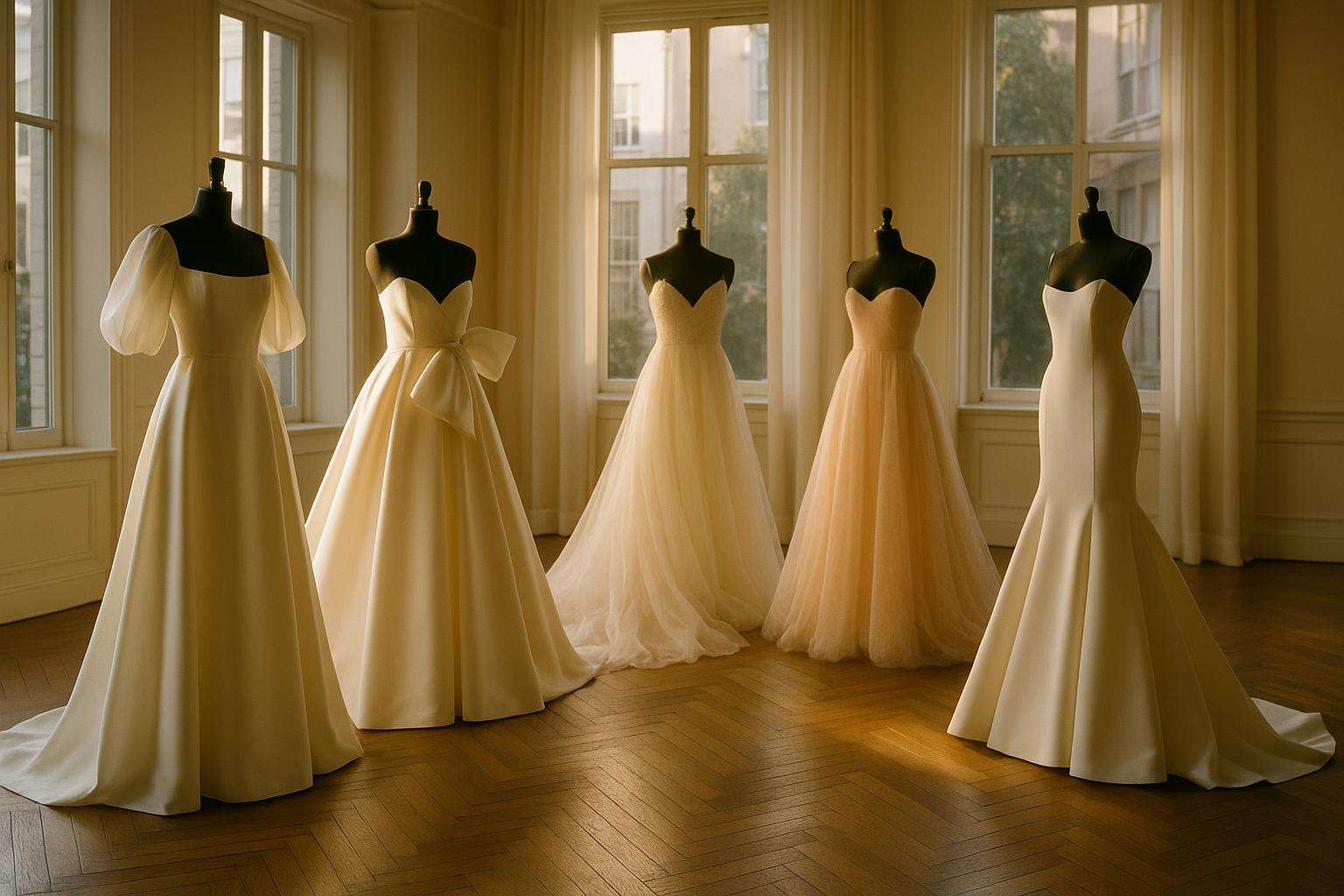
Five micro-trends defined the 2025 bridal season: sculptural sleeves, statement bows, oversized cathedral trains, non-white and pastel-colored gowns, and detachable or convertible elements. Each is led by a distinct cluster of designers, reaches a different price tier, and carries its own longevity curve through 2026 and 2027 — this guide maps all five.
What is driving the return to maximalism in 2025 bridal fashion?
After several seasons of clean, unadorned minimalism, New York Bridal Fashion Week 2025 marked an industry-wide pivot. The signal was not subtle: Wedding Sparrow's NYBFW recap described the tone as "maximalism with intentionality rather than excess" — volume and embellishment returned, but anchored to specific detail choices rather than head-to-toe spectacle. Kleinfeld Bridal, the flagship luxury salon in New York City, sent its merchandising team to NYBFW and identified six headline trends: fairytale ball gowns, bridal separates, evolved lace, high necklines, modern minimalism, and — most prominently — bows.
The international picture echoed the same pivot. Barcelona Bridal Fashion Week 2025 (April 23–27) brought together 44 runway presentations and nearly 450 brands from 32 countries, with Vivienne Westwood's inaugural Bridal Collection 2026 — presented at the University of Barcelona's historic cloister — signalling that the moment was genuinely cross-market rather than purely American. Viero Bridal's trend report for 2025–2026 confirmed the pattern: basque waists, corsetry, exaggerated bows, and puff sleeves were flagged as the defining silhouette details heading into the next calendar year.
What follows is a trend-by-trend breakdown of the five micro-categories with the widest runway consensus, the strongest salon-floor sales signal, and the most credible longevity into 2026 and beyond.
What makes sculptural sleeves one of 2025's most versatile bridal trends?
The sleeve trend in 2025 is notable for its breadth rather than a single dominant shape. Rather than one canonical sleeve, designers fragmented across a wide spectrum: puffed tulle volumes at one end, delicate cap sleeves and sheer illusion details at the other — with detachable sleeve options bridging the two commercial audiences. Lovestbrides documented a "captivating duality" in 2025 collections: clean minimalist gowns paired with expressive sleeves as a deliberate counterpoint. Vera Wang, Amsale, Monique Lhuillier, Danielle Frankel, and Elie Saab all showed gowns contrasting sculpted silhouettes with statement sleeve work.
At NYBFW, the tulle puff sleeve emerged as a runway standout, with designers leaning into voluminous constructions in light chiffon, organza, and tulle to strip historical stiffness from the form. Milla Nova's La Maison Rose collection revived voluminous sleeves directly from the designer's mother's 1989 gown, reinterpreted in modern construction — a move that captured both the nostalgic and directional notes of the trend simultaneously.
The counter-movement is equally significant for real brides. British couture designer Phillipa Lepley (Chelsea, London; starting at £6,500) offered a precise observation to Hello Magazine: "Rather than bell sleeves, we're seeing lots of textured lace and delicate flowing silks, playing into the romantic vibe." Her 'Christobal Lattice' gown features hand-embroidered sleeves as a focused decorative detail rather than a volumetric statement — proof that the sleeve category spans from maximum drama to quiet artisanal restraint.
Longevity forecast: Medium-High. The sleeve trend is fragmenting rather than fading. Subtle sleeve details — cap, sheer illusion, delicate lace — are gaining ground as a longer-cycle classic, while the maximalist puff sits in a tighter 2025–2026 peak window. Detachable versions extend the commercial lifespan by covering both audiences in a single SKU.
Why are bows the defining embellishment of the 2025 bridal season?
Bows were the single most cited detail across every editorial source covering 2025 bridal fashion — a remarkable degree of cross-market consensus. Sareh Nouri's NYBFW collection was described as "brimming with three-dimensional florals, oversized bows, and ultra-classic ball gowns." Ricca Sposa (designer Yuliia Lobachova) featured oversized bow decals as signature motifs across handbeaded fabrications. Kleinfeld Bridal called out bows as a standalone trend in its official NYBFW recap: "from subtle accents to bold statements, bows are making an impact across bridal fashion."
Monique Lhuillier's Spring 2025 bridal and Bliss collections embedded bows at nearly every scale. Specific styles include a strapless Mikado and tulle drop-waist ball gown with a bow-draped necklace detail; an off-the-shoulder trumpet gown with a bow neckline; embroidered sequin lace gowns with bow finishes; and, in the Bliss accessible-luxury line, a V-neck satin ball gown with slit that ships with a detachable Mikado bow train — allowing the bow to function as a removable accent. Asher Lane Bridal documented celebrity-driven momentum: Sophia Bush's widely photographed oversized-bow gown accelerated consumer search interest in bow-detailed bridal styles in 2025.
Longevity confirmation has already arrived from the 2026 runway: oversized bows and their scaled-down cousins — tiny bow ties, per Hayley Paige and HONOR — remain prominent in Spring 2026 collections, with editorial projections extending the trend into 2027.
Longevity forecast: High. Bow details are cycling from maximalist oversized (2025 peak) toward refined micro-bow accents heading into 2027, consistent with how the trend evolved in ready-to-wear. The design vocabulary is broad enough to sustain multi-year commercial relevance at every price tier.
How dramatic are the trains on 2025 wedding gowns — and which designers lead this trend?
Cathedral-length and Watteau trains are in editorial consensus as a 2025 standard for ceremony drama. Pronovias — founded Barcelona, 1922, and available at Kleinfeld and in 105+ countries — specifically cited "oversized bows and dramatic trains" as the season's showstopping combination in its design team commentary. The Bridal Council's Fall/Winter 2025 report identified Watteau trains (flowing from the shoulders rather than the waist, and named after the French Rococo painter) as the specific silhouette gaining traction with ateliers moving away from conventional floor-length hems.
Zuhair Murad's Fall 2026 Mariage collection leaned further into cathedral-worthy trains with hand-beading and intricate embroidery. Kleinfeld Bridal's 2025 trend report noted the fairytale ball gown revival as the anchor category driving renewed interest in dramatic length. Ines Di Santo and Sareh Nouri both showed extended trains as part of collections that otherwise balanced structural architecture with feminine detail.
The practical counterpart to the dramatic train is the detachable train: Pronovias' convertible collection allows brides to remove the train post-ceremony for a fitted mermaid silhouette at the reception. Monique Lhuillier's Spring 2025 Bliss collection ships several styles with detachable Mikado cape trains expressly for this ceremony-to-reception use case — bridging this trend directly into the detachable elements category below.
Longevity forecast: High. Cathedral trains are a perennial bridal category with genuine longevity — the 2025 trend amplifies them rather than redefining them. Watteau and asymmetric variations give the category editorial freshness into 2026 and 2027 without requiring the silhouette to reinvent itself.
Are colored wedding dresses actually selling in 2025, or is it still mostly editorial?
Non-white and non-ivory gowns are moving from novelty into meaningful market share — but the honest answer requires a clear distinction between editorial color and commercial color. Soft pastels represent the genuine trend; saturated bold hues generate attention but remain edge-case sales. The most credible sources identify the leading palette as blush pink, powder blue, champagne, and lavender.
Couture designer Phillipa Lepley offered precise insight in her Hello Magazine interview: brides are "including a subtle splash of colour," most commonly through embroidery in pale pink, gold, or blue, with blue emerging as "the new favourite" at her Chelsea atelier. Galia Lahav leads the colored-gown category at the luxury end, showcasing blush and champagne ball gowns with double-scooped corsets, low basque waists, and multi-layered tulle adorned with hand-beaded appliqués — as well as crimson floral lace designs for the most confident buyer. The brand's accessible line RE:GALIA also pursues colored palettes in a sustainable secondhand framework.
At accessible price tiers, True Society bridal shops (multi-location US chain) report strong demand in soft blush and champagne from designers Essense of Australia and Stella York, with gowns available from $2,500–$3,000 and below. HONOR's collection in pistachio green, dreamy lilac, and warm blush — documented by Wezoree — confirms the color breadth now reaching retail. Pinterest's internal data referenced across bridal editorial shows searches for "unique wedding dresses" up more than 200%, serving as a proxy for non-traditional color interest.
Longevity forecast: Medium-High. Soft pastels (blush, champagne, powder blue) carry the strongest longevity, aligned with the broader luxury fashion market's ongoing neutral-palette movement. Bold saturated colors — emerald, burgundy, black — remain editorial rather than mass-market and carry shorter trend cycles. Brides choosing pastels are investing in a safe horizon through 2026 and beyond.
What are detachable wedding dresses and why are they one of 2025's most commercially resonant trends?
Convertible bridal architecture — dresses designed to transform from ceremony to reception via removable overskirts, trains, sleeves, or capes — emerged as one of 2025's most commercially meaningful trends because it solves a real buyer problem: two distinct looks at the price of one gown. The category intersects directly with the contemporary reception-dress culture and the broader two-look expectation that has solidified across modern wedding formats.
Pronovias documents the full range: detachable cape, overskirt, sleeves, and train, each engineered for independent removal. Reem Acra's Spring 2025 collection — stocked at Kleinfeld Bridal — includes the label's "Elegant Detachable Overskirt" (style ASLA-DSKT), a fit-and-flare attachment with cathedral-length pleated train, using crepe sable, silk organza, and tulle as base fabrics with Alençon and Chantilly lace detailing. Monique Lhuillier's Bliss line offers detachable bow trains at accessible-luxury price points. Zuhair Murad and Marchesa address the ultra-luxury segment of the same category.
Sustainability is a secondary driver that extends the trend's commercial logic: detachable elements allow brides to rewear the core gown after modification, supporting the secondhand-bridal and eco-conscious purchasing narrative documented by Wezoree and Country & Town House.
| Trend | Lead Designers | Entry Price Access | Longevity Forecast |
|---|---|---|---|
| Sculptural Sleeves | Monique Lhuillier, Vera Wang, Milla Nova, Elie Saab, Phillipa Lepley | Essense of Australia from ~$1,500; Phillipa Lepley couture from £6,500 | Medium-High — delicate sleeve details becoming long-cycle; maximalist puff peaks 2025–2026 |
| Statement Bows | Monique Lhuillier, Sareh Nouri, Hayley Paige, HONOR, Ricca Sposa | Monique Lhuillier Bliss from ~$2,000; HONOR ready-to-wear | High — cycling from oversized to micro-bow; strong through 2027 |
| Oversized / Cathedral Trains | Pronovias, Zuhair Murad, Monique Lhuillier, Sareh Nouri, Ines Di Santo | Pronovias ready-to-wear from ~$2,000; Maggie Sottero from ~$1,400 | High — perennial category amplified; Watteau variation adds editorial freshness to 2027 |
| Colored Gowns (pastels) | Galia Lahav, Phillipa Lepley, HONOR, Rosa Clará, Hayley Paige | Stella York / Essense of Australia from ~$1,500–$2,500 at True Society | Medium-High — soft pastels align with luxury neutral trend; strong through 2026 |
| Detachable Elements | Pronovias, Reem Acra, Monique Lhuillier Bliss, Galia Lahav, Zuhair Murad | Monique Lhuillier Bliss detachable bow trains from ~$2,000; Pronovias from ~$2,000 | Rising / Long-cycle — functionality + fashion creates durable commercial category |
Longevity forecast: Rising / Long-cycle. Detachable elements combine functionality with fashion — a pairing that creates durable commercial trends rather than seasonal spikes. As the two-look ceremony-to-reception expectation continues to solidify across modern weddings, convertibility is becoming a permanent product category rather than a passing trend.
How do you tell which 2025 bridal trends will actually reach boutiques versus stay on the runway?
Not every runway trend makes the journey to boutique floors — and the 12-to-18-month runway-to-retail lag in the bridal industry means a gown shown at NYBFW or Barcelona Bridal Fashion Week in early 2025 may not arrive at your local salon until spring 2026. The surest filter is commercial echo: when multiple unrelated designers show the same direction in the same season and mid-market commercial houses such as Maggie Sottero ($1,200–$3,200 at authorized boutiques) and Essense of Australia ($1,500–$3,100) adopt the trend within one cycle, it is a reliable signal that it will reach real appointments on real brides.
All five micro-trends profiled here meet that test. Bows, sculptural sleeves, dramatic trains, soft pastel colors, and convertible elements all appeared across both NYBFW and Barcelona Bridal Fashion Week simultaneously in 2025, and all have mid-market commercial echoes in current authorized boutique stock. The editorial novelties that will not reach your appointment — feather-forward "Swancore" silhouettes, chainmail headpieces, extreme structural couture labeled "Runway Only" by Monique Lhuillier herself — are dazzling but explicitly not retail products.
When you book an appointment at Kleinfeld Bridal in New York, a True Society location, or any authorized designer boutique, ask your stylist directly: is this style available as a current floor sample, a special order (typically a six-to-ten-month wait), or a trunk-show exclusive? The answer reveals exactly where a trend sits on the runway-to-retail spectrum — and helps you plan your shopping timeline accordingly. Most experts recommend starting your dress search 10 to 12 months before your wedding date to access current collection cycles without incurring rush-production fees.
Considered Counsel
Frequently asked
What are the biggest wedding dress trends for 2025?
The five micro-trends with the strongest runway and salon-floor consensus for 2025 are: sculptural and layered sleeves (from puff tulle to delicate sheer illusion), statement bow embellishments at every scale, oversized and cathedral-length trains (particularly Watteau trains flowing from the shoulder), non-white and non-ivory gowns in soft pastels such as blush, champagne, and powder blue, and detachable or convertible elements — overskirts, trains, sleeves, and capes engineered for removal after the ceremony. These were documented across New York Bridal Fashion Week, Barcelona Bridal Fashion Week, and major US salon editorial coverage in 2025.
Which designers are leading the bow-detail bridal trend in 2025?
Monique Lhuillier embedded oversized bows at nearly every scale across her Spring 2025 bridal and Bliss collections — including a detachable bow-train attachment in the Bliss line. Sareh Nouri's NYBFW collection was described as 'brimming with three-dimensional florals and oversized bows.' Ricca Sposa (designer Yuliia Lobachova) featured oversized bow decals as signature motifs across handbeaded fabrications. Hayley Paige and HONOR brought scaled-down micro-bow tie accents into their 2026 collections, confirming the trend's longevity beyond the initial oversized-bow moment.
Are colored wedding dresses popular in 2025?
Yes, with a meaningful distinction: soft pastels — blush pink, champagne, powder blue, and lavender — are the palette with genuine commercial traction in 2025, not saturated bold hues. Couture designer Phillipa Lepley, speaking to Hello Magazine, noted brides are adding 'a subtle splash of colour,' with pale blue emerging as her atelier's new favourite. Galia Lahav leads the luxury colored-gown category with blush and champagne ball gowns; at accessible price tiers, True Society bridal shops report strong demand in soft blush and champagne from Essense of Australia and Stella York. Bold saturated colors remain editorial rather than mainstream.
What is a detachable wedding dress and why are brides choosing them?
A detachable or convertible wedding dress is engineered with elements — an overskirt, train, sleeves, or cape — designed for independent removal after the ceremony, transforming the look for the reception. The appeal is practical: one gown investment delivers two distinct looks without a full dress change. Pronovias documents the full range of the category: detachable cape, overskirt, sleeves, and train, each removable independently. Reem Acra's style ASLA-DSKT at Kleinfeld Bridal is a specific example of a luxury detachable overskirt, while Monique Lhuillier's Bliss line offers detachable Mikado bow trains at accessible-luxury price points. Sustainability is a secondary driver, allowing brides to rewear or resell the core gown after modification.
How long will the oversized train wedding dress trend last?
Cathedral and dramatic trains carry a high longevity forecast because they are a perennial bridal category that the 2025 season has amplified rather than reinvented. Watteau trains — which flow from the shoulders rather than the waist — and asymmetric variations are giving editorial freshness to the category and are expected to sustain coverage into 2026 and 2027 without the silhouette needing to reinvent itself. The current trend cycle reinforces, rather than challenges, the classic cathedral train, making it a strong investment for brides who want a timeless dramatic gown rather than a trend-specific one.
What is a Watteau train and is it a 2025 bridal trend?
A Watteau train — named after the French Rococo painter Jean-Antoine Watteau, whose works frequently depicted women in flowing back-draped mantles — flows from the back of the shoulders or neckline rather than from the waist or skirt. The Bridal Council's Fall/Winter 2025 trend report identified Watteau trains as a specific silhouette gaining traction with ateliers moving away from conventional floor-length hems and standard waist-attached cathedral trains. The effect creates an unusual visual drama: the silhouette from the front is relatively clean, while the back reveals an elaborate flowing panel. Ines Di Santo and several couture houses featured interpretations in their 2025 collections.
Which bridal salons carry convertible wedding dresses with detachable skirts?
Kleinfeld Bridal in New York City carries the Reem Acra ASLA-DSKT Elegant Detachable Overskirt and multiple other convertible styles from their design partner roster. Pronovias — available at Kleinfeld and 105+ countries — has a dedicated convertible editorial and sells detachable-element gowns at authorized boutiques globally. True Society bridal shops (multi-location US chain) carry mid-range convertible styles. BHLDN, Anthropologie's bridal division, offers detachable-element styles online and in stores. When shopping, ask specifically whether the detachable element is included in the listed price or sold separately — practices vary significantly by designer and retailer.