Dress Shopping
Bridal Appointment Etiquette: How to Behave at a Salon
What to wear, what to bring, how many guests to invite, whether to tip your consultant, and how to handle the no-hard-sell expectation — the complete etiquette guide for a first bridal dress appointment at any salon type.
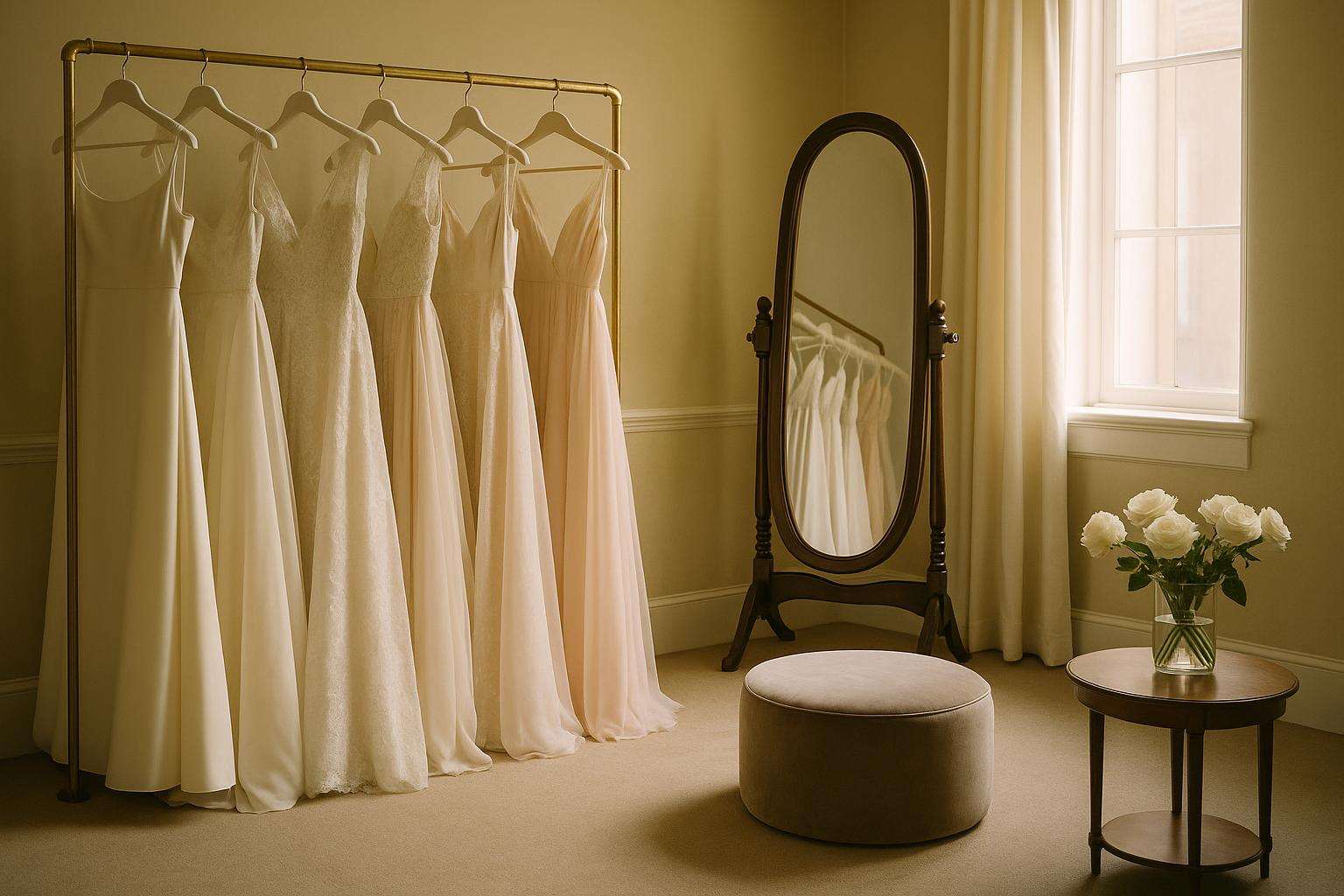
Bridal appointment etiquette comes down to one principle: arrive prepared so the appointment stays focused on the dresses, not on logistics. That means knowing your budget before the consultant pulls a single gown, wearing the right undergarments, limiting your guest list to two or four trusted voices, and understanding the no-hard-sell norm that governs every reputable salon. The bride who arrives ready is the bride the salon loves — and the one who usually says yes to the right dress.
Walking into a bridal salon for the first time feels, for many brides, like arriving at an unfamiliar restaurant where everyone else seems to know the menu. The appointments are timed. The consultants are professionals. The samples are delicate. And there is an unwritten set of expectations that shapes every interaction — expectations that most boutiques assume brides already know.
They don't. And that gap costs appointments their best energy, replacing it with avoidable friction: a guest who makes the bride feel guilty for loving a gown, a consultant who can't help because she doesn't know the budget, a booking fee that surprised the bride when she arrived. This guide covers everything a bride needs to know before she books, before she arrives, and before the first zipper goes up.
What Should You Wear to a Bridal Appointment?
The appointment will involve getting dressed and undressed multiple times in a small space, often on a pedestal in front of your guests. What you wear to the salon matters more than most brides expect.
Choose an easy-to-remove top — nothing with a complex neckline, a bodysuit that requires unhooking, or a turtleneck that has to be pulled over your head while a consultant holds a $3,000 sample gown out of the way. Comfortable bottoms that allow you to step up onto a fitting pedestal easily are the practical choice. The most important prep, however, is undergarments.
Wear nude underwear. White underwear shows through white and ivory fabric; nude reads as invisible. Bring or wear a strapless bra if you are considering off-the-shoulder or strapless silhouettes — both of which represent a large portion of the bridal market from designers like Vera Wang, Maggie Sottero, and Essense of Australia. Most bridal gowns have built-in boning and cups, so a bra is often unnecessary once you are actually in the dress, but having one on arrival keeps the session moving efficiently.
Wear shoes with a heel close to your intended wedding-day height. This is not about aesthetics — it is about hem accuracy. A bridal consultant needs to see how the skirt falls at your actual standing height to make accurate judgments about length and train. Kleinfeld Bridal, which has dressed brides for over seventy years from its 30,000-square-foot salon at 110 West 20th Street in Manhattan, lists appropriate footwear as one of their top preparation recommendations for every appointment tier.
Avoid fresh self-tanner, transfer-prone makeup, and heavy perfume. Sample gowns are worn by many brides before they are ever purchased, and staining or scenting them is considered a significant breach of etiquette. Grace Loves Lace, the Australian bridal brand with 26 showrooms globally, specifically requests that brides arrive spray-tan free.
What Should You Bring to a Bridal Appointment?
| Item | Why It Matters | Source |
|---|---|---|
| A stated budget | Prevents the consultant from pulling out-of-range gowns; protects you from falling in love with a dress that causes financial stress | DaVinci Bridal, Lovella Bridal |
| Inspiration photos | A curated visual reference resolves vocabulary gaps — “simple” and “romantic” mean different things to every bride and every consultant | Maggie Sottero, Lovella Bridal |
| Heel-height shoes | Lets the consultant see how the hem falls at your real standing height | Kleinfeld Bridal |
| Shapewear (if you plan to wear it) | Gives an accurate fit reading of each silhouette; the body the dress needs to fit is the body you will have on the wedding day | Grace Loves Lace, Princess Bridals |
| Existing accessories | A veil, headpiece, or heirloom earring reveals compatibility — or conflict — with the gown silhouettes you try | Maggie Sottero |
| Hair ties and pins | Allows you to test updo and down styles mid-appointment; changes how the back of the dress reads dramatically | Princess Bridals |
| A note-taking method | If photography is restricted, a guest who records style numbers and designer names preserves your options | DaVinci Bridal |
The single most valuable item on this list — according to Lovella Bridal's official styling guide and Maggie Sottero's wedding dress shopping checklist — is the inspiration photo. Not an open Pinterest board of 400 pins, but a curated edit of six to twelve images that represent what you are actually drawn to. The vocabulary mismatch between brides and consultants is real: “simple,” “romantic,” “timeless,” and “modern” are not shared terms. A photo resolves that instantly.
How Many Guests Should You Bring to a Bridal Appointment?
The professional consensus across independent boutiques is two to four guests maximum. This figure appears in the appointment guidelines of Elizabeth Scott Bridal in Burleson, Texas, Atlanta Street Bridal Company in Atlanta, Georgia, Sofia Bella Bridal, and most other boutiques with published guidance.
Some salons enforce it as a hard limit. Kleinfeld Bridal formally asks brides to bring no more than three guests; that limit tightens on Saturdays when the showroom is at peak occupancy. BHLDN locations (now operating under the Anthropologie Weddings banner across Phoenix, Los Angeles, Denver, Chicago, New York, Washington D.C., Atlanta, and more) vary by location but apply similar restrictions.
The constraint is not primarily about physical space. It is about decision quality. A bride navigating four competing opinions has less access to her own instincts than a bride with one trusted companion. Savvy Bridal, with boutiques in Kansas City and St. Louis, Missouri, notes that the guests who most frequently derail appointments are those who respond to how a gown looks on the hanger rather than how it looks on the bride — which are entirely different things. Invite only people who know your personal aesthetic and who will speak to your experience in the dress, not to their own taste.
If your circle is larger than four, consider a practical solution: bring two or three people to the first appointment, then schedule a second visit to share the finalists with anyone who couldn't attend.
How Do You Handle a Pushy Sales Situation — and What Is the No-Hard-Sell Norm?
The vast majority of reputable bridal boutiques — from Kleinfeld Bridal at the high end to regional independents — operate under a culture of earned trust, not pressure. A consultant who pushes a bride toward a gown she does not love is generating a return, a bad review, and a reputational problem all at once. The business logic of the bridal industry does not support high-pressure sales.
What looks like a hard sell is often a communication gap. When a consultant pushes a particular dress, she is usually reading something in your reaction that you have not articulated — a hesitation about budget, a concern about a silhouette detail, or a comparison to another gown she thinks would serve you better. The most effective response is directness: “I love the lace, but the skirt feels too voluminous for me — can we try something with less volume in a similar fabric?” is more productive than a polite non-committal.
If you feel a genuine pressure to purchase before you are ready, it is entirely within your rights to say, “I need to sleep on this and I'll call you tomorrow.” A boutique that does not accept that answer is not a boutique you should order from. DaVinci Bridal's etiquette guide notes that reputable bridal salons understand the weight of the decision and expect brides to take time — this is a purchase that averages $1,500 to over $5,000, and the right salon treats it accordingly.
What Are the Tipping Norms for Bridal Consultants?
Tipping norms in bridal retail are less codified than in, say, restaurant service, and they vary significantly by business model. At chain retailers with structured commission systems — including David's Bridal's national network — consultants are typically compensated through salary and commission, and tipping is less common.
At independent boutiques, the picture is different. Bridal consultants at independent salons often earn a base wage with commission, and the physical and emotional labor of an appointment is substantial: dressing and undressing a bride in heavy, structured gowns multiple times, managing group dynamics, prepping the suite, and bringing genuine expertise to every gown pull. Lovella Bridal in Glendale, California — one of the country's most respected independent boutiques, carrying designers including Pronovias, Maggie Sottero, and Sottero and Midgley — has published explicit guidance on this: a gratuity is not required, but it is a meaningful acknowledgment of the consultant's work.
A practical range for independent boutique appointments: $20–$50 for a standard session, more for extended or multi-hour appointments or where the consultant went above and beyond. If you did not find your dress, tipping is still appropriate — the consultant's effort is not contingent on a sale. If tipping feels awkward in the moment, a detailed online review naming the consultant is a genuinely valued alternative in an industry where reputation drives referrals.
What Are the Key Policy Differences Between Salon Types?
| Factor | Kleinfeld Bridal | BHLDN / Anthropologie Weddings | Independent Boutique |
|---|---|---|---|
| Appointment length | 90 min standard / 3 hr VIP | ~60 minutes | 60–120+ minutes (tiered) |
| Booking fee | $100–$125 weekends (applied to purchase) | None confirmed | $0–$199 depending on tier |
| Guest limit | 3 guests recommended | Varies by location | Typically 2–6; varies by suite |
| Photography | Permitted in most areas | Ask at booking | Varies; exclusives often restricted |
| Walk-ins | Not accepted | Not accepted | Rarely accepted |
| Price range | $2,500–$20,000+ | $500–$2,500 | $1,200–$14,000+ (wide) |
| Tipping norm | Less common (commission model) | Less common (chain model) | $20–$50; appreciated |
Photography policy is the most variable and the most consequential to check in advance. Some boutiques — particularly those carrying exclusive regional bridal lines or gowns from European designers — prohibit in-appointment photography to protect their inventory from counterfeit reproduction and from competitor intelligence-gathering. Others permit it freely. Savvy Bridal in Kansas City explicitly allows photos; Wedding Atelier NYC and similar luxury boutiques may restrict them. The rule of thumb: check the policy when you book, not when you arrive with your phone out.
How Do You Become the Bride a Salon Loves?
The bride who makes an appointment run well is the bride who arrives prepared, communicates honestly, and trusts the process. In practical terms, this means:
Tell the consultant your real budget at the start. Not a number ten percent under your ceiling, not a vague range — your actual ceiling. The consultant's entire pull strategy is built on this number. A bride who says “I'd like to stay under $2,500” and then falls in love with a $4,200 Sottero & Midgley gown is not served by the ambiguity; she is hurt by it.
Try the dress the consultant suggests, even if the hanger read is wrong. DaVinci Bridal's etiquette guide, Savvy Bridal's published appointment tips, and virtually every boutique's guidance include a version of the same observation: gowns read entirely differently on the body than on the rack. The shape, the way fabric moves, the way a neckline frames a face — these are invisible on a hanger and immediate when worn. A consultant who pulls a gown you would never have chosen has usually seen something in your proportions or your reaction that you haven't articulated. Try it.
Be direct about what is not working. A good consultant is not offended by “the waist sits too high for me” or “I want less skirt volume than this.” She is helped by it. Vague feedback — “I'm not sure, it's nice...” — costs time and produces more of the same. Specificity moves the session forward.
Manage your guest party, not your consultant. If opinions are conflicting, redirect guests by asking them to speak to how the dress looks on you — not whether they like the style in the abstract. Your bridal stylist is trained in group-dynamic management and can diplomatically refocus an unruly session if you lean on that expertise.
Most brides need four to six appointments across multiple boutiques before they find their dress, according to industry estimates from Essense of Australia's planning guides. That timeline is normal. The etiquette playbook above does not guarantee a “yes” at the first appointment — but it does guarantee that every appointment is spent on what matters: the gowns.
Considered Counsel
Frequently asked
What should you wear to a bridal dress appointment?
Choose an easy-to-remove top — nothing with a complicated neckline, turtleneck, or bodysuit that makes undressing slow. The most important prep is undergarments: wear nude underwear (nude reads as invisible under white and ivory samples) and bring a strapless bra if you plan to try off-the-shoulder or strapless silhouettes. Most bridal gowns have built-in boning and cups, so a bra is often not necessary inside the dress, but having one on arrival keeps things moving. Wear or bring shoes close to your intended wedding-day heel height so the consultant can read the hem accurately. Avoid fresh self-tanner, heavy perfume, or transfer-prone makeup, which can stain samples. Grace Loves Lace, which operates 26 showrooms globally, specifically asks brides to arrive free of spray tan.
How many guests should you bring to a bridal appointment?
The professional consensus across independent boutiques — including Elizabeth Scott Bridal in Burleson, Texas, Atlanta Street Bridal Company in Atlanta, and Sofia Bella Bridal — is two to four guests maximum. Some salons enforce hard caps: Kleinfeld Bridal asks brides to bring no more than three guests, and that limit tightens on weekend appointments due to showroom traffic. The logic is social, not spatial. A larger group introduces competing opinions, and decision fatigue sets in faster when the bride is managing a crowd rather than her own reactions. Bring only people who know your personal style and will reinforce rather than override your instincts. If you need to invite more people, consider a second appointment for family who couldn't attend the first.
Should you tip your bridal consultant?
Tipping is not universally mandated in bridal retail, but it is genuinely appreciated and increasingly standard at independent boutiques. Lovella Bridal in Glendale, California, one of the country's most respected independent salons, notes that a gratuity acknowledges significant physical and emotional labor: the consultant dresses and undresses the bride in heavy gowns repeatedly, preps the suite, manages guest dynamics, and invests real expertise in the pull. At major salons and chain retailers like David's Bridal, consultants are typically salaried or earn commission, so tipping customs differ. At independent boutiques, $20–$50 is a common range for a standard appointment; more is appropriate for an extended session or an exceptional experience. When in doubt, a thank-you note and an online review are meaningful alternatives.
What is the difference between a Kleinfeld standard and VIP appointment?
Kleinfeld Bridal offers two appointment tiers at its Manhattan salon at 110 West 20th Street. The standard appointment runs 90 minutes and is available seven days a week; weekend slots carry a booking fee ($125 Saturday, $100 Sunday) that applies toward the gown purchase if you buy. The VIP appointment runs three hours and provides a private viewing area, dedicated stylist, and refreshments — it is designed for brides who want an unhurried, exclusive experience and is especially popular for large bridal parties. Both tiers require advance booking; Kleinfeld does not accept walk-ins. Cancellations for either tier require 48 hours' notice to avoid a $100 cancellation fee.
Can you take photos during a bridal appointment?
Photography policy varies by boutique and sometimes by brand. Savvy Bridal, with locations in Kansas City and St. Louis, Missouri, permits in-appointment photography. Many independent boutiques do the same. However, boutiques carrying exclusive regional bridal lines or designer exclusivity agreements — particularly those stocking European designers like Pronovias or independent couture — may restrict photography to protect inventory from counterfeit reproduction and competitor intelligence. Bridal Buyer, the UK trade journal, has documented boutique owners banning photography for exactly these reasons. Always ask the salon's policy when you book, not when you arrive. If photography is restricted, bring a guest who can write down style numbers, designer names, and distinguishing details for later reference.
What should you bring to a bridal appointment?
The essentials: a clearly stated budget (tell the consultant your ceiling before she pulls any gowns — it prevents the heartbreak of falling for a dress that is $2,000 over range), a curated inspiration folder rather than an open Pinterest board, shoes near your intended wedding-day heel height, and any shapewear or Spanx you plan to wear on the wedding day. Maggie Sottero's official styling guide emphasizes that existing accessories — a veil, headpiece, or grandmother's earrings — are worth bringing to test compatibility with silhouettes. Hair ties let you test both updo and down styles mid-appointment. The single most valuable item, according to Lovella Bridal's checklist, is the inspiration photo: a visual reference does more work than verbal description because the vocabulary brides and consultants use for silhouettes rarely matches.
How long does a bridal appointment typically take?
Appointment lengths vary meaningfully by retailer type. Kleinfeld's standard appointment is 90 minutes; VIP appointments run three hours. BHLDN (now operating as Anthropologie Weddings) books 60-minute in-person appointments, with consultants estimating that brides can realistically try seven to ten gowns in that window, including second looks. Independent boutiques range more widely: some offer 60-minute standard sessions, while premium or private appointments can run 90 minutes to two hours or more. Blueberry Bridal Boutique, for example, offers tiered appointment structures from a 30-minute exploratory session to a two-hour private appointment for the bride and up to eight guests. Arrive five to ten minutes early — most boutiques run back-to-back bookings and cannot absorb a late start.