Dress Shopping
Bridal Sample Sale Guide: Designer Gowns at 20-70% Off
How the twice-yearly boutique inventory cycle creates January and June peaks, what the as-is sizing caveats really mean, and how to net out the true cost once alterations are on the bill.
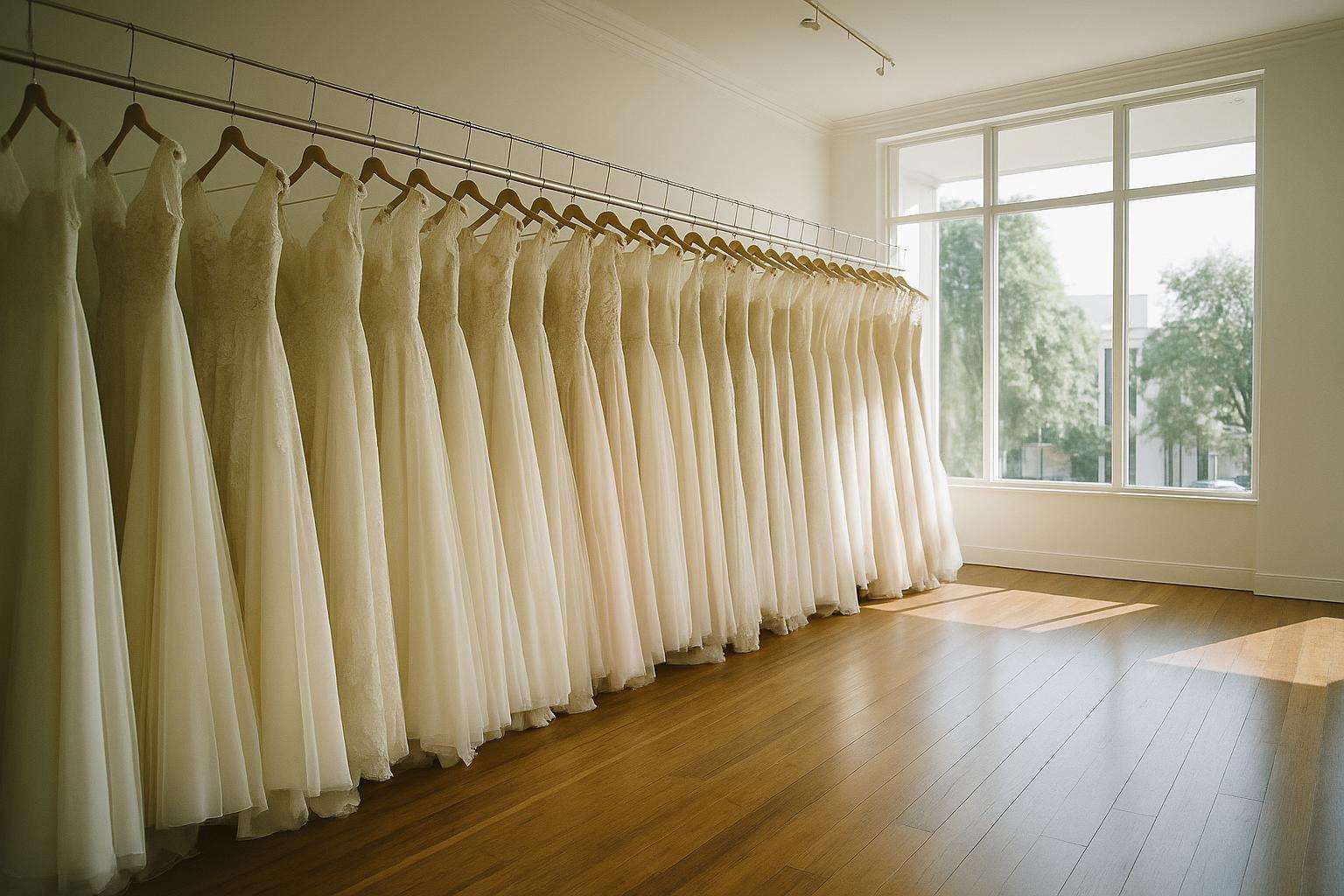
A bridal sample sale is a boutique's twice-yearly clearance of floor-model designer gowns — dresses that have been tried on but never worn at a wedding — sold off the rack at 20–70% off retail. The January and June/July calendar peaks offer the widest selection. True cost = sale price + alterations ($500–$800 on average) + cleaning ($75–$300), but the net saving over a new order is almost always substantial.
The path to a designer wedding gown does not have to run through a nine-month special-order wait and a full-retail price tag. Bridal boutiques hold sample sales twice a year — clearing out floor models to make room for incoming collections — and those events put gowns from Vera Wang, Pronovias, Maggie Sottero, Hayley Paige, Jenny Packham, and Justin Alexander on a rack at a fraction of what they cost new. Understanding how the sale calendar works, which flagship events are worth planning around, and how to calculate the true cost before you fall in love with a gown will put you in the best possible position to leave with a dress you adore and a budget still intact.
How Does the Bridal Inventory Cycle Create Sample Sales?
The bridal industry runs on a twice-yearly fashion market rhythm. Designers debut new collections at bridal market in April and October. Boutiques place orders at market, and the new gowns arrive in stores roughly three months later — in July/August (from the April market) and in January/February (from the October market). When that fresh inventory lands, the gowns that have been on the floor for six-to-twelve months need to go.
Those floor models — called samples — are the backbone of the bridal try-on experience. Every time a bride books an appointment and slips into a gown to see whether the silhouette works, she is wearing a sample. Over time, samples accumulate the evidence of that work: slight hem dirt from the floor, minor beading that has come loose, a faint mark at the bodice. They are technically unworn outside the boutique, but they carry the patina of their job. The discount — 20% to 70%, sometimes deeper at clearance events — reflects that condition, and almost always more than covers the cost of having a skilled seamstress restore the gown to near-new condition.
The result is four natural discount windows across the calendar year:
- January — the single deepest window, as boutiques clear post-holiday inventory ahead of spring arrivals
- June/July — the mid-year push anchored by the National Bridal Sale Event
- August — a secondary clearance before fall collections land
- September–November — end-of-wedding-season lull; many boutiques discount current inventory to offset slow foot traffic
When Are the January and June Peaks — and What Makes Them Different?
January is the month most consistently cited by boutique consultants and bridal editors as the best single month to hunt for a sample gown. Post-holiday foot traffic is at its annual low, boutiques are highly motivated to clear racks before spring appointments pick up, and the selection of discounted samples is at its widest. Discounts in January typically run 20–60% off retail, with some clearance events reaching higher. Bridal industry advisers consistently recommend calling boutiques in late November or early December — four to six weeks before the January window — to ask whether a sample sale is planned, since many shops announce events only to their email lists.
June/July is the coordinated peak, anchored by the National Bridal Sale Event (NBSE). The 2026 edition runs July 11–19, 2026, with nearly 500 independently owned boutiques participating nationwide. Originally conceived by Sue Maslowski of Jay West Bridal in South Jersey as a single-day local event modelled on Black Friday, the NBSE has grown into a week-long national programme operated by bridal-technology company SYVO. The format varies by boutique — some run pure sample sales, others stage trunk shows, storewide percentage discounts, or package upgrades — but sample gowns starting as low as $499 and veils from $49 are common. Designers regularly featured at NBSE boutiques include Martina Liana, Justin Alexander, Allure Bridals, Maggie Sottero, Lillian West, All Who Wander, and Sophie James.
Which Flagship Events Are Worth Travelling For?
Beyond the calendar-wide windows, a handful of destination events consistently attract brides who plan specifically around them.
Kleinfeld Bridal — Semi-Annual Sample Sale (New York City)
Kleinfeld, the 35,000 sq. ft. flagship on West 20th Street and the location of TLC's Say Yes to the Dress, holds its sample sale twice a year — spring and fall — by appointment only, with bookings opening approximately three months in advance. The March 2025 edition integrated pre-owned gowns from KleinfeldAgain.com — Kleinfeld's resale marketplace — alongside floor samples, spanning more than 800 dresses across 400 appointments. Designers featured have included Pnina Tornai, Vera Wang, Martina Liana, Ines Di Santo, Hayley Paige, Maggie Sottero, Jenny Packham, Randy Fenoli, and Anne Barge. A $5,000 gown routinely sells for under $1,000; the spring 2025 pre-owned range ran $1,400–$13,500. All items must be paid in full and taken home at purchase. Regular-priced inventory is not available for try-on during the event.
True Society Bridal — Annual Sample Sales
True Society, which operates boutiques across multiple US markets, runs branded sample sales — most recently in June and September 2025 — offering up to 70% off designer gowns. Appointments are required and a bridal stylist assists in a private fitting room session, making this one of the more curated sample sale experiences available outside New York.
Monique Lhuillier — Los Angeles Sample Sale (Vernon, CA)
Monique Lhuillier's annual Los Angeles sale, typically held in December at the brand's Vernon warehouse, offers gowns from the Platinum, Signature, and Bliss collections at 40–90%+ off, with prices historically ranging from $25 to $3,000 on a first-come, first-served basis. No appointments: doors open and the line determines priority.
anna bé / a&bé Bridal Shop — Warehouse Sales & Off-the-Rack
anna bé bridal boutique (flagship in Denver, CO; also Dallas, TX) and sister brand a&bé bridal shop host periodic warehouse sales offering up to 75% off designer samples. They also maintain an ongoing off-the-rack section year-round at 20–60% off, and run the OnceLoved resale platform for pre-owned anna bé and a&bé gowns.
BHLDN (Anthropologie Weddings) — Online Clearance
BHLDN does not stage formal warehouse events, but its website's sale section runs ongoing clearance, with the deepest markdowns in January (post-holiday) and March/April (winter-to-summer transition). End-of-season BHLDN samples also surface on Stillwhite and Nearly Newlywed, the two largest US pre-owned bridal marketplaces.
What Are the As-Is Sizing Caveats — and How Much Can You Alter a Sample?
This is the most important practical constraint of sample sale shopping, and it deserves an honest answer before you get attached to a gown.
Sample dresses exist in the size the boutique ordered for their floor, which is determined by the designer's standard sample size recommendation. In practice, most sample gowns run in bridal sizes 8–12, which corresponds approximately to street sizes 4–10 — though Kleinfeld, given its inventory volume, carries samples spanning bridal sizes 6–24. Bridal sizing itself runs one to two sizes larger than street sizing, so a bridal size 10 typically fits a street size 6–8.
When the sample is larger than you need, a skilled seamstress can take a gown in by up to three full bridal sizes without compromising the silhouette — this is the easier direction and the one most commonly encountered at sample sales. Taking a gown out (making it larger) is more limited: generally one to one-and-a-half sizes, dependent on the seam allowance built into the specific gown. If a sample is more than two sizes too small, put it back.
Before you buy, inspect the gown methodically under good light — ideally near a window. Check: the train and hem for floor scuffs or fraying; the armpits and bodice lining for staining; the zipper and every hook-and-eye closure; all beading and lace appliqués for loose or missing pieces; the outer fabric for snags or tears; and every button and button loop. Ask the stylist directly: “Are there any issues with this gown we haven’t discussed?”
How Do You Calculate the True Cost After Alterations?
The sale price is only the opening number. A realistic total-cost calculation must include alterations and, if the gown has visible marks, professional cleaning. The table below gives current market ranges for the most common services.
| Service | Typical Cost Range | Notes |
|---|---|---|
| Basic hem (simple fabric) | $150–$250 | Chiffon, crepe, plain satin |
| Beaded or lace hem | $400–$600+ | Lace reattachment is labour-intensive |
| Taking in / sizing adjustments | $200–$400 | Bodice, waist, and hips |
| Bodice restructuring | $200–$600 | Boning relocation, cup size adjustment |
| Bustle installation | $75–$250 | Varies by train length and bustle style |
| Strap modification (per strap) | $25–$75 | Shortening or style change |
| Stain treatment / dry cleaning | $75–$300 | Specialist bridal cleaner recommended |
| Full alteration package (elaborate gown) | $500–$700 (can exceed $1,000) | Beaded ballgowns at the higher end |
Worked example: A $3,000 designer gown purchased at a Kleinfeld-style event at 60% off costs $1,200. Add $600 for a full alteration package and $150 for professional cleaning. Total outlay: $1,950. Total saving versus ordering the same gown new: $1,050 — and you leave the sale with a dress in hand rather than waiting six to nine months for production and delivery.
Budget conservatively: plan for $500–$800 in alterations as a baseline unless the gown is close to your measurements and in near-perfect condition. If the gown needs a beaded hem and structural bodice work, $800–$1,000+ is realistic. Run the numbers honestly before you fall in love.
Alteration timeline: Book your seamstress appointment the moment you purchase — top alteration specialists fill up two to four months out, especially in peak wedding season (March–June, September–November). The standard schedule is a first fitting two to three months before the wedding for major structural work, a second fitting four to six weeks out to fine-tune with your actual shoes and undergarments, and a final fitting two to three weeks before the wedding, leaving time for steaming and any last-minute adjustments.
What Practical Steps Make the Difference on Sale Day?
Sample sales move fast and the gowns sell as-is. Going in prepared is the single biggest differentiator between brides who leave with a great result and those who leave with buyer's remorse.
- Know your bridal size before you arrive. Have your measurements (bust, waist, hips) written down, and know how they map to the designer's size chart. Boutique stylists at sales are busy; you will need to make this assessment yourself or with a trusted companion.
- Bring a trusted second opinion, not a committee. One or two people who know your taste and will give you an honest read. Large groups create noise and slow decisions at an event where speed matters.
- Wear or bring your wedding undergarments. Strapless bra, Spanx, or whatever you plan to wear on the day. The gown will sit differently on your body depending on what is underneath it.
- Have a rough alteration budget in mind. A gown that needs $800 in alterations is still a bargain at 60% off a $3,000 retail price — but it may not be a bargain at 20% off a $1,200 retail price. Do the maths on the spot.
- Be prepared to say yes on the day. Sample sales are final sale. There is no taking a night to think about it and returning. If a gown fits well, passes the inspection checklist, and the numbers work, the decision needs to happen in the fitting room.
Pre-owned platforms Stillwhite and Nearly Newlywed offer a lower-pressure alternative for brides who want designer gowns at similar discounts without the time pressure of a sale event. BHLDN, Kleinfeld Again, and anna bé's OnceLoved platform are the most curated options. The trade-off is less selection and a longer search — but no checkout clock.
Considered Counsel
Frequently asked
What is a bridal sample sale and how does it work?
A bridal sample sale is a time-limited event where a boutique sells its floor-model gowns — the dresses brides try on during appointments — at a significant discount, typically 20–70% off retail. Boutiques accumulate samples as new designer collections arrive (usually in January/February and July/August), and they need to clear floor space. The sale dresses are purchased off the rack, taken home the same day, and sold as-is with no returns. They are technically unworn outside the boutique but carry the wear of multiple try-ons: minor marks, loose beading, or hem dirt are common, and most are repairable by a skilled seamstress for far less than the savings.
When is the best time of year to find a bridal sample sale?
The two peak windows are January and June/July. January is widely regarded as the single best month: post-holiday foot traffic drops while boutiques push to clear space for spring arrivals, producing some of the deepest discounts of the year — 20–60% off — with the largest selection. The June/July peak is anchored by the National Bridal Sale Event (NBSE), a week-long programme that runs annually in mid-July (the 2026 edition is scheduled for July 11–19) and involves nearly 500 independent boutiques nationwide. Secondary windows occur in August and November. Calling boutiques four to six weeks before any of these periods to ask whether a sale is planned is strongly recommended — many shops publicise events only via email list and local social media.
What happens at the Kleinfeld Bridal sample sale?
Kleinfeld Bridal — the 35,000 sq. ft. New York City flagship and home of TLC's Say Yes to the Dress — holds its sample sale twice a year, spring and fall, by appointment only with bookings opening approximately three months in advance. The March 2025 edition was the first to integrate pre-owned gowns from KleinfeldAgain.com, Kleinfeld's resale marketplace, alongside floor samples, spanning more than 800 dresses across 400 appointments. Designer names featured have included Pnina Tornai, Vera Wang, Martina Liana, Ines Di Santo, Hayley Paige, Maggie Sottero, Jenny Packham, Randy Fenoli, and Anne Barge. All items must be paid in full and taken home the day of purchase; regular-priced inventory is not available for try-on during the event.
What is the National Bridal Sale Event and when does it happen?
The National Bridal Sale Event (NBSE) is a week-long coordinated discount event involving nearly 500 independently owned bridal boutiques across the United States. Originally conceived by Sue Maslowski of Jay West Bridal in South Jersey as a single-day local event modelled on Black Friday, it has grown into a national programme now operated by bridal-technology company SYVO. Participating boutiques may run sample sales, trunk shows, storewide percentage discounts, or package upgrades — the format varies by location. The 2026 edition is scheduled for July 11–19, 2026. Designers regularly featured at NBSE boutiques include Martina Liana, Justin Alexander, Allure Bridals, Maggie Sottero, and Lillian West, with sample gowns starting as low as $499 and veils from $49.
What should I inspect before buying a sample sale wedding dress?
Sample sale purchases are almost universally final sale — no returns, no exchanges — so a methodical inspection before you commit is essential. Work through the gown systematically: check the train and hem for floor dirt or fraying; examine armpits and bodice lining for deodorant marks or staining; test the zipper and every hook-and-eye closure; run your fingers along all beading and lace appliqués for loose or missing pieces; hold the outer fabric toward natural light to spot pulls or tears; and confirm all buttons and button loops are intact (replacement bridal buttons can be costly to source and colour-match). Ask the salon stylist directly whether there are any issues with the gown that have not been discussed. If damage appears unrepairable or repair cost would eliminate the savings, put the dress back.
How much should I budget for alterations on a sample sale gown?
A realistic baseline for a sample sale alteration budget is $500–$800 unless the gown is very close to your measurements and in near-perfect condition. Line items to anticipate include: basic hem $150–$250 (beaded or lace hem $400–$600+), taking in or sizing adjustments $200–$400, bodice restructuring $200–$600, bustle installation $75–$250, and stain treatment or dry cleaning $75–$300. A full alteration package for an elaborate gown can exceed $1,000. Even accounting for these costs, the savings are typically substantial: a $3,000 designer gown purchased at 60% off for $1,200, then altered for $600 and cleaned for $150, totals $1,950 — a saving of over $1,050 compared with ordering new.
Can I get a designer wedding dress at a bridal sample sale?
Yes — bridal sample sales are one of the most reliable routes to a genuine designer gown at a fraction of retail. Kleinfeld's semi-annual sale has featured Vera Wang, Pnina Tornai, Hayley Paige, and Jenny Packham. True Society Bridal's annual sample sale offers up to 70% off designer gowns from its curated in-store roster. The NBSE mobilises hundreds of boutiques carrying labels including Justin Alexander, Allure Bridals, Pronovias, and Maggie Sottero. Monique Lhuillier's annual Los Angeles sample sale (held each December in Vernon, CA) offers gowns from the Platinum, Signature, and Bliss collections at 40–90%+ off, with prices historically ranging from $25 to $3,000. The caveat in every case is that you are buying the specific sample in the size that exists — there is no ordering a different size or colourway.