Dress Shopping
Local Bridal Boutique vs. Chain: Where Should You Buy?
Service depth, designer exclusivity, alteration access, and timeline flexibility — an honest side-by-side of the independent salon and the national chain, with a decision matrix to guide your choice.
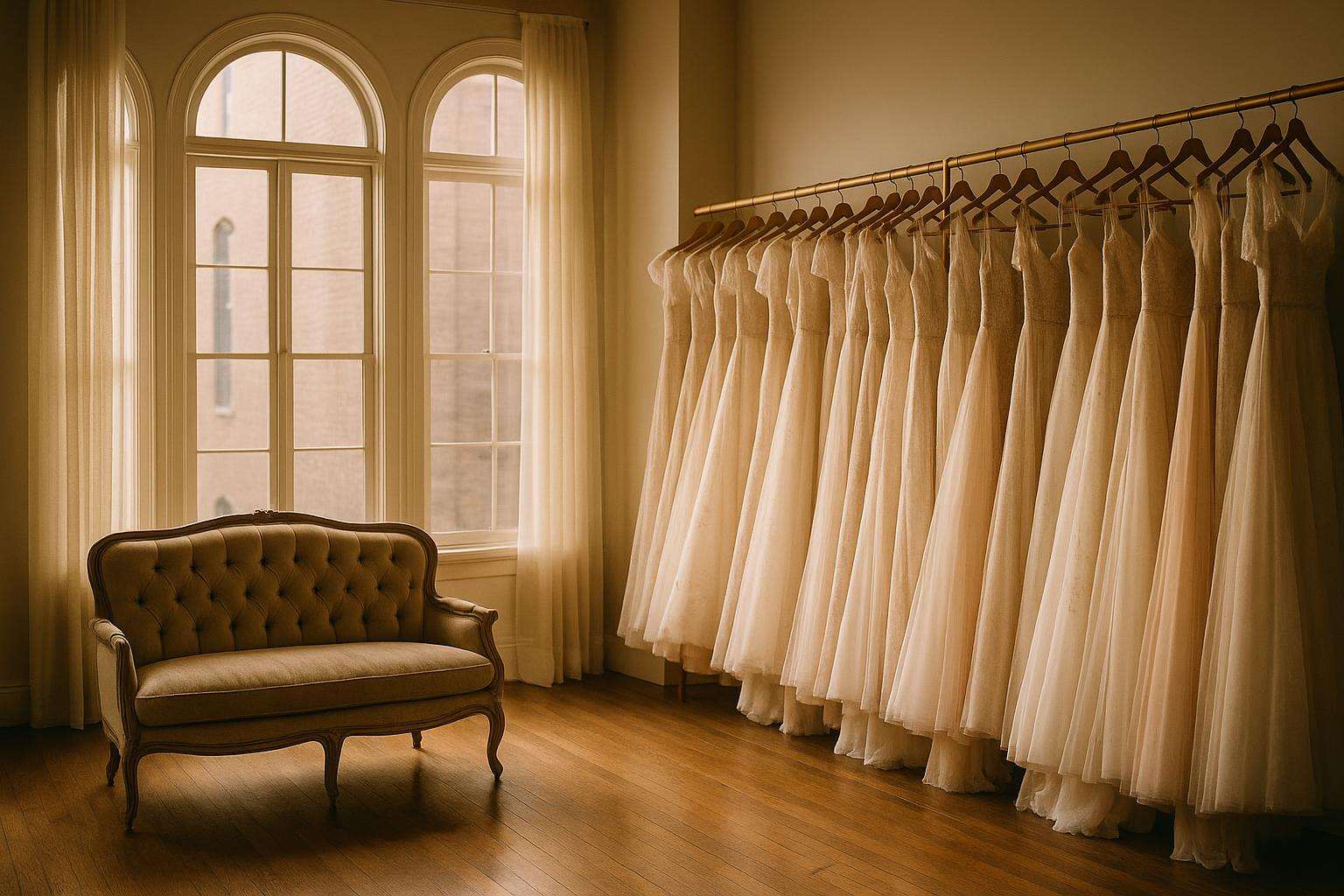
A local bridal boutique offers curated designer access, private appointments, and in-house alteration coordination — typically starting around $2,000. A national chain like David's Bridal offers walk-in access, off-the-rack inventory, and gowns from under $200. The right choice turns on your budget, timeline, and what you want from the shopping experience itself.
One in four American brides has historically bought her gown at David's Bridal. Thousands more have made an appointment at a curated independent boutique and spent weeks in the company of a single consultant who came to know their body, their aesthetic, and their nerves as intimately as the gown itself. Both paths end at the altar. But they are genuinely different journeys, and the differences — in service depth, designer exclusivity, alteration access, and timeline flexibility — are more consequential than most brides anticipate before they walk through either door.
What is the actual difference between a bridal boutique and a chain bridal store?
Independent bridal boutiques are small, appointment-based shops whose owners hand-select a curated designer roster — attending bridal markets in New York, Paris, and Barcelona to source styles that will not appear at national retailers. The appointment is the centrepiece of the experience: typically private or semi-private, with one consultant dedicated entirely to a single bride per time slot. At a well-run boutique, the floor is yours.
Chain bridal retailers like David's Bridal — which has historically dressed roughly one in four American brides — operate on a different model. Hundreds of gowns, broad silhouette and size coverage, and multiple clients served simultaneously give chains an unmatched combination of selection breadth and price accessibility. Gowns begin under $200 at David's Bridal and reach approximately $2,000 at the top of the range, with many popular styles available off-the-rack for immediate purchase.
There is a meaningful middle ground: Kleinfeld Bridal in New York — the salon made internationally known by TLC's Say Yes to the Dress — operates at high volume but carries over sixty designers, including Vera Wang (whose gowns start around $3,500), Monique Lhuillier, and Pnina Tornai. Kleinfeld occupies a category of its own: a high-volume authorized salon with the designer depth of a luxury boutique and the appointment throughput of a chain.
According to The Knot's 2026 Real Weddings Study, which surveyed 10,474 US couples married in 2025, the average wedding dress spend is approximately $2,100 — a number that reflects the full mix of chain and boutique purchases across the country.
How do designer exclusivity and authorized retailer status affect your choices?
Many independent boutiques hold regional or exclusive authorization agreements with designers, meaning certain gowns simply cannot be purchased anywhere else in a given market. Labels such as Maggie Sottero, Justin Alexander, Allure Bridals, and Randy Fenoli Bridal each maintain formal authorized-retailer networks, and brides can verify boutique authorization directly on each designer's website using store-locator tools.
Lovely Bride — a collective of 19 independently owned shops founded in New York's West Village in 2010 — carries exclusive label lines including Lover's Society and Louvienne (a Lovely Bride house label launched in 2015) available only through its network. The Dress Theory, a multi-location independent boutique, travels to international markets to source labels not available at national chains. These exclusivities are real and meaningful: if a particular designer or aesthetic is central to your vision, the boutique may be the only place to find it.
Before booking any appointment, check the designer's official website for its authorized-retailer locator. Justin Alexander notes that legitimate boutiques display an authorized-retailer sticker in-store and receive product directly from the design house. Be wary of any shop that refuses to disclose designer names before purchase — this is a documented red flag for grey-market or unauthorized sourcing, and it means you cannot verify the product's provenance before committing.
Kleinfeld operates its own authenticated resale arm, Kleinfeld Again, which offers pre-owned Vera Wang and Monique Lhuillier gowns at significantly reduced prices — a rare opportunity to access luxury designer labels at a fraction of retail cost through a verified channel.
What are the real differences in alteration costs and how long do alterations take?
Alterations are where many brides are surprised by cost — and where the boutique-versus-chain distinction matters in practice, not just in theory.
Many independent boutiques coordinate in-house alteration services through staff seamstresses or long-term partner sewists, which has a genuine convenience benefit: the boutique knows the gown's construction and can provide an estimate at or shortly after purchase. Chains like David's Bridal also offer in-store alteration services. In both cases, boutique alteration pricing tends to run slightly higher than using an independent seamstress working from her own studio.
According to Zola's expert wedding advice, typical alteration costs run $200 to $800, with complex work — bodice resizing, multi-layer hemming, or beading re-application — exceeding $1,000, particularly in major metro markets such as New York, Los Angeles, and Chicago. The industry standard budgeting guideline is to set aside 15–20% of the gown's purchase price for alterations. The alteration process typically spans 6 to 12 weeks across two to three fittings — a timeline that must be woven into the overall wedding calendar.
The single most important rule: get every alteration estimate in writing before work begins. Verbal-only estimates are among the most common sources of post-purchase conflict in the bridal industry, and no reputable boutique or chain should resist putting the scope and cost on paper.
How does the shopping timeline differ between boutiques and chains?
Timeline is often the deciding factor for brides who discover they have less runway than they expected.
Most independent boutique gowns are made to order by the designer after purchase — production and shipping take 4 to 6 months, followed by 2 to 3 months of alterations. The practical implication: brides who want a new boutique gown should begin shopping 9 to 12 months before the wedding date. Shopping with fewer than 6 months to go typically means paying a rush production fee (commonly around $200) and accepting that some styles will be unavailable. Some designers cannot accommodate rush orders on complex or heavily embellished styles at all.
David's Bridal and similar chains offer meaningful timeline flexibility because many styles are held in-store inventory and can be purchased off-the-rack — a genuine advantage for brides with 4 months or fewer before the wedding.
A third path: sample boutiques. Independent boutiques often sell floor models — gowns that have been tried on during appointments — at reduced prices. Sample sizes typically span sizes 8–12 with some extended sizing, depending on the boutique. Luxe Redux Bridal, a sample-focused boutique sourcing pre-owned designer gowns from salons across the country, offers labels including Berta, Hayley Paige, Jenny Yoo, Made With Love, Watters, and Monique Lhuillier at a fraction of retail cost — off-the-rack and ready for alterations on any timeline.
Which option is right for you? A decision matrix
| Your Situation | Better Fit | Why |
|---|---|---|
| Budget under $800 | Chain (David's Bridal) | Gowns from under $200; broad off-the-rack inventory at every price below $800 |
| Budget $800–$2,000 | Chain or sample boutique | David's Bridal top range; Luxe Redux Bridal off-the-rack designer samples |
| Budget $2,000–$5,000 | Independent boutique | Maggie Sottero, Justin Alexander, Allure Bridals; private appointments; alteration coordination |
| Budget $5,000+ | Luxury boutique or Kleinfeld Bridal | Vera Wang, Monique Lhuillier, Pnina Tornai; exclusive designer access; dedicated service |
| Wedding in 4 months or fewer | Chain or sample boutique | Off-the-rack availability; no made-to-order lead time; alteration timeline still fits |
| Wedding in 9–12 months | Independent boutique | Full made-to-order timeline without rush fees; alteration runway comfortable |
| Want a designer exclusive to one boutique network | Independent boutique | Exclusive labels (e.g. Louvienne at Lovely Bride) unavailable at chains |
| Need to try many silhouettes quickly | Chain | Broad inventory; walk-in or same-week appointments; no gatekeeping on styles |
| Want a private, dedicated appointment experience | Independent boutique | One-on-one consultant; curated selection; unhurried environment |
| Buying a pre-owned luxury gown | Luxe Redux Bridal or Kleinfeld Again | Authenticated pre-owned Vera Wang, Monique Lhuillier, Berta, Hayley Paige at reduced cost |
How do you vet an independent boutique before booking?
The boutique appointment is an investment of time, emotion, and in many cases a substantial financial commitment. A few minutes of vetting before you book can spare considerable frustration.
Read reviews with intent. Genuine reviews name the specific consultant, describe how the appointment unfolded, and detail how alterations were managed from estimate through final fitting. Cross-check across Google, WeddingWire, and The Knot. Recurring complaints about alteration cost surprises, missed production timelines, or unresponsive communication after deposit are meaningful warning signs regardless of overall star rating.
Verify designer authorization. Every designer the boutique claims to carry should appear on that designer's official authorized-retailer locator. Maggie Sottero's store locator even allows brides to filter by specific styles in stock at a given boutique. Any shop that refuses to name its designers before a purchase is made warrants caution.
Check professional credentials. The Association of Bridal Consultants (ABC), founded in 1955, is the oldest and most recognised certification body in the field. The Association of Certified Professional Wedding Consultants (ACPWC) also offers recognised training. Certification is a positive signal, but so is how a boutique handles first contact: how quickly do they respond to inquiries, do they ask about your timeline and budget before the appointment, and does the consultant listen more than she speaks in the first fifteen minutes?
Get the alteration estimate in writing. A reputable boutique provides a general price range before the appointment and offers a written alteration estimate at or shortly after the first fitting. If a shop cannot or will not do this, the risk of a billing dispute later is real.
Whether you walk into a David's Bridal on a Tuesday afternoon or settle into a tufted settee at a curated salon with a glass of champagne and an appointment that is entirely your own, the gown that matters is the one you love. The boutique-versus-chain decision is not a question of which experience is superior in the abstract — it is a question of which experience is right for your budget, your timeline, and the wedding you are building. Used honestly, this matrix is simply a starting point for that conversation with yourself.
Considered Counsel
Frequently asked
What is the difference between a local bridal boutique and a chain bridal store?
A local bridal boutique is an independently owned, appointment-based shop whose owner hand-selects a curated designer roster — typically attending bridal markets in New York, Paris, or Barcelona to source labels unavailable at mass retailers. Appointments are usually private or semi-private, with one consultant dedicated to a single bride at a time. A chain bridal store such as David's Bridal is a national retailer carrying hundreds of styles across a broad price range, where multiple brides shop simultaneously. Chains offer walk-in access, immediate off-the-rack purchases, and entry-level prices starting under $200, while boutiques typically start around $2,000 and offer higher service depth, exclusive designer access, and in-house alteration coordination. The right choice depends almost entirely on your budget, timeline, and how much the appointment experience matters to you.
Is a local bridal boutique more expensive than David's Bridal?
Generally, yes — though the gap varies considerably. David's Bridal carries gowns from approximately $100 to $2,000, making it the most accessible price tier in the US bridal market. Independent boutiques typically start around $2,000, with the $3,000–$5,000 range representing the mid-tier for boutiques carrying labels such as Maggie Sottero, Justin Alexander, and Allure Bridals. Luxury boutiques carrying Vera Wang (which starts around $3,500), Monique Lhuillier, or Pnina Tornai can reach $10,000 and above. The Knot's 2026 Real Weddings Study, surveying 10,474 US couples married in 2025, places the average wedding dress spend at approximately $2,100 — a figure that blends chain and boutique purchases. Budget an additional 15–20% of the gown price for alterations regardless of where you shop.
Do bridal boutiques do alterations in-house?
Many independent boutiques offer in-house alteration services, either through on-staff seamstresses or long-term partner sewists whose work the boutique coordinates. This has a practical advantage: the seamstress already knows the gown's construction and can provide an alteration estimate at or shortly after purchase. Chains like David's Bridal also offer in-store alteration services. However, in both cases boutique alteration pricing tends to run slightly higher than using an independent seamstress working from her own studio. Typical alteration costs range from $200 to $800, with complex work — bodice resizing, multi-layer hemming, or beading re-application — exceeding $1,000 in major metro markets. Industry professionals consistently recommend setting aside 15–20% of the gown price for alterations, and getting any estimate in writing before work begins.
How do I verify that a bridal boutique is an authorized retailer?
Check the official store locator on the designer's website before booking an appointment. Maggie Sottero, Justin Alexander, Allure Bridals, and Randy Fenoli Bridal each maintain searchable authorized-retailer directories. Justin Alexander notes that authorized boutiques display an official authorized-retailer sticker in-store and receive product directly from the design house — grey-market or unauthorized sellers do not. Be cautious of any shop that refuses to name its designers before a purchase is made: this is a known red flag for grey-market sourcing. Kleinfeld Bridal in New York, Lovely Bride's 19-shop collective, and The Dress Theory are well-documented examples of established salons with documented designer authorization and verified reviews on WeddingWire and The Knot.
How far in advance should I shop at a bridal boutique?
If you plan to order a new gown from an independent boutique, begin shopping 9 to 12 months before your wedding date. Most boutique gowns are made to order by the designer after purchase, with production and shipping taking 4 to 6 months, followed by 2 to 3 months of alterations across two to three fittings. Starting with fewer than 6 months to go almost always incurs a rush production fee of approximately $200 or more — and some designers cannot accommodate rush orders at all for complex styles. If your timeline is 4 months or fewer, chain retailers and sample-sale boutiques like Luxe Redux Bridal, which carries off-the-rack designer gowns from labels including Berta, Hayley Paige, and Watters, are more realistic options.
What should I look for in bridal boutique reviews?
Go beyond the star rating. Genuine reviews name the specific consultant, describe the appointment structure, and explain how alterations were handled from estimate through final fitting. Cross-check across Google, WeddingWire, and The Knot — wedding-specific platforms carry verified reviews from actual clients who have completed a purchase. A boutique with only perfect reviews across hundreds of entries warrants some scrutiny; authenticity is better signaled by how a shop responds professionally to occasional critical feedback. Look for patterns in negative reviews specifically: recurring complaints about alteration cost surprises, missed timelines, or unresponsive communication after purchase are meaningful warning signs, regardless of overall rating.
What credentials should a bridal consultant have?
The most recognised professional credential in the field is membership in the Association of Bridal Consultants (ABC), founded in 1955 and the oldest certification body for bridal professionals in the United States. The Association of Certified Professional Wedding Consultants (ACPWC) also offers recognised training and certification. Certification signals commitment to professional standards, but equally important are the qualitative signals from first contact: how quickly does the boutique respond to inquiries, do they ask about your timeline and budget before pushing an appointment, and how knowledgeable is the consultant about the specific designers they carry? An excellent consultant asks more questions than she answers in the first fifteen minutes, because the right dress cannot be found without understanding the bride who will wear it.