Dress Shopping
Buying a Wedding Dress Online: Risks, Sizing & Returns
Custom-sizing programs, at-home try-on, knockoff red flags, and return policies decoded — a straight-talking guide to the retailers who are genuinely worth your trust, and the ones who are not.
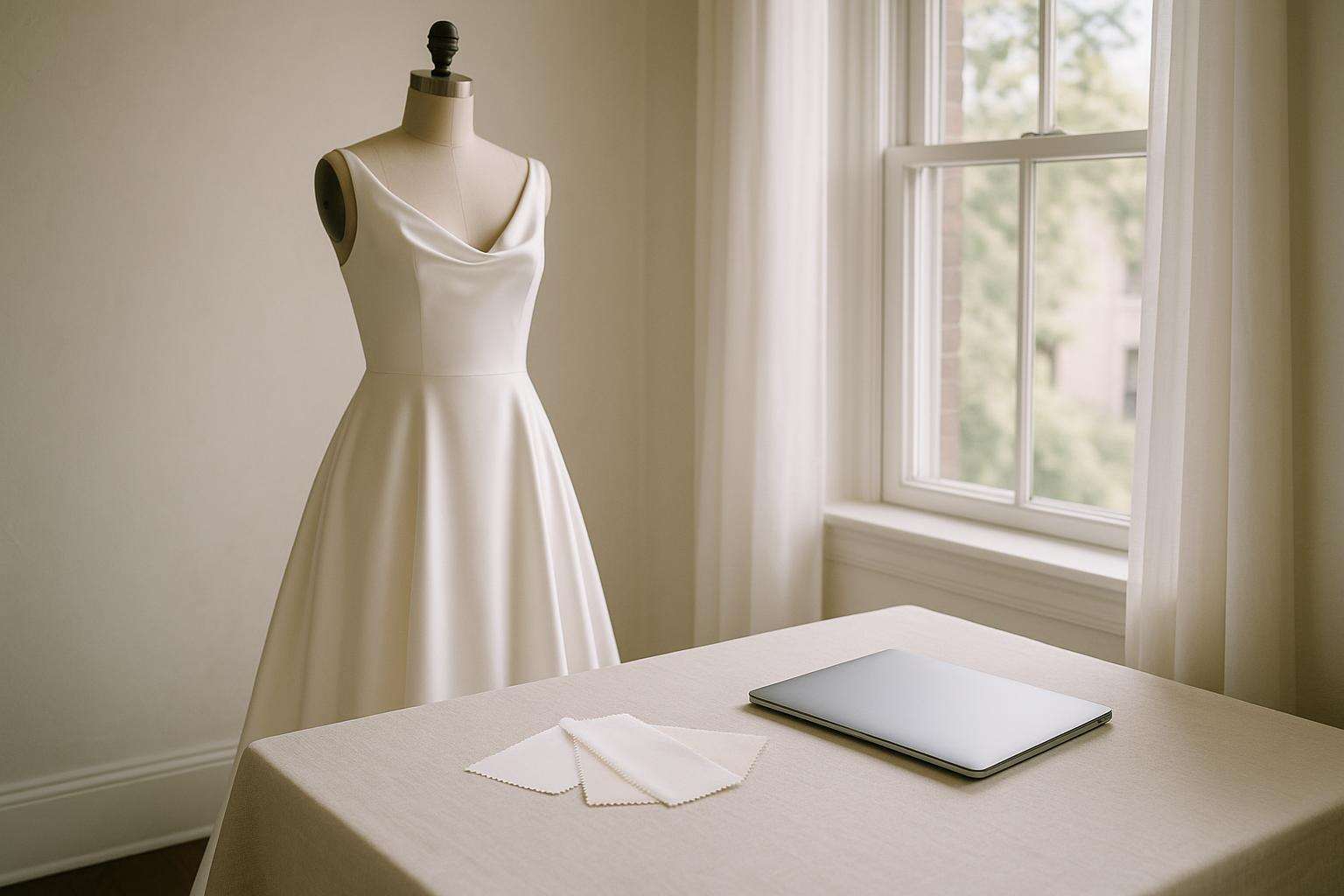
Buying a wedding dress online can save hundreds of dollars and hours of salon time — but only if you understand how bridal sizing differs from street clothing, which retailers offer genuine at-home try-on and honest return policies, what the red flags of a counterfeit listing look like, and how to budget for the alterations every online gown requires. The difference between a smooth experience and a costly mistake is almost always preparation.
Is it safe to buy a wedding dress online?
The short answer is: yes, with the right retailer and the right precautions. Online bridal retail has reshaped the market substantially. According to The Knot's 2025 Real Weddings Study, the average U.S. wedding dress cost $2,000, and the average bride visits only two stores before purchasing. Online-first brands such as Azazie, BHLDN, and Cocomelody have captured a meaningful share of that market by offering lower price points, extended size ranges, and at-home try-on programs that physical salons cannot match for convenience.
The risk is not online shopping in the abstract — it is the counterfeit and scam listings that populate search results alongside legitimate retailers. A 2024 Lloyds Banking Group study found that wedding scams in the United Kingdom rose by nearly 25 per cent in the twelve months through September 2024, and U.S. consumer advocates have documented identical patterns domestically. The brides most protected are those who know exactly what a legitimate online bridal retailer looks like — and exactly what does not.
Which DTC bridal labels are genuinely worth trusting?
Three online-first retailers stand above the rest for transparency, order fulfilment history, and consumer recourse.
Azazie (azazie.com) was founded in 2014 and is headquartered in San Jose, California. It carries more than 500 handmade gowns in sizes 0 to 30, all cut and sewn to order, and holds an A+ rating with the Better Business Bureau. Wedding gown pricing generally falls between $200 and $700 — among the most accessible price points in online bridal retail. Azazie's standout feature for cautious shoppers is its at-home try-on program: brides can borrow up to three sample dresses for $15 per gown, with two-way shipping included, evaluating fit, fabric weight, colour, and drape at home before committing. The brand also offers alteration reimbursements of $20 to $75 on select styles to help offset post-delivery tailoring costs.
BHLDN (bhldn.com) — pronounced "beholden" — is Anthropologie's bridal division, established in 2011. Its collection spans $350 to over $2,000, with the bulk of gowns in the $850 to $1,800 range. BHLDN offers virtual styling appointments via video call, sizing from 0 to 26W across roughly half its styles, and fabric swatch ordering for those navigating colour decisions. Its return policy is the most shopper-friendly of the major online bridal retailers: standard-size purchases may be returned within 30 days of delivery with a pre-paid label included (a $5.95 return shipping fee applies to online orders). For brides who want the feel of a real consultation without leaving home, BHLDN's virtual appointment model is the closest online equivalent to a salon fitting.
Cocomelody (cocomelody.com) operates a website supported by 15 physical showrooms across the U.S., Japan, and Europe, and has fulfilled orders for more than 100,000 brides globally. Like Azazie, it manufactures to order and offers a custom-sizing option. In June 2025, Cocomelody updated its return policy: standard-size dresses may be returned within 30 days of delivery, but a 20 per cent restocking fee on wedding gowns plus a 5 per cent transaction service charge apply. Custom-sized orders remain final sale. Reader reviews are mixed — some brides report excellent results with custom sizing; others note standard sizes required costly alterations. The showroom network gives Cocomelody a slight edge for brides who want to see fabric quality in person before ordering online.
How does bridal sizing actually work — and why is it so different online?
Bridal sizing follows a legacy industry standard that runs two to four sizes larger than contemporary street clothing. A bride who wears a street size 12 may need a bridal size 16 or 18, depending on the designer. This surprises nearly every first-time bridal shopper — and it surprises them at a particularly inconvenient moment, when they have already committed to a specific gown.
The logic is structural. Dresses are always sized to the largest measurement: if your bust measures a size 10 but your hips measure a size 14, you order the size 14. A seamstress can take fabric in (reduce the garment) far more easily — and at far lower cost — than she can add fabric out. This is why even a well-fitting online order almost always needs some professional alteration.
Custom-measurement programs complicate this further. Azazie's custom-sizing option collects five basic measurements to cut the dress closer to your frame. A truly bespoke gown requires twelve or more measurements taken under specific conditions by an experienced seamstress. The gap between "custom-sized" and "bespoke" is real — and it is why even custom-sized online orders typically require a local fitting after delivery.
A practical tip from experienced online bridal shoppers: if you are torn between ordering a standard size (which preserves your right to return) and a custom size (which removes it), order the standard size and budget the savings toward professional alterations. The alteration result is often cleaner, because a skilled local seamstress works from the actual gown on your actual body — not from five measurements submitted through a form.
| Retailer | Price Range | Size Range | At-Home Try-On | Standard Return Window | Custom Orders | Restocking Fee |
|---|---|---|---|---|---|---|
| Azazie | $200–$700 | 0–30 | Yes — $15/gown, up to 3, 2-way shipping included | 30 days from delivery | Final sale | Varies; $6.99/dress return shipping (customer pays) |
| BHLDN | $350–$2,000+ | 0–26W | Virtual styling appointments; no physical home try-on | 30 days from delivery | 50% restocking fee | $5.95 return shipping; pre-paid label included |
| Cocomelody | $200–$1,000+ | 0–28+ | 15 U.S./international showrooms | 30 days from delivery | Final sale | 20% (gown) + 5% transaction fee; customer pays shipping |
| StillWhite (pre-owned) | $200–$3,000+ | Varies by listing | No | ~7-day dispute window | N/A | None (resale platform) |
Why should you order fabric swatches before committing?
Screen rendering is unreliable. What appears as ivory on a calibrated studio monitor may display as champagne or stark white on a different device. The gap between what you see on screen and what arrives in the package is consistently cited as one of the most common sources of disappointment in online bridal orders — particularly for brides who are coordinating bridesmaids, florals, or table linens around the gown colour.
Ordering swatches first costs little and eliminates this risk entirely. Several online retailers make swatches available:
- Azazie offers mix-and-match fabric swatches by colour and fabric type, ordered through the website.
- BHLDN / Anthropologie provides bridesmaid swatch ordering via the Anthropologie bridesmaid page.
- Dessy Group (dessy.com) sends up to three free swatches; buyer pays shipping.
- Kennedy Blue (kennedyblue.com) provides free fabric colour swatches on request.
- GemGrace (gemgrace.com) ships free swatches with free shipping.
Beyond colour matching, swatches let you assess drape and weight. A fabric that photographs beautifully — flowing chiffon in a campaign image — may feel stiffer or heavier in person than expected. Handling a swatch in your own lighting conditions, with your own skin tone as context, is the closest you can get to a physical consultation without visiting a salon.
What are the red flags of a fake or scam wedding dress website?
Counterfeit and fraudulent bridal operations are widespread and increasingly sophisticated. Inside Weddings and consumer-protection advisors consistently highlight six warning signs that should prompt any bride to walk away immediately:
- Price dramatically below retail. A gown listed at $189 when the same design retails for $1,500 on the designer's official site is not a sale — it is a signal of a counterfeit or bait-and-switch operation. Legitimate boutique discounts run 20 to 40 per cent, not 80 to 90 per cent.
- Stolen or AI-manipulated photography. Fraudulent sites routinely steal high-resolution images from designer campaigns. Blurred or cropped faces, inconsistent background styles, or images where the gown details seem mismatched from photo to photo are evidence of image theft. A 2025 investigation found one operation allegedly running licensed designer images through AI to swap backgrounds and model faces before reposting them as original product photos.
- No verifiable address or phone number. Legitimate retailers publish a real, locatable street address and a working phone number. A website with only a contact form — or a phone number routing to an overseas call centre with no trace in business registries — is a red flag.
- Absent or vague return policy. No stated return policy removes all consumer leverage, especially when a seller operates outside U.S. jurisdiction and a chargeback is your only recourse.
- Non-standard payment requests. Requests for wire transfer, Zelle, Cash App, cryptocurrency, or PayPal Friends & Family eliminate chargeback protections entirely. Pay with a major credit card on every online bridal purchase — this single habit is the most effective consumer protection available.
- Designer gowns on non-authorised sites. Most designer bridal lines — Maggie Sottero, Vera Wang, Pronovias — are territory-protected and cannot be legally sold online by unauthorised retailers. If a recognisable designer gown appears on an unfamiliar discount site, verify authorisation using the designer's own store locator before proceeding.
How do I budget for alterations when buying a wedding dress online?
The ticket price on the dress tag is not the finished cost. This is true of salon purchases and doubly true of online orders, where the fit gap between a made-to-measure standard and a bespoke fitting is real. According to Zola's bridal alteration cost guide, standard adjustments to a wedding gown in 2025 run $300 to $800 for a typical set of work — side-seam adjustments, strap shortening, bustle addition, and basic hem work. Hemming alone on a multi-layer or lace gown can run $300 to $500.
Industry practitioners recommend allocating 10 to 20 per cent of the gown budget to alterations from the outset. For a $500 Azazie gown, that means budgeting $50 to $100 — extremely manageable. For a $1,800 BHLDN gown, it means $180 to $360 — still well below the cost of a boutique-purchased gown with alterations included. Start the alteration process eight to ten weeks before the wedding to allow three or four fittings without incurring rush-fee premiums of 25 to 50 per cent.
Add 10–20% of the gown price to your dress budget for alterations when ordering online. Start fittings 8–10 weeks before the wedding to avoid rush fees. For multi-layer or lace gowns, hem work alone can run $300–$500 — factor that in before choosing a retailer, not after the dress arrives.
Are pre-owned designer wedding dresses a legitimate option?
For budget-conscious brides who want designer names at fraction-of-retail prices, peer-to-peer resale platforms offer genuine value — with appropriate precautions. StillWhite (stillwhite.com) is the largest global pre-owned wedding dress marketplace, listing over 100,000 gowns. Designer dresses originally priced at $3,000 to $5,000 commonly appear for $800 to $1,500, and PayPal Buyer Protection covers purchases up to $20,000 for items that are misrepresented or undelivered. Nearly Newlywed (preownedweddingdresses.com) takes a more curated approach: it authenticates listings, provides sellers with prepaid insured shipping labels, pays sellers 80 per cent of the sale price, and reports that lightly used designer gowns in good condition recover 50 to 60 per cent of original retail. Both platforms are meaningfully safer than buying from a private individual via social media, where authentication and recourse are minimal.
The practical trade-off: a pre-owned gown is a fixed size and may require more alteration than a new made-to-order garment. Budget accordingly, and — as with all online bridal purchases — pay by credit card rather than bank transfer.
Considered Counsel
Frequently asked
Is it safe to buy a wedding dress online?
Buying a wedding dress online is safe when you shop with established, verifiable retailers such as Azazie, BHLDN (Anthropologie Weddings), or Cocomelody — all of which have A or A+ Better Business Bureau ratings, clearly published return policies, and provable order histories numbering in the tens of thousands. The risk is concentrated in discount sites with no traceable address, requests for wire-transfer payment, or listings that advertise designer names at prices far below those on the designer's own site. Use a major credit card on every online bridal purchase — it preserves chargeback rights and is the single most effective consumer protection available when shopping outside a physical salon.
How do I know if a wedding dress website is legit?
Legitimate bridal websites publish a verifiable U.S. street address, a working phone number (not a contact form only), a BBB profile, and a clearly stated return and cancellation policy. They accept major credit cards — not only wire transfer, Zelle, Cash App, or PayPal Friends & Family. Their product photography is professionally lit and internally consistent; stolen imagery from designer campaigns often shows blurred or cropped faces, inconsistent backgrounds, or AI-altered details. If a recognisable designer gown appears at a dramatic discount on an unfamiliar site, verify whether that site is an authorised retailer using the designer's own store locator — Maggie Sottero, Vera Wang, and Pronovias each maintain an authorised dealer search on their websites.
How does bridal sizing work, and why is it different from street clothing?
Bridal sizing follows a legacy industry standard that runs two to four sizes larger than contemporary street clothing — a bride who wears a street size 12 may need a bridal size 16 or 18, depending on the designer. Dresses are sized to the largest measurement: if your bust measures a size 10 but your hips measure a size 14, you order the size 14, because a seamstress can take fabric in far more easily than she can add it. Custom-measurement programs at online retailers such as Azazie collect your individual measurements to cut the dress closer to your frame — but Azazie gathers only five basic dimensions, versus the twelve or more used in truly bespoke construction, so even custom-sized online gowns typically require some professional alteration before the wedding day.
Can you return a custom-sized wedding dress?
In nearly all cases, no. Custom-sized wedding dress orders at Azazie and Cocomelody are final sale with no exceptions — the dress is cut to your supplied measurements and cannot be restocked or resold. BHLDN (Anthropologie Weddings) applies a 50% restocking fee to custom-size returns. This is why several experienced online bridal shoppers recommend ordering a standard size first — which preserves the right of return — and then having the gown tailored by a local seamstress rather than ordering a custom size that eliminates the safety net. If you do order custom-sized, ensure your measurements are taken by a professional seamstress with a flexible measuring tape and have them double-checked before submission.
Does Azazie offer an at-home try-on for wedding dresses?
Yes. Azazie's at-home try-on program allows brides to borrow up to three sample dresses for $15 per gown, with two-way shipping included in that fee. Samples arrive within a few business days and can be kept for a short evaluation window before being returned. The program lets brides assess fit, fabric weight, colour, and drape in their own environment — under their own lighting, with their own shoes and undergarments — before committing to a purchase. It is one of the most useful tools for de-risking an online bridal purchase, particularly for brides who cannot easily access a physical bridal salon. Azazie also offers alteration reimbursements of $20 to $75 on select styles to help offset post-delivery tailoring costs.
What is BHLDN's return policy on wedding dresses?
BHLDN (Anthropologie Weddings) offers a 30-day return window from the date of delivery for standard-size purchases, with a pre-paid return label included in the package (a $5.95 return shipping fee applies to online orders). Items must be in original, unworn condition with all tags attached. Custom-sized BHLDN orders carry a 50% restocking fee. BHLDN is consistently rated as having the most shopper-friendly standard-size return policy among the major online bridal retailers — the pre-paid label and the clean 30-day window significantly reduce the friction of a return compared to competitors. Virtual styling appointments are also available via video call for brides who want guidance before ordering.
How much should I budget for wedding dress alterations when buying online?
According to Zola's expert advice on bridal alteration costs, standard adjustments to a wedding gown in 2025 run between $300 and $800 for a typical set of alterations — taking in the side seams, adjusting the straps, adding a bustle, and basic hem work. Hemming alone on a multi-layer or lace gown can cost $300 to $500. Industry practitioners recommend budgeting 10 to 20 per cent of the gown price for alterations and starting the process eight to ten weeks before the wedding to allow three or four fittings without incurring rush-fee premiums of 25 to 50 per cent. Factor this into your total dress spend from the moment you place the online order — the alteration cost is not optional, it is part of the finished price.
Where can I buy a pre-owned designer wedding dress online?
Two established peer-to-peer platforms make pre-owned designer gown shopping relatively safe. StillWhite (stillwhite.com) is the largest global resale marketplace for wedding dresses, with over 100,000 listings; designer gowns originally priced at $3,000 to $5,000 commonly appear for $800 to $1,500, and PayPal Buyer Protection covers purchases up to $20,000 for items misrepresented or undelivered. Nearly Newlywed (preownedweddingdresses.com) curates and authenticates listings, provides sellers with prepaid insured shipping labels, pays sellers 80 per cent of the sale price, and reports that lightly used designer gowns in good condition typically recover 50 to 60 per cent of original retail. Both platforms are meaningfully safer than buying from a private individual via social media, where authentication and recourse are limited.