Dress Shopping
Wedding Dress Budget: What Gowns Really Cost in 2026
The national average, every price tier from Azazie to Vera Wang, and the hidden 15–30% for alterations and accessories — a complete financial map of the wedding dress purchase.
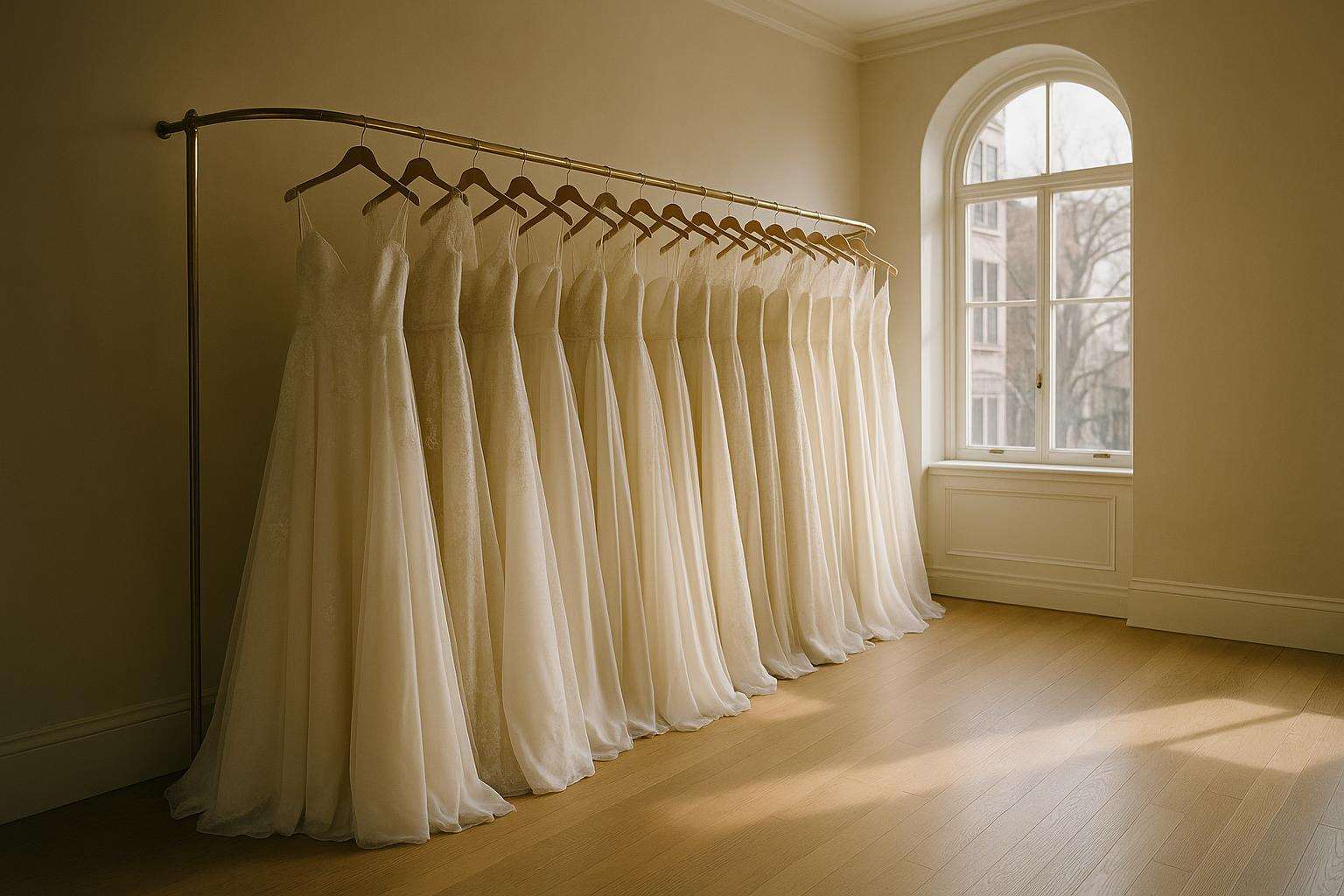
The average American bride spends $2,100 on her wedding dress in 2026 — but that figure covers only the gown tag. Alterations, accessories, and preservation reliably add 15–30% above sticker, bringing the true dressed cost for most brides to $2,700–$3,500. Understanding the full picture before you shop is the single most valuable thing you can do for your dress budget.
What is the average wedding dress cost in the United States in 2026?
The national benchmark comes from The Knot's 2026 Real Weddings Study, which surveyed 10,474 U.S. couples married in 2025: the average wedding dress spend is $2,100. A complementary analysis by With Joy, incorporating alteration costs, places the all-in bridal attire figure at roughly $2,450. Neither number is a target — it is a reference point.
What moves that number up or down? Geography matters considerably. Brides in New York and California average $2,500–$3,200; Midwest brides average $1,600–$2,100. One in five brides (21%) spends $4,000 or more on her complete bridal look. A rule of thumb worth writing down: allocate 8–10% of your total wedding budget to bridal attire — the gown, alterations, shoes, and accessories together — rather than to the dress alone. That framing changes how you plan.
What does a wedding dress cost at each budget tier?
The bridal market in 2026 operates across four meaningful price tiers, each with distinct retailers, design characteristics, and expectations around shopping experience and lead time. Here is an honest map of each.
| Tier | Price Range | Representative Brands | Where to Shop | Lead Time |
|---|---|---|---|---|
| Budget | Under $500 | Azazie, David's Bridal (entry collection) | Online; nationwide chain stores | Same-day to 8 weeks (made-to-order) |
| Mid-Range | $1,000–$3,200 | Rebecca Ingram, Maggie Sottero, Essense of Australia | Authorized independent boutiques | 4–7 months (made-to-order) |
| Upper-Mid / Premium | $2,900–$5,000 | Sottero & Midgley, Monique Lhuillier Bliss, Justin Alexander Signature | Authorized boutiques; flagship salons | 5–7 months (made-to-order) |
| Luxury / Couture | $7,500–$23,000+ | Vera Wang, Galia Lahav, Pnina Tornai | Premier salons: Kleinfeld Bridal (NYC) | 9–12 months recommended |
Tier 1 — Under $500: online-first and mass-market retail
Two platforms have built genuine reputations in this tier. Azazie offers more than 500 handmade-to-order gowns in 60-plus colors and sizes 0–30, with free custom sizing included. Popular styles like the Azazie Elyse run $379–$389; the collection spans from $119 (Azazie Malini) to $499 (Azazie Florentina). David's Bridal, the largest nationwide bridal retailer, maintains a dedicated '$500 & Under' category with hundreds of styles, personalized in-store styling consultations, expert alteration services on-site, and 48-hour rush delivery on many items. Compared to boutique pricing, online retailers broadly offer gowns 30–60% below comparable styles.
The honest trade-off: online gowns at this tier require careful self-measurement, and the fit gap between a standard size and a real body often means $300–$500 in alterations. A $350 gown plus $400 in alterations is $750 — still a significant saving, but the calculation is worth running before you order.
Tier 2 — $1,000–$3,200: the mid-range sweet spot
The largest share of American brides shop in this range, and it is where the authorized-boutique experience begins in earnest. Maggie Sottero's flagship label carries gowns from $1,400 to $3,300, with a design signature that runs from classic lace A-lines to corset-bodice ball gowns. Its sub-line Rebecca Ingram targets the entry-mid tier at $1,000–$1,500, applying the same pattern-making and fit engineering as the flagship at a lower price point. The third Maggie Sottero family label, Sottero & Midgley, occupies the upper-mid tier at $1,700–$4,000 with an average around $2,400 — distinguished by heavier embellishment and a more dramatic register.
Essense of Australia gowns range from $2,000 to $3,200, carried in authorized boutiques nationwide and recognized for timeless silhouettes with artful lace layering and modern textures. Together these labels represent the most widely stocked names in independent bridal boutiques across the U.S. At this tier, expect a made-to-order production timeline of 4–7 months and a 50–60% non-refundable deposit at order placement, with the balance due on arrival.
Tier 3 — $2,900–$5,000: upper-mid and premium
Monique Lhuillier Bliss — the designer's accessible diffusion line — sits at $2,900–$4,900, offering the Lhuillier aesthetic of French-inflected romanticism at a more approachable price than the main collection ($4,900–$12,900). This tier is also where Justin Alexander Signature operates ($2,800–$4,000), distinguished by couture-level beading and construction in ready-to-order gowns stocked at premier boutiques. Brides shopping here typically have one to two boutique appointments, are measured and ordered rather than purchasing off-the-rack, and receive the full salon fitting experience over 2–3 alterations appointments.
Tier 4 — $7,500 and above: luxury and couture
Vera Wang, founded in New York in 1990, produces gowns from $7,500 to $23,000, with a typical purchase in the $9,000–$13,600 range — known for dramatic silhouettes, risk-taking design, and the finest silk fabrication. Galia Lahav, founded in Tel Aviv in 1984 and now a global couture house, prices gowns from $7,500 to $15,000, with a signature of sensual intricate lace and sumptuous embellishment. Both labels are stocked at Kleinfeld Bridal in Chelsea, Manhattan — the most famous bridal salon in the United States — alongside Pnina Tornai, Randy Fenoli, Martina Liana, and Tony Ward. Kleinfeld carries over 60 designers, with sample sizes 10–12 and plus-size samples through size 32, and recommends shopping 9–12 months in advance for the full ordering experience.
What are the hidden costs that drive the true dress budget 15–30% higher?
The sticker price on the gown tag is the beginning of the budget conversation, not the end. Four categories of additional spend are consistent and predictable enough that they should be built into every dress budget from the outset.
Alterations
Most wedding dresses require alterations — the made-to-order or off-the-rack sizing system is built around standard measurements, and few brides are a standard. The Knot's analysis places the average alteration spend at $450. The realistic range for a standard gown is $300–$800; complex gowns or last-minute rush work can exceed $1,200. Typical individual costs:
- Hemming: $85–$400 (varies by fabric, embellishment, and number of layers — a plain crepe hem is fast; a beaded cathedral-train hem is not)
- Bodice adjustment (taking in or letting out): $100–$600
- Bustle addition: $75–$300
- Adding sleeves or straps: $200–$500
Geography matters: the same alterations costing $450 in Hoboken may cost $1,200 in Manhattan. Book your seamstress when you order the gown — the best independent tailors fill up fast in peak wedding season.
Accessories and veil
A veil typically costs $100–$600, with cathedral-length or custom-designed options reaching $800–$1,000. Bridal shoes run $75–$190 and above. Jewelry, hairpieces, and other bridal accessories add another $100–$300 or more. Budgeting $500–$1,500 total for accessories is realistic for most brides — and this is a category where borrowing, renting, or buying vintage can produce meaningful savings without visual compromise.
Dress preservation
Professional wedding dress cleaning and preservation — acid-free packaging, anti-yellowing treatments, sealed archival storage — ranges from $300–$600 for standard packages, rising to $600–$1,000 at high-end boutiques. Acting quickly after the wedding reduces cost by preventing stains from setting. For a gown that represents a significant investment, or that a bride hopes to pass down, preservation is not optional.
Deposit and contract terms
The financial mechanics of boutique buying are worth knowing in advance: most authorized salons require a 50–60% non-refundable deposit at order placement, with the balance due at delivery. Wedding gowns are almost universally non-returnable once ordered — the dress is cut and made to your measurements. Read the contract carefully before signing, and ask explicitly about the salon's alteration and cancellation policies.
For most brides, the honest all-in dress cost is gown price + 15–30%. A $2,000 gown typically costs $2,300–$2,600 dressed — accounting for alterations, veil, and preservation. A $3,500 gown runs $4,000–$4,550. Building these costs in from the start prevents the anxiety of discovering them after the purchase is signed.
Can you buy a designer wedding dress for less — pre-owned and sample sales?
Yes — and with greater ease than ever before. The secondary bridal market has matured significantly, and it is no longer a compromise route: it is a legitimate strategy for accessing higher-tier designers at lower-tier prices.
StillWhite is the largest global pre-owned wedding dress marketplace, with more than 102,000 gowns listed and a flat $29.95 seller listing fee — which means sellers are not inflating prices to cover platform costs. Gowns typically sell at 40–80% below original retail. Nearly Newlywed (established 2004) authenticates and vets every gown it carries, offers pre-owned dresses at up to 90% off retail, and provides a buyer-friendly return policy that is unusual in the bridal market. Boutique sample sales — where floor models that have been tried on but rarely worn are cleared at 30–70% off — are another reliable avenue, particularly for brides who fall within the standard sample sizes of 10–12.
The practical parameters: pre-owned gowns may require more substantial alterations if the previous owner's measurements differ significantly. Verify the gown's condition, request detailed photographs of any wear, and budget for professional cleaning before the wedding. That said, the environmental case for pre-owned is strong — and so is the financial one. Pre-owned gown purchases rose 31% among brides aged 26–34 in recent seasons, a trend that shows no sign of reversing.
When should you start shopping for a wedding dress?
Bridal consultants and salon managers are consistent on this point: begin 9–12 months before the wedding. The reason is production timelines, not shopping enjoyment. Made-to-order gowns from authorized boutiques — including Maggie Sottero, Rebecca Ingram, Essense of Australia, and similar labels — require 4–7 months of production time. Add 2–3 fitting appointments over 4–8 weeks for alterations, and the final gown typically arrives in the bride's hands 1–2 weeks before the wedding.
Brides with compressed timelines have real options. David's Bridal offers same-day and 48-hour rush availability on its ready-to-wear collection. Sample sale purchases are immediate. Authenticated pre-owned gowns from StillWhite and Nearly Newlywed ship in days. For brides who discover they are outside the 9-month window, these routes are not a concession — they are a practical path to a beautiful dress delivered on time.
Considered Counsel
Frequently asked
What is the average cost of a wedding dress in the United States in 2026?
According to The Knot's 2026 Real Weddings Study, which surveyed 10,474 U.S. couples married in 2025, the national average wedding dress spend is $2,100. A complementary analysis by With Joy places the all-in bridal attire figure — including alterations — at roughly $2,450. Regional variation is meaningful: brides in New York and California average $2,500–$3,200, while Midwest brides average $1,600–$2,100. One in five brides (21%) spends $4,000 or more on her complete bridal look. A reliable planning rule of thumb is to allocate 8–10% of the total wedding budget to bridal attire — covering the gown, alterations, shoes, and accessories — rather than to the dress alone.
How much do wedding dress alterations cost?
Alterations are the most consistently underestimated element of the dress budget. The Knot's analysis places the average at $450, but the real range spans $300–$800 for a standard gown and can exceed $1,200 for complex or rush work. Hemming — which varies by fabric, embellishment, and number of layers — runs $85–$400. Taking in or letting out the bodice costs $100–$600 depending on seam complexity. Adding a bustle is $75–$300; adding sleeves or straps typically $200–$500. Geography matters substantially: the same service costing $450 in a smaller city can cost $1,200 in Manhattan. Budget for alterations as a separate line item from the outset — they are not optional for most gowns.
Can you find a good wedding dress for under $500?
Yes — two platforms in particular have built strong reputations in this tier. Azazie offers more than 500 handmade-to-order gowns in 60-plus colors and sizes 0–30, with free custom sizing included; popular styles run $139–$499. David's Bridal, the largest nationwide bridal chain, maintains a dedicated '$500 & Under' category with hundreds of styles, in-store styling consultations, and 48-hour rush delivery on many items. The trade-off to understand is fit: online gowns at this tier often require alterations to achieve a precise silhouette, which can add $300–$500 to the final cost. That said, a $300 gown with $400 in alterations still totals $700 — well below the national average.
What does a luxury or couture wedding dress cost — Vera Wang, Galia Lahav, Kleinfeld?
Vera Wang, founded in New York in 1990, produces gowns ranging from $7,500 to $23,000, with a typical spend of $9,000–$13,600. Galia Lahav, founded in Tel Aviv in 1984 and now a global couture house, prices its gowns from $7,500 to $15,000. Both labels are stocked at premier appointment-only salons including Kleinfeld Bridal in Chelsea, Manhattan, which carries over 60 designers — including Pnina Tornai, Randy Fenoli, Martina Liana, and Tony Ward — with sample sizes 10–12 and plus-size samples through size 32. Kleinfeld recommends shopping 9–12 months in advance. At this tier, alterations, veil, and accessories commonly add $2,000–$4,000 above the gown price.
What hidden costs should I budget for beyond the wedding dress price?
Four categories routinely surprise brides. Alterations: average $450 per The Knot, with a realistic range of $300–$800 for most gowns and up to $1,200 for complex work. Accessories: a veil typically costs $100–$600 (cathedral or custom styles reach $800–$1,000); bridal shoes run $75–$190 and up; jewelry and hairpieces add $100–$300. Preservation: professional cleaning and preservation runs $300–$600 for standard packages and $600–$1,000-plus at high-end boutiques. Deposit terms: most authorized boutiques require a 50–60% non-refundable deposit at order placement, with the balance due at delivery. Wedding gowns are almost universally non-returnable. Taken together, these costs add 15–30% above the gown sticker price for most brides.
When should I start shopping for a wedding dress?
Bridal consultants consistently recommend beginning the search 9–12 months before the wedding date. Standard made-to-order production from authorized boutiques runs 4–7 months — a custom Maggie Sottero or Essense of Australia gown ordered in January for an August wedding is cutting it close. After the gown arrives, 2–3 fittings spaced over 4–8 weeks are typical before the final fitting and pickup, usually 1–2 weeks before the wedding. Brides who need to compress this timeline can look at off-the-rack options at David's Bridal (same-day availability), sample sale purchases, or authenticated pre-owned gowns through platforms like StillWhite or Nearly Newlywed. Rush production is available from some boutiques but carries a premium fee.
Is buying a pre-owned or sample-sale wedding dress a good idea?
For the right bride, yes — pre-owned and sample gowns offer some of the best value in the bridal market. StillWhite, the largest global pre-owned wedding dress marketplace, lists 102,000-plus gowns and charges a flat $29.95 seller listing fee, meaning gowns are often 40–80% below original retail. Nearly Newlywed (established 2004) authenticates and vets every gown it lists, with pre-owned dresses available at up to 90% off retail and a buyer-friendly return policy — unusual in the bridal market. Boutique sample sales offer 30–70% off floor models. The practical considerations: sample gowns are typically cut in sizes 10–12, so a bride outside that range will need more significant alterations; and popular styles sell quickly, so a bride needs to act decisively.