Dress Shopping
Who to Bring Wedding Dress Shopping (and Who to Leave Home)
The 2–3 person rule, choosing a decisive entourage, managing too-many-opinions, and the psychology of decision fatigue.
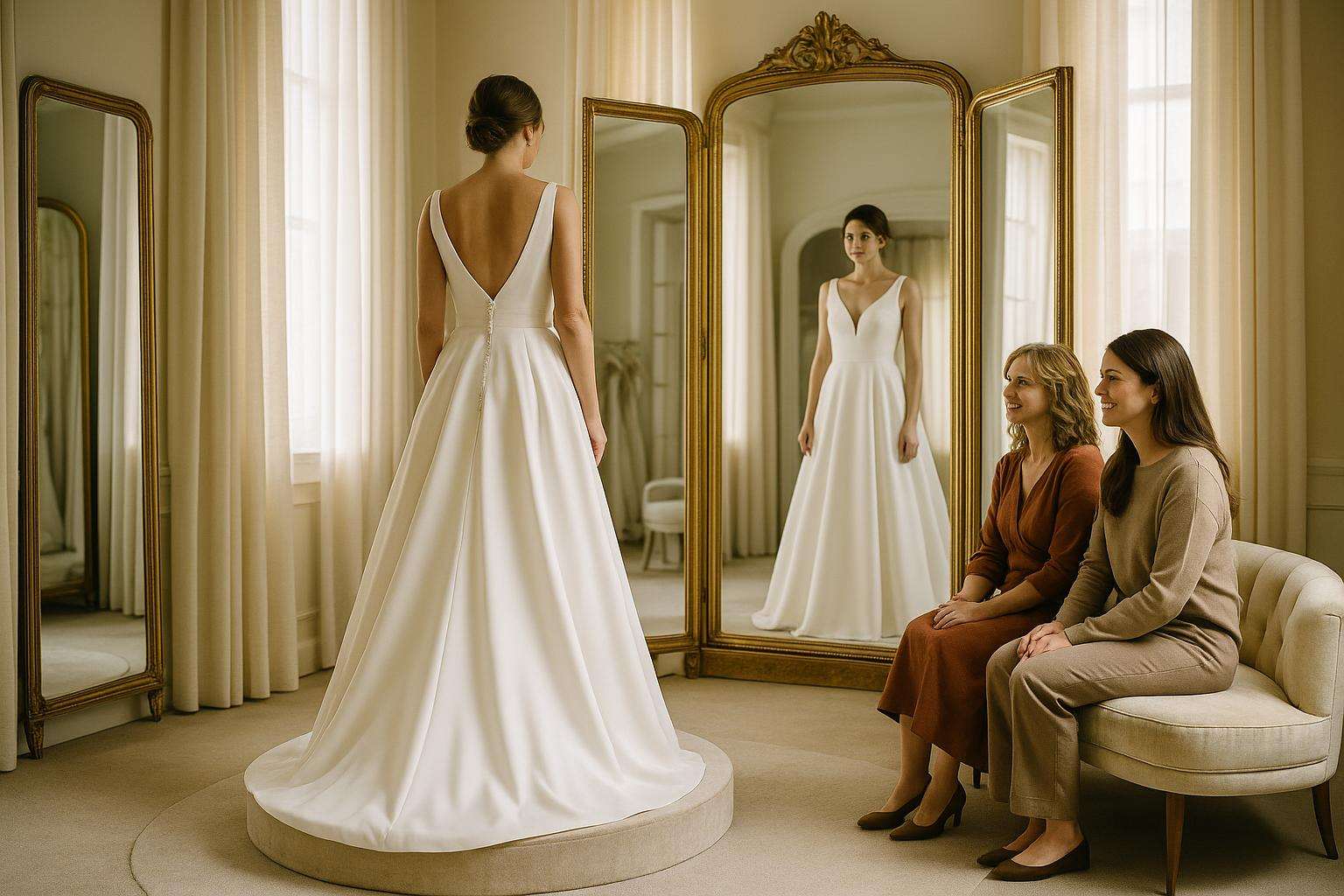
Bridal consultants across the country — from Kleinfeld Bridal in New York to Lovella Bridal in Los Angeles — converge on the same advice: bring two to three people whose roles are clearly defined before you walk in the door. Every additional voice beyond that dilutes your ability to hear your own reaction, and the dress that makes you cry in a crowded room of competing opinions is rarely the one you would have chosen alone.
How Many People Should You Bring to a Wedding Dress Appointment?
The answer the bridal industry has settled on, through years of appointment data, is two to three guests — with a hard ceiling at five for most salons. Kleinfeld Bridal, the flagship New York City retailer and one of the most recognized bridal destinations in the country, advises no more than three to four companions, with consultants noting plainly that "the more people, the more difficult the decision." Leora Bridal in Richmond, Virginia — which carries labels including Casablanca Bridal, Justin Alexander, and Beloved — formally caps attendance at five guests per appointment.
The reason is not logistical. It is neurological. Each additional opinion your brain must process while simultaneously evaluating a gown erodes the executive-function capacity you need to trust your own gut. Decision researchers call this phenomenon decision fatigue: the cumulative depletion of judgment that occurs when too many variables compete for cognitive attention. In a bridal context, it typically sets in after the fourth or fifth gown in a single session — and it arrives much earlier when six people are simultaneously telling you different things about how you look.
Savvy Bridal Boutique, with locations in Kansas City and St. Louis, Missouri, puts the upper boundary at five guests and cautions directly: brides who arrive with larger parties "quickly realize that having so many voices can be overwhelming." The sweet spot their consultants recommend is two to three — enough to feel supported, few enough to stay decisive.
The Knot's 2025 Real Weddings Study, which surveyed 10,474 U.S. couples, places the average wedding dress spend at $2,100. At that investment level, arriving to your appointment with the clearest possible head is not a preference — it is a financial strategy.
What Role Should Each Person Play at a Bridal Appointment?
Rather than filling seats with whoever feels entitled to attend, the approach that consistently yields faster, happier decisions is to assign a functional role to every chair in the salon. Leora Bridal's stylists frame it precisely: "The right guests provide encouragement, honest feedback, and help you feel confident in your choices." Anyone who cannot do at least one of those three things is occupying a seat at significant cost.
The Emotional Anchor. This is typically your mother, a sister, or the closest female figure in your life — the person whose presence signals that this moment carries weight. If your relationship with your mother is warm and uncomplicated, her seat is almost never a question. The future mother-in-law can also fill this role if the relationship is genuinely close; Leora Bridal advises setting expectations with in-laws in advance to ensure the appointment stays centered on the bride's vision rather than anyone else's.
The Honest Opinion-Giver. Usually the maid of honor, this person's job is to tell the truth without cruelty — to say "the neckline is competing with your shoulders" when everyone else is nodding politely. Bridesmaids who will stand alongside you can offer practical insight into how a gown photographs in a bridal party context. Leora Bridal's stylists note that even here, "too many opinions can create noise — choose one or two who know your style well."
The Style-Savvy Wildcard. Optional but powerful: a fashion-forward companion whose eye for silhouette, fabric weight, and proportion catches details others miss. This guest earns her seat if you feel uncertain about your aesthetic direction and want someone who can articulate why a gown does or does not work on your body — not just whether it looks pretty.
The Wedding Planner (if applicable). Viero Bridal — with showrooms in New York, Miami, Chicago, Los Angeles, and Michigan — identifies the wedding planner as a uniquely valuable appointment guest because she already holds the full vision: venue, color palette, ceremony style, and season. Her job is not to validate the gown emotionally but to assess whether it is "vibing with the rest of the wedding elements." That functional clarity makes her one of the least disruptive guests you can invite.
| Role | Typical Person | What They Contribute | Red Flag to Watch For |
|---|---|---|---|
| Emotional Anchor | Mother, sister, closest relative | Witnesses the moment; validates the emotional "yes" | Has a competing aesthetic vision for the dress |
| Honest Opinion-Giver | Maid of honor, best friend | Candid feedback without cruelty; knows bride's style | Speaks before the bride has formed her own reaction |
| Style-Savvy Wildcard | Fashion-forward friend | Articulates silhouette and fabric observations | Redirects appointment toward her own preferences |
| Wedding Planner | Hired planner | Assesses dress against venue, palette, and overall concept | Overrides emotional input with logistics |
Who Should You NOT Bring to a Wedding Dress Appointment?
Knowing who to leave home is, counterintuitively, the more valuable decision. Lovella Bridal in Los Angeles — a luxury boutique serving brides across the full size range — is direct: invite only people "who will provide a positive experience and add value." That sentence sounds simple; executing it requires saying no to people with legitimate feelings about being included.
The personality types that bridal consultants consistently identify as appointment disruptors:
The Early Reactor. Anyone who tends to respond before the bride has shared her own feeling. Lovella Bridal flags this as the highest-stakes dynamic on the salon floor: "If a guest reacts negatively before the bride can process her own emotions, the recovery can be extremely awkward and she may become insecure" about a dress she genuinely loved. The damage is often irreversible in that session. Darinanna Bridal makes waiting for the bride's reaction an explicit etiquette rule — not a suggestion.
The Obligatory Invite. Anyone whose presence is about social duty rather than genuine closeness. Savvy Bridal Boutique articulates it plainly: "The people who are with you should be there because you want them there, not because you feel obligated." Obligation-based guests are more likely to feel entitled to airtime — and more likely to take it.
The Person with a Competing Vision. Karen Willis Holmes, the Australian bridal designer with U.S. stockists, notes in her shopping guidance that "sometimes the exact opposite of what you planned ends up being what you choose" — a discovery process that requires mental freedom. A guest who arrived committed to you wearing ballgown-and-cathedral-train will not be a neutral presence when you fall in love with a minimalist bias-cut sheath.
Large Crowds in General. Gavin Christianson Bridal in Durham, North Carolina — a boutique with particular expertise serving mid-size and plus-size brides — designs their fitting experience around an intimate, one-on-one styling environment. Their consultants note that this environment works best when the guest count is low, independent of the personality profiles involved. Sheer headcount generates noise.
Lovella Bridal's in-house bridal fashion expert Nayri, author of I'm Getting Married And I Have Nothing To Wear, offers the cleanest workaround for brides navigating complicated family dynamics: attend a first solo appointment to clarify your own vision before inviting anyone. Then the second visit becomes a celebration, not a discovery session.
How Do You Manage Conflicting Opinions in the Salon?
Even the most carefully chosen entourage will occasionally pull in different directions. Bridal consultants have tested a small set of tactics that reliably reduce friction without requiring anyone to feel dismissed.
Let the bride speak first — always. Darinanna Bridal makes this an explicit instruction: wait for the bride to share her reaction before offering any feedback. This single rule, consistently applied, prevents the most common appointment breakdown. A bride who says "I love the lace but the silhouette feels wrong" before anyone else speaks has just given her entourage a directive. A bride who hears "I don't think that style suits you" before she has formed her own opinion has been handed someone else's directive to argue with internally for the rest of the session.
Brief guests before you walk in. Lovella Bridal advises sharing your inspiration images with guests before the appointment so they arrive with a shared aesthetic baseline. The leading cause of in-salon friction is mismatched expectations — a guest who pictured you in a romantic tulle ballgown watching you try on sleek crepe minimalist designs will not be a neutral commentator.
Use the top-two elimination method. Kleinfeld Bridal consultant Kelsey uses a structured process: brides maintain a top two favorites at all times, and any additional gown must displace one of them to remain in consideration. This gives guests a concrete, bounded way to contribute feedback ("Does this beat either of your top two?") rather than rendering a verdict on each gown in isolation. The method also prevents the analysis paralysis that arrives when eight dresses feel equally viable.
Redirect high-energy guests to accessories. Both Lovella Bridal and Savvy Bridal Boutique recommend channeling family members who want to participate — but who risk being disruptive at the gown appointment — toward a separate accessories or veil shopping session. The emotional stakes are lower, the decisions are smaller, and their enthusiasm finds a productive outlet without competing with the primary event.
Consider a solo first appointment. Lovella Bridal reports that it is common practice for brides to attend an initial solo session, identify the dress, and then invite their entourage to a subsequent appointment framed as the first time. Stylists support this explicitly when a bride flags it in advance. The solo session produces clarity; the group session produces the shared experience.
What Do Top Designers and Salons Actually Recommend?
Budget tier shapes the stakes of the group dynamic in a practical way. Maggie Sottero gowns — widely stocked at salons nationwide — range from approximately $1,000 to $3,000. Vera Wang gowns cluster at $5,000 and above. Pronovias, available at authorized boutiques in sizes 0 to 28, occupies the mid-to-upper range with samples typically stocked in bridal sizes 10 to 14. At the higher end of the price spectrum, the Kleinfeld team notes a consistent pattern: brides who arrive with smaller, more decisive groups reach their "yes" moment faster and with greater confidence. The math is not complicated — fewer competing opinions means fewer cognitive interruptions between you and your own reaction.
Brilliant Bridal, which operates multiple U.S. locations and allows brides to take gowns home the same day at price points from $95 to $3,000, has its own distilled version of guest criteria: bring people who know your style, who give constructive rather than crushing feedback, and who remain emotionally supportive even when their favorite is not yours. Three traits, three seats. If a guest satisfies all three, the chair is theirs. If they satisfy fewer than two, the kindest thing you can do — for them, for yourself, and for the dress — is to find them a different role in the wedding.
Considered Counsel
Frequently asked
How many people should I bring to a wedding dress appointment?
Most bridal consultants recommend two to four guests as the optimal range. Kleinfeld Bridal — one of the country's most recognized bridal retailers — advises a hard cap of three to four, with consultants noting that more people makes the decision harder, not easier. Leora Bridal formally caps appointments at five guests. The sweet spot most stylists converge on is two to three: one emotional anchor (often a mother or closest relative) and one honest opinion-giver (often the maid of honor). Beyond that, additional voices tend to introduce competing aesthetic preferences rather than useful feedback, and the bride's own reaction to a dress gets drowned out before she has a chance to form it.
Who should you bring wedding dress shopping?
The ideal guest fills one of three clear roles: the emotional anchor (typically your mother, a sister, or the person whose approval means the most to you), the honest opinion-giver (a close friend who will tell you the truth without cruelty — usually the maid of honor), and optionally a style-savvy companion who can catch silhouette and fabric details others miss. Viero Bridal also notes that a wedding planner who already knows your venue, color palette, and overall concept can be a powerful appointment ally — she can assess whether a gown aligns with your broader vision. Anyone who does not fill one of these roles clearly is a candidate for a later appointment or a accessories-shopping invite instead.
Who should you NOT bring to a bridal appointment?
Bridal consultants are consistent on several types of guests who derail appointments. First is anyone who tends to speak before the bride has processed her own reaction — Lovella Bridal notes that if a guest reacts negatively before the bride has shared her feelings, the recovery is difficult and the bride may become permanently insecure about a dress she actually loved. Second is anyone invited out of social obligation rather than genuine closeness. Third is anyone with a strong competing vision for the dress — Karen Willis Holmes advises that the discovery process often leads brides somewhere unexpected, and that mental freedom requires not having an audience pushing a different direction. Lovella Bridal's stylist Nayri, author of I'm Getting Married And I Have Nothing To Wear, recommends a solo first appointment for brides who anticipate dominant personalities in their entourage.
What is decision fatigue when wedding dress shopping, and how do you avoid it?
Decision fatigue in a bridal context occurs when a bride has tried on enough gowns — and absorbed enough competing opinions — that her ability to distinguish her genuine preference from social pressure collapses. It typically sets in after six to eight gowns in a single session and is dramatically worsened by large entourages. The science is straightforward: each additional opinion the brain must process reduces its executive-function capacity. Practical countermeasures recommended by salon professionals include limiting each appointment to four to six gowns maximum, writing down your honest first reaction to each dress before asking guests for feedback, and using Kleinfeld consultant Kelsey's top-two elimination method — any gown that does not beat one of your top two favorites gets removed from consideration immediately.
Should I bring my mom or maid of honor to the bridal appointment?
Both, if your relationship with each is uncomplicated — though in different roles. Your mother or closest female relative serves best as the emotional anchor: the person who witnesses the 'yes' moment and whose presence signals that this milestone matters. The maid of honor tends to serve best as the honest opinion-giver: someone who knows your style preferences and will give candid feedback without being crushing. If your mother has a strong competing aesthetic vision or the relationship involves tension, consider inviting her to a second appointment after you have already narrowed to two or three gowns — reducing the decision surface reduces the friction. Leora Bridal advises setting clear expectations with in-laws before any appointment to keep the session centered on the bride.
Can I go wedding dress shopping alone?
Not only can you go alone — for some brides it is the most effective first move. Lovella Bridal in Los Angeles reports that it is common for brides to attend an initial solo appointment, identify their dress, and then bring guests to a subsequent visit framed as the 'first time' — a strategy the salon actively supports when a bride flags it in advance. Going solo removes social pressure from the initial discovery process, letting you form a genuine reaction to each silhouette before any audience can shape it. This is especially recommended for brides who know they tend to defer to the strongest personality in the room, or who anticipate a guest with a competing vision. You can always share the experience at a second fitting.
How do you handle conflicting opinions when shopping for a wedding dress?
Three tactics that bridal consultants return to consistently: let the bride speak first before any guest offers a reaction (Darinanna Bridal makes this an explicit etiquette rule); brief guests before the appointment by sharing inspiration images so there is a shared aesthetic baseline; and use the top-two elimination method, where any dress must beat one of the current favorites to stay in contention. If a particular guest's opinion dominates in a destructive way, redirect their involvement toward a separate accessories or veil appointment where the emotional stakes are lower and the decision surface is smaller. Savvy Bridal Boutique and Lovella Bridal both use this redirection tactic to preserve harmony without excluding well-meaning family members.
What price should I expect to spend on a wedding dress in 2026?
The Knot's 2025 Real Weddings Study, which surveyed 10,474 U.S. couples, places the average wedding dress spend at $2,100 — a figure that underscores why a clear-headed, distraction-free appointment environment matters. Budget-friendly same-day options from retailers like Brilliant Bridal start at $95; mid-range designers like Maggie Sottero run approximately $1,000 to $3,000 at authorized salons; and luxury houses like Vera Wang cluster around $5,000 and above. Pronovias, available at authorized boutiques in sizes 0 to 28, occupies the mid-to-upper range. Knowing your budget ceiling before the appointment — and sharing it with your guests — prevents the embarrassing situation where the group rallies behind a gown that is significantly outside your range.