The Bride's Circle
Best Bridesmaid Dress Colors by Season (2026)
A season-by-season palette edit with photograph-tested colors, skin-tone guidance, and flattering-across-the-group notes from the retailers who know their swatches best.
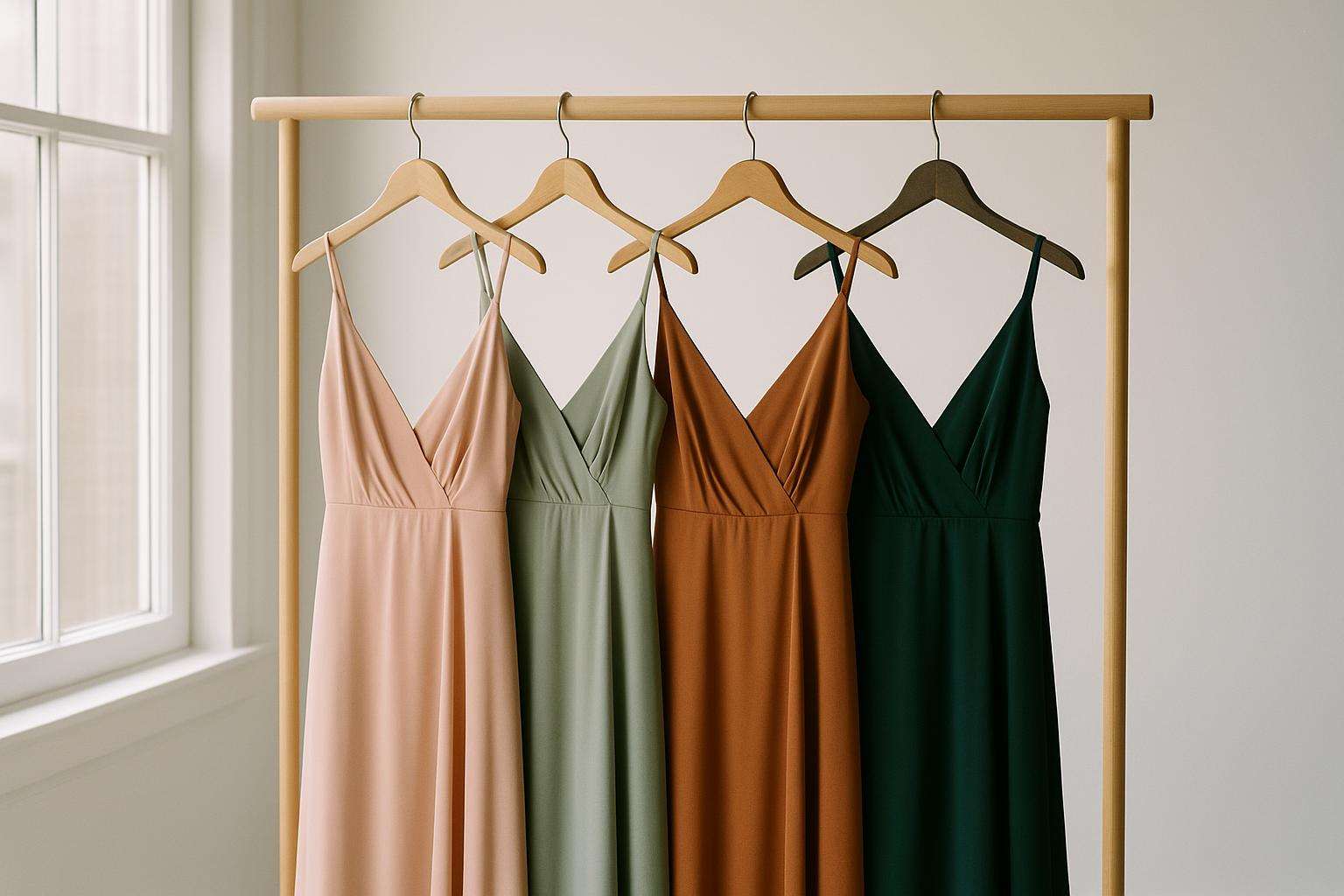
Season-by-SeasonPalette GuideSkin-Tone Notes2026 TrendsReal Retailers
The quick verdict
Four seasons, one photograph-tested palette each — with the shades that work across the group, the retailers carrying them, and the honest undertone notes your bridesmaids will thank you for.
- Best overall
- Sage Green (Spring & Fall) — Kennedy Blue's own data names sage green the most-requested outdoor and garden-wedding color for 2025–2026. It reads botanical without sweetness, photographs cleanly in natural light, and — among neutral-undertone bridesmaids — is one of the most universally flattering shades in any retailer's lineup.
- Best value
- Dusty Blue / Sky Blue from Azazie — Azazie starts at $69 and carries dusty blue in 20-plus style variations with custom sizing at no extra cost. Sky blue is Kennedy Blue's #1 trending 2026 color and crosses seasons from late spring through winter, offering the longest wearable window of any shade in this guide.
- Best for Mixed bridal party with diverse skin undertones
- Burgundy (Fall) or Midnight Navy (any season) — Both shades sit in a near-undertone-neutral zone that flatters warm, cool, and neutral complexions without visible compromise. The Dessy Group and Azazie both name navy as the safest group pick when undertones vary dramatically. Burgundy earns the same citation for fall weddings specifically.
How we evaluated
Rankings are based on the consensus of published styling and trend guidance from Kennedy Blue, Azazie, The Dessy Group, Adrianna Papell, Jenny Yoo, Pronovias, Weare Rewritten, Rocky Mountain Bride, and MB Bride & Special Occasion — all verified editorial sources active in 2025–2026. Each season's palette is assessed on four criteria: photograph performance in seasonal light, wearability across the full range of skin undertones in a typical bridal party, real retail availability at named retailers in 2026, and whether the shade has been reported as trending by two or more independent sources. An honest weakness is included for every seasonal palette — no color works for every group in every scenario.
- Photograph performance in seasonal light. How does the shade read in the natural or artificial light conditions most common to the season — bright spring sun, high summer exposure, warm fall tungsten, winter candlelight?
- Undertone range across a typical bridal party. Does the shade work across warm, cool, and neutral undertones? Or does it require careful undertone-matching before committing to the group?
- Real retail availability in 2026. Can you shop this shade from a named retailer today at a range of price points? Shades carried only at couture tier are noted.
- Trend corroboration from multiple sources. Is this shade reported as trending by at least two independent editorial sources in 2025–2026?
Rating scale: Ratings are on a 1–5 scale in 0.5 increments. 5.0 = photograph-tested across all four criteria, widely available, trending, undertone-safe. 4.0 = excellent with one caveat. 3.5 = solid but requires undertone pre-screening. Below 3.5 = noted in body copy only.
Last verified .
At a glance
| # | Name | Rating | Best for | Pricing |
|---|---|---|---|---|
| 1 | Sage Green — Spring | 5.0 | Outdoor spring and garden weddings with a botanical, nature-forward aesthetic | From $69 (Azazie); $99–$149 (Kennedy Blue, sizes 00–32); $200–$450 (Jenny Yoo crepe/velvet) |
| 2 | Champagne — Spring | 4.5 | Spring weddings where the bride wants a neutral, elegant palette that photographs warmly without committing to a chromatic color | From $69 (Azazie); $99–$149 (Kennedy Blue); $200–$400+ (The Dessy Group via salons); styled appointment via Bella Bridesmaids |
| 3 | Navy — Summer (Evening) | 4.5 | Summer evening receptions and indoor summer weddings where the bride wants a sophisticated, undertone-safe palette with maximum bride-forward contrast | From $69 (Azazie, 40+ styles); $99–$149 (Kennedy Blue, sizes 00–32); $200–$400+ (The Dessy Group) |
| 4 | Terracotta — Fall | 4.5 | Fall weddings at warm, textured venues (vineyard, barn, forest, estate) where the bride wants a palette that photographs richly in low golden light | From $69 (Azazie); $99–$149 (Kennedy Blue, sizes 00–32) |
| 5 | Burgundy — Fall | 5.0 | Fall weddings with mixed bridal party undertones; evening receptions where the bride wants maximum depth and richness in the palette | From $69 (Azazie); $99–$149 (Kennedy Blue); $200–$400+ (The Dessy Group / Alfred Sung / After Six via salons) |
| 6 | Emerald Green — Winter | 4.5 | Winter evening weddings in ballroom, estate, or church venues where the bride wants a dramatic, jewel-toned palette with strong visual hierarchy against a white gown | From $69 (Azazie); $200–$450 (Jenny Yoo crepe/velvet/satin/chiffon) |
| 7 | Sky Blue / Dusty Blue — Spring & Summer | 5.0 | Outdoor spring and summer weddings; mixed bridal parties where undertone safety is the primary selection criterion | From $69 (Azazie, 20+ styles in dusty blue); $99–$149 (Kennedy Blue sky blue + slate blue, sizes 00–32) |
Sage Green — Spring
The most-requested outdoor and garden-wedding color in 2025–2026, and the shade that replaced blush as the default spring pick.
Editor's pick
Sage green has overtaken blush pink as the single most-requested outdoor and garden-wedding bridesmaid color in 2025–2026, and it earns that position on photographic merit as much as trend momentum. Under bright spring daylight, sage's muted yellow-green base reads as soft and botanical rather than electric — it harmonises naturally with white and ivory bridal gowns, picks up warmth from spring foliage and flower arrangements, and photographs with a clarity that more heavily saturated greens lose in direct sun. Kennedy Blue names sage green their most consistent top-trend color alongside their debut pick of Sky Blue, and their swatch library shows why: the shade sits far enough from jewel-tone green to avoid reading as festive but far enough from grey-green to stay warm and flattering. Jenny Yoo, whose editorial identity is built on the green family — sage, moss, olive, eucalyptus, emerald — offers sage green bridesmaid dresses in crepe, velvet, and satin from approximately $200–$450. For budget-conscious parties, Azazie carries sage in multiple silhouettes from $69 with custom sizing at no extra charge. The undertone picture is genuinely strong: sage works best on neutral and warm undertones, reading luminous without overwhelming warm complexions. On cool undertones it sits comfortably but reads slightly more muted — a considerate choice is to move cool-undertone bridesmaids toward a eucalyptus or grey-sage variation within the same green family rather than forcing the exact same shade across the group.
Strengths
- Photographs cleanly in spring natural light without flattening or over-saturating — the most forgiving of any outdoor spring shade
- Works on neutral and warm undertones; manageable on cool undertones with a grey-sage variation
- Available at every price tier: from $69 at Azazie to $200–$450 at Jenny Yoo for premium fabrications in crepe and velvet
Weaknesses
- On cool undertones, pure sage can read slightly washed out compared to its effect on warm complexions — a mixed group benefits from allowing variation within the green family rather than enforcing one exact swatch
- Best for
- Outdoor spring and garden weddings with a botanical, nature-forward aesthetic
- Pricing
- From $69 (Azazie); $99–$149 (Kennedy Blue, sizes 00–32); $200–$450 (Jenny Yoo crepe/velvet)
Source: Kennedy Blue — 2026 Bridesmaid Dress Color Guide · Visit Sage Green — Spring
Champagne — Spring
The universally flattering neutral that photographs like warm silk under natural daylight and pairs with virtually every bridal gown.
Champagne occupies a unique position in the bridesmaid dress palette: it is technically a neutral but it photographs with a warmth that true ivory and white cannot match. Adrianna Papell's spring editorial specifically recommends champagne as universally flattering under natural daylight, and the photographic evidence supports it — the shade's warm gold undertone catches ambient light and reads as luminous rather than washed out even in direct spring sun. Kennedy Blue lists champagne as their best-selling neutral, which speaks to something beyond trend: it is the backup pick for brides who want elegance without committing to color, and it delivers on that promise consistently. The Dessy Group (whose labels include Alfred Sung and After Six, priced $200–$400+ and sold through salons nationwide) carries champagne across multiple fabrications, from matte chiffon to structured satin, with regional salon access for in-person comparisons. Bella Bridesmaids, the national salon chain carrying Adrianna Papell Platinum among other designer lines, offers one-on-one stylist appointments for color consultation — a useful resource when a bride needs to compare champagne against her specific gown color in real light. The one genuine limitation: if your wedding dress is a warm champagne or gold-adjacent ivory, the two colors can blend together in photographs in a way that lacks the contrast needed to differentiate the bride from the bridal party. In that case, consider dusty rose or sage green as a complementary alternative that still reads soft and spring-appropriate.
Strengths
- Universally flattering across warm, cool, and neutral undertones — the closest thing in the bridal palette to a guaranteed-safe spring color
- Photographs with warm luminosity under natural daylight; holds its saturation under cloud cover without going dull
- Available at every tier: Azazie from $69, Kennedy Blue at $99–$149, The Dessy Group and Adrianna Papell via Bella Bridesmaids at $200–$400+
Weaknesses
- Champagne bridesmaids can blend photographically with a warm champagne or gold-ivory wedding dress — brides must swatch their gown color directly against the bridesmaid champagne before confirming; the effect depends entirely on how far apart the two shades actually are in person
- Best for
- Spring weddings where the bride wants a neutral, elegant palette that photographs warmly without committing to a chromatic color
- Pricing
- From $69 (Azazie); $99–$149 (Kennedy Blue); $200–$400+ (The Dessy Group via salons); styled appointment via Bella Bridesmaids
Source: Adrianna Papell — Spring Bridesmaid Dress Color Trends · Visit Champagne — Spring
Navy — Summer (Evening)
The one summer color that earns the same undertone-safe endorsement as midnight blue does for fall — and delivers the most bride-forward contrast of any summer palette.
Navy's reputation as the safest bridesmaid dress color transcends season, but it earns a specific summer evening placement because of what it does against warm artificial reception lighting. Where highly saturated summer colors — coral, aqua, sunshine yellow — carry real undertone risk in a mixed bridal party, navy sits in a near-neutral zone that The Dessy Group and Azazie both cite as their top recommendation when undertones vary dramatically across the group. Pronovias recommends navy as an evening summer choice because its depth reads as sophisticated rather than heavy under tungsten reception lighting, and because the shade creates the clearest possible visual separation between the bridal party and the white wedding gown — the bride stands out, which is ultimately the point. In lightweight chiffon or satin, navy keeps the bridal party cool at warm-weather celebrations while delivering the visual gravity of a darker shade. Kennedy Blue carries navy in their full size range (00–32) at $99–$149; Azazie stocks navy across 40-plus silhouettes from $69 with custom sizing. The practical limitation is that navy in bright direct daylight can read as flat or drain during outdoor summer ceremonies — it genuinely performs best as an evening or covered-venue choice. For outdoor midday ceremonies, a dusty sky blue or soft French blue delivers a similar undertone-safe reading with better daylight performance.
Strengths
- Virtually undertone-safe — performs across warm, cool, and neutral complexions without visible compromise, which no saturated summer color can claim
- Creates strong visual contrast against the bridal gown — the clearest bride-forward effect of any summer palette choice
- Available at every price point: Azazie from $69 across 40-plus styles; Kennedy Blue at $99–$149; The Dessy Group at $200–$400+
Weaknesses
- In direct bright summer daylight, navy can read as heavy or drain energy from an outdoor ceremony — it performs best for evening receptions or covered/indoor summer venues, not midday garden ceremonies
- Best for
- Summer evening receptions and indoor summer weddings where the bride wants a sophisticated, undertone-safe palette with maximum bride-forward contrast
- Pricing
- From $69 (Azazie, 40+ styles); $99–$149 (Kennedy Blue, sizes 00–32); $200–$400+ (The Dessy Group)
Source: Pronovias — Top Bridesmaid Dress Colors for Every Season · Visit Navy — Summer (Evening)
Terracotta — Fall
The definitive fall bridesmaid color of the 2024–2026 wedding cycle — warm, earthy, and made for golden-hour photography.
Terracotta has spent three years at or near the top of fall bridesmaid dress inspiration boards, and it has stayed there because it earns its position on photographic merit rather than trend momentum alone. Kennedy Blue describes it as "soft and earthy — pink and orange with hints of brown — extra stunning for summer and fall weddings," and that description is precise: terracotta is not a sharp orange and not a dusty rose — it occupies a warm, sun-baked middle ground that catches amber and gold light naturally, making it one of the most camera-friendly fall bridesmaid colors available. At vineyard ceremonies, barn receptions, and forest venues, terracotta picks up the warmth of the surrounding environment in a way that a cooler palette cannot. Kennedy Blue and Azazie both carry terracotta in their 2026 lines; Kennedy Blue's Slate Blue and Terracotta are specifically featured as their 2026 standout colors. The honest undertone limitation is genuine: terracotta is at its best on warm undertones (golden, peachy, olive skin), where it amplifies natural warmth without clashing. On cool undertones (pink or bluish cast), terracotta can appear to sit against the skin rather than with it — the most considerate approach for a mixed group is to offer a rust or copper variation as an alternative within the same warm fall family, creating a mix-and-match palette that keeps everyone in their most flattering terracotta-adjacent tone. Rocky Mountain Bride's 2026 trends report confirms terracotta remains a top-performing fall shade for editorial photography.
Strengths
- Photographs with exceptional warmth in fall golden-hour light — one of the most camera-friendly bridesmaid colors at autumn venues (vineyards, barns, forests)
- Versatile within the warm fall palette — pairs naturally with burgundy, copper, rust, and mocha in a mix-and-match group approach
- Carried by Kennedy Blue ($99–$149) and Azazie (from $69) in 2026 with confirmed availability
Weaknesses
- Best on warm undertones; on cool undertones it can read flat or clashing — a mixed group should offer rust or copper as a companion shade within the same warm fall palette rather than enforcing one exact terracotta swatch across everyone
- Best for
- Fall weddings at warm, textured venues (vineyard, barn, forest, estate) where the bride wants a palette that photographs richly in low golden light
- Pricing
- From $69 (Azazie); $99–$149 (Kennedy Blue, sizes 00–32)
Source: Kennedy Blue — 2026 Bridesmaid Dress Color Guide · Visit Terracotta — Fall
Burgundy — Fall
Fall's most universally flattering shade — the one color that earns the same group-safe endorsement as midnight navy, but in the season's own register.
Burgundy is the bridesmaid equivalent of a reliable anchor shade: it is deeply fall in its associations — wine, ripe fruit, autumn foliage — but it sits in a blue-red zone that works across warm, cool, and neutral undertones without the compromise that other fall shades require. The Dessy Group, whose skin-tone guidance is among the most detailed in the industry, specifically cites burgundy as a fall shade that flatters the broadest range of complexions; Azazie's color-matching guide names it a group-safe pick for mixed bridal parties. Burgundy under warm tungsten reception lighting deepens to a rich wine that photographs with extraordinary depth, and under natural fall daylight it reads as saturated without being heavy. The shade pairs naturally with the seasonal florals — deep red roses, burgundy dahlias, dried grasses — and with the white or ivory bridal gown, it creates a contrast register that photographs with strong visual hierarchy. The Dessy Group's Alfred Sung and After Six labels both carry burgundy at $200–$400+ through their nationwide salon network, with five free swatches available. Kennedy Blue carries burgundy in sizes 00–32 at $99–$149. One practical note: burgundy in very pale morning or overcast light can look slightly brown rather than rich red — test the shade in your actual venue's lighting conditions before committing, and compare both the burgundy and a wine-red swatch if your ceremony begins before noon.
Strengths
- Among the most undertone-safe fall colors available — performs across warm, cool, and neutral complexions without visible compromise
- Photographs with exceptional depth under warm tungsten reception lighting; holds its richness in natural fall daylight
- Available from The Dessy Group ($200–$400+ via salons), Kennedy Blue ($99–$149), and Azazie (from $69) — the widest retail distribution of any fall shade in this guide
Weaknesses
- In very pale morning or heavily overcast light, burgundy can shift toward brown rather than rich red — worth testing in your ceremony venue's specific light conditions, especially for morning ceremonies
- Best for
- Fall weddings with mixed bridal party undertones; evening receptions where the bride wants maximum depth and richness in the palette
- Pricing
- From $69 (Azazie); $99–$149 (Kennedy Blue); $200–$400+ (The Dessy Group / Alfred Sung / After Six via salons)
Source: The Dessy Group — What Bridesmaid Dress Colors Work Best for Different Skin Tones? · Visit Burgundy — Fall
Emerald Green — Winter
Winter's statement color in 2026 — luxurious, architectural, and one of the few shades that actually improves under ballroom tungsten lighting.
Emerald green is the winter arrival of the green family that has dominated bridesmaid palettes for three years. Where sage reads botanical and spring-soft, and olive reads earthy and fall-editorial, emerald reads luxurious and deliberately dramatic — a shade that holds its saturation under tungsten ballroom light in a way that sage or dusty green would lose. Under candlelight, emerald deepens toward forest and jewel, creating a depth that photographs with visual weight and deliberateness. Against a white or ivory bridal gown, emerald creates one of the strongest contrast effects in the seasonal bridesmaid palette — the separation is immediate and the visual hierarchy is clear. Jenny Yoo is the most considered retail source for emerald and deep green bridesmaid dresses in 2026 — their green spectrum editorial, which covers sage, moss, olive, eucalyptus, and emerald in crepe, velvet, satin, and chiffon, is the deepest single-brand treatment of the green family in the market, with bridesmaid dresses ranging from approximately $200 to $450. At the accessible end, Azazie carries emerald in multiple silhouettes from $69. The undertone picture for emerald is one of the strongest in the jewel-tone family: unlike deep plum or sapphire (which favor cool undertones), emerald sits in a slightly warmer green register that works on both warm and cool undertones — bridesmaids with warm undertones read against the emerald's depth as luminous rather than clashing, while cool undertones receive the same jewel-tone benefit they get from sapphire or navy.
Strengths
- One of the few jewel-tone shades that works across both warm and cool undertones — broader group-flattering range than deep plum or sapphire
- Holds saturation under ballroom tungsten and candlelight; actually deepens toward forest rather than appearing flat under artificial lighting
- Jenny Yoo's dedicated green-spectrum editorial — the most considered retail resource for emerald bridesmaid dresses — carries the shade in crepe, velvet, satin, and chiffon at $200–$450
Weaknesses
- On very pale or fair complexions with a pink undertone, emerald can create a stark contrast that reads as harsh rather than luxurious in photographs — a deep teal or dusty jade softens the effect while staying within the same cool green family
- Best for
- Winter evening weddings in ballroom, estate, or church venues where the bride wants a dramatic, jewel-toned palette with strong visual hierarchy against a white gown
- Pricing
- From $69 (Azazie); $200–$450 (Jenny Yoo crepe/velvet/satin/chiffon)
Source: Jenny Yoo — Green, Emerald, Sage, Moss, Eucalyptus, and Olive Bridesmaid Dress · Visit Emerald Green — Winter
Sky Blue / Dusty Blue — Spring & Summer
Kennedy Blue's #1 trending color for 2026 — a cross-season workhorse that performs in natural light at outdoor weddings better than almost any other shade.
Editor's pick
Dusty blue has been a bridesmaid dress staple since 2022, but Kennedy Blue's identification of Sky Blue as their single most-trending color for 2026 marks a meaningful shift in the family: the move from dusty and muted toward a brighter, cleaner sky register — still soft enough to remain universally flattering, but with more luminosity than the heavily muted dusty tones of recent years. Weare Rewritten's 2026 colour forecast echoes this, highlighting "dusty blue" alongside olive and sage as the breakout shades replacing blush-heavy palettes. The photographic case for sky blue and dusty blue is particularly strong: both tones perform well in natural light across all four seasons, photographing most beautifully in outdoor spring and early summer contexts where bright ambient light can flatten more saturated colors but gives these softer blues a luminous quality. Azazie carries dusty blue in more than 20 dedicated colorways from $69 — one of their most comprehensively stocked colors — and Kennedy Blue offers sky blue and slate blue in sizes 00–32 at $99–$149. The undertone picture is among the strongest in this guide: dusty blue and sky blue work on warm, cool, and neutral undertones without visible compromise, making this the closest thing in the bridesmaid dress palette to a guaranteed-safe choice for a mixed bridal party at a spring or summer wedding. The one legitimate limitation is winter: in low-light ballroom conditions, sky blue can read as pale and slightly flat rather than luminous — in that context, steel blue or sapphire in a richer, more saturated register will perform better.
Strengths
- Genuinely undertone-safe across warm, cool, and neutral complexions — the most broadly flattering blue in the market for mixed bridal parties
- Confirmed #1 trending bridesmaid color for 2026 by Kennedy Blue; corroborated by Weare Rewritten's 2026 colour forecast as a breakout shade
- One of the most widely stocked colors across retail: Azazie carries 20+ dusty blue styles from $69; Kennedy Blue offers sky blue in sizes 00–32 at $99–$149
Weaknesses
- In low-light ballroom or candlelit winter settings, sky blue and dusty blue can read as pale and flat rather than luminous — for winter receptions, steel blue or sapphire in a deeper, more saturated register is a more effective choice
- Best for
- Outdoor spring and summer weddings; mixed bridal parties where undertone safety is the primary selection criterion
- Pricing
- From $69 (Azazie, 20+ styles in dusty blue); $99–$149 (Kennedy Blue sky blue + slate blue, sizes 00–32)
Source: Azazie — How to Choose the Perfect Color for a Bridesmaid Dress · Visit Sky Blue / Dusty Blue — Spring & Summer
Which should you choose?
Spring bride with a mixed-undertone bridal party · Online retailer with swatch program
Goal:Find a spring color that works across all undertones and stays on budget
Sage Green — Spring — Azazie's sage green from $69 with custom sizing and a free swatch program makes it practical to test across the group before committing. Kennedy Blue's sage at $99–$149 with a free home try-on program is the step-up option.
Fall bride planning a vineyard or barn wedding · Online retailer
Goal:A rich, warm fall palette that photographs well in natural and golden-hour light
Terracotta — Fall — Kennedy Blue's terracotta in sizes 00–32 at $99–$149 is the most practical starting point; mix with a rust or copper swatch from Azazie for bridesmaids with cool undertones to create a cohesive mixed-shade fall palette.
Winter bride wanting a luxury evening palette · Premium designer boutique
Goal:A statement jewel-tone palette that holds up under ballroom lighting
Emerald Green — Winter — Jenny Yoo's emerald in velvet or crepe at $200–$450 delivers the luxury fabrication required for a winter ballroom aesthetic; the brand's green-spectrum editorial is the most authoritative styling resource for this specific color in 2026.
Frequently asked
What bridesmaid dress colors are trending in 2026?
The four dominant bridesmaid dress colors for 2026 are sky blue, sage green, terracotta, and dusty slate, according to Kennedy Blue's 2026 color guide and Weare Rewritten's 2026 colour forecast. Sky blue is Kennedy Blue's confirmed #1 trending color for the year, with sage green close behind. Weare Rewritten highlights olive, sage, and dusty blue as the breakout shades replacing the blush-heavy palettes of the early 2020s. Mocha — a warm earthy brown — is confirmed by Rocky Mountain Bride as one of the most-requested new colors introduced in 2025 and carrying strongly into 2026. Desert rose, described as a sun-baked mauve, is also gaining ground as a more editorial alternative to traditional blush.
What is the most universally flattering bridesmaid dress color?
Dusty blue and midnight navy are the two most universally flattering bridesmaid dress colors for a mixed bridal party, according to guidance from The Dessy Group and Azazie. Both shades sit in a near-undertone-neutral zone that works across warm, cool, and neutral complexions without visible compromise. Sage green and champagne are the next most universally cited choices — sage works on neutral and warm undertones with only a minor adjustment needed for cool complexions, while champagne's warm gold base photographs as luminous on almost every skin tone. Among jewel tones, emerald is the most broadly flattering because it occupies a slightly warmer green register that works on both warm and cool undertones, unlike deep plum or sapphire which clearly favor cool undertones.
Should bridesmaid dresses match the season?
Bridesmaid dress colors do not need to match the season literally, but dressing in seasonal harmony improves photograph quality and creates a more cohesive visual aesthetic. The practical reason is lighting: spring natural light, fall golden hour, and winter ballroom tungsten all render colors differently — a shade that is calibrated to its seasonal light context will photograph more beautifully than one chosen without it. Brides who want a color they love that falls outside the seasonal palette should test fabric swatches in their venue's actual lighting conditions before committing. The one exception is neutral shades — champagne, dusty blue, soft sage — which perform consistently across seasons and are genuinely season-agnostic.
How many bridesmaid dress colors can I mix in one bridal party?
The current standard approach, as documented by Rocky Mountain Bride and Azazie's styling guides, is to mix two to four shades within a single color family rather than choosing one uniform exact color. Mixing soft rose, dusty pink, and mauve within a blush palette — or pairing olive with eucalyptus and sage within a green palette — creates visual depth and allows each bridesmaid to wear the shade that flatters her individual undertone most. The constraint is that all shades should share the same undertone direction (all warm or all cool within the family) so the group photographs as intentional rather than random. Mixing more than four distinct shades within one family tends to lose visual cohesion in group photographs unless the arrangement is choreographed very carefully.
How do I choose a bridesmaid dress color that flatters dark skin tones?
Deep and rich colors — emerald, burgundy, navy, plum, and cobalt — are among the most flattering bridesmaid dress shades for deep skin tones, as the contrast creates a striking, luminous effect that softer pastels cannot match. The Dessy Group's skin-tone guide notes that jewel tones and cool-based deep shades bring out the warmth and radiance in deeper complexions. Earth tones — terracotta, copper, warm chocolate — also photograph beautifully on deep warm undertones, amplifying natural richness. The shades that tend to underperform on deeper skin tones are very pale pastels (mint green, baby blue, pale blush) and heavily muted dusty neutrals at the lightest end of the spectrum — these can read as flat against deeper complexions rather than complementary.
Where can I order bridesmaid dress swatches before buying?
The three most accessible free swatch programs from real retailers in 2026 are: Azazie, which offers free swatches across its 90-plus colors and allows custom sizing at no extra cost on orders from $69; Kennedy Blue, which offers a free home try-on program alongside fabric swatches for their $99–$149 range in sizes 00–32; and The Dessy Group (Dessy, Alfred Sung, After Six labels), which offers five free swatches per order with paid shipping through their salon network and website. Bella Bridesmaids — a national salon chain carrying Adrianna Papell Platinum and other designer lines — offers in-person styled swatch consultations at their locations. The standard advice from The Dessy Group's own color guide is to order three to five adjacent shades, not just the one you think you want, because neighboring colors look near-identical on screen but read differently on actual fabric in real light.