The Bride's Circle
Bridesmaid Dresses: The Complete Selection Guide
From the mix-and-match decision to dye lots, ordering timelines, and body-type accommodation — a complete, retailer-grounded framework for choosing bridesmaid dresses that flatter your whole party.
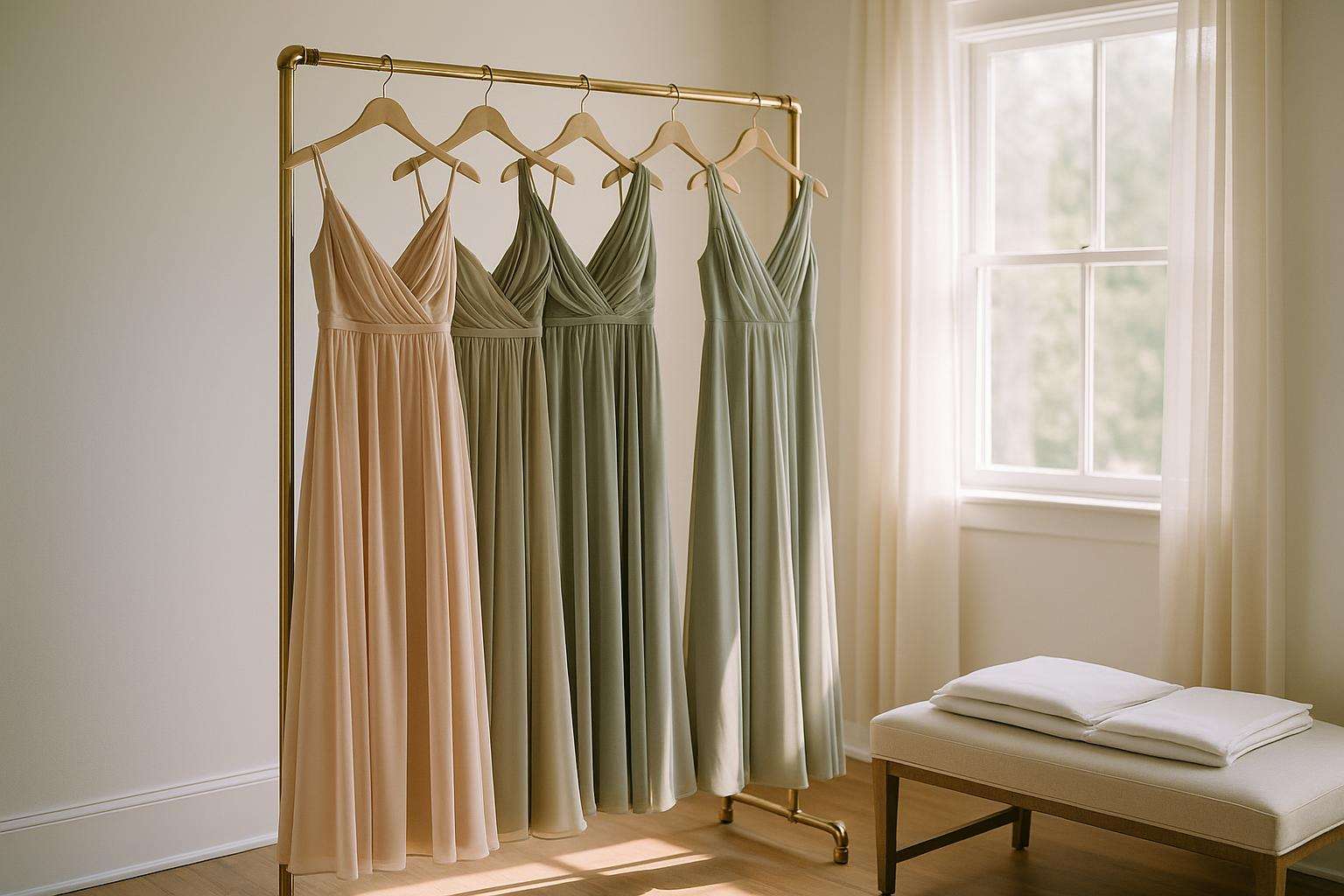
The national average bridesmaid dress costs $128 (The Knot, 2025), with all-in costs including alterations typically running $200–$280. Order all dresses in a single batch six to eight months before the wedding to guarantee same-dye-lot color consistency. The A-line silhouette in chiffon is the most universally flattering choice for a mixed-body-type party; the mix-and-match approach — same color, different silhouettes — is now the dominant trend for 2026 weddings.
Bridesmaid dresses sit at an unusual intersection of fashion, logistics, and diplomacy. You are choosing a look that must flatter six different body types, land within each bridesmaid's budget, coordinate with your gown and venue palette, and arrive — complete and altered — weeks before the wedding. This guide resolves each of those variables in sequence, drawing on real retailers, verified pricing, and expert guidance from the industry's most-consulted sources.
What does the average bridesmaid dress actually cost in 2026?
According to The Knot's 2025 Real Weddings Study — which surveyed nearly 17,000 couples who married in 2024 — the national average bridesmaid dress cost is $128 per person. Regional variation is real: in the Mid-Atlantic and Northeast, averages climb to approximately $140. Alterations are the most commonly overlooked line item. Most bridesmaids can expect to pay an additional $75 to $150 for tailoring, with hemming alone averaging around $45. All-in, a dress plus alterations typically runs $200 to $280 before shoes or accessories.
The major retailers span every budget tier with genuine options at each level:
| Retailer | Price Range | Size Range | Color Options | Key Strength |
|---|---|---|---|---|
| Birdy Grey | From $89 | XS–4X | 40+ | Budget-forward; ready-to-ship; photographer-praised fabrics |
| David's Bridal | Many styles under $100 | 0–30W | 40 | In-store try-on; immediate availability; largest U.S. chain |
| Azazie | $69–$150 | 0–30 + custom | 90+ | 600+ silhouettes; free custom sizing; at-home try-on program |
| Dessy Group (incl. After Six, Alfred Sung) | $175–$300 | 0–32 | 150+ colors and prints | Heritage brand (est. 1939); specialty fabrics; boutique distribution |
| Jenny Yoo Collection | $500–$600 | 0–32 | 30+ | Designer quality; 10 fabrics; built for mix-and-match parties |
Should bridesmaids match exactly, or is the mix-and-match approach better?
Mix-and-match bridesmaid dressing — coordinating dresses in the same color but different silhouettes — has become the dominant approach for 2025 and 2026 weddings. The method allows each bridesmaid to wear a cut suited to her body and comfort level while producing a cohesive, editorial look in photographs. Two primary strategies exist.
Same color, different silhouettes. Lock in one color — dusty sage, blush, burgundy — and let each bridesmaid choose her neckline, sleeve style, and length. Azazie, which actively promotes this approach, offers over 90 colors across 600+ silhouettes specifically to enable unlimited individual variation within a unified palette.
Same silhouette, tonal palette. Choose one versatile cut — typically an A-line or convertible style — and allow a range of shades within a color family (blush through rose gold, for example). Jenny Yoo's Spring 2026 collection is built around this tonal-mix aesthetic, with shades including Light Whisper Blue, Powder Pink, and Buttercup Yellow designed to layer beautifully as a coordinated group.
A non-negotiable operational rule applies to both strategies: order all dresses in a single transaction, in the same dye lot. Color can vary between production batches, and even a subtle difference is visible in wedding photographs. Bella Bridesmaids and David's Bridal both cite dye-lot mismatches as the most common and entirely preventable bridesmaid ordering mistake. Even when styles differ, place every order at the same time.
What silhouette and fabric flatter every body type in a bridal party?
Experts universally recommend anchoring the group in one universally flattering element — typically fabric or color — then allowing silhouette flexibility. The A-line silhouette is the single most widely recommended style for mixed bridal parties because it flares gently from a natural or empire waist and flatters the broadest range of body proportions in a single group. Chiffon is the analogous fabric recommendation: it drapes smoothly across varied proportions, moves gracefully through a ceremony and reception, and photographs well in both natural and artificial light.
For brides who want to specify silhouettes by body type, the guidance from Azazie's editorial team and David's Bridal's style consultants is consistent:
- Hourglass: Nearly any silhouette works. Fitted-waist styles — wrap, sheath, or mermaid — emphasize natural proportions without requiring adjustment.
- Pear-shaped (fuller hips, narrower bust): A-line skirts skim the hips while structured bodice details or statement necklines draw attention upward and create visual balance.
- Apple or full-figured: V-necklines elongate the torso and visually widen the shoulder; A-line and empire-waist cuts create a clean, flowing line from bust to hem.
- Rectangle or athletic: Sweetheart necklines and ruched waistlines suggest curves; asymmetrical necklines interrupt horizontal shoulder lines and add visual interest.
- Petite: High-waisted silhouettes and floor-length gowns with a side slit create the illusion of height; excessive volume overwhelms a smaller frame and should be avoided.
- Tall: Draped fabrics, cowl necks, and halter styles complement long lines while adding the romantic softness that a very vertical silhouette can lack.
The mix-and-match method works best when the bride identifies two or three universally flattering silhouettes — typically an A-line, a convertible/wrap style, and one sheath option — and lets each bridesmaid self-select from that curated menu rather than the entire catalog. This narrows the range enough to stay cohesive while still honoring individual body preferences.
Which fabric and length work best by season and venue?
Fabric choice should be driven by the time of year and venue type before any other factor. The environment determines what reads well and what is practical to wear for a five-to-eight-hour day.
Spring and summer, outdoor: Lightweight chiffon is the industry standard. It is breathable in warm weather, moves beautifully in garden and waterfront settings, and photographs well in natural light. Floor-length chiffon is the classic choice for formal spring garden weddings; midi and knee-length cuts work well for more casual outdoor events. Azazie's Spring 2026 trending fabrics include lightweight chiffon, stretch satin, and floral burnout — all appropriate choices for warm-weather ceremonies.
Autumn, indoor or tented: Satin reads as appropriately formal and substantial for the season. Its weight and subtle sheen complement the amber and burgundy palette typical of autumn weddings. The Dessy Collection by Vivian Diamond, distributed through authorized boutiques including Bella Bridesmaids, uses specialty fabrics that work particularly well for autumn and early winter events.
Winter, indoor: Velvet is the seasonal standout. Birdy Grey's cabernet and emerald velvet styles are consistent bestsellers for December and January weddings, pairing naturally with candlelight and rich interior spaces. Floor length is the correct call here — the formality of velvet demands a full-length gown.
Destination and beach: Georgette, gauze, and loosely woven chiffon are the lightest options and resist wind. Tea-length or midi cuts are practical for sand and uneven terrain. Birdy Grey's airy pastels in their lightest fabrications are consistently recommended for beach events.
At the premium tier, Jenny Yoo's Spring 2026 bridesmaid collection offers all four fabric families — satin, chiffon, velvet, and tulle — across more than 30 colorways, making it possible to specify fabric by season and venue without changing silhouette or color palette. Signature Spring 2026 styles include the Simona (floral tiered ruffles), Berkley (lightweight tulle with a drop waist), Graham (sweetheart neckline in pale blue), and Mercy (garden-embroidered gown in yellow and blush).
What is the correct ordering timeline for bridesmaid dresses?
The expert consensus across The Knot, Bella Bridesmaids, and David's Bridal converges on a clear timeline. Peak wedding season — May through October — requires beginning at the eight-month mark. Off-season weddings have somewhat more flexibility, but six months remains the practical minimum for made-to-order styles.
| Milestone | Lead Time Before Wedding |
|---|---|
| Gather inspiration; set color palette and style direction | 8–10 months out |
| Share options with bridesmaids; collect measurements | 7–8 months out |
| Place all orders in a single batch (same dye lot) | 6–8 months out |
| Book tailor or seamstress appointments | 3–4 months out |
| Complete all alterations | 4–6 weeks out |
| Final try-on with accessories; steam and press | Wedding week |
Made-to-order dresses from Azazie, Jenny Yoo, and Dessy typically require three to four months of production time, which means six months of lead time is the floor — not a comfortable buffer but the minimum required to leave time for alterations. Last-minute brides should target Birdy Grey's or Azazie's ready-to-ship category, or David's Bridal in-store, where dresses are available immediately in a broad size range.
Every dress — regardless of style, size, or silhouette — must be ordered in a single transaction to guarantee they come from the same production batch. Even a subtle color variation between dye lots is visible in group photographs. This is the single most preventable ordering mistake, according to both Bella Bridesmaids and David's Bridal.
Which retailer is right for your bridal party?
Azazie is the most flexible option for mix-and-match parties. Their at-home try-on program lets each bridesmaid order up to six sample dresses for $10 each, try them for seven days at home, and receive 15% off retail when she places her order. Custom sizing is free on every order regardless of price point — a meaningful advantage for parties where bridesmaids range widely in proportions. Standard sizes run 0–30. A PR Newswire announcement in 2026 confirmed the launch of a new spring collection specifically designed for mix-and-match bridal parties, with lightweight chiffon, stretch satin, and floral burnout as the hero fabrics.
Birdy Grey is the right choice for budget-conscious parties or shorter timelines. Dresses start at $89, with a permanent sale section running up to 50% off. The palette exceeds 40 colors, with seasonal standouts including emerald, cabernet velvet, and airy pastels for spring. Wedding photographers consistently note that Birdy Grey fabrics reproduce well in images — a useful quality signal for couples who are heavily invested in photography.
David's Bridal, the largest bridal chain in the United States, carries hundreds of bridesmaid styles under $100 in sizes through 30W across 40 colors. The practical advantage here is physical presence: bridesmaids can try on together in-store, which removes the guesswork of online ordering for parties that prefer a group shopping experience. Recent in-store arrivals include a Chiffon Halter A-Line, a Matte Satin Bow Shoulder A-Line, and a Sculpting Satin Strapless Mermaid.
Dessy Group — the heritage bridal wear company founded in 1939, whose brands include After Six and Alfred Sung — curates over 150 colors and prints, from sage and dusty blue through terracotta and floral jacquard. The premium Dessy Collection by Vivian Diamond uses specialty fabrics at the upper end of the $175 to $300 price range. Authorized boutiques including Bella Bridesmaids and An Elegant Affair Bridal carry the Spring 2026 collection, making this the right choice for parties that want boutique-quality service without full designer pricing.
Jenny Yoo Collection, with bridesmaid dresses ranging from $500 to $600, is built explicitly for mixed bridal parties: 30+ colors and 10 fabric options allow nearly unlimited combination within a single coordinated aesthetic. Styles are made-to-order in sizes 0 through 32; ready-to-ship options dispatch within one to two business days from Jenny Yoo's New York and Chicago showrooms. For brides who want maximum creative control and are working with a generous budget, Jenny Yoo is the premium standard in the category.
Considered Counsel
Frequently asked
How far in advance should I order bridesmaid dresses?
The expert consensus across The Knot, Bella Bridesmaids, and David's Bridal is to place all bridesmaid dress orders six to eight months before the wedding date, with peak-season (May through October) weddings requiring the full eight months. Made-to-order retailers such as Azazie, Jenny Yoo, and Dessy typically require three to four months of production time alone, which means six months is the practical minimum lead time. Alterations add another four to six weeks after delivery. Brides who are working with a shorter timeline should target Birdy Grey's ready-to-ship inventory or David's Bridal's in-store selection, where dresses are available immediately. The single most critical rule: all dresses — even mix-and-match styles — must be ordered at the same time to guarantee they come from the same dye lot. Color can vary between production runs, and even a subtle variation is visible in group photographs.
Should all bridesmaids wear the same dress, or is mix-and-match better?
Mix-and-match bridesmaid dressing — coordinating dresses in the same color but different silhouettes — has become the dominant approach for 2025 and 2026 weddings. The method allows each bridesmaid to wear a silhouette suited to her body and comfort level while producing a cohesive, editorial effect in photographs. Two primary strategies exist: same color with different silhouettes (locking in one shade and allowing each bridesmaid to choose her neckline and length) or same silhouette with a tonal palette (one cut in a range of shades within a color family). Azazie supports the former approach with over 600 silhouettes in 90+ colors. Jenny Yoo's Spring 2026 collection is specifically built for the latter, with shades like Light Whisper Blue, Powder Pink, and Buttercup Yellow designed to work together. The key operational rule: even when styles differ, all orders must be placed in one batch to preserve color consistency across dye lots.
What bridesmaid dress silhouette flatters every body type in a group?
The A-line silhouette is the single most universally recommended style for mixed bridal parties. It flares gently from a natural or empire waist, accommodating a broad range of hip proportions without adding bulk, and it photographs cleanly in both natural and formal light. For pear-shaped figures it skims the hips while structured bodice details draw the eye upward; for fuller figures a V-neckline version elongates the torso; for petite bridesmaids a high-waisted version creates the illusion of height. Chiffon is the analogous fabric recommendation — it drapes smoothly across varied proportions, moves gracefully, and is forgiving in fit. When a group cannot agree on one silhouette, anchoring in a shared fabric or shared color and allowing silhouette flexibility achieves similar cohesion while giving each person genuine control over their own comfort.
What is the average cost of a bridesmaid dress in 2026?
According to The Knot's 2025 Real Weddings Study, which surveyed nearly 17,000 couples who married in 2024, the national average bridesmaid dress cost is $128 per person. In the Mid-Atlantic and Northeast, regional averages climb to approximately $140. Alterations add a commonly overlooked additional cost: most bridesmaids pay $75 to $150 for tailoring, with hemming alone averaging around $45. All-in, a dress plus alterations typically costs $200 to $280 before shoes or accessories. Retailers span every tier: Birdy Grey starts at $89, David's Bridal carries hundreds of styles under $100, Azazie runs $69 to $150 with free custom sizing, Dessy Group ranges from $175 to $300, and Jenny Yoo Collection runs $500 to $600 as a made-to-order designer option.
What bridesmaid dress fabric works best by season and venue?
Fabric choice should be driven by the time of year and venue environment before any other factor. For spring and summer outdoor weddings, lightweight chiffon is the industry standard: it is breathable, drapes beautifully in garden and beach settings, and photographs well in natural light. Satin is better suited to autumn and winter events, particularly indoor venues — its weight and sheen read as formal and warm. Velvet is reserved for late autumn and winter weddings in indoor or covered settings; Birdy Grey's cabernet velvet and emerald velvet styles are consistent bestsellers for December and January weddings. For destination and beach ceremonies, georgette and gauze fabrics are the lightest options and resist wind. At the luxury tier, Jenny Yoo's Spring 2026 collection offers satin, chiffon, velvet, and tulle across 30+ colorways, making it possible to assign fabric by season without changing silhouette or color.
Is Azazie or Birdy Grey better for bridesmaid dresses?
The choice depends primarily on timeline and customization needs. Azazie is the stronger option for parties requiring custom sizing — every order includes free custom measurements regardless of price point, and the brand's at-home try-on program lets bridesmaids order up to six sample dresses for $10 each, try them for seven days, and receive 15% off retail when they order. With 600+ silhouettes in 90+ colors, it also offers the broadest selection for mix-and-match bridal parties. Birdy Grey is the better choice for speed and budget: dresses start at $89 with a permanent sale section offering up to 50% off, and ready-to-ship options allow last-minute ordering. Birdy Grey's palette exceeds 40 colors and their fabrics are consistently praised by wedding photographers for how well they reproduce in images. For the longest lead times and highest design quality, Jenny Yoo and Dessy are the premium alternatives.
What is a dye lot, and why does it matter for bridesmaid dresses?
A dye lot refers to the specific batch in which a fabric is dyed during production. Even when two rolls of fabric are dyed the same color using the same formula, slight variations in temperature, timing, and dye absorption can produce subtle but visible differences between batches. In a bridesmaid party where all dresses are meant to match, two dresses produced in different dye lots may read as slightly different shades of the same color — a mismatch that is invisible on a screen but conspicuous in photographs and under venue lighting. The practical rule is simple: all bridesmaid dresses must be ordered in a single transaction, in the same dye lot, regardless of how many styles or sizes are involved. Bella Bridesmaids and David's Bridal both cite dye-lot mismatches as the single most common and preventable bridesmaid dress ordering mistake.