The Bride's Circle
Engagement Party Dress: The Bride's First Style Moment
White or floral? Mini or midi? The engagement party dress sets the stylistic tone for everything that follows — here's how to read formality by venue, settle the color debate, and shop real picks from BHLDN, Reformation, Revolve, and more.
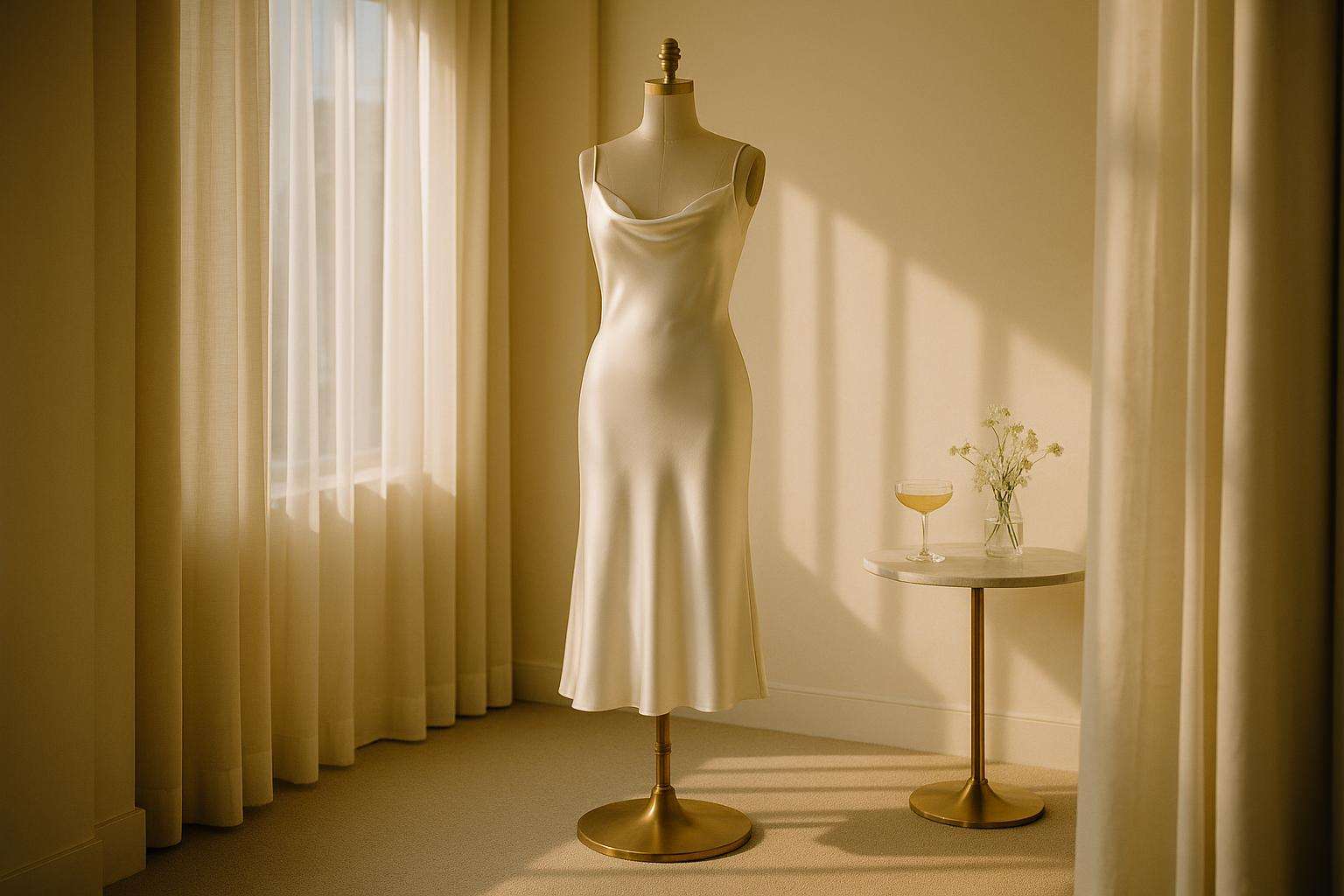
The engagement party dress is the bride's first style moment of the wedding journey — and the most important decision is formality calibration by venue: a casual backyard calls for a relaxed white midi or sundress, a semi-formal restaurant calls for a silk or satin midi, and a formal ballroom calls for a floor-length gown. White is conventional but not required; florals, pastels, and prints are equally legitimate, especially for spring and summer parties.
Why does the engagement party dress carry its own styling logic?
Unlike the wedding gown, the engagement party dress comes without aisle-pressure attached. There is no year-long search, no weeping in the fitting room, no vows to honor. But it is the opening note of a pre-wedding wardrobe arc that runs through the bridal shower, bachelorette, rehearsal dinner, and wedding day — which means the choice carries aesthetic stakes even when the stakes feel low.
The engagement party is the bride-to-be's first public appearance as a fiancée. It is often the event at which many guests meet the couple for the first time, and the first occasion at which the bride's style is read as a preview of what is to come. The Knot's editorial team, which has compiled 25 best engagement party dresses across editorial cycles, consistently notes that this is the event where the bride earns the right to set herself apart — and the dress is the tool for doing so.
The single most consequential decision is not color or hemline. It is formality calibration. Engagement parties span an enormous range: a casual backyard barbecue, a garden brunch, a semi-formal cocktail dinner at a restaurant, or a formal evening affair at a country club or ballroom. Reading that range correctly before opening a single browser tab is more important than any individual dress choice.
How formal should an engagement party dress be?
Formality at an engagement party is dictated by venue and time of day, not by a universal dress code. The invitation is the clearest signal — when one is unclear, err toward more dressed up rather than less. Over-dressing for a celebratory event is far safer than under-dressing, as Zola's expert wedding advice editorial specifically notes. For a full rundown on who hosts, what it costs, and every protocol decision, the engagement party etiquette and planning guide is the right next read.
| Venue / Setting | Formality Level | Recommended Silhouette | Practical Notes |
|---|---|---|---|
| Backyard, garden, or brunch | Casual | Flirty mini, white sundress, chic jumpsuit, floral midi | Stiletto heels are impractical on grass; block heels, wedges, or flat sandals are the practical choice |
| Restaurant or cocktail party | Semi-formal | Midi-length dress in silk, satin, or structured cotton; white or ivory cocktail-length | The midi is the most versatile shape at this tier — long enough to feel dressed up, short enough to move freely |
| Country club, hotel ballroom, fine dining | Formal | Full-length gown or floor-length silhouette in satin, silk, or chiffon | Long-sleeve styles with dramatic construction need no additional accessories; particularly strong for fall and winter |
Does the bride have to wear white to her engagement party?
White is the conventional choice for the bride-to-be — and there are practical reasons for the tradition. According to Zola's expert wedding advice, going white "will immediately set you apart as the bride-to-be" — particularly useful at large parties where guests may not all know one another, and where photographs will serve as the official record of the occasion. White is also the visual cue that helps casual observers understand immediately who is being celebrated.
The tradition of the little white dress has expanded well beyond the wedding day. Tailored white dresses are now a fundamental staple across the entire pre-wedding calendar, from the engagement party through the rehearsal dinner. Jovani's bridal editorial notes that shorter and midi hemlines dominate in engagement party contexts because they read as celebratory rather than overly bridal — the full gown is still reserved for the wedding day itself.
But white is not mandatory. Brides can wear any color to their engagement party, and the white convention is increasingly understood as a tradition rather than a rule. Florals, pastels, and prints are an especially effective choice for spring and summer outdoor parties, where they feel season-appropriate and relaxed. A floral-print mini or midi in ivory, blush, or a light pastel retains a bridal softness while giving the bride visual distinction from guests who will typically avoid white as a courtesy.
For 2025–2026, Brittany Bekas Photography's bridal trends editorial identifies mesh overlays, feather-hem details, and silky slip silhouettes in non-white tones as on-trend alternatives to the classic little white dress. Practical color guidance by undertone and aesthetic: champagne and pearl ivory suit warm skin tones; blush and lavender work for whimsical aesthetics; silvery-blue and dove gray suit minimalist, fashion-forward sensibilities.
Where can you find the best engagement party dresses for brides?
BHLDN at Anthropologie
BHLDN — pronounced "beholden" — is Anthropologie's dedicated bridal brand, founded in 2011, and one of the most consistently cited engagement party destinations across bridal editorial. Its bridal event dress category at anthropologie.com/bhldn-bridal-event-dresses covers engagement parties, bridal showers, rehearsal dinners, and receptions in one curated shop. Price range for engagement party styles runs from approximately $150 to $400, with BHLDN's full bridal catalog extending to $3,500 for designer collaborations.
The Knot's editorial team cites the BHLDN Long-Sleeve Drop-Waist Dress at $228 as a standout affordable pick for engagement party brides. BHLDN extends to size 26W for roughly half of its existing styles, making it a broadly inclusive option. The aesthetic leans bohemian and vintage-inspired — intricate lace, floral appliqués, soft flowing fabrics, and contemporary cuts for brides who want something distinctive without a traditional-formal look. The Jenny Yoo x Anthropologie Weddings collaboration also offers romantic midi and maxi dresses with soft structure that read well at semi-formal engagement parties.
Revolve
Revolve organizes its bridal and engagement dress categories specifically by pre-wedding occasion — engagement party, bridal shower, bachelorette, ceremony, second look, and honeymoon — making it easy to shop by event without wading through irrelevant styles. The white dresses for engagement party category alone carries over 500 styles. Designers stocked in the engagement party category include Amanda Uprichard, ELLIATT, Katie May, Michael Costello, and Bronx and Banco, spanning structured cocktail silhouettes to floaty ethereal minis in ivory, white, and blush. Revolve ships in 2–3 days with free returns and a 30-day price match guarantee. Direct URL: revolve.com/v/bridal-dresses-for-engagement-party.
Reformation
Reformation is a sustainability-focused fashion brand with a dedicated bridal events collection covering engagement parties, receptions, and bachelorettes — all made using eco-certified materials including TENCEL Lyocell, FSC-certified viscose, and Eco Silk. Most bridal event and occasion styles fall in the $250–$400 range, with a dedicated Occasion Dresses Under $300 category available at thereformation.com/bridal/occasion-under-300.
Reformation's style identity is what its own editorial describes as "cool-girl" — silky bias cuts, on-trend midi and mini lengths, fun floral prints — that appeal to brides who want modern rather than overtly bridal. The Gwenyth Dress, a wrap midi with ruffle-edged neckline and cap sleeves available in multiple floral colorways at approximately $218, is one of the most widely cited pre-wedding picks across bridal editorial. For brides planning their full pre-wedding wardrobe on a budget, the Occasion Under $300 filter at thereformation.com is the most efficient single browse in this price tier.
Anthropologie (Main Line)
Beyond the BHLDN sub-brand, Anthropologie's main line carries engagement party outfits — dresses, jumpsuits, and separates — from labels including Ouma, Mirror Palais, Sebastian Luke, and Costarellos, with designer-tier exclusive styles in the $1,150 to $4,370 range per the 2025 bridal drop covered by Refinery29. For brides at accessible price points, BHLDN remains the correct starting point within the Anthropologie family; the main-line bridal designations are for brides with a higher budget who want designer exclusives.
David's Bridal (White by Vera Wang)
David's Bridal, through its revived White by Vera Wang collaboration, provides accessible semi-formal engagement party options from approximately $150, scaling to $450 for the customizable layering capsule. The layering system — simple spaghetti-strap slip dresses paired with sheer over-dresses — is particularly intelligent for engagement parties: the over-dress attends the party; the slip dress underneath doubles as the reception look after an accessories swap. Sizing runs 0–30W, making this among the most inclusive options at its price point for engagement party brides.
How does the engagement party dress fit into the full pre-wedding wardrobe arc?
The engagement party is one of four to six major pre-wedding occasions for most brides — and thoughtful planning across the full arc avoids both aesthetic repetition and decision fatigue. WeddingWire and Faviana's editorial guidance both recommend planning the full pre-wedding wardrobe together rather than purchasing each dress event by event, which enables smarter budgeting and more deliberate style progression.
| Event | Formality Level | Typical Dress Style | Arc Note |
|---|---|---|---|
| Engagement party | Casual to semi-formal | White or floral mini/midi; jumpsuit | Opening note — sets the bride's style tone |
| Bridal shower | Casual to smart-casual | Floral midi, lace dress, or pastel wrap dress | More relaxed daytime register; a midi can cross over from the engagement party with an accessories swap |
| Bachelorette party | Venue-dependent | White mini, white set, or sequined bodycon | The most flexible category — set entirely by the event plan |
| Rehearsal dinner | Semi-formal to formal | White maxi or LWD with elevated accessories | Should sit between the engagement party and wedding in formality; typically cocktail to formal |
| Wedding day | Formal | Wedding gown | The full-length gown is reserved for this moment alone — keeping it off the pre-wedding arc preserves its impact |
Four planning insights ground-tested across bridal editorial at WeddingWire and Faviana:
- Re-wearing across events is not a faux pas. The bride is the only person who attends every pre-wedding event. A dress worn at the engagement party for one guest group is entirely new to the bridal shower guest group. Repeating is practical, not problematic.
- A versatile midi earns its cost many times over. A clean midi in white or ivory silk with simple lines can cover the engagement party, bridal shower photos, and a rehearsal dinner reception hour with nothing more than an accessories swap — three events from one investment.
- Plan for alterations lead time. Each dress may require an ordering window of four to twelve weeks plus minor tailoring. Starting the wardrobe arc early avoids last-minute constraints, particularly for any dress that requires a custom size or significant alteration.
- Budget across the arc, not per dress. Total pre-wedding wardrobe costs add up across five or six events. Planning the full budget upfront — rather than committing per dress — produces better choices and avoids the common situation of over-spending on the engagement party dress and under-spending on the rehearsal dinner.
The engagement party dress, when chosen well, does more than dress a single evening. It opens the bride's wedding-season style story, establishes her aesthetic register for everything that follows, and — worn in the first photographs of her engagement journey — becomes one of the images the couple will return to for decades.
Considered Counsel
Frequently asked
What should the bride-to-be wear to her engagement party?
The bride-to-be's engagement party dress should be calibrated first to venue formality, then to personal style. For a casual backyard or brunch setting, a flirty white midi, a sundress, or a chic jumpsuit with block heels or wedges is ideal. For a semi-formal restaurant party, a silk or satin midi in white or ivory is the consensus pick — long enough to feel dressed up, short enough to move freely through dinner and photographs. For a formal country club or ballroom, a floor-length gown in chiffon, satin, or silk is appropriate. White sets the bride apart visually in photographs and signals her role, but florals, pastels, and prints are equally valid — particularly for spring and summer outdoor parties. The universal rule: when in doubt, err toward more dressed up rather than less.
Does the bride have to wear white to her engagement party?
No — white is a convention, not a rule. According to Zola's editorial guidance, white will "immediately set you apart as the bride-to-be" in photographs, particularly useful when guests may not all know one another. But brides can wear any color to their engagement party. Florals and pastels are especially effective for spring and summer outdoor parties, where a floral-print midi in ivory, blush, or a light pastel retains bridal softness while giving the bride visual distinction from guests who will typically avoid white. Champagne and pearl ivory suit warm undertones; blush and lavender work for whimsical aesthetics; silvery-blue and dove gray suit minimalist, fashion-forward sensibilities. For 2025–2026, mesh overlays, feather-hem details, and silky slip silhouettes in non-white tones are on-trend alternatives to the classic little white dress.
How formal should an engagement party dress be?
Formality at an engagement party is dictated by venue and time of day, not by a universal code. Casual backyard and garden parties call for relaxed, comfortable silhouettes — white sundresses, floral midis, or jumpsuits with wedges or flat sandals. Stiletto heels are a practical liability on grass. Semi-formal restaurant or cocktail parties suit a midi-length dress in silk, satin, or structured cotton — the midi is the most versatile silhouette at this tier. Formal engagement parties at country clubs, hotel ballrooms, or fine dining venues call for full-length gowns in satin, silk, or chiffon. Rock My Wedding specifically notes that long-sleeve styles with dramatic construction work well for fall and winter formal settings and require no additional accessories to make a statement. Always read the invitation for dress-code cues.
What is the difference between an engagement party dress and a bridal shower dress?
The two events have different characters and the dresses reflect that. Engagement parties are often held in the evening and may have a more cocktail-hour feel, making slightly dressier, more structured silhouettes appropriate — particularly white or ivory to signal the bride's status. Bridal showers typically fall on weekend daytime — most between 11 AM and 3 PM — giving them a more brunch-adjacent, relaxed register. The bridal shower dress skews more casual and daytime-appropriate: a floral wrap midi, a lace white dress, or a pastel wrap dress in silk or crepe. Both events suit a midi-length white or ivory dress, making a single elegant midi a smart investment that can carry across both occasions with an accessories swap. The engagement party dress tends to read slightly more formal; the bridal shower dress slightly more relaxed and romantic.
Where can you find the best engagement party dresses for brides in 2026?
Several retailers are consistently cited by bridal editorial sources as the top destinations for engagement party dresses in 2026. BHLDN (Anthropologie's bridal label, founded 2011) covers engagement party, bridal shower, rehearsal dinner, and reception dresses in one curated shop at anthropologie.com, with styles from approximately $150 to $400 for event dresses, sizing to 26W. Revolve organizes its bridal category by pre-wedding occasion — its engagement party white dress category alone carries over 500 styles from brands including Amanda Uprichard, ELLIATT, and Bronx and Banco, with free 2–3 day shipping and a 30-day price match. Reformation's bridal events collection at thereformation.com covers all pre-wedding occasions in sustainable fabrics with most styles falling in the $250–$400 range, including a dedicated Occasion Under $300 category. David's Bridal, through the White by Vera Wang collaboration, offers accessible semi-formal options from $150. The Knot's editorial team has roundupped 25 best engagement party dresses, citing BHLDN's Long-Sleeve Drop-Waist Dress at $228 as a standout affordable pick.
Can the bride wear floral to her engagement party?
Yes — florals are a strong and increasingly popular choice for engagement party brides. Jovani's editorial specifically calls out florals and prints as "an especially effective choice for spring and summer outdoor parties, where they feel season-appropriate and relaxed." A floral-print mini or midi in ivory, blush, or a light pastel retains a bridal softness while giving the bride visual distinction from guests who will naturally avoid white. Florals are particularly well-suited to daytime garden or brunch parties; for formal evening engagement parties, a cleaner, more graphic floral or a jewel-toned print reads more intentionally fashion-forward. The practical advantage of a floral over white is stain resistance — at an outdoor party with food and drinks, a printed background hides spills far more forgivingly than pure white fabric.
How many outfits does a bride need for pre-wedding events?
Most brides attend four to six major pre-wedding occasions: the engagement party, bridal shower, bachelorette party, rehearsal dinner, wedding day, and potentially a brunch the morning after. WeddingWire and Faviana's editorial guidance suggests planning the entire wardrobe arc together rather than individually per event, which makes budgeting more efficient and avoids aesthetic repetition. Re-wearing a dress across events where different guest groups attend is entirely acceptable — the bride is the only person who attends every event. A versatile engagement party choice — a midi in white or ivory silk with clean lines — can double as a bridal shower dress or a rehearsal dinner look with an accessories change. When shopping, also build in lead time: each dress may need minor tailoring or an ordering window of four to twelve weeks.