The Bride's Circle
Mismatched Bridesmaid Dresses: How to Do It Cohesively
The mix-and-match bridal party has moved well past its bohemian origins — today it is a considered editorial choice. The difference between a curated look and an accidental one comes down to anchoring one element, releasing the others, and communicating the rules in writing before anyone opens a browser.
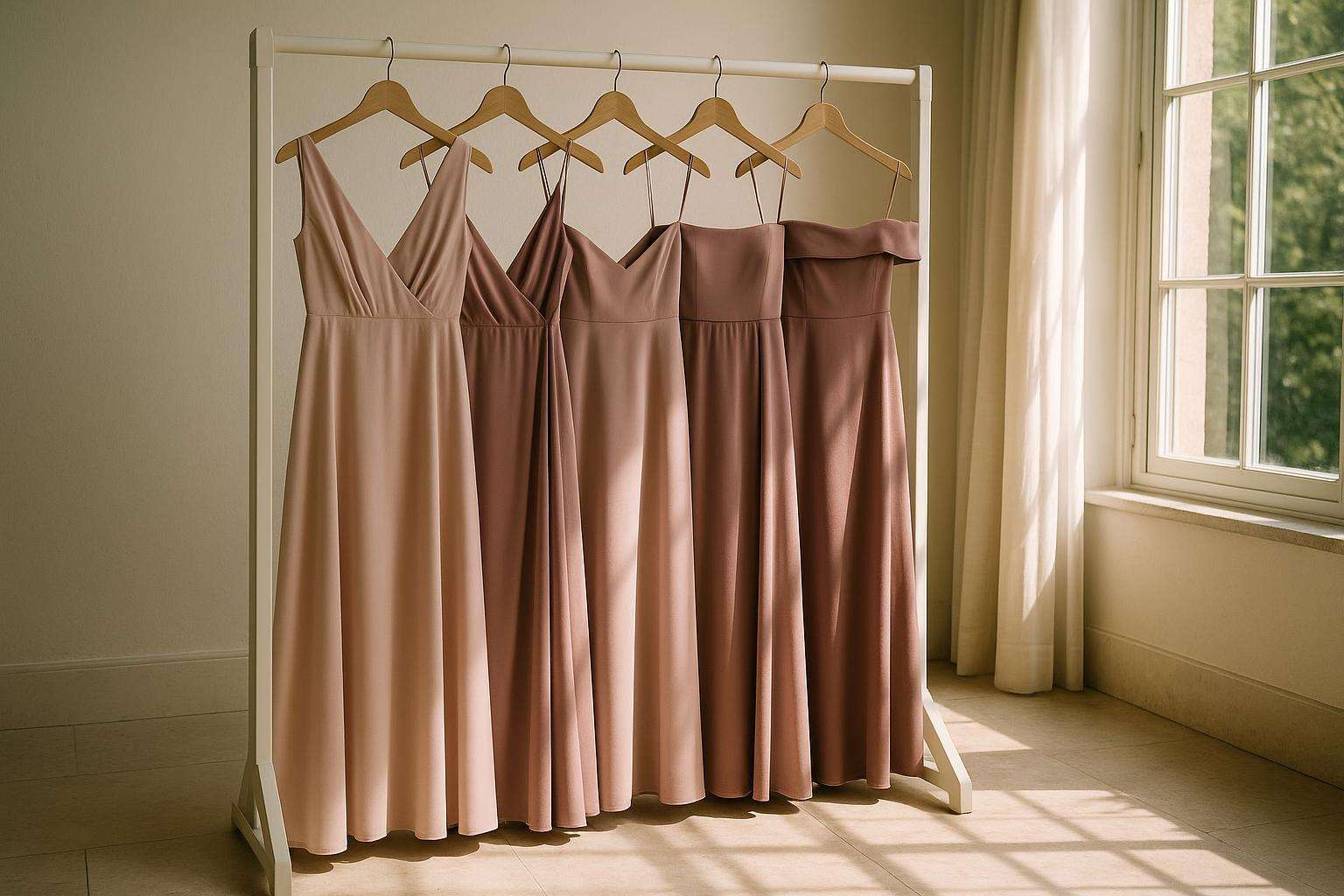
Mismatched bridesmaid dresses work when one element is held constant — color, fabric, or silhouette — and the variables are assigned deliberately rather than left to individual choice. Anchor one thread, release the others, communicate the rules in writing, and the look reads as art-directed; skip that anchor and the same variation reads as a planning oversight.
The mismatched bridal party has crossed a threshold. What began as a bohemian-leaning departure from the matching-dress tradition has become a mainstream editorial choice at garden ceremonies, formal ballrooms, and heritage-church weddings alike. Retailers like Azazie and Birdy Grey have built dedicated collections and landing pages around it; specialist boutiques like Bella Bridesmaids have made mix-and-match consultation a core service. The question is no longer whether to do it — it is how to do it so that the group photograph, the processional, and the reception portraits all read as the considered choice they were meant to be.
There are three structurally distinct strategies, each with its own rules and its own failure mode. Understanding which one fits your wedding's aesthetic — and communicating it precisely to your party before anyone opens a browser — is the difference between a curated look and a disordered assembly.
What Is the Easiest Way to Anchor a Mismatched Bridal Party?
The most forgiving entry point is same color, different silhouette. One shade does the unifying work; the variation in cuts adds the dynamism that makes mismatched dressing worth doing in the first place. Kennedy Blue, which stocks over 70 colors with bridesmaid styles starting at $99, describes this as the approach that lets every bridesmaid highlight her best features — A-line, mermaid, sheath, halter, and wrap silhouettes each flatter different proportions, and releasing bridesmaids to choose their cut within a fixed color rewards body diversity without visual penalty.
Bella Bridesmaids — a specialist boutique chain with locations across the United States — calls this the golden rule of mix-and-match: one color, one fabric weight, one designer, multiple silhouettes. The designer specification matters because the same color name can read noticeably differently between manufacturers. Ordering from a single label simultaneously is the only reliable way to ensure dye lots stay consistent across different cuts.
Neckline variation is where same-color mixing creates its most visible dynamism. Halter, strapless, V-neck, off-the-shoulder, and one-shoulder cuts can coexist without visual tension when the color and hem length hold steady. True Society Bridal Shops, a multi-location bridal retailer, recommends that each bridesmaid receive professional measurements before ordering — dresses from the same designer can grade differently across silhouettes — and that any local party book a group try-on at True Society's private Bridesmaid Suites, where combination issues that a mood board misses will surface immediately.
The one rule that cannot bend: hold hem length constant. A floor-length gown beside a knee-length cocktail dress dissolves the cohesion that the shared color is meant to supply. This is the most common error in same-color mix-and-match execution, and it is entirely preventable with a single written instruction.
Can Bridesmaids Wear Different Colors and Still Look Unified?
Yes — but only within a defined color family, and with shades assigned by the bride rather than self-selected by the party.
The same silhouette, different color strategy produces an ombré or tonal gradient that photographs with particular elegance. Kennedy Blue's editorial team identifies five color families that work reliably for this approach in 2026: greens (Moss, Olive, Sage, Forest Green), blues (Cornflower, Slate Blue, Fog, Sky), pinks (Dusty Pink, Cinnamon Rose, Rosewood, Desert Rose), purples (Boysenberry, Dark Purple, Eggplant, Plum), and desert neutrals (Sienna, Burnt Orange, Terracotta, Spice). The brand's specific instruction is to assign each shade to a specific bridesmaid — rather than letting the group self-select — to prevent two adjacent bridesmaids from landing on colors that clash at the seam.
Azazie, which offers over 90 colors and custom sizing starting at $69 per dress, notes that its Dusty Blue and Stormy pairing is one of its most-requested same-silhouette tonal combinations for 2025–26, citing its versatility across ceremony formalities and seasons. Its home try-on program — where bridesmaids can receive up to three dresses to assess at home before committing — is particularly useful when the party is geographically dispersed and a group salon appointment is impractical.
| Strategy | Fixed element | Variable element | Main rule | Primary failure mode | Best retailer for this approach | Price from |
|---|---|---|---|---|---|---|
| Same color, different silhouette | Shade + hem length | Neckline, cut, sleeve | One designer, same dye lot, identical hem | Mixed hem lengths undercut the color anchor | Kennedy Blue; Bella Bridesmaids | $99 |
| Same silhouette, different color | Silhouette + fabric | Shade within one color family | Bride assigns specific shades — no self-selection | Two bridesmaids self-select the same shade; adjacent clash | Azazie; Kennedy Blue | $69 |
| Mixed fabrics, shared palette | Color family + palette range | Fabric (max two types), silhouette | 50/60 split between two fabrics; no third fabric | Three or more fabrics create visual noise rather than depth | Birdy Grey; Adrianna Papell | $99 |
How Do You Mix Lace, Chiffon, and Satin Without It Looking Accidental?
Fabric mixing is the most advanced of the three approaches, and the one most dependent on a governing formula. The free-form mixing of three or more fabrics is the most common error at this level — the result reads as plural purchases rather than a considered editorial palette.
AW Bridal's styling editorial recommends a 50/50 or 60/40 split between exactly two fabrics — for example, three bridesmaids in chiffon and three in satin. That ratio keeps the variation legible as a decision. Adrianna Papell's bridesmaid fabric guide characterises each textile's photographic behavior with precision: chiffon diffuses light into a soft, matte finish that reads beautifully in outdoor and garden settings; satin reflects and intensifies color, making it the choice for formal evening receptions where artificial light is a factor; lace adds intricate surface detail and a heritage character that works across rustic, romantic garden, and formal church aesthetics.
A practical bridge device: a dress with a satin bodice and a chiffon skirt unifies the two camps visually in the group photograph. It is worth assigning this transitional style to the bridesmaid who will stand at the center of the processional lineup, where her dress can quietly anchor both ends of the spectrum.
Birdy Grey, a direct-to-consumer bridesmaid retailer with dresses starting at $99, built its chiffon collection with this kind of mixing explicitly in mind. As the brand's editorial notes: the consistency of its chiffon fabric allows color hues to remain similar across styles, making it possible to interchange both color and silhouette where most fabrics would limit you to varying only one element at a time. Its convertible styles — where a single dress can be arranged into multiple necklines by the wearer — reduce the per-bridesmaid SKU decisions while preserving the visual variety that makes the mix-and-match approach worth executing.
What Rules Keep a Mismatched Look from Appearing Unplanned?
Three guardrails separate the editorial look from the accidental one:
1. Anchor one element, release at most one variable at a time. Same color + same hem + same fabric = bridesmaids choose only the silhouette. Same silhouette + same fabric = bridesmaids vary only the shade. Releasing two variables simultaneously — color and silhouette, or fabric and length — compounds the combinatorial risk and demands far more precise coordination to hold together.
2. Assign; do not invite. Left to self-selection, two bridesmaids will frequently choose the same shade, and adjacent bridesmaids will sometimes clash at the hem. The Knot and Junebug Weddings both identify assigned colors and silhouettes as the single most effective operational decision in mismatched-party coordination. Written assignments, sent to each bridesmaid individually, prevent ambiguity at the point of purchase.
3. Set a single ordering window at one retailer. Dye lots vary between production runs. Ordering within the same two-week window at a single retailer is the safest way to ensure color consistency across different silhouettes — critical when same-color mixing is the strategy and the shared shade is the only unifying element.
Unified accessories are the fastest way to lock a mismatched group into a coherent portrait. Matching shoes, a single jewelry metal (gold or silver, not both), identical bouquet wrapping, or even a shared hairpiece give the eye a resting point across silhouettes and fabrics. Even when dresses vary significantly, a shared accessory reads as the detail that proves the variation was chosen — not inherited from a scheduling oversight.
How Should You Style the Group Photo with Mismatched Dresses?
The group portrait is the most unforgiving test of a mismatched bridal party — it either reads as art-directed or as a planning gap. Three decisions determine which.
Arrange by color progression, not by height. Ordering bridesmaids from lightest to darkest shade, or from cool to warm, gives the photograph a deliberate gradient that signals intention. Random placement — where similar shades end up adjacent or the darkest and lightest shades stand next to each other — produces visual noise. This arrangement should be agreed upon before the wedding day and rehearsed at the ceremony run-through.
Place the transitional dress at center. If one bridesmaid is wearing a dress that bridges two fabrics — a satin bodice, chiffon skirt — or a shade that sits mid-spectrum in the tonal gradient, center placement gives her dress the most visual leverage. She becomes the anchor the eye returns to across the full lineup.
Align with your photographer before the day. Photographers experienced with mismatched parties know that satin can blow out in direct sunlight where chiffon diffuses it softly. Diffused natural light or shade flatters mixed-fabric groups. Your photographer can also suggest alternative arrangements once they see the group assembled — an outside perspective that a mood board cannot replicate. Junebug Weddings recommends sharing the full bridesmaid roster, with fabric types noted, with your photographer at the engagement session or final walk-through, not on the wedding morning.
The group try-on, if your party is local, remains the most reliable pre-wedding quality check. True Society Bridal Shops' private Bridesmaid Suites allow the full party to try styles simultaneously — which surfaces tonal clashes, length inconsistencies, and fabric-mixing issues that no mood board or online preview can expose. For remote parties, Azazie's home try-on program offers the nearest equivalent, allowing each bridesmaid to assess up to three dresses at home before any order is finalised.
Mismatched dressing rewards precision in the planning stage and generosity in execution. The rules are few, the communication investment is moderate, and the result — when the anchor holds — is a bridal party that photographs with a distinctly personal, deliberate character that the matching-dress tradition cannot produce.
Considered Counsel
Frequently asked
What is the easiest way to do mismatched bridesmaid dresses?
The safest and most popular entry point is the same-color, different-silhouette approach: choose one shade — say, dusty sage or slate blue — and let each bridesmaid select the neckline and cut that suits her best. Kennedy Blue, which stocks over 70 colors starting at $99, identifies this as the approach that lets every bridesmaid flatter her own figure while keeping the group visually unified. The guardrails are simple: order from a single designer at the same time so dye lots stay consistent, keep hem length identical across the group, and assign the specific shade rather than letting bridesmaids self-select. Follow those three rules and the look reads as intentional even if no two dresses share a cut.
Can bridesmaids wear different silhouettes in the same color and still look cohesive?
Yes — this is actually the most cohesion-friendly of the three main mix-and-match strategies. Bella Bridesmaids, a specialist boutique chain with locations across the United States, describes it as the golden rule of mismatched dressing: one color, one fabric weight, one designer, multiple silhouettes. The key is that the color is doing the unifying work, so variations in neckline — halter, strapless, V-neck, off-the-shoulder — add dynamism without diluting the group portrait. The one non-negotiable: hold hem length constant. A floor-length gown alongside a knee-length dress fragments the visual unity that the shared color is supposed to provide. True Society Bridal Shops also recommends professional measurements for each bridesmaid before ordering, since silhouettes from the same designer can grade differently across sizes.
How do you mix lace and chiffon bridesmaid dresses without it looking accidental?
Fabric mixing requires a formula rather than a free-for-all. AW Bridal's styling guidance recommends a 50/50 or 60/40 split between two fabrics rather than introducing a third — for instance, three bridesmaids in chiffon and three in satin. That ratio keeps variation purposeful. Adrianna Papell's bridesmaid fabric guide characterises each textile's photographic behavior: chiffon diffuses light for a soft, matte finish well-suited to outdoor and garden ceremonies; satin reflects light and intensifies color, making it the choice for formal evening receptions; lace adds intricate surface detail and reads best in romantic, garden, or heritage-church settings. A dress with a satin bodice and a chiffon skirt serves as a visual bridge between the two camps in group photographs — it is worth assigning this transitional style to a bridesmaid who will stand at the center of the lineup.
What color families work best for mismatched bridesmaid dresses in 2026?
Kennedy Blue's editorial team identifies five proven color families for tonal mix-and-match: greens (Moss, Olive, Sage, Forest Green), blues (Cornflower, Slate Blue, Fog, Sky), pinks (Dusty Pink, Cinnamon Rose, Rosewood, Desert Rose), purples (Boysenberry, Dark Purple, Eggplant, Plum), and desert neutrals (Sienna, Burnt Orange, Terracotta, Spice). The critical instruction is that shades should be assigned by the bride to specific bridesmaids — not left to self-selection — so no two adjacent bridesmaids land on colors that clash at the seam. Azazie, which offers over 90 colors with custom sizing starting at $69, notes that its 'Dusty Blue and Stormy' pairing is among its most-requested same-silhouette tonal combinations for 2025–26, citing its versatility across seasons and ceremony settings.
What should you tell bridesmaids when organizing a mix-and-match look?
Written, specific instructions are essential — verbal guidance creates ambiguity at the point of purchase. The most effective communication follows this pattern: state the fixed elements explicitly (for example, 'all floor-length, all dusty rose chiffon') and the variables bridesmaids control ('your choice of neckline and silhouette'). Supplement with a mood board showing at least three to five completed bridal parties, not just color swatches. Set a single two-week ordering window at one retailer so dye lots remain consistent across silhouettes. Zola's expert advice team and The Knot both identify early, written communication as the single most-cited difference between a cohesive mismatched party and a chaotic one. A shared accessory — matching shoes, a specific metal for jewelry, identical bouquets — provides additional unification regardless of how much the dresses vary.
How do Azazie and Birdy Grey handle mix-and-match bridesmaid orders?
Both retailers have built dedicated mix-and-match infrastructure. Azazie offers a curated 'Mix & Match Bridesmaid Dresses' collection at azazie.com, with editorial guidance recommending ombré groupings of three to five shades within one color family. Its home try-on program lets bridesmaids order up to three dresses for assessment before committing — particularly useful for geographically dispersed parties. Birdy Grey maintains a dedicated mix-and-match landing page at birdygrey.com/pages/mix-match-bridesmaid-dresses where all styles are pre-vetted for cross-style compatibility. Its convertible styles — where one dress can be arranged into multiple necklines — reduce the individual SKU decisions for each bridesmaid. Its Blue Le Fleur floral print is offered across multiple silhouettes, giving brides a print-based option. WeddingWire reviewers consistently cite Birdy Grey's size-inclusive grading and flat pricing as advantages for large, remote parties.
How do you style the group photo when bridesmaids wear mismatched dresses?
The group portrait is where a mismatched bridal party either reads as art-directed or reads as accidental. Three decisions matter most. First, arrange bridesmaids by color progression — from lightest to darkest shade, or from cool to warm — rather than by height or randomness; this gives the photograph a deliberate gradient. Second, unify accessories: matching shoes, identical bouquet wrapping, or the same earring shape give the eye a resting point across different silhouettes. Third, consult your photographer before the wedding to agree on the lineup order; photographers with mismatched-party experience will often adjust for how different fabric textures reflect light. A satin bodice can blow out in direct sunlight where chiffon diffuses it, so shade or diffused natural light flatters the full group. A transitional dress — satin bodice, chiffon skirt — placed at the center helps anchor both camps visually.