The Bride's Circle
Rehearsal Dinner Dress: What the Bride Should Wear
The rehearsal dinner has become a full fashion moment — the first look of the wedding weekend. Here is how to choose the right dress for your venue's formality, whether you wear white or color, and which real brands deliver the best options.
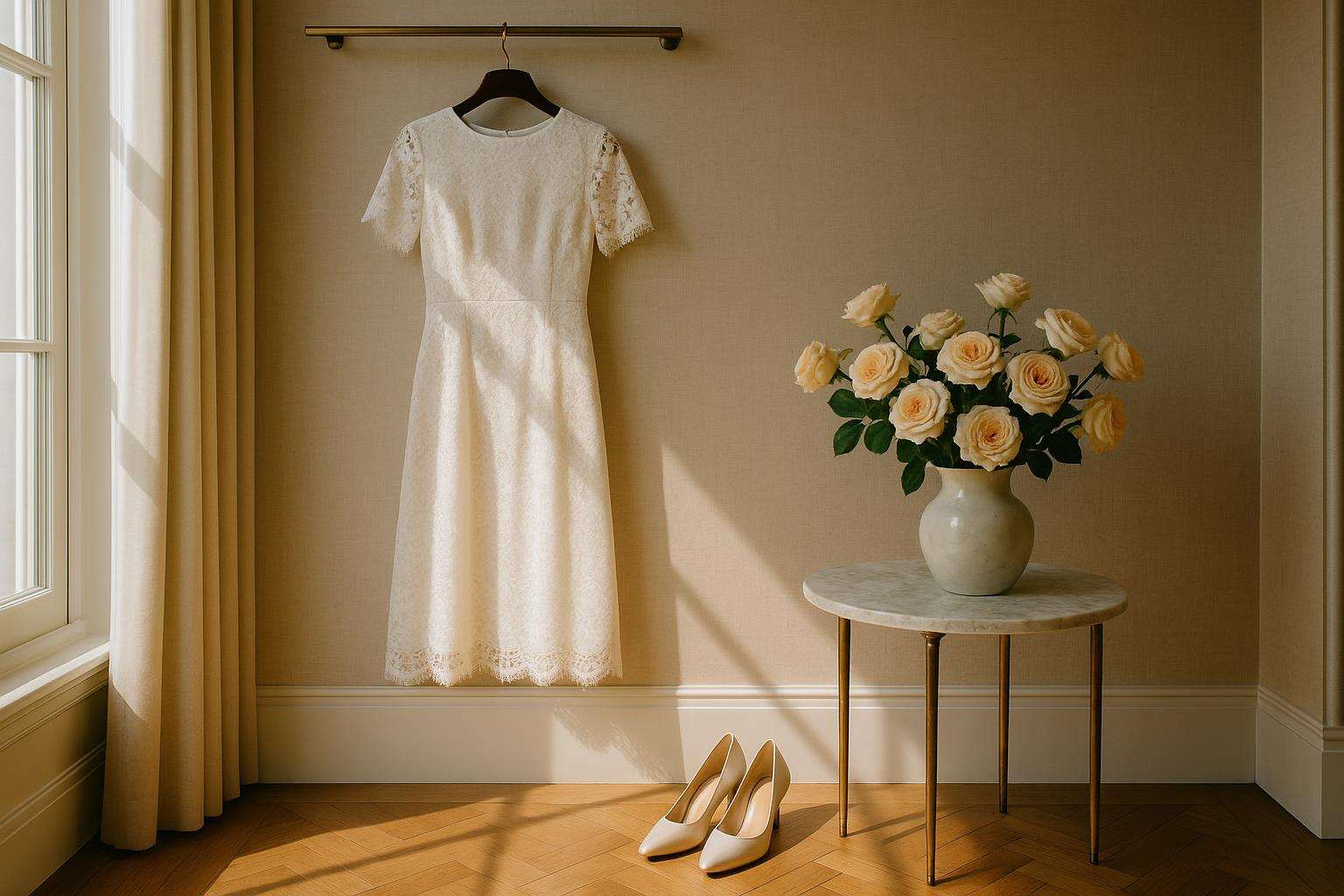
The rehearsal dinner is the first look of the bridal weekend — choose your dress by matching the venue's formality first, then your personal style. White and ivory remain the dominant choice (86% of brides per The Bridal Finery), but color is fully valid. BHLDN, Revolve, Reformation, and Grace Loves Lace are the strongest retail starting points, with options from $80 to $798.
The rehearsal dinner has stepped firmly into the spotlight for 2025 and 2026 brides. What was once a casual family cookout has evolved into a considered event in its own right — and with it, the bride's rehearsal dinner dress has become the opening statement of the bridal weekend. It lands before the gown, before the veil, before the wedding morning. It is the look your florist, your photographer, your officiant, and your out-of-town guests see first. That makes it worth deliberate thought — not anxiety, but intention.
The good news is that the decision framework is simpler than it feels. One variable drives almost everything: venue formality. Once you have matched your silhouette to the setting, the rest — white versus color, fabric choice, styling direction — follows naturally. This guide walks through the full formality spectrum, the white-versus-color debate backed by real data, every major silhouette suited to the occasion, and a brand-by-brand reference with real price anchors.
How formal should a rehearsal dinner dress be?
Venue is the single most reliable guide to formality — more reliable than what other guests will wear, more reliable than the groom's suit, and far more reliable than the general vibe described in the invitation. Here is how the formality spectrum maps across the most common rehearsal dinner settings.
| Venue Type | Formality Level | Recommended Silhouettes | Ideal Fabrics |
|---|---|---|---|
| Backyard, brewery, beachside, or casual outdoor | Casual to smart-casual | Breezy maxi, linen midi, sundress, two-piece set | Chiffon, linen, cotton-blend crepe, lightweight silk |
| Restaurant private room, winery terrace, or rooftop | Smart-casual to cocktail | Silk slip dress, structured midi, tailored jumpsuit, cape overlay | Crepe, satin-back crepe, lightweight silk, charmeuse |
| Upscale hotel ballroom, fine restaurant, or formal private club | Cocktail to formal | Floor-skimming column gown, strapless mini with corset, embellished cocktail dress | Silk, satin, velvet (fall/winter), embellished mesh, lace |
One practical note for outdoor venues at any formality tier: sky-high stilettos sink into turf, and a very full skirt catches the breeze in ways that become a management problem rather than a fashion statement. Midi and maxi lengths that clear the ground handle uneven terrain gracefully, and block heels or elegant flats are far more practical on grass than a four-inch needle heel. Lightweight fabrics — chiffon, linen, cotton-blend crepe — are the right call for warm outdoor settings where anything heavier wilts.
Is it okay to wear white to your rehearsal dinner?
Yes — and the data supports it overwhelmingly. An informal survey by The Bridal Finery found that 86 percent of 283 respondents planned to wear white or a white-adjacent tone (ivory, off-white, champagne) to their rehearsal dinner. The reasoning is both practical and aesthetic: a white or ivory dress visually signals "bride" in a room full of guests who may not all know each other, and it creates a cohesive bridal wardrobe arc across the full run of pre-wedding events — engagement party, bridal shower, bachelorette, and rehearsal dinner.
Little white dresses have become a near-standard for exactly this reason. They are easy to style, photograph beautifully across a range of lighting conditions, and feel unmistakably bridal without encroaching on the territory of the wedding gown itself. The critical distinction is silhouette contrast: if your wedding gown is a full-length ball gown with cathedral-length train, a mini or structured midi in white for the rehearsal creates a clean before-and-after narrative that registers immediately in photographs and in memory.
Color is fully valid. The 14 percent of brides who chose color in The Bridal Finery's survey were ahead of a trend that has only grown. Modern brides use the rehearsal dinner as a deliberate opportunity to show off a personality the white wedding gown may not fully capture. Jewel tones — deep sapphire, emerald, rich burgundy — read as striking and confident against white tablecloths and candlelight. Pastels like blush, lilac, and sage offer a softer bridal adjacency. Romantic florals, bold prints, and soft metallics in champagne, silver, or rose gold all appear in 2026 editorial coverage as legitimate and stylish choices.
The practical argument for color deserves weight: a colorful rehearsal dinner dress is far more likely to be worn again after the wedding than a white or ivory one. Brides who prioritize reusability consistently cite this as the deciding factor in favor of color.
What styles work best as a rehearsal dinner dress?
Several silhouettes have established themselves as consistent performers across the range of rehearsal dinner settings.
Lace mini and lace midi dresses are a headline trend for 2026. Pinterest points to lace as one of the top predicted bridal aesthetics for the year, and modern takes have moved well beyond the dated all-over lace of a decade ago. Sheer lace panels over a structured underlayer, 3D floral lace appliqués across a mini length, and layered lace over a fitted slip all feel contemporary and distinctly bridal without veering into costume territory. Grace Loves Lace, the Australian bridal brand with US boutiques and virtual styling appointments, has built its rehearsal dinner category almost entirely around this aesthetic — handcrafted lace, silk, and satin in minis and midis across sizes XS through 3XL.
Silk slip and sheath silhouettes carry a quiet luxury register that photographs exceptionally well. The draped asymmetrical silk gown, the simple spaghetti-strap slip in ivory or champagne, the barely-there bias cut — all of these evoke an editorial sensibility that feels aspirational and personal rather than costume-like. Reformation has made this category its signature: their bridal event range includes styles such as the Turin Bridal Lace V-Neck Mini (around $348) and full silk maxi gowns like the Ronda Silk Dress (around $798), with the brand's sustainability-forward Eco Silk fabric as the base layer across much of the collection.
Midi dresses in crepe or satin-back crepe are the most versatile option across the widest range of formality settings. They are elegant and effortless, photograph cleanly through long toasts and heartfelt speeches, and feel polished without tipping into black-tie territory. BHLDN — Anthropologie's bridal division — has built its rehearsal dinner category around exactly this range: structured midis, cape-overlay statement pieces, and A-line cocktail dresses in fabrics and colorways that read as bridal without requiring interpretation, priced approximately $168 to $398.
Sheer tulle with 3D florals or botanical details is a standout choice for brides who want a look guests will remember. A sheer outer layer over a structured underlayer — combined with dimensional floral or leaf details — brings the kind of craft and detail usually associated with the wedding gown itself, scaled to a party-appropriate silhouette. It is a strong choice for cocktail-to-formal settings where the theatrical moment is welcomed.
Jumpsuits and two-piece sets offer a modern and practical alternative for brides who do not want a dress at all. A well-tailored jumpsuit in crepe, silk, or structured cotton photographs beautifully, stays comfortable through a full evening of greeting guests, and avoids the dress-management logistics that come with layers and trains. Two-piece sets — a silk or satin top with a high-waisted matching skirt — allow mix-and-match creativity and have the added advantage of giving both pieces a life beyond the rehearsal dinner, worn separately in later months.
Sequins and embellished gowns bring a party-ready energy that matches the celebratory spirit of the evening without requiring additional accessories. A strapless mini with a built-in corset covered in sequin flowers, a column gown with scattered crystal embellishment across sheer mesh — both read as celebratory and deliberate at a formal or semi-formal rehearsal dinner setting without competing with the wedding gown's gravity.
Where do you buy a rehearsal dinner dress, and what does it cost?
The market for bridal rehearsal dinner dresses has grown significantly in recent years, and several retailers now maintain dedicated categories with strong selection across silhouettes and price points.
BHLDN (Anthropologie Weddings) is one of the clearest starting points. As Anthropologie's bridal division, BHLDN has curated a rehearsal dinner category featuring cocktail and midi dresses in bridal-coded fabrics and silhouettes — silk, crepe, lace, and satin-back crepe in ivory, white, and soft champagne. Typical price range: approximately $168 to $398. The brand sits in the premium-contemporary segment — quality fabrics and bridal-appropriate aesthetics at accessible-to-mid price points, with the Anthropologie in-store experience available for those who prefer to shop in person.
Revolve curates white and bridal rehearsal dinner styles from a broad portfolio of contemporary labels, with free two-to-three-day shipping and free returns making it a low-friction option for brides who want to try multiple styles at home. The selection spans from budget-friendly minis under $200 to elevated pieces from Revolve-exclusive contemporary labels, covering plissé fabric dresses, strappy-back designs, and embellished midi gowns. Price range: roughly $80 to $400 depending on the label.
Reformation has developed a strong bridal and rehearsal dinner category in its Bridal Salon. Their silk and Eco Silk gowns carry a sustainability-forward positioning and a quiet-luxury aesthetic — spaghetti straps, bias cuts, backless details. The Turin Bridal Lace V-Neck Mini retails around $348; the Noelle (a spaghetti-strap backless crepe maxi) became a popular bridal resale item after selling through; the Ronda Silk Dress reaches approximately $798. Most relevant rehearsal dinner styles fall in the $348–$598 range.
Grace Loves Lace has built an entire rehearsal dinner collection around handcrafted lace, silk, and satin styles in minis and midis. The Australian brand operates US, UK, Canadian, and Australian boutiques alongside virtual styling appointments, and its ready-to-wear options ship to the US in three to five days in sizes XS through 3XL — an important consideration for brides who need inclusive sizing.
Budget-entry options: Lulus carries a wide selection of rehearsal dinner styles, with many options priced under $100. ASTR the Label keeps its full wedding collection under $200, offering a polished aesthetic at a lower investment. David's Bridal — which famously operates as an accessible bridal retail chain with hundreds of US locations — also stocks white and ivory party-length dresses appropriate for rehearsal dinners. For brides who want designer quality at a lower price, resale platforms Stillwhite and Nearly Newlywed regularly carry BHLDN, Reformation, and name-brand styles at meaningful discounts.
Many brides are now thinking about the pre-wedding period as a cohesive "bridal era" — a run of white or white-adjacent looks across engagement photos, bridal shower, bachelorette, and rehearsal dinner. Choosing dresses that share a fabric family (all silk-adjacent, or all lace), a consistent length range, or a recurring color (ivory throughout, or consistent use of champagne metallics) creates visual coherence across the full set of events without requiring a matching-set purchase. The rehearsal dinner dress sits at the top of that wardrobe arc — the final pre-wedding look before the gown — so it earns the largest investment of the three or four dresses in the set.
The formality of the rehearsal dinner, the personality of the bride, and the contrast with the wedding gown are the only three real constraints in this decision. Within those three, the field is wide open — and it has never been better stocked.
Considered Counsel
Frequently asked
What should the bride wear to a rehearsal dinner?
The bride's rehearsal dinner dress should reflect the venue's formality level while feeling distinctly bridal — and different enough from the wedding gown that it stands on its own as a considered look. For a casual outdoor setting such as a backyard or beachside gathering, a breezy chiffon maxi or structured linen midi in ivory or white reads effortless and appropriate. For a restaurant private room or winery terrace, a silk slip dress, crepe midi, or tailored jumpsuit hits the smart-casual to cocktail register comfortably. For an upscale hotel ballroom or formal private club, a floor-skimming column gown, a structured strapless mini with a built-in corset, or an embellished cocktail dress with sequin or floral detail is the right scale. Across all settings, the guiding principle is the same: match the venue's tone, signal bride clearly, and wear something you genuinely love.
Is it okay to wear white to your rehearsal dinner?
Yes — and most brides do. An informal survey by The Bridal Finery found that 86 percent of 283 respondents planned to wear white or a white-adjacent tone (ivory, off-white, champagne) to their rehearsal dinner. The reasoning is both practical and aesthetic: a white or ivory dress visually signals "bride" in a room full of guests who may not know each other, and it creates a coherent bridal era across the full run of pre-wedding events — engagement party, bridal shower, bachelorette, and rehearsal dinner. Little white dresses have become a near-standard for exactly this reason. That said, wearing color is increasingly valid and stylish: jewel tones, rich florals, pastels like blush or lilac, and even soft metallics in champagne or rose gold are all legitimate and increasingly popular choices. The only rule that actually matters is that the look feels intentional and personal.
How formal should a rehearsal dinner dress be?
The venue is the single most reliable guide to formality level. A backyard barbecue or brewery gathering calls for casual-to-smart-casual — a breezy sundress, a flowy linen two-piece, or a lightweight chiffon maxi in a flat-heel-friendly silhouette. A restaurant private room or winery terrace sits in the smart-casual to cocktail range — a silk slip dress, structured midi in crepe, or satin-back crepe gown is appropriate. An upscale hotel ballroom, fine restaurant, or formal private club calls for cocktail-to-formal attire — floor-length column gowns, embellished cocktail dresses, or velvet and satin silhouettes earn their place here. One practical note for outdoor venues at any formality level: midi and maxi lengths that clear the ground handle uneven terrain better than full-length gowns, and block heels or flats are far more practical than stilettos on grass.
What is the difference between a rehearsal dinner dress and a wedding reception dress?
The key distinction is visibility and contrast. The wedding gown — worn for ceremony and typically into the reception — is the centrepiece; everything else in the bridal weekend wardrobe should feel complementary but distinct. A rehearsal dinner dress is the first look of the wedding weekend, so it carries the tone-setting responsibility without the gravity of the gown itself. In practice this means: if your wedding gown is a full-length ball gown in ivory silk, a mini dress or structured midi in white or cream for the rehearsal dinner creates deliberate contrast and a sense of progression. If your gown is a slinky bias-cut slip in champagne, a more structured or embellished silhouette for the rehearsal can provide an interesting counterpoint. Reception dresses — sometimes called second dresses — serve a different function: they are worn after the ceremony to enable dancing and comfort. The rehearsal dinner dress is purely pre-wedding and carries no functional constraint beyond the evening's activities.
Can the bride wear color to a rehearsal dinner?
Absolutely. While white and ivory remain the dominant choice — roughly 86 percent of brides in The Bridal Finery's survey chose white-adjacent tones — color has become a fully legitimate and stylistically compelling option. Modern brides use the rehearsal dinner as a deliberate opportunity to show off a personality that the white wedding gown may not capture: rich jewel tones like deep sapphire or emerald, romantic florals, pastels in blush or lilac, and bold prints are all documented in editorial sources as appropriate and fashionable choices. The practical argument for color is reusability — a colorful rehearsal dinner dress is far more likely to be worn again after the wedding than a white one. Soft metallics in silver, champagne, or rose gold offer a bridal middle path: distinctly elevated and party-ready in feel, but not literally white.
Where can I buy a rehearsal dinner dress?
Several retailers have built out strong dedicated rehearsal dinner dress categories. BHLDN (Anthropologie's bridal division) carries cocktail and midi dresses from approximately $168 to $398 in bridal-coded fabrics and silhouettes. Revolve curates white and bridal rehearsal dinner styles from a broad portfolio of contemporary labels, with options from roughly $80 to $400 and free two-to-three-day shipping with free returns. Reformation's bridal category offers silk and Eco Silk rehearsal dinner options from around $348 for a lace mini up to $798 for full silk maxi gowns. Grace Loves Lace runs a dedicated rehearsal dinner collection with handcrafted lace and silk styles in minis and midis, shipping to the US in three to five days. For budget-conscious brides, Lulus carries many options under $100 and ASTR the Label keeps its full wedding collection under $200. Resale platforms Stillwhite and Nearly Newlywed carry Reformation, BHLDN, and designer styles at significant discounts.
How much does a rehearsal dinner dress cost?
Rehearsal dinner dress pricing spans a very wide range depending on the brand and fabric. At the accessible end, Lulus stocks options broadly under $100, and ASTR the Label keeps its wedding collection under $200 — both are popular entry points for brides who want a beautiful bridal look without a large spend. In the mid-range, BHLDN dresses typically fall between $168 and $398, while Revolve's curated selection spans roughly $80 to $400 depending on the label. Reformation's rehearsal dinner category starts around $348 for simpler styles and reaches $798 for full silk maxi gowns like the Ronda Silk Dress. Grace Loves Lace handcrafted lace and silk styles are priced comparably to Reformation. For designer-tier investment pieces — think structured satin, couture-quality embellishment, or name-brand labels — expect $600 and above, with bridal-adjacent designer pieces available at retailers like Saks Fifth Avenue and Nordstrom.