The Wedding Dress
A-Line Wedding Dress: The Complete Bride's Guide
The anatomy, fit mechanics, body-type mapping, fabric pairings, and real designer examples — everything a bride needs to know about the silhouette that flatters everyone.
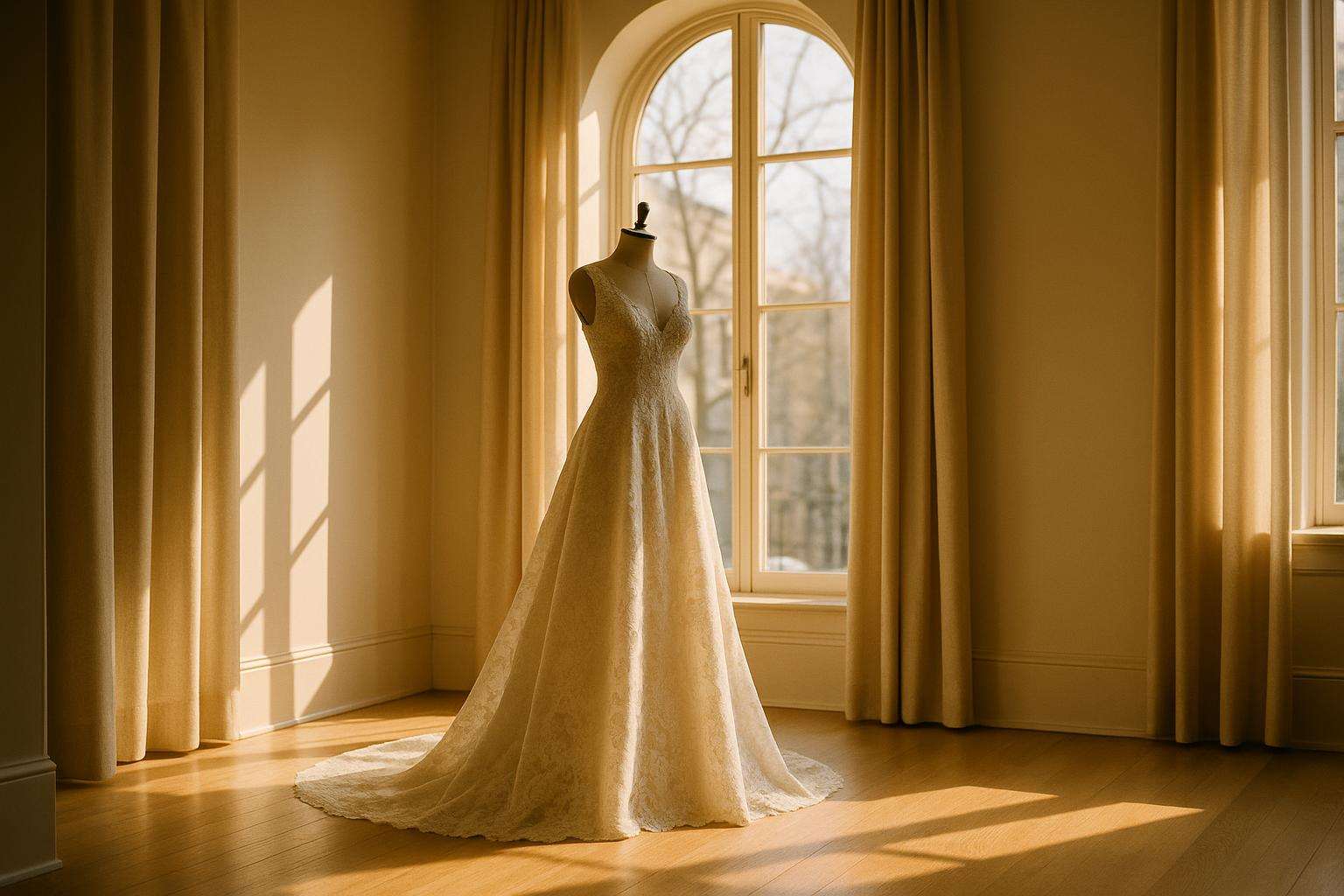
An A-line wedding dress is a fitted bodice that flows into a gradually widening triangular skirt from the natural waist — mirroring the capital letter A. Codified by Christian Dior and refined by a century of bridal craft, it is the most universally flattering silhouette in wedding fashion, requiring no hoopskirt or heavy scaffolding to create an hourglass impression on almost every figure.
What is an A-line wedding dress, and where did the silhouette come from?
The A-line wedding dress takes its name from its geometry: a structured bodice fitted to the bust and waist, from which the skirt fans outward in a continuous, triangular flare — the letter A rendered in cloth. The shape was codified by Christian Dior in the mid-twentieth century as part of his effort to restore a soft, feminine architecture to postwar fashion. Bridal designers adopted it quickly, and it has held its position as the dominant wedding silhouette for decades, accounting for a significant share of gowns sold at salons such as Kleinfeld Bridal in New York in any given season.
It is worth being precise about what the A-line is not. The fit-and-flare — sometimes called a mermaid or trumpet — hugs the body from bust through hip and thigh before releasing at or below the knee. A sheath or column follows the body with minimal volume from shoulder to hem. The A-line sits between: more relaxed through the hip than a fit-and-flare, more defined at the waist than a sheath. That considered middle ground is what gives it its flattery range.
How is an A-line wedding dress constructed?
Understanding the dress's anatomy helps a bride know what to look for — and what to ask a consultant to adjust.
The bodice runs from neckline to waistline and provides the dress's structural foundation. Common internal engineering includes corset boning (steel or spiral), built-in underwire cups, and illusion panels of sheer mesh to extend coverage without adding weight. Maggie Sottero's Spring/Summer 2026 collection, Elegance Unravelled, made an aesthetic choice that illuminates how far this engineering has come: visible boning expressed on the exterior of the bodice as a structural-ornamental element, not hidden inside it.
The waistline is where the silhouette's flattery is decided. A natural waistline sits at the narrowest point of the torso — the classic A-line placement. A basque waist drops to a V-shape at the front for an elongating effect; Justin Alexander's Fall/Winter 2026 collection L'Amour En Fleur and Maggie Sottero's Elegance Unravelled both feature basque waistlines prominently in their A-line offerings.
The skirt flares from the waist seam, creating the titular A. Fullness is achieved through panels, godets (triangular fabric inserts), or layers of netting underneath. A modified A-line produces a subtler, slimmer flare; a fuller A-line approaches ball-gown volume without the rigid hoopskirt underpinning. A-line skirts release from the waist rather than the knee, which gives brides substantially more freedom of movement than a mermaid or sheath — a detail that consultants at True Society Bridal Shops cite as one of the primary reasons brides choose the silhouette for longer celebrations.
Train options include sweep (a few inches of fabric brushing the floor), chapel (approximately one yard behind the hem), and cathedral (two or more yards). The chapel train is the most popular A-line pairing, balancing ceremony drama with practicality.
What body type does an A-line wedding dress look best on?
The honest answer is: almost all of them. The A-line's flattery mechanism is the waist seam — it traces the body's narrowest point and then releases, which means it does not require the hips or thighs to carry the silhouette. Here is how it maps to common proportions:
- Pear shape (narrower shoulders, fuller hips): The skirt flows over the hip-and-thigh zone, drawing the eye upward to a V-, sweetheart, or off-the-shoulder neckline. The waist cinch visually narrows the midsection relative to the shoulder.
- Apple shape (fuller midsection): An empire-waist or high-waist A-line cuts above the natural waist, directing visual attention to the décolletage and creating a long, vertical line from bust to hem. A V-neckline adds a downward sightline that elongates the torso.
- Hourglass shape (defined waist, balanced bust and hip): The A-line traces the natural waist and releases through the hip, mirroring the figure rather than constraining it. Corset bodices and belted waistlines amplify the effect.
- Petite brides: A slim or modified A-line in a single fabric avoids the visual cutting that a wide skirt can create on a shorter frame. Vertical seam details and a V-neck or scoop neckline add the impression of height. Bridal Closet's style guide specifically advises petite brides to prioritise less volume in an A-line.
- Plus-size brides: The A-line's structured bodice with built-in stretch lining and underwire provides shaping and support. The skirt releases cleanly from the waist without clinging to the hip, producing a clean, confident line. Kleinfeld Bridal notes its plus-size A-line inventory is among its highest-demand categories.
What fabrics work best for an A-line wedding gown?
Fabric transforms the A-line's personality entirely — the same silhouette reads as fairy-tale romantic in tulle and lace, or sharply modern in crepe. The choice should be made in dialogue with the venue, the season, and the ceremony's register.
| Fabric | Character | Best A-Line Application | Venue / Season Fit |
|---|---|---|---|
| Lace (Chantilly, guipure) | Romantic, textured, photogenic | Full overlay on a satin or crepe lining; or bodice-only with a plain skirt | Church, estate, indoor ballroom — all seasons |
| Satin (silk or duchess) | Luminous, structured, formal | Full-length A-line with chapel or cathedral train; holds shape and photographs with a liquid sheen | Grand ballroom, cathedral — autumn/winter |
| Chiffon | Lightweight, billowing, ethereal | Layered over a crepe lining for movement; produces natural ventilation and a soft hem | Garden, outdoor, destination, beach — spring/summer |
| Crepe | Matte, modern, wrinkle-resistant | Streamlined A-lines for civil or city ceremonies; drapes close to the body without clinging | Registry office, city rooftop, contemporary venue — year-round |
| Tulle | Airy, voluminous, fairy-tale | Layered skirts combined with lace appliqués for a romantic finish; produces the fullest A-line without a hoop | Estate, barn, romantic indoor — spring/summer |
| Mikado | Crisp, structured, slightly lustrous | Formal cathedral settings; holds a precise A-shape flare with minimal lining | Cathedral, formal ballroom — autumn/winter |
Fabric layering is the norm rather than the exception: a satin lining beneath a lace overlay gives the skirt body while the surface reads as delicate lace. Chiffon over crepe is the standard formula for destination and beach weddings. Boutique educators at Love Bridal Boutique, Platinum Bridal Colorado, and Ashley Grace Bridal all point to layering as the technique that reconciles structure with surface beauty.
Which designers make the best A-line wedding dresses in 2026?
Three labels dominate the authorised-boutique A-line market across different price tiers, each with distinct design signatures.
Maggie Sottero is the most widely distributed American bridal label, with an A-line portfolio that spans its flagship collection and the sister brand Rebecca Ingram. The flagship's Spring/Summer 2026 Elegance Unravelled collection features visible-boning corsets, cat-eye (pointed scoop) necklines, and basque waists — several in A-line. The Fall 2026 collection Lost in Reverie extends this into velvet, chandelier-crystal embellishment, and pearl-trimmed skirts. Flagship pricing runs $1,600 to $3,000 at authorised boutiques. The Charlene — a vintage-inspired A-line with a beaded bodice, Swarovski crystal accents, an illusion V-neckline, and a tulle skirt — is one of the label's most frequently searched named styles.
Justin Alexander operates two labels: the main Justin Alexander line ($1,800–$2,500) and the premium Justin Alexander Signature label ($2,800–$4,000). The AMANI (Style 99291, Signature, Fall 2024) has become a defining current A-line: a strapless satin gown with a pointed scoop neckline, sequined embroidered lace appliqués, 3D chiffon flowers inset with pearls, satin-covered buttons, pockets, and a chapel train. It is carried by Kleinfeld Bridal in New York, Mon Amie Bridal Salon, The White Flower in San Diego, and other authorised retailers.
Rebecca Ingram, the accessible sub-label of Maggie Sottero Designs, applies the same pattern-making and fit engineering as the flagship at a lower price point ($1,100–$1,800). The Hattie Lane (Style 22RT517) — dreamy sparkling tulle with intricate floral lace motifs and a plunging sweetheart neckline — is a frequently requested style, as is the Hattie Lane Lynette variant (Style 22RT517B01), which adds an illusion lace plunge V-neckline and sleeves for additional coverage. The Lizzy (Style 23RK684A01), a V-neck A-line in sparkle tulle with a cathedral train, is Rebecca Ingram's most dramatic A-line entry.
At the luxury end, Vera Wang, Pronovias, and Ines Di Santo occupy the $2,500–$5,000 tier, while couture houses — Monique Lhuillier, Galia Lahav — begin at $6,000 and ascend well beyond $15,000 for custom work.
How much does an A-line wedding dress cost?
The Knot's 2026 Real Weddings Study — drawn from 10,474 US couples — places the national average wedding dress spend at approximately $2,100. The A-line specifically averages lower, at around $1,620 nationally, because it requires less structural scaffolding than a mermaid or ball gown.
A note on total cost that many brides overlook: the ticket price on the dress tag is not the final figure. Bridal retailers consistently observe that alterations ($300–$600), a veil or accessories, and preservation add 15 to 30 per cent above the gown price. Budget for those separately from the outset.
Budget ($500–$1,000): off-the-rack, sample sales, and online-only brands. Mid-range ($1,000–$2,500): Rebecca Ingram, Justin Alexander main line, Maggie Sottero flagship. Luxury ($2,500–$5,000+): Justin Alexander Signature, Ines Di Santo, Vera Wang, Pronovias. Couture ($6,000–$15,000+): Monique Lhuillier, Galia Lahav, bespoke atelier. Budget alterations ($300–$600) and accessories separately — final dressed cost typically runs 15–30% above the gown ticket.
What necklines and trains pair best with an A-line skirt?
The A-line's proportions are generous with necklines precisely because the silhouette creates its own strong vertical line — the widening skirt draws the eye downward, so any neckline that counterbalances with an upward focal point works well. Sweetheart and V-neck necklines are the most consistently recommended pairings across bridal consultants, for figures of all proportions. Off-the-shoulder and portrait (wide, horizontal) necklines broaden the shoulder visually, which is particularly effective for pear shapes. Illusion and halter necklines suit outdoor and beach A-lines, where full coverage in a lightweight mesh reads as modern without adding heat.
For trains, the chapel train — approximately one yard of extension behind the hem — is the most versatile A-line pairing. It provides ceremony drama and photographs well without the impracticality of a cathedral train, which is best reserved for very formal religious or black-tie weddings where a procession aisle is long enough to display it properly. A sweep train, which merely brushes the floor, suits semi-formal venues and destination weddings where practicality is a concern.
Considered Counsel
Frequently asked
What is an A-line wedding dress?
An A-line wedding dress takes its name from the capital letter A: a fitted, structured bodice meets a cinched natural waistline, from which the skirt fans outward in a continuous, triangular flare. The silhouette was codified by Christian Dior in the mid-twentieth century and has remained the dominant shape in bridal fashion ever since. It differs from a fit-and-flare, which hugs through the hips before releasing at the knee, and from a sheath, which follows the body without significant volume. The A-line sits between those extremes — more relaxed through the hip than a fit-and-flare, more defined at the waist than a sheath — which is precisely why it flatters such a wide range of figures.
What body type does an A-line wedding dress look best on?
Bridal consultants and style editors consistently describe the A-line as the most universally flattering silhouette in bridal fashion, and the evidence supports that claim. It works for pear shapes because the skirt flows over hips and thighs while drawing the eye upward. It works for apple shapes via an empire or high-waist variation that cinches above the natural waist and creates a long vertical line. Hourglass figures are complemented directly — the waist seam traces the body's narrowest point. Petite brides benefit from a modified or slim A-line in a single fabric, with vertical seam detailing to add the illusion of height. Plus-size brides find that the structured bodice with built-in support and the releasing skirt provide both shaping and freedom of movement.
What is the difference between an A-line and a fit-and-flare wedding dress?
The distinction lies in where the skirt releases from the body. A fit-and-flare — sometimes called a mermaid or trumpet — hugs the body closely from the bust all the way through the hips and thighs, then flares outward at or below the knee. An A-line releases from the waist seam, creating a continuous triangular shape from torso to hem without clinging to the hip or thigh. The practical result: an A-line offers significantly more freedom of movement. Bridal consultants at True Society Bridal Shops note this as a primary reason brides choose an A-line for longer celebrations — the skirt does not restrict the stride or create the hobble effect common in mermaid gowns when ascending stairs or entering vehicles.
What fabrics are best for an A-line wedding gown?
The best fabric depends on the setting and the effect the bride wants to achieve. Lace — particularly Chantilly or guipure — is the most romantic choice, typically applied as a full overlay over a satin or crepe lining. Satin (silk or duchess) gives the skirt a luminous, structured drape well suited to formal venues and cathedral trains. Chiffon, layered over a crepe lining, produces movement and airiness ideal for outdoor or garden ceremonies. Crepe reads as modern and matte, drapes close to the body without clinging, and resists wrinkles — the practical favourite for civil ceremonies. Tulle layers produce fairy-tale volume when combined with lace appliqués. Mikado, a crisp and slightly lustrous fabric, holds a precise A-shape flare for the most formal settings.
How much does an A-line wedding dress cost in 2026?
The Knot's 2026 Real Weddings Study, drawn from 10,474 US couples, places the national average wedding dress spend at approximately $2,100. The A-line specifically averages lower — around $1,620 nationally — because it requires less structural engineering than a mermaid or ball gown. At the accessible end, Rebecca Ingram (a Maggie Sottero sub-label) prices its A-line gowns between $1,100 and $1,800 at authorised boutiques. Maggie Sottero's flagship line runs $1,600 to $3,000; Justin Alexander's main line $1,800 to $2,500; Justin Alexander Signature $2,800 to $4,000. Designers such as Vera Wang, Pronovias, and Ines Di Santo occupy the $2,500-to-$5,000 tier. Budget for alterations separately — industry consultants consistently note that the final dressed cost is 15 to 30 per cent above the gown ticket price.
Can a petite bride wear an A-line wedding dress?
Yes — with a considered choice of proportion. Bridal Closet's style guide advises petite brides to prioritise a modified or slim A-line with less volume and vertical seam details rather than a very full skirt, which can visually bisect a shorter frame. A single fabric from bodice to hem — rather than a contrast between a fitted lace top and a voluminous tulle skirt — elongates the figure. A V-neck or scoop neckline draws the eye upward and adds the impression of height. Avoiding wide embellishment at the hip keeps the silhouette lean. Many petite brides also have the hem altered to a slightly shorter floor length so the skirt grazes, rather than pools at, the floor without a pronounced bustle.
What designers make the best A-line wedding dresses?
Three American labels dominate the authorised-boutique A-line market at different price points. Rebecca Ingram — the accessible sub-label of Maggie Sottero Designs — applies the same pattern-making and fit engineering as its parent at $1,100 to $1,800; standout styles include the Hattie Lane (sparkling tulle, floral lace) and the Lizzy (V-neck, cathedral train). Maggie Sottero's flagship label ($1,600 to $3,000) is known for visible-boning corsets and basque waistlines in its 2026 collections. Justin Alexander's main line and premium Signature label offer A-line options from $1,800 to $4,000, with the Signature AMANI (Style 99291) — a strapless satin A-line with 3D chiffon flowers, pearl accents, and pockets — among the most recognised current styles, carried by Kleinfeld Bridal in New York.