The Wedding Dress
Basque Waist Wedding Dress: The Elongating V-Waistline
What a basque (dropped-V) waistline is, why its architectural point elongates the torso and visually slims the silhouette, and the 2026 designer collections featuring it.
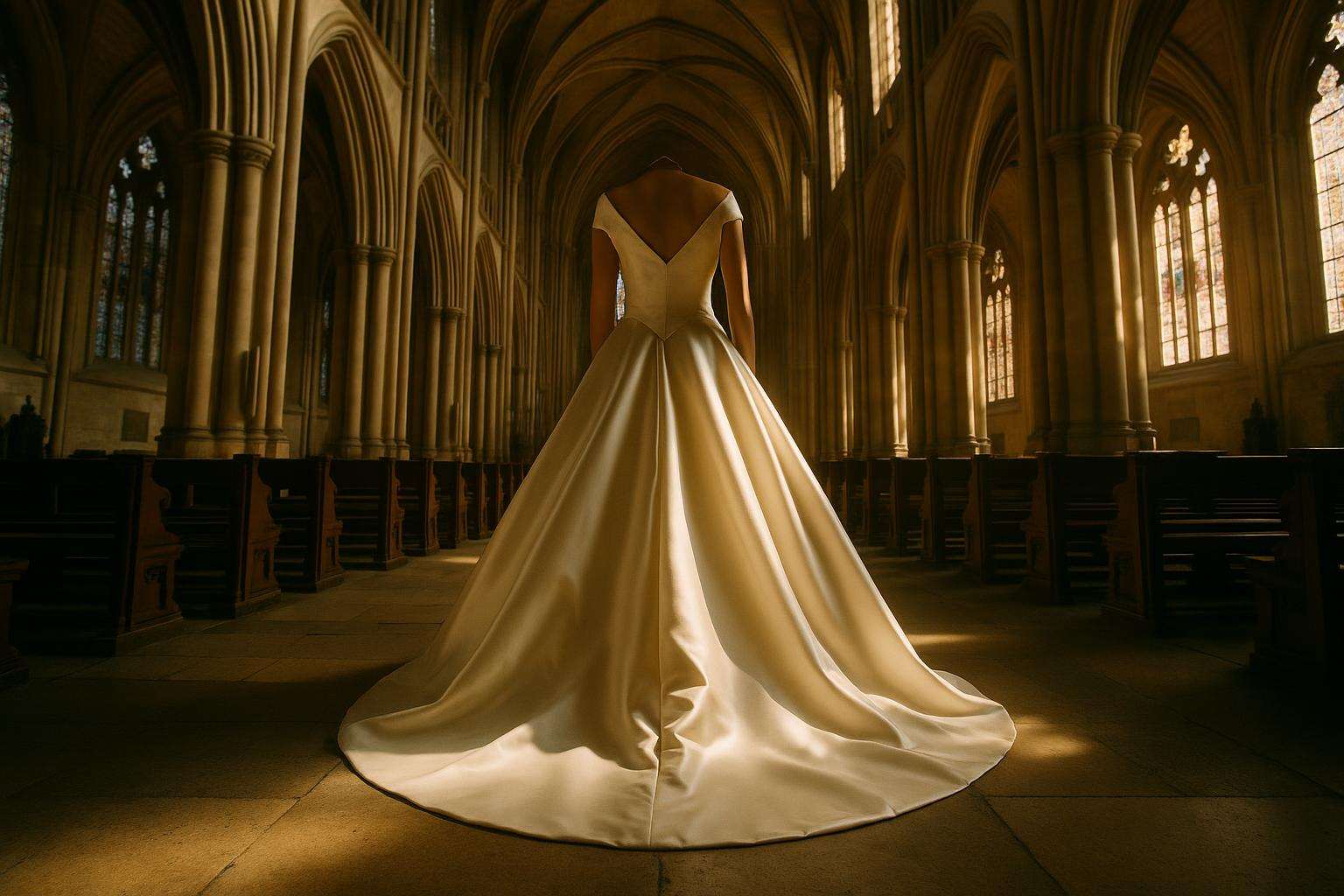
A basque waist wedding dress features a structured bodice seam that dips one to three inches below the natural waistline into a signature inverted-V or pointed shape before the skirt begins — elongating the torso, defining the waist, and creating a proportional silhouette that flatters across figure types. Rooted in Victorian-era corseting and revived emphatically on the 2025–2026 bridal runways, it is one of the most searched silhouette terms in bridal fashion this season.
What exactly is a basque waist wedding dress?
The term names a specific structural decision in gown construction: the seam where the bodice meets the skirt does not terminate at the natural waistline but descends — typically one to three inches — into an inverted-V or gently curved point at the front center, and sometimes the back center as well. The resulting dip is the defining signature of the silhouette. Unlike a dropped waist, which falls all the way to or below the hip and tends to minimise the waist, the basque sits precisely between natural waist and hip, framing and exaggerating the narrowest part of the torso.
The internal architecture that makes this possible is corset-style boning — typically steel or spiral boning running vertically through the bodice — that holds the pointed seam taut without distorting the fabric during wear. Structured fabrics amplify the effect: silk mikado, satin, and jacquard are the industry's preferred cloths precisely because their weight and body allow the inverted-V to read cleanly and hold its shape through a long reception. Lace is frequently layered over a stiff structured underlining for the same reason. The seam itself may be a sharply angled point or a softer, deeper U-curve, and designers often draw additional attention to the join with embellishment — pearl trim, fine beading, or three-dimensional floral appliqués — to emphasise the waist as a focal point.
The style takes its name from the Basque Country, the cross-border region straddling northern Spain and southwestern France, where traditional women's dress featured corseted bodices extending past the natural waistline to accentuate the hips. The construction dates to sixteenth-century corseted bodice making, became prominent during the Victorian era as a foundational silhouette ideal, and underwent a major bridal revival in the 1980s and 1990s — the era of structured, dramatic gowns that defined a generation of appointments at salons such as Kleinfeld Bridal in New York City.
Why does the basque waistline elongate and slim the figure?
Two simultaneous visual effects explain the silhouette's enduring appeal, and understanding them helps a bride assess whether the gown is the right choice for her proportions.
The first is vertical eye-travel. When the bodice seam dips below the natural waist into a V-point, the eye follows the diagonal lines of the seam downward before being redirected outward into the skirt. That downward journey makes the bodice appear taller than it is — the impression of a longer torso is created entirely by the seam's path, not by the bride's actual measurements. This is the same principle a V-neckline applies to the décolletage, applied here to the waist.
The second is waist definition through framing. The angular point of the basque seam draws a firm visual boundary between bodice and skirt, directing attention to the narrowest part of the midsection. Even when the natural waist is not particularly defined, the boning and the geometry of the seam construct the appearance of a cinched, hourglass silhouette. Paired with a full ball-gown or A-line skirt, the contrast between the narrow point and the widening skirt amplifies the effect further.
What body types does a basque waist wedding dress suit?
Bridal stylists consistently rank the basque waist among the most versatile waistline treatments across figure types. The table below summarises the consensus guidance from styling professionals:
| Figure Type | How the Basque Waist Helps | Best Skirt Pairing |
|---|---|---|
| Petite | Extends the bodice downward to create the impression of a longer torso and greater height — one of the most effective tools for adding perceived inches | Ball gown or A-line (volume balances the extended bodice) |
| Pear-shaped | Draws focus upward and inward, away from the hips; the pointed seam implies an hourglass at the waist before the eye reaches the lower body | Ball gown (skirt volume balances wider hips) or fit-and-flare |
| Apple-shaped | Elongates the torso and redirects attention from the midsection; the boning cinches and structures independently of the body's natural contour | A-line or empire hybrid (skims rather than clings below the waist) |
| Hourglass | Follows and amplifies an already-defined natural waist; the seam mirrors the body's own curves and adds architectural precision | Mermaid or fit-and-flare (most dramatic result) |
| Athletic / Rectangle | Boning and seaming introduce curve and definition independent of natural contours — the gown constructs an hourglass through tailoring alone | Ball gown or A-line (adds contrast volume below the defined waist) |
| Tall | The elongated, regal bodice suits a tall frame naturally; the silhouette reads as authoritative rather than overwhelming | Mermaid, sheath, or full ball gown (all proportionate on a tall frame) |
| Long torso (note) | Try before committing — the additional drop below the natural waist can occasionally add excessive length to an already long midsection | Request a muslin fitting to assess the exact point placement first |
Which designers and collections feature the basque waist in 2026?
The silhouette's return has been broad and coordinated rather than the signature of a single house. At New York Bridal Fashion Week Spring 2025, Berta, MUSE by Berta, Essense of Australia, Leah Da Gloria, Ines Di Santo, Nicole + Felicia, Martina Liana, and Pronovias all sent basque waist looks down the runway in the same season — a signal that the industry had collectively committed to the silhouette. By the 2026 collection season, THE WED documented 28 distinct basque waist gowns from a single season's offerings.
Maggie Sottero offers the most accessible entry point, with the "Serafina" style listed explicitly as a Basque Waist Satin Ball Gown on the brand's website. The Sottero & Midgley sub-label's "Terry" style pairs a beaded and sequined lace bodice with boning and a basque waist transitioning into a Solstice crepe skirt. Retail pricing runs approximately $1,400–$3,300 through authorised boutiques.
Pnina Tornai for Kleinfeld Bridal offers two standout Love collection styles: Style #15261, a Romantic Lace Basque-Waist Ball Gown with three-dimensional florals, an exposed boning corset, and a sheer bodice; and Style #15092K, a Grand Satin Basque Waist Ball Gown with a cat-eye neckline and pearl-trimmed waistline. Pre-owned Pnina Tornai basque waist styles are also available via Kleinfeld Again in the $2,200–$6,300 range — a compelling option for brides seeking the silhouette at a reduced price point.
Grace Loves Lace takes a lighter approach in the "Vittoria" — a full-circle A-line in structured luminous Mikado satin with a sharp basque waist and a deep asymmetric cat-eye pleated bodice, handmade at the brand's Australian headquarters using sustainably sourced materials. It demonstrates that the basque waist translates gracefully into contemporary, directional design as readily as into traditional ball-gown silhouettes.
Monique Lhuillier's Fall 2025 Signature Collection included two basque waist mikado ball gowns — one with a Chantilly lace jacket overlay — positioning the silhouette within an unambiguously couture context. Ines Di Santo's "Lourdes" from the Heritage Collection, a 30-year retrospective of the brand's archive, pairs a subtly sculpted petite basque waistline with three-dimensional floral lace in a strapless A-line — proof that the treatment can be restrained as well as dramatic. Allure Bridals, available through Kleinfeld, offers sculpted basque styles in mikado, satin, and lace at accessible price points, broadening the silhouette's accessibility across budget tiers.
Can a seamstress add a basque waist to an existing wedding dress?
Yes — but with an honest caveat: it is classified as a complex structural alteration, not a routine hem or size adjustment. Adding a basque point requires redrafting the waist seam, reshaping or replacing the boning channels, and potentially relining the bodice. The work is meaningful, and the outcome depends heavily on the gown's existing construction: a dress already fitted with internal boning and structured seaming is significantly easier (and less costly) to adapt than a soft, unlined design.
Alteration specialists consistently recommend requesting a muslin mock-up first — a working prototype in inexpensive fabric — so that both bride and seamstress can assess the exact depth and angle of the point before any cutting occurs on the actual gown. This step adds time and a modest cost but prevents the far greater expense of having to undo or redo structural work in the final fabric.
Budget for structural basque modification: $500–$1,200 or more, on top of the standard alteration costs ($300–$800 for non-structural work such as hem, bust, and size-in). Complex structural projects can reach $1,200 in total for the modification component alone in high-cost markets such as Manhattan or San Francisco; regional studios will generally quote less. Removing or softening an existing basque point is considerably simpler — a skilled seamstress can flatten the seam toward a natural waistline, though the original seam location will remain visible internally.
Is the basque waist the right silhouette for you?
The surest way to answer that question is to try the gown on a human body — yours — with the correct undergarments and footwear. The basque waist is a silhouette that photographs strikingly and wears comfortably in structured fabrics, but the precise position of the point (its depth below the natural waist, its angle, the sharpness of its V) interacts with your individual proportions in ways no photograph can fully predict.
When booking your first appointment at a salon — whether at Kleinfeld Bridal in New York, an authorised Maggie Sottero boutique, a Grace Loves Lace stockist, or a Pronovias atelier — ask to try at least one basque waist style alongside whichever other silhouettes you are considering. The bodice's boning will feel different from an unstructured gown; some brides find it reassuringly anchored, others prefer the freedom of softer construction. Neither preference is wrong. The basque waist rewards the bride who wants her gown to do structural work — to lengthen, define, and hold — rather than simply drape.
For brides whose priority is timelessness over trend, the basque waist has one further distinction: its origins in sixteenth-century corseting, its Victorian height, its 1980s bridal revival, and its current 2025–2026 runway moment collectively make it one of the most historically persistent silhouettes in western dress. Choosing it is, in the most literal sense, choosing something that has outlasted every other trend it has ever shared a runway with.
Considered Counsel
Frequently asked
What is a basque waist on a wedding dress?
A basque waist is a structured bodice seam that does not end at the natural waistline but instead dips one to three inches below it into an inverted-V or gently pointed shape at the front center — and often the back — before the skirt begins. The construction relies on corset-style boning to hold the pointed form without distorting the fabric. The result is a two-part visual effect: the torso appears longer because the eye travels down to the point before redirecting outward into the skirt, and the waist appears more defined because the angular seam frames the midsection. It differs from a dropped waist, which descends all the way to or below the hip.
What is the difference between a basque waist and a drop waist?
Both sit below the natural waistline, but the drop waist falls to the hip (or lower), creating a boyish or Gatsby-era silhouette that de-emphasises the waist altogether. The basque waist sits strictly between the natural waist and the hip — typically one to three inches below the natural waist — forming a precise architectural dip or V-point. Where the drop waist minimises the waist, the basque waist exaggerates and defines it. The basque also relies on internal boning to maintain its structured point, while drop-waist gowns are often unstructured and fluid.
What body type does a basque waist wedding dress flatter?
Bridal stylists consistently rate the basque waist as one of the most versatile waistline treatments across figure types. Petite brides benefit most directly: the extended bodice creates the impression of a longer torso and greater height. Pear-shaped figures gain from the way the pointed seam draws the eye upward and inward, away from the hips. Apple and rectangle figures benefit from the boning and seaming, which introduce curve and definition independent of the body's natural contours. Hourglass silhouettes are beautifully amplified, especially in mermaid and fit-and-flare skirts. The one figure to approach with care is a naturally long torso — try the gown in person to confirm the point falls at a flattering position.
Which designers make basque waist wedding gowns in 2026?
The 2026 bridal season has seen broad adoption of the silhouette. Maggie Sottero's "Serafina" is explicitly listed as a Basque Waist Satin Ball Gown on their website, with the Sottero & Midgley "Terry" pairing beaded lace with a basque transition into crepe. Kleinfeld Bridal carries Pnina Tornai's Love collection styles #15261 and #15092K, and Allure Bridals' sculpted mikado and satin A-lines with basque seaming. Monique Lhuillier's Fall 2025 Signature Collection included two basque waist mikado ball gowns. Pronovias, Grace Loves Lace (the "Vittoria"), and Ines Di Santo ("Lourdes", Heritage Collection) also feature the waistline across price points.
How much does it cost to have a basque waist added to a wedding dress?
Adding a basque point to an existing gown is a complex structural alteration: it requires redrafting the waist seam, reshaping or replacing the boning channels, and potentially relining the bodice. Specialist seamstresses recommend requesting a muslin mock-up first so both bride and atelier can agree on the exact depth and angle before cutting the actual gown. Expect to budget $500–$1,200 or more for the modification alone, depending on gown construction, fabric, embellishment density, and your geographic market — Manhattan and San Francisco ateliers charge considerably more than regional studios. Standard non-structural alterations (hem, bust, size-in) run $300–$800 for most bridal gowns; budget the structural premium on top of that.
Is a basque waist the same as a corset waist on a wedding dress?
They are related but distinct. A corset waist refers to the lacing or boning system that closes and structures the back of the bodice — it is a fastening and shaping mechanism. A basque waist is a seam-line decision: the location and shape where the bodice meets the skirt, descending into an inverted-V point below the natural waist. Many basque-waist gowns also feature a corset closure at the back (the two complement each other beautifully), but a gown can have a corset back without a basque seam, and a basque seam without a traditional laced corset back. When both are combined — as in several Pnina Tornai styles at Kleinfeld Bridal — the result is an exceptionally dramatic, figure-sculpting silhouette.
Why is the basque waist wedding dress trending in 2025–2026?
Two concrete moments drove search and purchase interest. Podcast host Alex Cooper wore a basque waist gown at her 2024 wedding, generating immediate bridal search traffic. At New York Bridal Fashion Week Spring 2025, the silhouette appeared on multiple runways simultaneously — Berta, MUSE by Berta, Essense of Australia, Leah Da Gloria, Ines Di Santo, Nicole + Felicia, Martina Liana, and Pronovias all sent basque waist looks down the runway in a single season, signalling a coordinated industry shift rather than a solo designer bet. By the 2026 collection season, editorial outlet THE WED documented 28 distinct basque waist gowns from the season's offerings alone.