The Wedding Dress
Off-the-Shoulder Wedding Dress: The Romantic Neckline Guide
How the portrait-collar effect works, which fabrics and silhouettes suit each body type, when to choose fixed versus detachable sleeves, and how to pair jewelry with the most enduringly romantic neckline in bridal fashion.
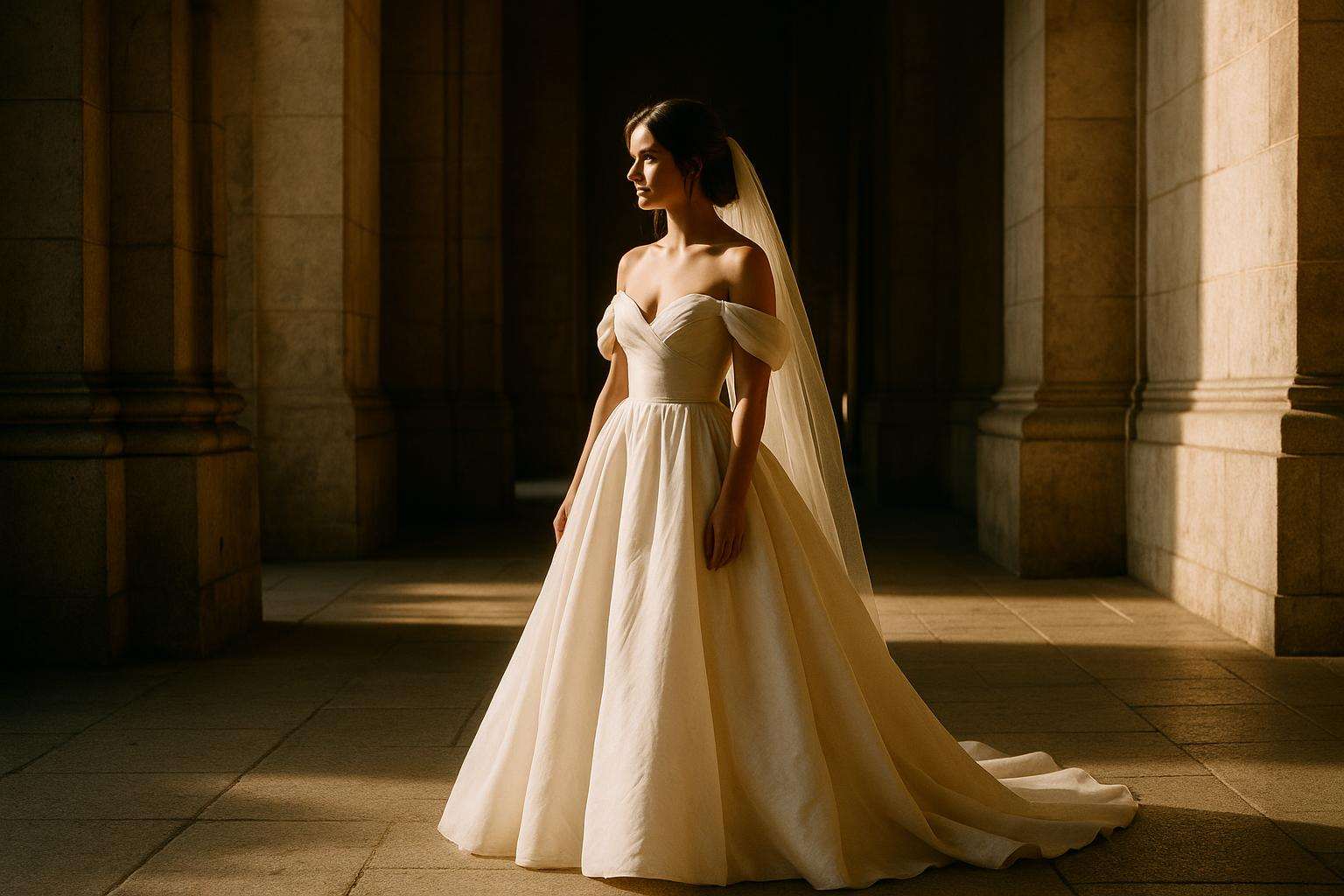
An off-the-shoulder wedding dress features a horizontal neckline that bares the collarbone and rests a fabric sleeve on the upper arm — a portrait-collar effect that elongates the neck, frames the décolletage, and suits a far wider range of body types than conventional wisdom suggests, from pear to broad-shouldered to plus-size, when construction, fabric, and jewellery are chosen thoughtfully.
Of all the neckline decisions a bride makes, none carries quite the same romantic weight as the off-the-shoulder. It is the neckline of oil portraits and opera gowns, of débutante balls and silver-screen sirens — and it has never left bridal fashion because it does something architecturally useful: it creates a visual frame around the face and throat, the way a portrait collar focuses attention on its subject. Understanding how that effect is engineered, and how to buy and wear it intelligently, is the purpose of this guide.
What Is the Difference Between an Off-the-Shoulder and a Cold-Shoulder Wedding Dress?
The two terms appear interchangeably in bridal boutiques, but they describe genuinely distinct constructions with different structural and stylistic implications.
A fully off-the-shoulder gown features a neckline that sweeps horizontally across the chest — typically landing at a sweetheart or straight-across cut — with a sleeve or fabric band that rests on the upper arm below the shoulder joint, fully baring the collarbone and the shoulder blade. The bodice behaves structurally like a strapless dress; what distinguishes it is the fabric extension that wraps the upper arm and anchors the neckline. The result is the portrait-collar effect: a clean horizontal line that visually frames everything above it.
A cold-shoulder dress retains coverage across the front neckline — which may be a V-neck, crew, or boat neck — but is cut away at the shoulder tip itself, leaving a small window of bare skin between the main bodice and any sleeve. Because the center chest and neck remain covered, cold-shoulder designs read as more contemporary and occasionally casual; off-the-shoulder reads as classically bridal and romantic. The practical consequence is meaningful: cold-shoulder styles generally allow greater arm mobility because the neckline anchors to the body through the chest coverage, while fully off-the-shoulder gowns depend on internal boning, elastic, or silicone grip along the upper arm to stay in position through a full day of embracing guests and dancing.
For brides who love the bare-shoulder aesthetic but want maximum security, the off-the-shoulder construction — when correctly engineered — actually holds more reliably than many strapless gowns, because the sleeve band adds a second anchor point around the upper arm.
How Does an Off-the-Shoulder Wedding Dress Actually Stay Up?
Construction quality is the single most important variable to evaluate when shopping this neckline. Three structural elements work in concert.
Internal boning running vertically through the bodice distributes the gown's weight evenly and prevents neckline migration downward. Brands such as Madi Lane build all of their off-the-shoulder styles with a signature fusion bodice construction that includes a horizontal boning channel specifically engineered to resist dropping under the weight of a full skirt — a feature worth asking about by name in any salon appointment.
Elastic at the sleeve edge provides secondary security. A tunnel of elastic hidden inside the arm band keeps the fabric taut enough to grip the upper arm without pinching. For brides whose arms fall between sizes, a qualified seamstress can widen or narrow this elastic channel; adding elastic approximately 1.5 inches wide is the standard alteration. During any fitting, raise both arms overhead, hug yourself, and simulate a first-dance sway. If the neckline climbs above its natural line at any point, ask for elastic reinforcement before the final fitting — not after.
Detachable sleeves represent a third approach: the underlying bodice is essentially strapless, and the off-the-shoulder band clips or buttons on, giving the bride the option to remove the sleeves during the reception. Essense of Australia's Style D3787 offers exactly this — detachable bishop sleeves that anchor under the arm and convert the gown from a fully romantic ceremony look to a clean strapless silhouette for dancing. For brides who want two distinct looks without two dresses, this construction is worth seeking out.
Which Body Types Does an Off-the-Shoulder Neckline Suit?
The short answer: more than most styling guides suggest. The longer answer depends on shoulder width, arm proportion, and torso length.
Pear and hourglass shapes are the neckline's most natural home. The horizontal sweep of fabric optically widens the shoulder line, adding visual balance above broader hips, and the neckline draws attention upward toward the face and collarbone. Pairing with an A-line or ball-gown skirt enhances this effect by adding volume below the waist to complete the balanced silhouette.
Broad or square shoulders work beautifully with this neckline — contrary to popular advice. The off-the-shoulder sweep draws the eye down and across the collarbone rather than squaring off at the shoulder tip. The key is avoiding sleeves with heavy embellishment at the shoulder point, which would re-emphasize width. Clean, draped fabric or lace that flows toward the décolletage is preferable. Kleinfeld Bridal's style editors have consistently noted that the neckline softens angular shoulders rather than dramatising them, when the sleeve is styled correctly.
Petite frames require care. The strong horizontal line can visually shorten the torso if not counterbalanced. Vertical seam lines in the bodice, a high leg slit, or a slightly higher waist seam can restore the illusion of height.
Plus-size and full-bust brides often find this neckline flattering precisely because it moves the eye away from the bustline and toward the collarbone. Look for styles with a wider sleeve band — one that falls to mid-upper-arm — rather than a thin elastic cord, which can create visual and physical constriction. Grace Loves Lace's Palm style is specifically designed for 40+ cup sizes and maintains the full off-shoulder aesthetic with a generous, elegantly cut sleeve.
What Fabric Is Best for an Off-the-Shoulder Bridal Gown?
The fabric choice changes not just the visual register of the gown but how the neckline behaves mechanically — a consideration that rarely appears in styling guides but matters enormously to how comfortable a bride is at hour six of her wedding.
| Fabric | Character at the Shoulder | Best Silhouette Match | Key Trade-Off |
|---|---|---|---|
| Chantilly Lace | Soft drape; natural grip against skin; floaty border detail | A-line, ball gown, sheath | Susceptible to snagging; pattern repeat must be preserved at seams |
| Guipure (Venetian) Lace | Heavy, structured; sleeve holds shape without extra boning | Ball gown, structured bodice | Less mobility; warm to wear; suits formal venues best |
| Organza | Crisp, architectural; sleeve stands slightly away from the arm | High-drama ball gown, formal chapel | No stretch; unforgiving fit; wrinkles in transit |
| Stretch Crepe | Lies flat; comfortable stretch; smooth drape to elbow | Mermaid, trumpet, minimalist sheath | Shows every wrinkle and pulling sensation; fit must be exact |
| Satin | Weighted, lustrous; holds the neckline line with authority | Ball gown, structured princess | Can read stiff if cut is too rigid; warm in summer venues |
| Mikado | Firm, matte-finish; structured without boning; contemporary edge | Fit-and-flare, modern ball gown | Less romantic than lace or organza; limited drape |
Grace Loves Lace's Mila — an off-the-shoulder mermaid in buttery stretch crepe — and Essense of Australia's Style D2477, a structured Mikado gown with a plunging sweetheart neckline, demonstrate opposite ends of the fabric spectrum: one liquid and body-conscious, the other architectural and formal. Both are correct choices; which is right depends on the venue, the season, and the bride's comfort with a close fit.
Fixed vs. Detachable Off-Shoulder Sleeves: Which Should You Choose?
This is one of the most practically useful questions a bride shopping this neckline can ask — and one that salons rarely volunteer an opinion on unless pressed.
Fixed sleeves — the traditional off-the-shoulder construction — offer a completely unified silhouette in photographs and require no management during the day. The sleeve is structurally integrated into the bodice; it stays on. The limitation is obvious: if you want to dance freely in the reception without anything on your arms, you cannot remove them. For brides whose ceremony and reception are in the same venue and who value a single, coherent look, fixed sleeves are the right choice.
Detachable sleeves give you two distinct looks within one gown. Essense of Australia's Style D3787 is among the best-documented examples: detachable off-the-shoulder bishop sleeves anchor under the arm via small fasteners concealed in the side seam, converting to a clean strapless bodice for dancing. Maggie Sottero's Personalize It! program allows brides at authorized retailers — including Kleinfeld Bridal in New York — to specify detachable sleeve modifications at point of sale, adding flexibility to gowns that were not originally designed with that construction. For brides who want the romantic sleeve for the ceremony and the freedom of a strapless line for the reception, detachable construction is an elegant practical solution.
Ask your salon specifically how the attachment mechanism works, whether it has been stress-tested for a full day, and whether the fasteners are invisible in photographs. A detachable sleeve that shows its hardware in close-up images is a fitting-room problem, not a photographer problem.
What Jewelry Pairs Best With an Off-the-Shoulder Neckline?
The off-the-shoulder neckline creates a natural portrait collar — a strong horizontal frame that functions as its own jewellery. The styling principle that follows from this is straightforward: do not fight the frame, extend it.
Chandelier or drop earrings are the most refined choice. They draw the eye upward toward the face and create vertical movement that counterbalances the neckline's horizontal sweep. An ivory or blush pearl drop, a diamond pavé chandelier, or a delicate gold tassel all work beautifully in the heritage register this neckline occupies.
Delicate necklaces can work — but only if they sit at or above the collarbone line, not below it. A fine diamond tennis necklace or a single-strand gold chain at collarbone height completes the frame without duplicating the drama. A heavy statement pendant that falls into the décolletage competes with the neckline rather than enhancing it.
Avoid chokers at this neckline. A choker creates a second strong horizontal line within inches of the first, producing visual clutter rather than elegance.
At the wrist, a single delicate bracelet or a thin cuff on one arm anchors the look at the sleeve's end without pulling attention away from the collarbone. Stack gently, if at all — the strength of this silhouette is in its restraint.
Where Can You Find an Off-the-Shoulder Wedding Dress in 2026?
The market spans every budget tier, and real options exist at each. Below is an honest account of what is available and at what investment.
David's Bridal ($500–$1,500, sizes 0–30W) offers the Off-the-Shoulder Satin Ball Gown (WG3979) in seven colors including Ivory and Dusty Blue with hidden pockets and a detachable sparkle belt, alongside the Off-the-Shoulder Lace A-Line (CWG765) and the Off-the-Shoulder Satin Sheath (SDWG1203) with draped swag sleeves and a sweeping side slit. The widest accessible size range in this neckline category.
Maggie Sottero (approximately $1,500–$3,500 at authorized retailers) offers off-the-shoulder gowns in ball gown, mermaid, and A-line silhouettes with sculpted corsetry and the Personalize It! neckline-modification program. Available through salons including Kleinfeld Bridal.
Grace Loves Lace (from approximately $2,500, direct-to-consumer) produces named styles across constructions: Mila (stretch crepe mermaid), Cupid (cinched-waist with built-in shapewear), Deia (elongated sleeve for upper-arm coverage), and Palm (boho lace, 40+ cup sizes). Global shipping with virtual appointments.
Essense of Australia (mid-to-premium, salon-exclusive) includes Style D2477 — a structured Mikado off-the-shoulder gown — and Style D4110, a ball gown with boned bodice and delicate off-the-shoulder sleeves, alongside the detachable-sleeve Style D3787.
Pronovias ($3,000–$8,000+) features the LEIGHT (satin mermaid), EVARLY (princess silhouette from the Privée Preview line), and EDNITH (Chantilly and tulle A-line with long off-the-shoulder sleeves) in its 2026 collection. Order 9–12 months before the wedding date.
Kleinfeld Bridal in New York carries off-the-shoulder gowns from Pnina Tornai, Martina Liana, Justin Alexander, Anne Barge, and Hayley Paige — the broadest single-location selection of this neckline in the United States market, spanning mid-market to couture price points.
Whatever the budget, budget an additional $200–$800 for alterations. The elastic reinforcement, bustle attachment, and hem work that this neckline typically requires are not optional details; they are what converts a beautiful gown into one that stays exactly where it belongs from the ceremony to the last dance.
Considered Counsel
Frequently asked
What is the difference between an off-the-shoulder and a cold-shoulder wedding dress?
A fully off-the-shoulder gown sweeps horizontally across the chest — typically at a sweetheart or straight-across cut — with a fabric band resting on the upper arm below the shoulder joint, fully baring the collarbone. A cold-shoulder dress retains front neckline coverage (V-neck, crew, or boat neck) but is cut away at the shoulder tip itself, leaving a small window of bare skin. Because the center chest and neck remain covered, cold-shoulder styles read as more contemporary and casual; off-the-shoulder reads as classically romantic. The practical consequence: cold-shoulder styles allow greater arm mobility because the neckline anchors through the chest coverage, whereas fully off-the-shoulder gowns depend on internal boning, elastic, or silicone grip along the upper arm to stay positioned during dancing.
Does an off-the-shoulder wedding dress stay up all day and night?
Yes — when the gown is correctly constructed and properly fitted. Three structural elements work together: internal vertical boning that distributes the gown's weight and prevents neckline migration; elastic hidden inside the sleeve band that keeps the fabric taut against the upper arm; and, in some designs, a silicone grip strip along the inner neckline edge. Brands such as Madi Lane build an internal horizontal boning channel specifically engineered to resist dropping under the weight of a full skirt. During any fitting, raise both arms overhead, hug yourself, and simulate a first-dance sway. If the neckline climbs at any point, ask the seamstress to reinforce or widen the elastic — adding elastic approximately 1.5 inches wide is the standard alteration — before the final fitting. A well-fitted off-the-shoulder gown is among the most secure necklines in bridal fashion.
What body types look best in an off-the-shoulder wedding dress?
The off-the-shoulder neckline is more versatile than most guides acknowledge. For pear-shaped brides, the horizontal sweep of fabric optically widens the shoulder line, creating beautiful visual balance above broader hips — this is the neckline's most natural sweet spot. For brides with broad or square shoulders, the style draws the eye down and across the collarbone rather than squaring off at the shoulder tip; the key is avoiding embellishment concentrated at the shoulder point. Brides with a well-defined collarbone and long neck will find the neckline acts as a natural portrait frame. Petite brides should look for bodices with vertical seam lines to restore the illusion of height, as the horizontal neckline can shorten the visual torso if not counterbalanced. Plus-size brides do well in styles with a wider sleeve band that falls to mid-upper-arm, such as Grace Loves Lace's Palm, designed for 40+ cup sizes.
What fabric works best for an off-the-shoulder bridal gown?
Each major fabric brings a distinct character. Lace — particularly Chantilly lace — is the most popular choice because its texture creates natural grip against skin and can be layered over a satin underliner for modesty. Guipure (Venetian) lace is heavier and more structured, excellent for ball-gown bodices. Organza creates architectural volume at the shoulder; the sleeve stands slightly away from the arm for a high-drama, formal effect but is less forgiving for brides who need stretch. Stretch crepe is the modern minimalist's choice: it lies flat against the arm, allows movement, and drapes smoothly without bunching — Grace Loves Lace's Mila mermaid gown is one of the most-reviewed examples in this construction. Satin, used by David's Bridal in styles such as WG3979 and by Pronovias in the LEIGHT mermaid, provides weight and lustre ideal for structured ball gowns.
What jewelry should I wear with an off-the-shoulder wedding dress?
The off-the-shoulder neckline frames the collarbone and upper chest as a natural portrait collar, which changes the jewelry calculus significantly. Because the neckline itself is a strong horizontal statement, a long pendant necklace or a heavy statement piece fights for visual attention. The most refined approach is a pair of chandelier or drop earrings that draw the eye upward toward the face, allowing the bare collarbone to remain the focal feature. If you prefer a necklace, choose a delicate chain that sits just at or above the collarbone line — a diamond tennis necklace or a fine gold strand works beautifully without duplicating the neckline's drama. A pearl drop earring in ivory or blush is a perennially strong choice. Avoid a choker, which competes with the neckline rather than completing it. Stacked bracelets or a cuff on one wrist can anchor the look at the arm without overwhelming the collarbone.
What is the price range for an off-the-shoulder wedding dress in 2026?
Off-the-shoulder gowns are available at every budget tier. At the accessible end, David's Bridal carries multiple styles — including the Off-the-Shoulder Satin Ball Gown (WG3979) and the Off-the-Shoulder Lace A-Line (CWG765) — in the $500–$1,500 range, in sizes 0–30W. Mid-market options from Maggie Sottero, available at authorized retailers including Kleinfeld Bridal, typically fall in the $1,500–$3,500 range and include the brand's Personalize It! program for neckline modifications. Grace Loves Lace's named styles (Mila, Cupid, Deia, Palm) start at approximately $2,500 and are available direct-to-consumer globally. At the luxury tier, Pronovias gowns including the LEIGHT mermaid and EVARLY princess silhouette from the Privée Preview line range from $3,000 to $8,000 or more at authorized salons. Allow a separate budget of $200–$800 for alterations, which are nearly always required at this neckline.
Should I choose fixed or detachable off-shoulder sleeves?
The choice depends on how your day is structured and how much flexibility you want. Fixed sleeves — the traditional off-the-shoulder construction — offer a completely unified silhouette in photographs and require no management during the day, but you cannot remove them for the reception. Detachable sleeves, such as the bishop sleeves on Essense of Australia's Style D3787, clip or button onto what is essentially a strapless bodice, giving you two distinct looks: the romantic, covered off-shoulder aesthetic for the ceremony and a sleeker strapless silhouette for dancing. Detachable constructions add a small layer of complexity — the attachment points must be secure and invisible — but for brides who want versatility without buying two gowns, they are an elegant practical solution. Ask your salon specifically how the attachment mechanism works and whether it has been stress-tested during a full day of wear.