The Wedding Dress
Sheath Wedding Dress: The Minimalist Column Gown Guide
The slim, straight-falling column — why it needs the least structure, how crepe and satin drape it differently, and why it photographs so beautifully from city hall to a clifftop destination.
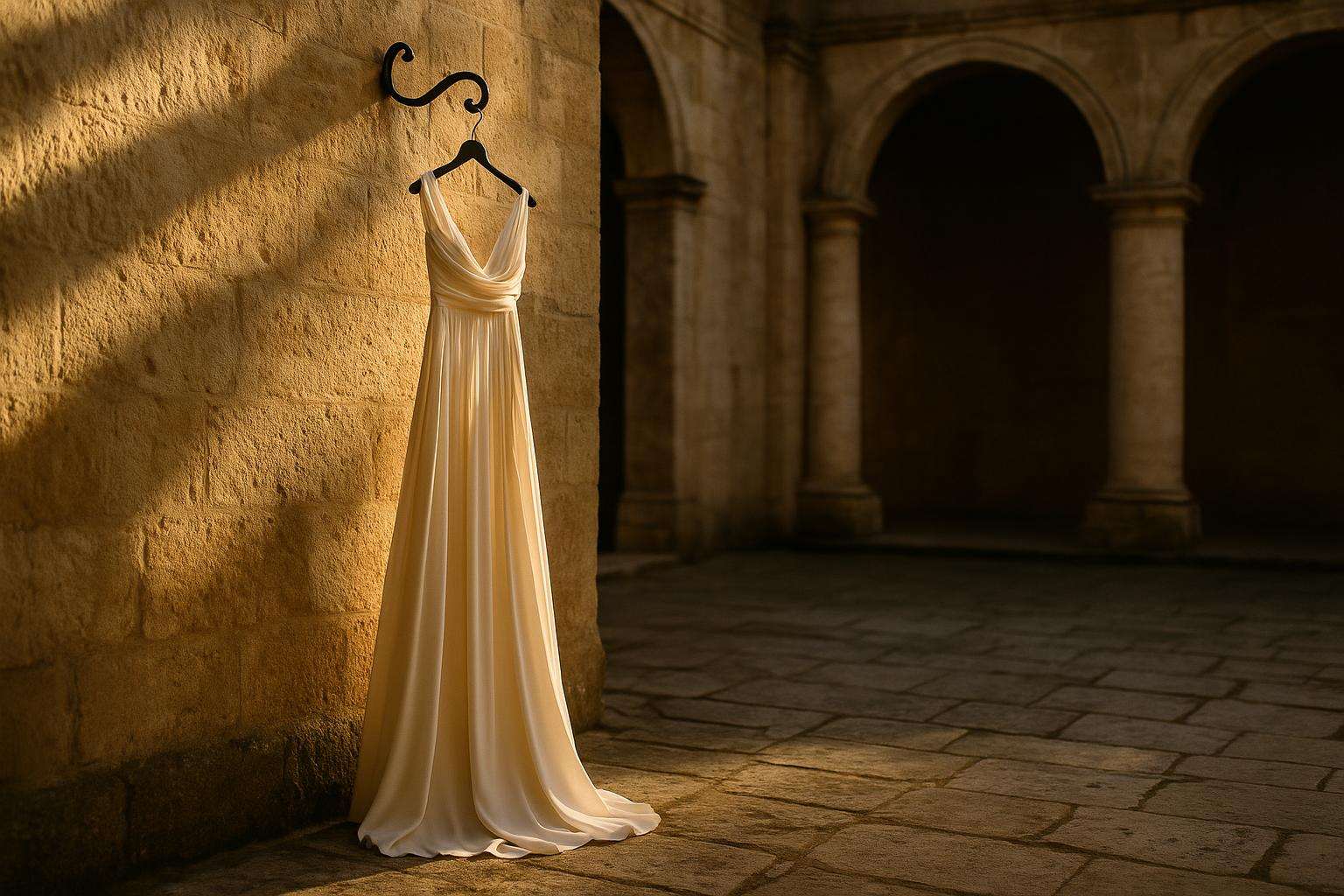
A sheath wedding dress follows the body's natural line in one unbroken vertical column, relying on fabric drape and clean seaming rather than structure or volume to make its impression. It is the defining silhouette of modern bridal minimalism — equally at home at city hall, a destination clifftop, and any ceremony where the bride herself, not the gown's architecture, is the focal point.
The sheath has been the bridal silhouette of quiet confidence for decades. It appeared on the models of Vera Wang's early 1990s collections when Wang set out to prove that a wedding dress could be as rigorously edited as haute couture. It is the gown Amsale Aberra designed for her own wedding in 1985 when she could not find a pared-down alternative to the over-structured styles of the era. And it is the silhouette that continues to dominate the pages of every major bridal retailer in 2026 — from the $99 crepe options at David's Bridal to the $12,000 silk faille columns at Vera Wang — because it solves a problem elegantly: how to make a bridal gown feel both exceptional and entirely wearable.
What Is a Sheath Wedding Dress and How Is It Different from a Column?
The sheath and column are the two most closely related silhouettes in bridal design, and the terms are often used interchangeably at retailers, salons, and in editorial coverage. The meaningful distinction is structural.
A sheath gown is cut to skim the body's natural curves — fitted through the bodice, waist, and hips — with a soft, slight flare possible at the hem. Because it relies on drape rather than rigid construction, it typically uses lighter-weight, less structured fabrics. A column is architecturally stricter: the hemline opening is narrower, the vertical line more deliberate, and fabrics with inherent body — ponte, bonded crepe, or silk faille — are used to maintain that upright shape. According to Essense Designs' editorial comparison of the two silhouettes, the key shared principle is this: no separate skirt, no gathered layers, no structural crinoline. All shaping comes from the cut, seaming, any boning, and the fabric itself.
This is what distinguishes both silhouettes from a fit-and-flare or mermaid gown — those styles are also close to the body but introduce a dramatic flare below the knee that disrupts the long vertical line defining the sheath. The sheath keeps that line intact, from neckline to hem, with nothing to interrupt it.
Which Fabric Is Best for a Sheath Wedding Dress?
Fabric is the single most consequential decision in a sheath gown. Because there is no volume or crinoline to distract, the fabric's drape, weight, and surface finish become the entire visual statement. Three fabrics define the contemporary sheath market.
| Fabric | Drape Character | Best Setting | Travel & Destination | Price Tier |
|---|---|---|---|---|
| Silk charmeuse | Liquid, high-gloss, body-conscious | Indoor or warm-weather ceremony | Delicate — wrinkles under pressure, requires careful packing | Luxury ($4,000+) |
| Silk / poly crepe | Matte, structured drape, slight stretch | City hall, destination, formal venue | Excellent — wrinkle-resistant, packs well | Mid–luxury ($500–$8,000) |
| Jersey (knit) | Soft, four-way stretch, matte | Beach, garden, destination, boho | Best of all — packs flat, no ironing needed | Accessible–mid ($99–$2,000) |
| Silk faille | Crisp, holds shape, subtle sheen | Formal venue, black-tie, European setting | Moderate — structured, can crease at fold lines | Luxury ($5,000+) |
Silk and poly crepe have become the dominant sheath fabrics in the 2025–2026 bridal season. Crepe's matte finish reads as modern and unfussy; its slight natural stretch helps it conform to curves without constricting; and its structure eliminates the transparency risk of charmeuse. Justin Alexander's fabric guide identifies silk crepe as the premium option with the best balance of structure and drape, and notes that poly crepe versions are more wrinkle-resistant and therefore better suited to destination travel.
Silk charmeuse produces the archetypal slinky, body-conscious look of 1990s and early 2000s minimalist bridal — the liquid drape associated with Vera Wang's earliest ready-to-wear sheaths. It performs best in warm-weather indoor settings but requires careful handling: the thin face telegraphs seam allowances, boning edges, and undergarment lines, making undergarment selection critical before fittings begin.
Jersey is the choice for maximum comfort and packability. Its four-way stretch drapes cleanly over the body without boning or structure, making it the most natural fit for destination ceremonies, beach receptions, and any wedding requiring extended wear. David's Bridal carries jersey V-neck ruched sheath styles within its beach destination collection, with prices beginning around $99.
Does a Sheath Wedding Dress Work for Every Body Type?
The sheath is most commonly recommended for two figure types — hourglass and petite — though it can be adapted for nearly any body with thoughtful fabric and construction choices.
Hourglass figures benefit most directly from the sheath's lack of volume. The silhouette traces the waist and hips without adding bulk, making the body's own geometry the focal point. Adding a cinched belt or corseted bodice panel to a crepe sheath can further emphasize the waist and create strong visual balance.
Petite brides (typically under 5 feet 5 inches) gain a visually elongating effect from the sheath's uninterrupted vertical line. Because there is no horizontal cut at the bodice-skirt junction — as in a ball gown — the eye travels continuously from neckline to hem, adding apparent height. Vera Wang Bride's editorial on wedding dresses for body types confirms this recommendation, describing the sheath and A-line as the styles that most effectively elongate the petite frame.
The sheath also suits athletic and straight figures where fabric and seaming can create the impression of curves; strategic princess seaming through the bodice and a flared hem introduce shape where the body is more linear. Brides with fuller hips may prefer a draped or bias-cut crepe that flows over the hip rather than a style that clings at that point.
Why Does a Sheath Gown Need the Least Structure of Any Wedding Dress?
In bridal construction, structure serves one purpose: to create a shape the body does not already provide. A ball gown requires a crinoline to hold the volume of its skirt. A mermaid requires boning to mold the bodice into its trumpet shape at the hip. A fit-and-flare needs internal architecture at the knee to produce the dramatic kick of the flare.
A sheath needs none of this because it does not fight the body — it follows it. The shaping is inherent in the fabric's drape and the precision of the seaming. Well-executed princess seams through the bodice are often sufficient to create structure and fit without a single bone. Bridal stylists at Bridal & Tuxedo Galleria note that the sheath's minimal internal construction is also what makes it the lightest-wearing silhouette — a significant advantage in warm climates, extended celebrations, and any ceremony involving stairs, dancing, or travel.
The trade-off is that fit must be exact. A ball gown forgives minor discrepancies between the body and the dress because the volume absorbs them. A sheath does not. A skilled seamstress at alteration specialists such as Darianna Bridal & Tuxedo in Warrington, Pennsylvania — an authorized salon that carries multiple sheath labels — notes that sheath alterations are often fewer in number but require greater precision: a single seam adjustment at the hip can shift the entire silhouette.
Is a Sheath Wedding Dress Right for a City-Hall or Destination Wedding?
The sheath is arguably the silhouette most naturally suited to both contexts. At city hall, where the setting is compact and the occasion intimate, the sheath's lack of volume means no struggling through doorways, no choreographing a crinoline through courthouse corridors, and no need to bustle the train before the celebration dinner. A silk crepe sheath or a simple satin column worn with low heels or even elegant flats is a complete, refined outfit that does not require the full apparatus of a traditional bridal ceremony to feel intentional.
For destination weddings, the logistics are equally compelling. A poly crepe or jersey sheath compresses into a garment bag without the volume of a ball gown, travels more easily as a carry-on, and arrives with fewer wrinkles than heavier-weight satin. Essense of Australia's destination wedding guide identifies lightweight crepe as one of its top fabric recommendations for destination brides precisely because of its wrinkle-resistance and clean drape in outdoor settings. Pronovias offers chiffon column silhouettes in its 2026 collection described as "lightweight yet ethereal, designed for outdoor and summer wedding celebrations," while All Who Wander — the boho destination label under Essense Designs — produces flowing sheath and A-line styles in sizes 2–24 at authorized retailers including Lotus Bridal, with prices from approximately $1,800.
How Does a Sheath Wedding Dress Photograph?
The sheath is among the most photogenic of all wedding dress silhouettes, for reasons that are as much compositional as they are aesthetic. Its long, unbroken vertical line reads as graphic and deliberate in still images: against stone walls, city streets, vineyard rows, or clifftop vistas, the column creates a strong shape that anchors the frame rather than competing with the background.
In motion — walking, turning, caught mid-dance — silk charmeuse and jersey catch and release light with a fluidity that looks effortless on camera. Crepe holds its shape in movement without billowing or bunching, producing clean, editorial-style frames that work equally well at a golden-hour outdoor shoot and in the flash-lit interior of a reception hall.
The absence of volume also keeps the bride's face and expression as the focal point of every image. In a ball gown, the skirt's scale can dominate wide-angle shots; in a sheath, the proportion stays human. This makes the sheath particularly sought-after by brides who want fashion-forward, minimalist wedding imagery — and by photographers who prefer a clean, graphic aesthetic over romantic, volumetric framing.
Which Designers Make the Best Sheath Wedding Gowns?
Vera Wang has built a defining portion of her bridal identity on the architectural sheath and column. The 2026 Vera Wang Haute Wedding collection includes a silk faille column dress with a carved neckline and a removable pearl-embellished overskirt — a study in detachable minimalism. Ready-to-wear sheath offerings run approximately $4,500–$12,000, with sample sale pricing at Kleinfeld Bridal NYC running $2,500–$5,000 quarterly. Her crepe sheaths are available in sizes 00–30.
Amsale, founded by Amsale Aberra in New York in 1985 after she designed her own pared-down bridal gown, remains the standard-bearer for architectural minimalism in American bridal. The AMSALE Bridal line, hand-sewn at the brand's SoHo atelier in silk crepe, silk charmeuse, and satin, starts at $6,000. Ready-to-wear draped crepe and halter-tie sheath silhouettes begin at $695–$1,250 on amsale.com and at authorized retailers including La Jeune Mariee and En Blanc LA.
Grace Loves Lace serves the mid-market with stretch French lace and silk chiffon column styles produced at its Australian atelier and sold direct-to-consumer. The Hollie 2.0, retailing at $1,780 USD, features a stretch French lace bodice with hand-cut motifs and draped chiffon panels, and is widely cited as one of the most-pinned bridal gowns on Pinterest.
Kleinfeld Bridal in New York City carries one of the broadest sheath inventories of any US retailer, with sheath gowns spanning designers including Tony Ward and Allure, starting from approximately $3,000. Kleinfeld Again, the salon's pre-owned arm, offers sheath gowns from Amsale and Carolina Herrera at reduced sample prices. For accessible options, BHLDN — Anthropologie's bridal line, also available through Kleinfeld Again — carries silk-chiffon and lace sheath styles. David's Bridal anchors the accessible tier with crepe and jersey sheaths beginning at $99, including beach-specific styles for destination brides. Maggie Sottero rounds out the mid-market with structured crepe sheaths in a broad size range at authorized salons nationwide.
Considered Counsel
Frequently asked
What is a sheath wedding dress?
A sheath wedding dress is a close-fitting gown that follows the body's natural silhouette from shoulder to hem in one continuous, uninterrupted line. Unlike a ball gown or A-line, it has no separate skirt panel and no structural crinoline — all shaping comes from the cut, seaming, optional boning, and the drape of the fabric itself. The result is the defining silhouette of modern bridal minimalism: slim, straight-falling, and architectural. It is often described interchangeably with the column gown, though strictly speaking a column holds a narrower, more upright vertical line while a sheath may allow a subtle flare at the hem.
What is the difference between a sheath and a column wedding dress?
Both silhouettes are close to the body with no separate skirt, but a column is the stricter of the two. A column gown maintains a narrow, consistent width from shoulder to hem — almost like a vertical architectural structure — and typically uses fabrics with inherent body such as ponte or bonded crepe to sustain that standing shape. A sheath is more forgiving: it skims the body's natural curves and may have a soft flare toward the hem. The distinction matters in fabric choice and construction, but in everyday bridal usage the terms are frequently used as synonyms, particularly at retailers like Kleinfeld Bridal and David's Bridal.
What fabric is best for a sheath wedding dress — crepe, charmeuse, or jersey?
The answer depends on the ceremony setting and the look the bride wants. Silk or poly crepe is the dominant choice in contemporary minimalist sheaths: its matte finish reads as modern and unfussy, its slight natural stretch conforms to curves without constricting, and its structure eliminates the transparency risk of lighter weaves. Silk charmeuse delivers a liquid, high-gloss drape that suits intimate indoor and warm-weather ceremonies but requires careful handling during fittings. Jersey — a four-way-stretch knit — is the most comfortable and the most packable, making it the top choice for destination weddings and extended wear. Justin Alexander's fabric guide identifies these three as the primary sheath fabrics for 2025–2026 collections.
Does a sheath wedding dress work for petite brides?
Yes — a sheath or column is one of the most flattering silhouettes for petite brides (typically under 5 feet 5 inches). Because the silhouette has no horizontal cut at the waist the way a ball gown does at the bodice-skirt junction, the eye travels in one uninterrupted line from neckline to hem, creating an elongating effect. Vera Wang Bride's editorial on wedding dresses for body types specifically identifies the sheath and A-line as the designs that most effectively add apparent height to a petite frame. Choosing a high-cut neckline, a vertical seam detail, or a slight V-neck all reinforce the vertical emphasis further.
Is a sheath wedding dress appropriate for a destination or city-hall wedding?
The sheath is arguably the single silhouette best suited to both contexts. For city-hall ceremonies — where the setting is compact, the gathering intimate, and practicality matters — a silk crepe or poly crepe sheath requires no bustling, no structural crinoline, and moves easily through courthouse corridors and restaurant celebrations. For destination weddings, a jersey or lightweight poly crepe sheath packs into a garment bag without the volume of a ball gown, resists travel wrinkles better than heavyweight satin, and photographs beautifully against open-air backdrops. David's Bridal stocks beach-specific crepe sheath styles from around $99, while Amsale's ready-to-wear collection offers draped crepe sheaths from $695 for brides seeking a more refined option.
How does a sheath wedding dress photograph?
The sheath photographs exceptionally cleanly because its long, unbroken vertical line reads as graphic and intentional in both still images and film. Against architectural or landscape backdrops — stone walls, city streets, cliffside terraces — the column silhouette creates a strong, defined shape that does not compete with the setting. In motion — walking, turning, caught mid-dance — silk charmeuse and jersey catch and release light with a fluidity that looks effortless on camera. The absence of volume also means photographs are not dominated by skirt mass, keeping the bride's face and expression as the focal point. Bridal photographers specifically recommend the sheath for couples who want editorial-style, fashion-forward imagery.
What should you wear under a sheath wedding dress?
Undergarment choice for a sheath gown is more consequential than for any other silhouette, because the close fit means seams, boning channels, and lining edges telegraph through lightweight fabric. Bridal experts universally recommend choosing undergarments before the first fitting appointment and wearing them to every subsequent appointment — that means the specific strapless bra, shapewear, or no-show brief that will be worn on the day. Nude-toned (skin-matched, not white) undergarments are the industry standard, as white undergarments can show through crepe, charmeuse, or chiffon. Compression shapewear should be assessed carefully: in a well-fitted crepe sheath, the gown's own seaming provides shaping and additional compression can create unwanted rippling at the hips.