The Wedding Dress
How to Choose a Wedding Dress for Your Body Type
A silhouette-and-neckline decision system for pear, apple, hourglass, rectangle, and inverted-triangle figures — the same framework bridal consultants at Kleinfeld and Atlanta Street Bridal use from the very first appointment.
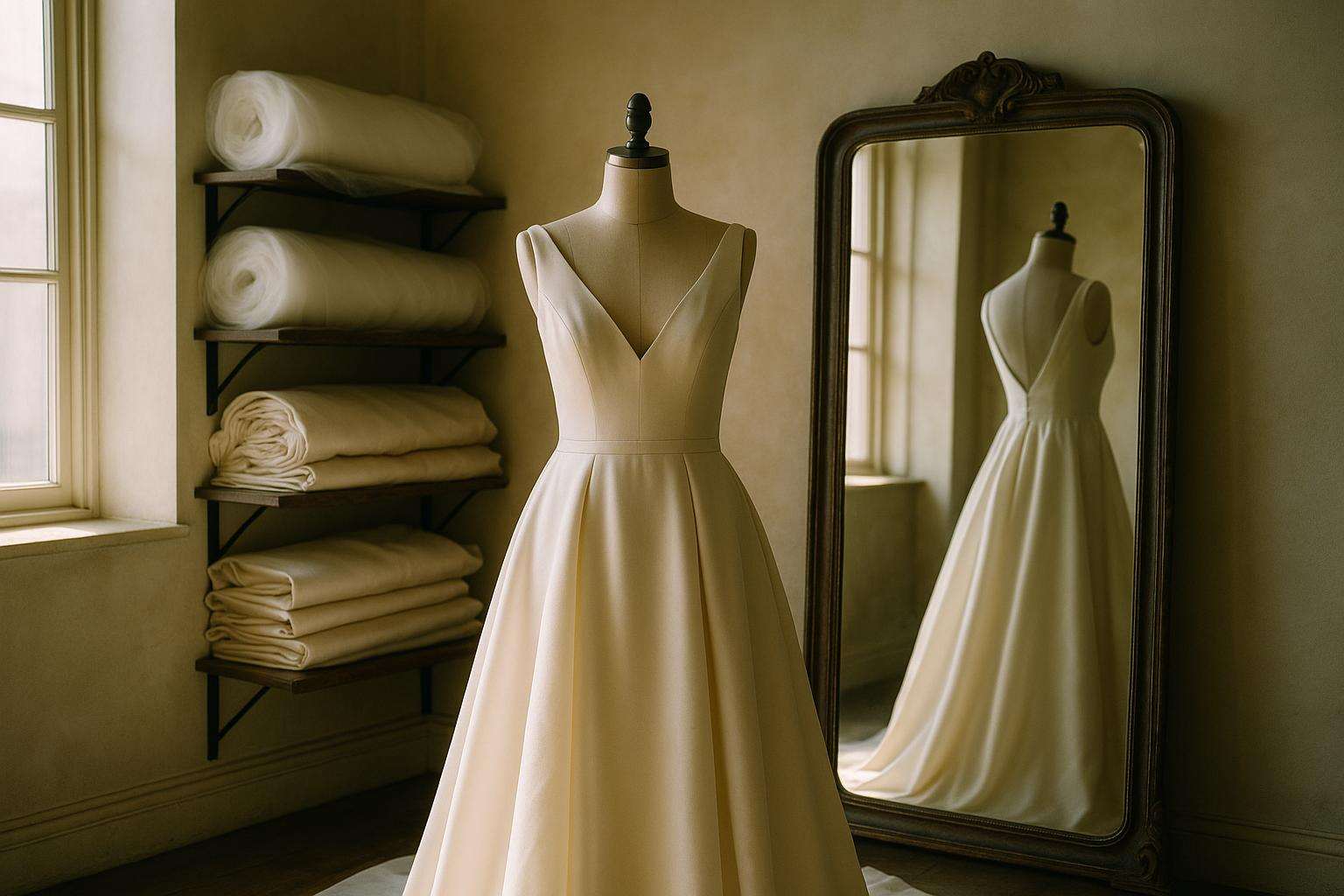
Choosing a wedding dress for your body type is a two-step decision system, not a list of rules: first, identify your primary silhouette based on where your proportions are widest; second, refine with a neckline and fabric that direct the eye where you want it. Bridal consultants at salons from Kleinfeld Bridal in New York to Atlanta Street Bridal in Georgia apply this same framework across every appointment — silhouette first, neckline second, fabric third.
The moment a bride steps onto the salon floor, one question governs every gown she tries: where does this dress want the eye to travel? Silhouette is the architectural answer. It defines the overall shape of the gown and, by extension, how that shape interacts with the bride wearing it. Justin Alexander's editorial team calls it “one of the first and most important style decisions you’ll make, as it defines the overall shape of your gown and how it fits and moves on your body.” Get the silhouette right and the neckline and fabric choices that follow become much easier to make.
The five shapes below — pear, apple, hourglass, rectangle, and inverted-triangle — are the frame the consultant uses before a single gown comes off the rack. Each shape has a primary silhouette that works with its proportions, a neckline formula that reinforces that effect, and a fabric logic that carries both through to the hem. Use this as your decision system before your first appointment, not as a list of prohibitions.
What Is the Best Wedding Dress Silhouette for a Pear-Shaped Figure?
The pear shape has narrower shoulders and a defined waist, with fuller hips and thighs. The consultant’s goal is to draw the eye upward — to the face, the décolletage, and the shoulders — and to balance the upper and lower body so neither dominates the other.
Primary silhouette: A-line. Fitted close through the bodice and waist, then gently skimming the hips rather than accentuating them, the A-line is the pear shape’s most reliable ally. Paloma Blanca, the Canadian bridal house founded in Toronto in 1937, describes the A-line as the ideal for pear shapes because it “fits through the bodice and waist, then gradually widens toward the hem” without pulling across the hips. Their style 4955 — a fit-and-flare with a draped ruched fitted bodice and off-the-shoulder straps — is a textbook execution of pear-shape styling at the retail level.
Secondary silhouette: ball gown. A heavily structured or embellished bodice on a ball gown redirects the eye to the décolletage and keeps it there. The full skirt below visually widens the lower half, which can create balance on a narrower-shoulder frame.
Neckline formula: off-the-shoulder, sweetheart, halter, or cap-sleeve. Each of these widens the visual footprint of the shoulder line, bringing it into proportion with fuller hips. Kleinfeld Bridal advises concentrating beadwork, ruching, or draping at the bodice to reinforce this upward focal point. Avoid narrow halter straps that visually compress the shoulders.
Fabric for the skirt: flowing tulle or chiffon creates movement and balance at the hip line; avoid tightly fitted fabrics through the hip that pull across the widest point.
What Wedding Dress Is Most Flattering for an Apple-Shaped Body?
Apple-shaped brides carry more volume at the waist and midsection than at the bust or hips. The styling objective is twofold: create a visual waistline where the natural waist is less defined, and elongate the frame.
Primary silhouette: empire waist. The seam sits just below the bust, letting the skirt fall freely over the midsection without clinging. Essense of Australia — whose 2026 collection features 3D floral lace and detachable elements across their A-line and empire-waist range — recommends this silhouette specifically for fuller midsections because it “skims over the tummy and hips rather than clinging.” Atlanta Street Bridal’s consultants in Atlanta, Georgia, pair the empire waist with ruched or draped bodice detailing to add structure around the bust.
Secondary silhouette: A-line with ruching. Subtle ruching at the bodice provides structure while skimming the torso. The diagonal lines created by ruching are visually slimming.
Neckline formula: V-neck and sweetheart. Both draw the eye upward and away from the midsection. A deep V also elongates the torso visually, which is especially effective when paired with an empire-waist bodice.
Fabric intelligence: structured materials — mikado, taffeta, duchess satin — hold their shape and resist clinging at the midsection in a way that jersey and chiffon cannot. Avoid bias-cut sheaths, which follow every contour without compromise.
Which Silhouette Works Best for an Hourglass Figure?
The hourglass has roughly equal bust and hip measurements with a noticeably smaller waist — the most symmetrical proportions in bridal terms. Nearly every silhouette works, but structured, body-conscious styles deliver the most impact because they have the proportions to show off.
Primary silhouette: mermaid or trumpet. Both hug the body through the waist and hips before flaring dramatically below. The mermaid flares at or below the knee; the trumpet flares from mid-thigh, producing a slightly softer line and easier stride. Galia Lahav, the Israeli couture house, specifically recommends mermaid styles for hourglass figures: “structured bodices with defined waists, or mermaid silhouettes” are optimal. Their gowns Lafayette and Alejandra are cited as exemplars of this construction approach at the luxury price point ($4,000–$12,000+).
Secondary silhouette: fit-and-flare. For brides who want more skirt volume without losing the body-conscious bodice, the fit-and-flare adds drama below the knee while still showing off the defined waist.
Neckline formula: square, V-neck, or sweetheart with built-in support. Galia Lahav stylists note that “scoop or square necklines that have support are key” for fuller busts common to the hourglass shape. A strapless sweetheart with boning or a structured corset bodice is equally strong.
What to avoid: empire waist and very full ball gowns add volume in areas — bust and hips — that are already well-balanced on this shape. The effect is visual noise rather than elegance.
How Do I Choose a Wedding Dress for a Rectangle Figure?
Rectangle figures have shoulders, waist, and hips that measure within a few centimeters of each other, with little natural waist indentation. The styling goal is to create the visual impression of curves. This is a shape that rewards construction — silhouettes with built-in structure at the waist and volume at the hip do most of the work.
Primary silhouette: fit-and-flare. The skirt’s flare at the hip introduces curvature the body does not otherwise present. Maggie Sottero’s editorial team highlights a “square neck fit-and-flare with a deep V-back” as a high-impact choice that “cinches the waistline and adds natural curvature.” Maggie Sottero gowns in this category range from approximately $1,600 to $3,000 across their core label and Sottero & Midgley tiers.
Secondary silhouettes: mermaid, trumpet, or ball gown. The mermaid and trumpet both hug through the torso and then flare dramatically, engineering curves from the construction itself. A ball gown adds hip volume through the skirt and creates a defined visual waist via a structured, often corseted bodice.
Detail work: ruching, draping, and waist-cinching belts or sashes all add perceived shape. Corset-back closures are particularly effective because they can be fitted tightly to pinch the waist. Beading or lace concentrated at the waistband draws the eye to the narrowest point of the torso.
Necklines: horizontal necklines — off-the-shoulder, portrait collar, or wide sweetheart — add width at the bust and shoulder, which indirectly makes the waist appear narrower by comparison.
What Wedding Dress Flatters an Inverted-Triangle Body Shape?
The inverted-triangle has broader shoulders and a fuller bust relative to narrower hips. The styling goal runs opposite to the pear: add visual volume to the hip line and draw the eye downward, so that the lower body balances the broader upper body.
Primary silhouette: ball gown. The full, structured skirt adds breadth below the waist and balances wider shoulders naturally. The volume is in exactly the right place. Justin Alexander — whose bridal house was founded in 1946 and whose Signature collection runs approximately $2,775 to $4,350 — produces ball gowns with crystal beadwork and illusion necklines that concentrate detail at the bodice while the skirt does its balancing work below.
Secondary silhouette: A-line. In heavier fabric — structured tulle, duchess satin, or taffeta — the A-line creates a similar balancing effect with less volume, which suits brides who want an elegant silhouette without the full drama of a ball gown.
Neckline formula: sweetheart and V-neck. Both draw the eye inward and downward, visually slimming the shoulders. A deep V in particular creates a long central line that reduces the perceived width of the upper body. Avoid off-the-shoulder, portrait-collar, and cap-sleeve necklines, which add visual width to a shoulder line that is already broad.
What to avoid: heavily embellished or ruffled necklines concentrate the eye at the shoulders and amplify the inverted-triangle effect rather than countering it. Wide-strap or cap-sleeve constructions do the same.
How Do Bridal Consultants Actually Use This Decision System in the Fitting Room?
Knowing your shape is step one. What happens in the fitting room is where the framework becomes a gown. Bridal consultants at major salons follow a consistent methodology that experienced brides describe as more efficient than the trial-and-error approach most first-time shoppers expect.
Kleinfeld Bridal — a New York City institution with over seventy years of appointments, more than 200 staff, and a 30,000-square-foot salon floor — describes their core process as a “process of elimination.” Begin with two silhouette candidates; every subsequent gown must outperform one of the original two to remain in the running. This prevents the decision fatigue that sets in when a bride tries twenty dresses without a framework. Atlanta Street Bridal, a boutique salon in Atlanta, Georgia, pairs each bride with a professionally trained stylist who listens to venue, budget, and vision before pulling any silhouettes. Their inventory spans 175+ bridal styles priced $1,000–$3,600.
The consultant sequence: (1) measure at bust, waist, and hip; size to the largest measurement — most designers order up to accommodate the widest point, with fabric removed rather than added; (2) select silhouette first, neckline second, fabric third; (3) test mobility in every candidate — walk, sit, and attempt a dance step, because movement reveals fit problems that standing conceals; (4) limit the guest party to two or three people to protect the decision.
One practical note that surprises many brides: bridal sizing diverges from ready-to-wear. Most designers size up to the largest measurement, so a bride who wears a size 10 in street clothes may order a size 14 or 16 in a designer gown. This is a construction norm, not a commentary on fit — alterations reduce the excess. Budget for alterations at the time of purchase, not as an afterthought: most gowns require two to four fittings over eight to twelve weeks.
Which Wedding Dress Designers and Retailers Work for Each Body Type?
| Designer / Retailer | Silhouette Strengths | Best For | Price Range (USD) |
|---|---|---|---|
| Vera Wang Bride | Sheath, mermaid, architectural A-line | Hourglass, rectangle | ~$2,500–$3,800+ |
| Galia Lahav | Mermaid, trumpet (couture construction) | Hourglass | $4,000–$12,000+ |
| Justin Alexander Signature | Ball gown, fit-and-flare, A-line | Inverted-triangle, pear | ~$2,775–$4,350 |
| Justin Alexander (core) | A-line, mermaid | Pear, hourglass | ~$1,700–$3,325 |
| Maggie Sottero | Fit-and-flare, mermaid, A-line | Rectangle, hourglass | ~$1,600–$3,000 |
| Sottero & Midgley | Statement ball gown, couture mermaid | Inverted-triangle, hourglass | ~$1,700–$4,000 |
| Essense of Australia | A-line, empire waist, mermaid | Apple, pear | ~$1,700–$2,900 |
| Paloma Blanca | A-line, fit-and-flare, minimalist sheath | Pear (style 4955) | Varies by retailer |
| Rebecca Ingram (Maggie Sottero) | A-line, empire, modest styles | Apple, pear | ~$1,000–$1,800 |
| Azazie (online) | A-line, mermaid, sheath, ball gown | All shapes; custom sizing | $99–$1,400 (most under $500) |
The table above reflects 2026 retail pricing and silhouette specialization based on each house’s current collections. Price ranges are approximate and vary by retailer, alteration scope, and regional market. Azazie’s try-at-home program — up to three dresses shipped for home try-on — is the most accessible entry point for brides who want to test silhouettes before committing to a salon appointment.
One final note on the decision system: these are starting points, not verdicts. Every bride arrives with a different combination of proportions, height, posture, and personal style — and the body-type framework exists to narrow the field from dozens of silhouettes to three or four strong candidates. From there, the fitting room does its work. Book your appointment nine to twelve months before your wedding date to leave room for production lead time (typically four to six months for designer gowns) and the alteration schedule that follows.
Considered Counsel
Frequently asked
What wedding dress silhouette is best for a pear-shaped body?
The A-line is the pear shape's most reliable silhouette: it fits close through the bodice and waist, then gently skims the hips and thighs without accentuating them. A ball gown with an embellished or detailed bodice works equally well by directing attention upward. The key neckline choices are off-the-shoulder, sweetheart, or halter — each widens the visual footprint of the shoulders to balance fuller hips. Paloma Blanca's style 4955, a fit-and-flare with a draped ruched bodice and off-the-shoulder straps, is a textbook execution of this principle. Kleinfeld Bridal advises concentrating beadwork or draping at the bodice to keep the eye above the hip line.
What wedding dress works best for an apple-shaped figure?
Apple-shaped brides carry more volume at the midsection than at the bust or hips. The empire waist is the primary recommendation from consultants at salons including Atlanta Street Bridal: the seam sits directly below the bust, letting the skirt flow away from the midsection rather than clinging to it. An A-line with ruching at the bodice offers similar coverage with a little more structure. Necklines that draw the eye upward — V-neck and sweetheart cuts — are the most flattering choices. Fabric matters considerably here: structured materials such as mikado, taffeta, or duchess satin hold their shape and resist clinging in a way that jersey or chiffon cannot. Avoid mermaid and fitted-sheath styles, which hug the natural waist.
Which wedding dress silhouette flatters an hourglass figure most?
Hourglass figures — roughly equal bust and hip measurements with a noticeably smaller waist — are flattered by almost every silhouette, but body-conscious styles deliver the most impact. The mermaid and trumpet are the top picks from both Galia Lahav and Vera Wang's editorial teams: both hug the body through the waist and hips before flaring below. The Israeli couture house Galia Lahav specifically recommends styles with structured bodices and defined waists for this shape, citing their gowns Lafayette and Alejandra as exemplars. A fit-and-flare adds more skirt volume for brides who want additional drama below the knee. For fuller busts common to the hourglass shape, Galia Lahav stylists recommend square or scoop necklines with built-in support.
How do I choose a wedding dress for a rectangle body shape?
Rectangle figures have shoulders, waist, and hips that measure within a few centimeters of each other, with little natural waist indentation. The styling goal is to create the visual impression of curves. A fit-and-flare is the top pick: the skirt's flare below the hip introduces curvature the silhouette does not otherwise have. Mermaid and trumpet styles work similarly — both hug through the torso and then flare dramatically below. Ball gowns add volume at the hip and create a defined visual waist via a structured bodice. Ruching, draping, and waist-cinching detail at the midsection all add perceived shape. Corset-back closures are particularly effective because they can be tightened to emphasize the waist. Maggie Sottero's fit-and-flare range, with a deep V-back and defined waistline, is a well-regarded retail option at the $1,600–$3,000 price point.
What wedding dress style suits an inverted-triangle body shape?
Inverted-triangle figures have broader shoulders and a fuller bust relative to narrower hips. The styling goal is to balance the upper and lower body by adding visual volume to the hip line. Ball gowns are the most effective choice: the full, structured skirt adds breadth below the waist and balances wider shoulders naturally. A-line styles in heavier fabric (structured tulle, taffeta) create a similar balance with less volume. Necklines should be modest at the shoulder — avoid off-the-shoulder and cap-sleeve styles, which add width to an already broad shoulder line. Sweetheart and V-neck cuts are the strongest options: both draw the eye inward and downward, slimming the appearance of the shoulders. Avoid heavily embellished or ruffled necklines and off-the-shoulder sleeves.
What is the difference between a mermaid and a trumpet wedding dress?
Both silhouettes hug the body through the bust, waist, and hips, but they differ in where the skirt begins to flare. A mermaid gown fits tightly all the way to the knee or just below, then flares into a dramatic skirt from the knee down. A trumpet gown begins its flare higher — typically at mid-thigh — creating a silhouette with a slightly softer, more flowing line. In practical terms: the mermaid requires a more fitted, structured construction and restricts stride more than the trumpet. Justin Alexander's editorial team describes the trumpet as 'a more forgiving, wearable variation' for brides who love the body-conscious look but want easier movement during a reception. Both are best suited to hourglass and rectangle figures.
How early should I start shopping for a wedding dress?
Most bridal consultants recommend beginning your search nine to twelve months before the wedding date. The reason is production lead time: designer gowns from labels like Vera Wang, Galia Lahav, Justin Alexander, and Maggie Sottero typically require four to six months to produce after the order is placed, and alterations take an additional two to three months. Kleinfeld Bridal, which has dressed brides for over seventy years from its 30,000-square-foot salon in New York City, advises booking a consultant appointment as early as possible to secure preferred appointment times and avoid a rush surcharge on production. Ordering within six months of the wedding date is possible but usually incurs a rush fee of 10–30% above the gown price.