The Wedding Dress
Wedding Dress Fabrics: Satin, Lace, Tulle, Crepe & More
A material-by-material reference — drape, weight, season, photography behaviour, and price implications of every major bridal fabric.
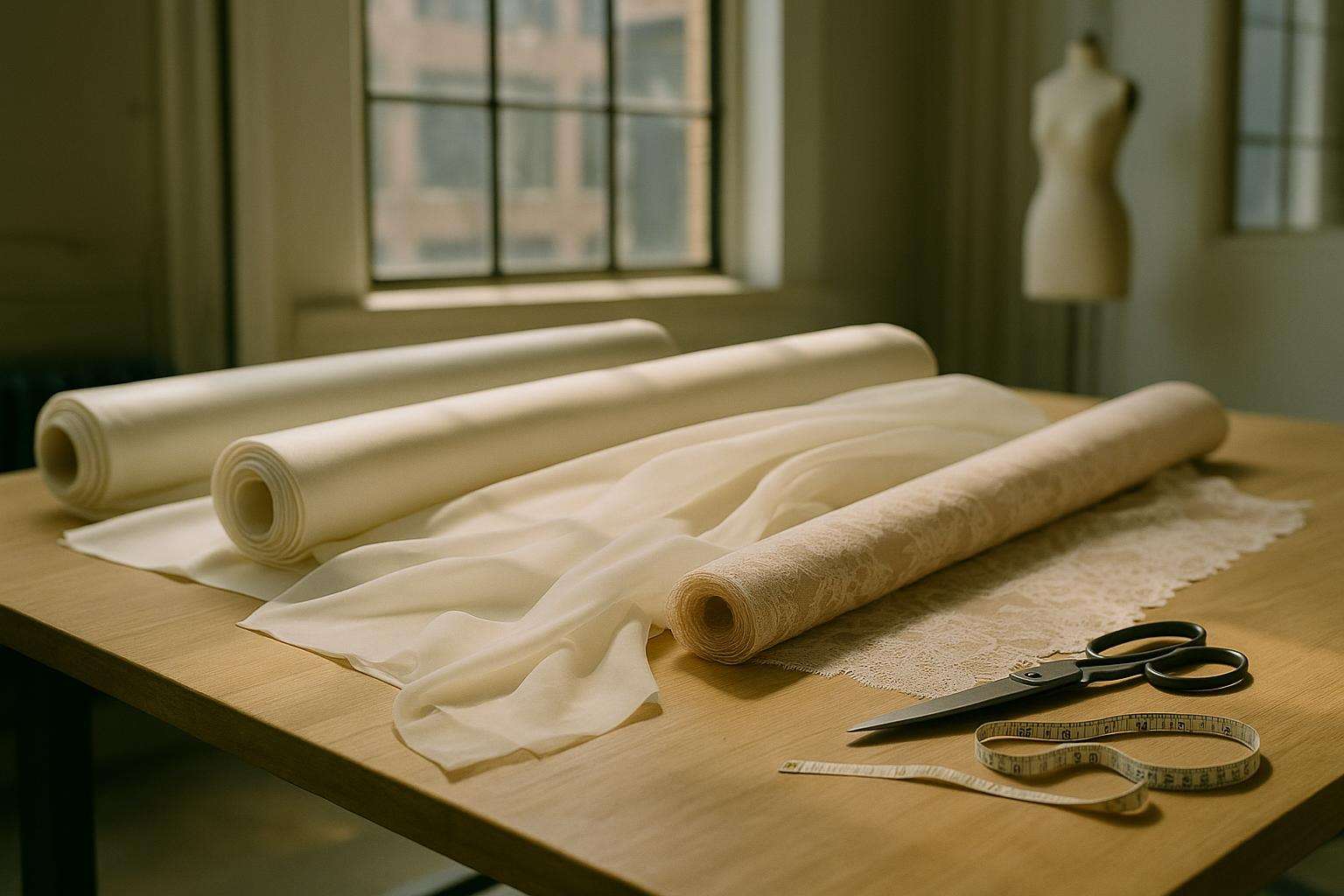
Wedding dress fabric determines silhouette, seasonal comfort, photographic behaviour, alteration cost, and gown price. The nine most common bridal cloths — duchess satin, Mikado, crepe, chiffon, tulle, organza, Chantilly lace, guipure lace, and charmeuse — each make fundamentally different structural and aesthetic promises. Knowing what each fabric does before you set foot in a salon is the single most useful preparation a bride can make.
The moment a bridal consultant pulls a gown from the rack, the fabric is already doing half the work: it is telling the skirt how to fall, deciding whether the dress will photograph with liquid luminosity or quiet matte depth, and setting the outer limit of how much your seamstress will charge to take in the seams. Most brides arrive at appointments focused on silhouette and budget — but the cloth that silhouette is cut from shapes the experience of wearing the dress as profoundly as its shape does. What follows is a material-by-material account of every major bridal fabric, examined on the axes that matter most to the bride who will live in it.
What Is the Difference Between Duchess Satin and Mikado for Wedding Dresses?
Satin is a weave construction, not a fibre. Any yarn — silk, polyester, or a blend — woven in a satin pattern produces the smooth, high-gloss face and matte back that characterise the family. Duchess Satin is the heaviest bridal variant, typically weighing 300–450 GSM at 19–22 momme, and it drapes close to the body while reflecting light with a pearly, almost mirror-bright luster. Kleinfeld Bridal, New York's flagship bridal retailer employing more than 100 in-house fitters and sewers, stocks duchess satin ballgowns and A-lines for formal indoor venues precisely because the fabric's luminosity performs beautifully under warm amber lighting. Its weight enables cathedral trains and stiff structured bodices — but that same weight means wrinkles photograph clearly and any imperfection in construction is visible on the smooth face. Alteration work on plain high-gloss satin demands exceptional precision: every stitch mark telegraphs.
Mikado is a different proposition. A silk-and-synthetic-blend fabric woven to a 250–350 GSM weight (16–20 momme), Mikado produces a semi-textured, matte-to-low-sheen surface that shapes rather than drapes. Its stiffer hand maintains sculptural silhouettes — ballgowns, trumpet skirts, architectural basque waists — without the high gloss of traditional satin. UK silk specialist Mayfairsilk notes that Mikado resists wrinkles better than duchess satin and is more forgiving in warm or humid conditions. Justin Alexander, whose fabric guide was updated in February 2025, positions Mikado across A-line, ballgown, mermaid, mini, and tea-length silhouettes: essentially any shape that benefits from a cloth that holds its form without structural boning. For brides choosing between the two, the practical distinction is this — duchess satin announces itself in a room; Mikado sculpts quietly and lets the silhouette speak.
Which Wedding Dress Fabric Is Best for a Summer Outdoor Wedding?
Chiffon is the most breathable common bridal cloth. A plain-weave, low-count fabric in either silk or polyester, chiffon is characterised by a slightly rough, pebbled surface and a near-weightless hand. Its open weave allows air circulation that heavier satins and Mikado simply cannot match. Sophia's Bridal Tux & Prom in San Jose specifically endorses chiffon for warm-weather weddings, noting its ability to keep a bride comfortable from the first look through the last dance. Because a single layer of chiffon is semi-sheer, gowns use multiple layers to add soft volume without weight — making it ideal for Grecian-style gowns, fluid A-lines, and destination styles. J. Andrews Bridal notes an additional practical advantage: chiffon resists creasing and packs neatly with tissue paper in a garment bag, which matters enormously for brides flying to their venue.
Lightweight stretch crepe is the close second for outdoor summer weddings. Its natural stretch prevents the heat-compression discomfort of a rigid structured gown, and its matte surface does not pick up sweat marks or seat creases the way duchess satin can. Grace Loves Lace, the Australian direct-to-consumer bridal brand with a strong presence among modern brides, recommends "soft, buttery stretch crepe" for its combination of elegance and comfort-first construction. Sydney-based luxury designer Karen Willis Holmes echoes this: her crepe collection uses structural seam lines that sculpt the silhouette with a fabric that "feels substantial and looks beautiful but has stretch for comfort and dancing."
What Are the Different Types of Lace Used in Bridal Gowns, and How Do They Differ in Price?
Lace is a decorative overlay or surface layer rather than a structural cloth, and the three dominant bridal types differ substantially in weight, three-dimensionality, and alteration complexity. Understanding which type is on a gown is important before signing an alteration contract — the complexity, and the cost, are not equivalent.
Chantilly lace is a lightweight bobbin lace with a fine tulle ground and delicate floral motifs. It is the fabric historically associated with French haute couture bridal — Vera Wang, Monique Lhuillier, and Oscar de la Renta all use genuine French Chantilly in their couture tiers, priced at $3,500 and above. Raw yardage runs approximately $16–$60 per metre. The eyelash border (scalloped edge) is characteristic of true Chantilly and is one of the simplest ways to identify it on the hanger.
Alençon lace, often called "the Queen of Lace," is a needlepoint lace with raised corded outlines over a net ground — heavier, more dimensional, and one of the most labour-intensive laces to produce. It features prominently in gowns at Kleinfeld Bridal and in luxury collections from Pronovias's ATELIER tier. Its raised motifs make it immediately identifiable by touch.
Guipure lace is the most structural of the three: dense motifs connected by thread bars rather than a net ground, making it more durable and suited to mermaid silhouettes and urban-modern gowns. Raw yardage runs $9–$40 per metre. Darianna Bridal's reference guide lists twelve bridal lace variants in total, including Venetian, Schiffli, and re-embroidered lace, for brides who want to research further. Alteration costs on lace — regardless of type — tend to be the highest in bridal sewing, because motifs must be removed before seam work and re-attached afterward to maintain pattern continuity. At Kleinfeld Bridal's in-house department, lace modification can run $300–$700 depending on bead density; hand-beading labour runs $75–$150 per hour per Zola's 2026 alteration cost report.
Is Crepe or Satin Better for a Minimalist Wedding Dress?
For clean, restrained aesthetics, crepe is the superior choice on nearly every dimension. Produced by highly twisted yarns that create a pebbly matte surface with inherent stretch and controlled drape, crepe sits close to the body without clinging and photographs with consistent tonal depth rather than the reflective flash-points of high-gloss satin. Maggie Sottero offers three primary crepe weights in its 2026 collection: Crepe Georgette (thin, elastic, and layerable), Heavy Stretch Crepe (structured, for mermaid and sheath silhouettes), and Spandex/Scuba Crepe (thick and smooth with performance stretch) — a spectrum that illustrates how one fabric family can address radically different body types and silhouettes. Ashley Grace Bridal in Lynchburg, Virginia notes that crepe is the fabric stylists most often recommend when a bride wants "clean lines and restraint" with minimal post-purchase adjustment.
Satin, at its most minimal, is best represented by silk charmeuse: a lightweight, silk-faced satin weave with a high-gloss front and matte back, prized for its liquid drape in bias-cut slip gowns and cowl-neck columns. Justin Alexander offers a dedicated charmeuse filter and describes the fabric as producing "weightless elegance" that "flows with every step." However, charmeuse is technically demanding to cut and sew — couturier Brooks Ann Camper documents that bias-cut charmeuse requires extra-long seam allowances and overnight hanging before final stitch lines are marked — and its high-shine surface is among the most difficult bridal fabrics to alter without leaving visible marks. For the minimalist bride, crepe gives more room for error; charmeuse rewards it only when executed impeccably.
How Does Fabric Choice Affect Alteration Cost and Ease?
Fabric is the single largest driver of alteration pricing variation in bridal sewing. The general rule: the more a fabric reflects light, the less it forgives imprecision; the more decorative elements are bonded to it, the more labour is required to move any seam. Zola's 2026 alteration cost report places the national average for a full set of wedding dress alterations at $250–$500, but that figure masks significant fabric-driven variation — a plain crepe seam adjustment at one end, heavily beaded Alençon lace at the other.
Tulle ballgowns present their own alteration challenge: not complexity per seam, but sheer volume of work. A ballgown may have ten or more stacked tulle layers, each of which must be cut and finished individually when hemming. Organza — crisp, slightly stiffer than chiffon, and used in formal ballgown skirts and overskirts — creates full dome shapes that hold without a petticoat, but its tight weave means seam allowances are thin and hems must be rolled rather than turned. Chiffon demands care in a different way: pins leave marks, seam rippers risk pulls, and the sheer layers must each be finished individually. The practical advice from bridal seamstresses is consistent: budget 15–20% of your gown's ticket price for alterations regardless of fabric, and revisit that figure upward if your dress has dense beading, multiple lace appliqués, or a cathedral train in heavy satin.
Wedding Dress Fabric Comparison: Drape, Weight, Season & Alteration Ease
| Fabric | Weight | Finish | Best Silhouettes | Best Season | Alteration Ease | Price Signal |
|---|---|---|---|---|---|---|
| Duchess Satin | Heavy (300–450 GSM) | High gloss | Ballgown, A-line, Mermaid | Fall / Winter | Moderate — shows marks | $1,200–$6,000+ |
| Mikado | Medium-heavy (250–350 GSM) | Matte / semi-sheen | Ballgown, Mermaid, Trumpet | All seasons | Good — wrinkle-resistant | $1,000–$5,000 |
| Crepe | Light–medium (stretch) | Matte | Sheath, Mermaid, Fit-and-Flare | Spring / Summer / Fall | Easiest — hides stitches | $800–$4,000 |
| Chiffon | Very light | Soft sheer | Boho, A-line, Grecian | Spring / Summer | Harder — delicate layers | $500–$3,000 |
| Tulle | Very light (by layer) | Airy netting | Ballgown, fairy-tale | All seasons | Harder — many layers | $800–$5,000 |
| Organza | Light–medium | Crisp sheer | Formal ballgown, overskirts | All seasons | Moderate | $1,000–$5,000 |
| Chantilly Lace | Light overlay | Floral net | Any (as overlay) | Spring / Summer | Hardest — appliqué removal | $1,500–$10,000+ |
| Guipure Lace | Medium overlay | Dense, networkless | Mermaid, urban-modern | All seasons | Moderate–hard | $1,000–$6,000 |
| Charmeuse | Very light | High gloss / liquid | Bias-cut slip, cowl-neck | Spring / Summer | Hardest — marks easily | $1,500–$8,000+ |
Practical Guidance Before Your First Appointment
Three questions worth settling before you walk into a salon: First, what is your venue's lighting? High-gloss fabrics — duchess satin and charmeuse — perform brilliantly in warm amber indoor light and golden-hour exteriors; they can look harsh under direct midday sun or on-camera flash. Matte fabrics — crepe and Mikado — photograph consistently across all lighting conditions and are a safer default if you are unsure. Second, what is your alteration budget? If you are working with a tight post-purchase budget, prioritise crepe or a simple Mikado over heavily beaded lace, regardless of how much you love the look. Third, when is your wedding and where? Chiffon and lightweight crepe for spring and summer; duchess satin and Mikado for autumn and winter indoors; organza and tulle work year-round for brides willing to manage the weight and volume.
True Society Bridal Shops, which operates salons across multiple US states, advises brides to touch fabrics before committing to images — the hanger and the Instagram photo tell an incomplete story. The weight of a sample in your hands, the way it moves when you walk, and how a consultant's fabric swatch feels against your skin are the three inputs that no amount of online research can replace. Build the reference frame here; make the final call in the fitting room. For a deeper look at how fabrics interact with silhouette, see our guide to A-line wedding dresses and the full Bride Atlas fabric-by-silhouette pairing index. For authoritative alteration cost data, Zola's 2026 alteration cost report is the most current publicly available source. For a wider view of how season and venue shape fabric choice across every major bridal cloth, Rose & Vow's complete fabric guide covers the same territory from a planning-first perspective.
Considered Counsel
Frequently asked
What is the most popular fabric for wedding dresses?
Satin — specifically duchess satin and Mikado — remains the most widely stocked bridal fabric at retailers such as Kleinfeld Bridal and David's Bridal, appearing across ballgowns, A-lines, and mermaid silhouettes. Its structured weight photographs with a luminous sheen under most lighting conditions and holds its shape without reinforcement. Crepe has emerged as the close second in 2025–2026, favoured by modern brides seeking a matte, body-skimming look. Essense of Australia's 2026 collection filters explicitly by Crepe, Satin/Mikado, Silk, Lace, Tulle, and Jacquard — a practical guide to which fabrics dominate the contemporary bridal market. The "best" choice always depends on silhouette, season, and venue formality rather than popularity alone.
Is satin or crepe easier to alter on a wedding dress?
Crepe is meaningfully easier to alter than satin in most circumstances. Its matte, slightly pebbly surface hides stitch lines and does not telegraph small construction imperfections the way a high-shine satin does. Seamstresses at boutiques including Ashley Grace Bridal in Lynchburg, Virginia note that crepe takes in and lets out cleanly, and there are no appliqués or beaded motifs to remove before seam work. Plain duchess satin, by contrast, reveals every pin mark and seam impression on its smooth face — meaning alterations must be executed with exceptional precision. The alteration premium on heavily beaded satin or lace can run $300–$700 or more at a salon such as Kleinfeld Bridal, compared with a more modest $150–$350 for a straight crepe seam adjustment.
Which wedding dress fabric is best for a summer outdoor wedding?
Chiffon and lightweight crepe are the two most-recommended fabrics for warm-weather outdoor weddings. Sophia's Bridal Tux & Prom in San Jose specifically endorses chiffon for its breathability, noting that even polyester chiffon allows air circulation that heavier satins and Mikado cannot match. Its near-weightless hand and pebbled open weave keep a bride comfortable from pre-ceremony portraits through dancing. Lightweight stretch crepe (as carried by Grace Loves Lace and Karen Willis Holmes) is a close second: its natural stretch prevents the heat-compression discomfort of a rigid structured gown, and its matte surface does not pick up sweat marks or seat creases the way duchess satin can. Tulle ballgowns — while voluminous — are also well-ventilated because the many airy layers trap little heat.
What are the different types of lace used in wedding dresses?
The three dominant bridal lace types differ substantially in weight, texture, and cost. Chantilly lace is a lightweight bobbin lace with a fine tulle ground and delicate floral motifs — the fabric of choice for couture tiers at Vera Wang, Monique Lhuillier, and Oscar de la Renta, with raw yardage running approximately $16–$60 per metre. Alençon lace (often called "the Queen of Lace") is a needlepoint lace with raised corded outlines over a net ground; heavier and more three-dimensional than Chantilly, it features prominently at Kleinfeld Bridal and in high-end atelier collections. Guipure lace is the most structural of the three — dense, networkless motifs connected by thread bars rather than a net ground — making it more durable and better suited to mermaid silhouettes or urban-modern gowns. Darianna Bridal's reference guide lists twelve bridal lace variants in total, including Venetian, Schiffli, and re-embroidered lace.
How does fabric choice affect wedding dress photography?
Fabric finish has a significant impact on how a wedding dress appears in photographs. High-gloss fabrics — duchess satin and silk charmeuse — reflect light dramatically, creating a luminous, liquid sheen in well-lit indoor or golden-hour outdoor conditions; under harsh midday sun or direct flash, the same reflectivity can produce blown-out highlights or unflattering shine. Matte fabrics — crepe, Mikado, and guipure lace — photograph with more consistent tonal depth and are more forgiving under a range of lighting scenarios. Tulle and chiffon read as airy and dimensional in natural light, with soft layers creating gentle movement in portraits. Chantilly lace, with its intricate net ground and floral motifs, tends to photograph beautifully in all but the lowest-light conditions. If your venue has strong directional lighting or you are planning outdoor midday portraits, your photographer and bridal stylist should both be consulted about fabric finish before you commit to a gown.
What fabric is used in Vera Wang and Pronovias wedding dresses?
Vera Wang's signature aesthetic draws heavily on silk chiffon for its draped, ethereal column and sheath gowns, and on genuine French Chantilly lace for couture-tier designs priced at $3,500 and above. Wang's more accessible diffusion lines — White by Vera Wang (carried at David's Bridal) and Vera Wang Bride — incorporate polyester interpretations of chiffon and tulle to bring the silhouette within a wider price range. Pronovias, the Barcelona-based luxury house available in the US through Kleinfeld Bridal and its own boutiques, is particularly known for Mikado and heavy crepe in its structured bridal collection, and for Chantilly and re-embroidered lace in its ATELIER tier. BHLDN (Anthropologie's bridal label) favours chiffon, tulle, and lightweight crepe, positioning them as the go-to fabric choices for a romantic, approachable aesthetic at a $500–$2,000 price point.
What is the price difference between silk and polyester bridal fabrics?
The fiber content beneath a fabric's construction significantly affects both gown price and ownership experience. A silk duchess satin gown from an authorized bridal boutique typically begins at $2,500–$4,000 and rises steeply through couture, whereas a polyester satin gown with a similar silhouette can be found at David's Bridal or BHLDN for $500–$1,500. UK fabric retailer Bridal Fabrics places raw silk duchess satin yardage at £67.90–£249.90 per metre versus silk Mikado at £49.90–£189.90 — figures that illustrate the fibre premium before any labour or construction costs. For the bride, silk offers superior breathability, natural temperature regulation, and a subtler drape; polyester is more wrinkle-resistant, easier to clean spot-treat, and far more accessible. Many mid-range gowns use high-quality polyester blends that are difficult to distinguish from silk at arm's length — a sensible choice for most budgets.