The Wedding Dress
Wedding Dresses for Petite Brides: Proportion & Height Tricks
How to scale silhouette, detail and hemline to a smaller frame — the vertical lines, necklines and alteration strategies that add apparent height without a single extra inch.
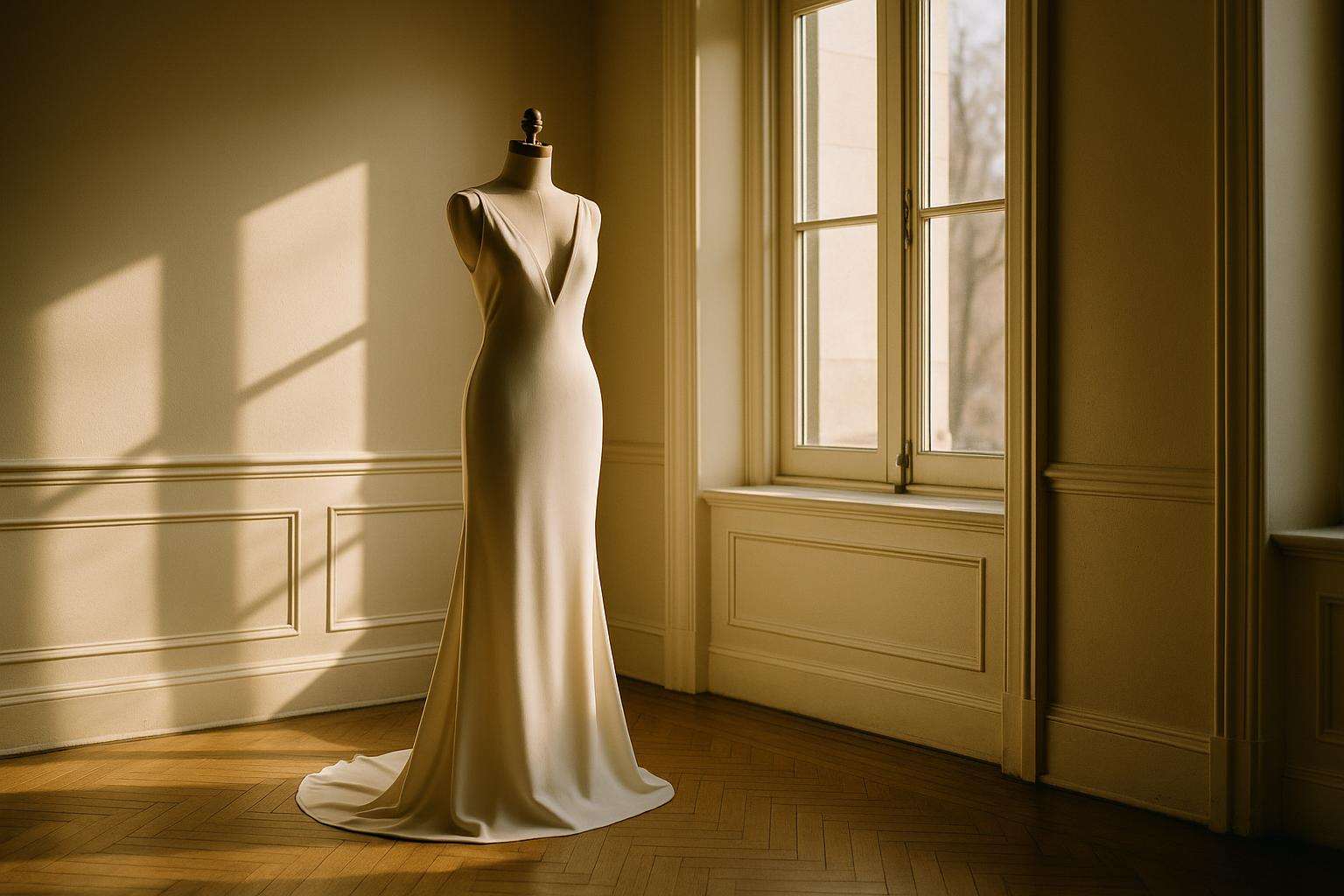
Standard wedding gowns are drafted for a 5’7″ model frame. If you stand under 5’4″, the waist seam falls too low, skirts pool at the floor and bodice proportions can overwhelm a shorter torso. The solution is not simply hemming a standard gown shorter — it is choosing a silhouette that works with vertical geometry: unbroken lines, single-fabric skirts, V or sweetheart necklines, and a hem strategy planned around your exact hollow-to-hem measurement and the heel you will wear all day.
There is a particular kind of discouragement that arrives in a bridal salon when a gown that looked breathtaking on the hanger swallows you. The waist sits somewhere around your hips. The skirt pools in a three-inch circle around your feet. The bodice compresses your proportions rather than celebrating them. None of this is a fault of the dress — or of you. It is a drafting problem. The industry standard is a 5’7″ figure, and most gowns are constructed to that reference without a petite alternative. What follows is the framework for choosing around that reality, using real silhouettes, verified designers and specific alteration guidance grounded in current 2026 pricing.
What does “petite” actually mean in bridal fashion?
In bridal sizing, petite refers to brides 5’4″ and under — but height is only part of the picture. A shorter frame typically means a shorter torso, narrower shoulder span and less distance between the waist and the hip. Standard gowns place the waist seam for a 5’7″ torso, so on a shorter bride it falls below the natural waist, visually shortening the leg line and distorting the proportions the silhouette was designed to create.
Maggie Sottero designs petite-proportioned gowns specifically for brides under 5’5″, adjusting shoulder width, bodice length and skirt volume simultaneously rather than simply shortening an existing style. Azazie goes further, offering a dedicated Petite length SKU that is five inches shorter than their standard cut, plus free custom sizing by individual measurements — making them one of the most accessible direct-to-consumer options for brides who fall outside the standard range.
Which silhouettes elongate a petite frame most effectively?
The geometry of vertical line is the governing principle for petite dressing. Any detail that draws the eye across the body — a wide horizontal neckline, a dropped waist seam, a tiered skirt that stacks horizontal breaks — adds apparent width and subtracts apparent height. The silhouettes that work best are those that keep the eye moving downward from shoulder to floor in as uninterrupted a line as possible.
Sheath and column gowns are the single most elongating choice. The unbroken fall of fabric from shoulder to hem — with no waist seam to interrupt the eye — creates more apparent height than any other silhouette. True Society Bridal, with locations across the United States, specifically recommends sheath gowns for petite clients because clean fabric fall eliminates the horizontal breaks that shorten the figure. Lightweight crepe and plain satin reinforce the effect; avoid heavy boning or structured side panels that interrupt the column.
A-line silhouettes are universally recommended. The gentle flare from a naturally placed waist keeps the eye moving vertically, adds no bulk at the hip, and remains forgiving across a wide range of body proportions. Kleinfeld Bridal — the New York flagship salon with over 30,000 square feet of inventory and more than 200 staff — advises petite brides that the A-line critical factor is ensuring the waist seam sits exactly at the natural waist. If it falls even an inch below, the skirt shortens the torso and the elongating effect is lost.
Empire waist gowns place the seam just below the bust, creating the longest uninterrupted line from chest to floor of any silhouette. Zola’s bridal editorial notes this is particularly effective for brides wanting to maximise the illusion of leg length, and it requires fewer complex bodice alterations than a waist-seam style because the most intricate fit zone is confined to the bust area.
Fit-and-flare silhouettes work for petite brides with one critical caveat: the flare must begin at or slightly above mid-thigh, never at the knee. A knee-level join line visually cuts the leg and creates the illusion of shorter stature. Styled with the flare point higher on the body, the silhouette enhances curves and elongates the lower body simultaneously.
Short and tea-length hemlines deserve serious consideration. Exposing the leg provides a natural elongating effect, and short gowns eliminate the most costly and complex petite alteration — the floor-length hem — entirely. Essense of Australia’s All Who Wander line includes short bridal options such as the London style (square neckline, tiered skirt, removable underskirt) that are designed to work off the rack for petite frames.
Which necklines add height — and which ones cut it?
Neckline choice is one of the most underestimated proportion levers available to a petite bride. The goal is to draw the eye upward and inward, creating a vertical focal point rather than a horizontal band across the upper body.
V-necks are the most consistently flattering neckline for a shorter frame. The V shape creates a strong downward arrow that lengthens the neck, narrows the visual width of the shoulders and pulls the eye toward the centre of the body — all of which compound the elongating effect of a vertical silhouette.
Sweetheart necklines perform a similar function, framing the décolletage with a gentle curved V that adds softness without horizontal width. They pair naturally with fitted bodices and flared skirts.
Avoid boat necks, wide bateau cuts and wide jewel necklines. These add horizontal visual weight at the shoulder line — the exact opposite of what a petite frame needs. Kleinfeld’s stylists flag wide necklines as a proportion risk for shorter brides for precisely this reason: the wider the horizontal at the top of the body, the shorter and broader the silhouette reads overall.
How does hemline mathematics work for petite brides?
The hollow-to-hem measurement — taken from the center collarbone to the floor, with the bride standing in her actual wedding shoes — is the most important number in a petite bride’s fitting. Most floor-length gowns require at least two to four inches of hem removal for a bride under 5’4″, and the construction of the hem determines whether that removal is a straightforward task or a costly, time-consuming one.
| Hem type | Typical cost range | Notes |
|---|---|---|
| Simple hem — slim sheath or crepe gown | $70 – $150 | Single-layer, no embellishment at hem border |
| Lace or chiffon hem (per layer) | $130 – $300 per layer | Must be re-finished at each layer; beaded borders add cost |
| Multi-layer ballgown hem | $300 – $600+ | Each tier cut and re-finished separately |
| Full alteration package (hem + bodice + bustle) | $400 – $1,000+ | Full-service salon or independent seamstress; complexity drives the high end |
The practical implication is clear: avoid gowns with intricate hemline embellishment if alteration budget is a concern. A plain satin or crepe hem is far less expensive to shorten than a lace-bordered ruffle with hand-applied bead work.
Kleinfeld Bridal recommends submitting the hollow-to-hem measurement to the designer at the time of ordering. Many designers can cut the gown slightly shorter at the factory, preserving the integrity of the hem embellishment before any scissors touch it at the salon. This single step can save both time and hundreds of dollars in alteration fees.
Alteration timelines should allow for three fittings: the first approximately ten to twelve weeks before the wedding, a second at four weeks, and a final check at two weeks. Rush alterations at established salons typically carry a premium of 20–30 per cent over standard pricing.
Which designers and retailers carry petite-specific wedding dresses?
Maggie Sottero maintains three labels — Maggie Sottero, Sottero & Midgley, and Rebecca Ingram — with petite-proportioned cutting across multiple silhouettes. The brand’s “Personalize It!” program also allows structural customisation (back closures, sleeve removal, neckline adjustments) without a full bespoke commission. Retail price range: approximately $1,400–$3,300 depending on label and retailer.
David’s Bridal is the most accessible entry point, with a dedicated petite wedding dress category and styles starting under $400. The retailer explicitly re-proportions shoulder width, bodice length and skirt construction — not merely overall length — across its petite range, making it a genuine structural option rather than simply a shortened standard gown.
Azazie offers free custom sizing by bust, waist and hip measurements alongside a dedicated Petite length SKU that is five inches shorter than standard. Floor-length petite options are priced from approximately $300–$600 depending on style, and the direct-to-consumer model eliminates the salon markup that can double the price of a comparable gown elsewhere.
Essense of Australia and All Who Wander both include petite-friendly styles in their current lines. The D3080 from Essense of Australia — a curved V-neck, fitted bodice with strong vertical front seaming — is cited in the brand’s own petite guidance as a strong elongating choice. Retail pricing runs from approximately $1,499 at authorised retailers.
Kleinfeld Bridal in New York carries over thirty designer lines with petite cuts, including Essense of Australia, Allure Bridals, Sareh Nouri, Anna Campbell, Ines Di Santo, Enaura Bridal and Maison Signore. Alterations are included in the salon experience, which materially changes the total cost of ownership compared with buying at a lower price point and then paying separately for complex alterations.
True Society Bridal’s multi-location US network carries Essense of Australia, Stella York, Martina Liana, Martina Liana Luxe, Oxford Street and All Who Wander. Their petite guide specifically addresses bodice-length proportioning and recommends shopping at least one year before the wedding date to avoid rush alteration fees.
What heel height should a petite bride plan around?
Heel selection and hemline planning are inseparable. A petite bride who switches shoes between ceremony and reception will need either a second hem or a dress that was intentionally left slightly long to accommodate a flatter shoe — neither of which is ideal, and both of which require explicit planning at the first fitting.
Bella Belle Shoes — a specialist bridal footwear brand whose low-heel styling guide is one of the most cited resources for comfort-conscious brides — advises against debuting a new heel height on the wedding day. The heel worn at the final fitting is the heel that determines the finished hem, and there is no graceful last-minute correction.
The recommended range for most petite brides: a 2–2.5 inch block heel or kitten heel provides meaningful lift, maintains stability over a twelve-hour reception day, and performs across most venue surfaces including grass, stone paths and heritage flooring. Platform heels at 3–4 inches offer maximum elongation with better stability than stilettos of the same height and suit indoor venues particularly well. Embellished flats remain entirely valid — pearl-trimmed and jewelled flat styles have been a consistent editorial pick through 2025 and 2026 — but commit to flats at the outset, because a hem set for flats will trail on the floor behind any heel.
Choose a silhouette with an unbroken vertical line (sheath, column, A-line or empire waist). Pick a V-neck or sweetheart neckline to lengthen the neck and avoid horizontal width at the shoulder. Submit your hollow-to-hem measurement to the designer at order, wear your exact wedding shoes to every fitting, and budget alteration costs against hem complexity rather than gown price alone. These four decisions together will do more for apparent stature than any single element in isolation.
Considered Counsel
Frequently asked
What is the best wedding dress silhouette for a petite bride?
The sheath and A-line silhouettes are the two most consistently recommended choices for petite brides. The sheath creates an uninterrupted vertical line from shoulder to floor, maximising apparent height, while the A-line flares gently from the natural waist without adding visual weight to the hips. Both work because they keep the eye moving downward rather than across. Fit-and-flare can also elongate when the flare point begins at or above mid-thigh; if it begins at the knee it visually cuts the leg. Avoid drop-waist cuts, which shorten both the torso and the leg simultaneously, and very full ballgown skirts unless the construction is lightweight tulle rather than layered duchess satin.
Which wedding dress designers have petite-specific lines?
Several major bridal brands offer petite-proportioned cutting rather than simply shortening a standard gown. Maggie Sottero (and its sister labels Sottero & Midgley and Rebecca Ingram) designs petite gowns for brides under 5’5″, adjusting shoulder width, bodice length and skirt volume simultaneously. David’s Bridal maintains a dedicated petite wedding dress category from around $400 with re-proportioned construction. Azazie offers a Petite length SKU that is five inches shorter than their standard cut, plus free custom sizing by measurements. At the salon level, Kleinfeld Bridal in New York carries over thirty designer lines with petite options, including Essense of Australia, Allure Bridals and Martina Liana, among others.
How much does it cost to hem a wedding dress for a petite bride?
Hemming costs vary significantly by construction. A plain hem on a slim sheath or crepe gown typically runs $70–$150. A lace or chiffon hem, which must be cut per layer and re-finished, ranges from $130 to $300 per layer, and multi-tiered skirts with embellished borders can push a full alteration package to $400–$1,000 or more when bodice adjustments and a bustle are included. The practical implication for petite brides: seek gowns with plain or minimal hemline detail if budget is a concern, and discuss factory shortening with your designer at point of order—many houses can cut the gown slightly short before it ships, preserving hem integrity at no additional cost.
What heel height should a petite bride wear on her wedding day?
A 2–2.5 inch block heel or kitten heel is the range most recommended by bridal shoe specialists for petite brides: it provides a meaningful lift while remaining stable across a long reception day and a variety of venue surfaces, including grass and cobblestone. Platform heels of 3–4 inches offer maximum elongation with better stability than stilettos of the same height, and suit indoor venues well. The critical rule is to bring your actual wedding shoes to every fitting—the heel height determines the finished hemline, and switching from a 3-inch heel to a flat after final alterations will leave your gown trailing on the floor. Bella Belle Shoes advises never debuting a new heel height on the wedding day itself.
Can a petite bride wear a ballgown without being overwhelmed?
Yes, with careful construction choices. The risk of a ballgown on a petite frame is that a heavy, voluminous skirt can overwhelm the figure and make the bride appear to disappear into the dress. The corrective is to seek lightweight tulle construction rather than multiple layers of duchess satin, keep bodice embellishment minimal so the eye reads the vertical line first, and ensure the bodice is precisely fitted so the structure begins at the correct waist position. Kleinfeld Bridal recommends requesting a fitting where the consultant holds the skirt volume at different heights to gauge visual impact before committing. A cathedral-length train can further elongate, provided the train begins at the waist rather than adding mass at the hem.
What is the hollow-to-hem measurement and why does it matter for petite brides?
The hollow-to-hem is the measurement taken from the center collarbone hollow to the floor, typically with the bride standing in the shoes she will wear on the wedding day. It is the single most important number in a petite bride’s fitting because most floor-length gowns are cut for a 5’7″ figure and require at least two to four inches of hem removal for a bride under 5’4″. Submitting this measurement to the designer at the time of order—rather than waiting to alter the gown after delivery—allows many houses to make the shortening before embellishment is applied, which preserves the integrity of the hem border and keeps alteration costs lower. Bridal seamstresses universally recommend taking the measurement in the precise heel that will be worn at the ceremony.