The Wedding Dress
Wedding Dress Trains Explained: Sweep to Cathedral
From the grazing sweep to the grand royal, every train length has a logic — a venue it was made for, a silhouette it perfects, and a bustle that sets it free for the dancing.
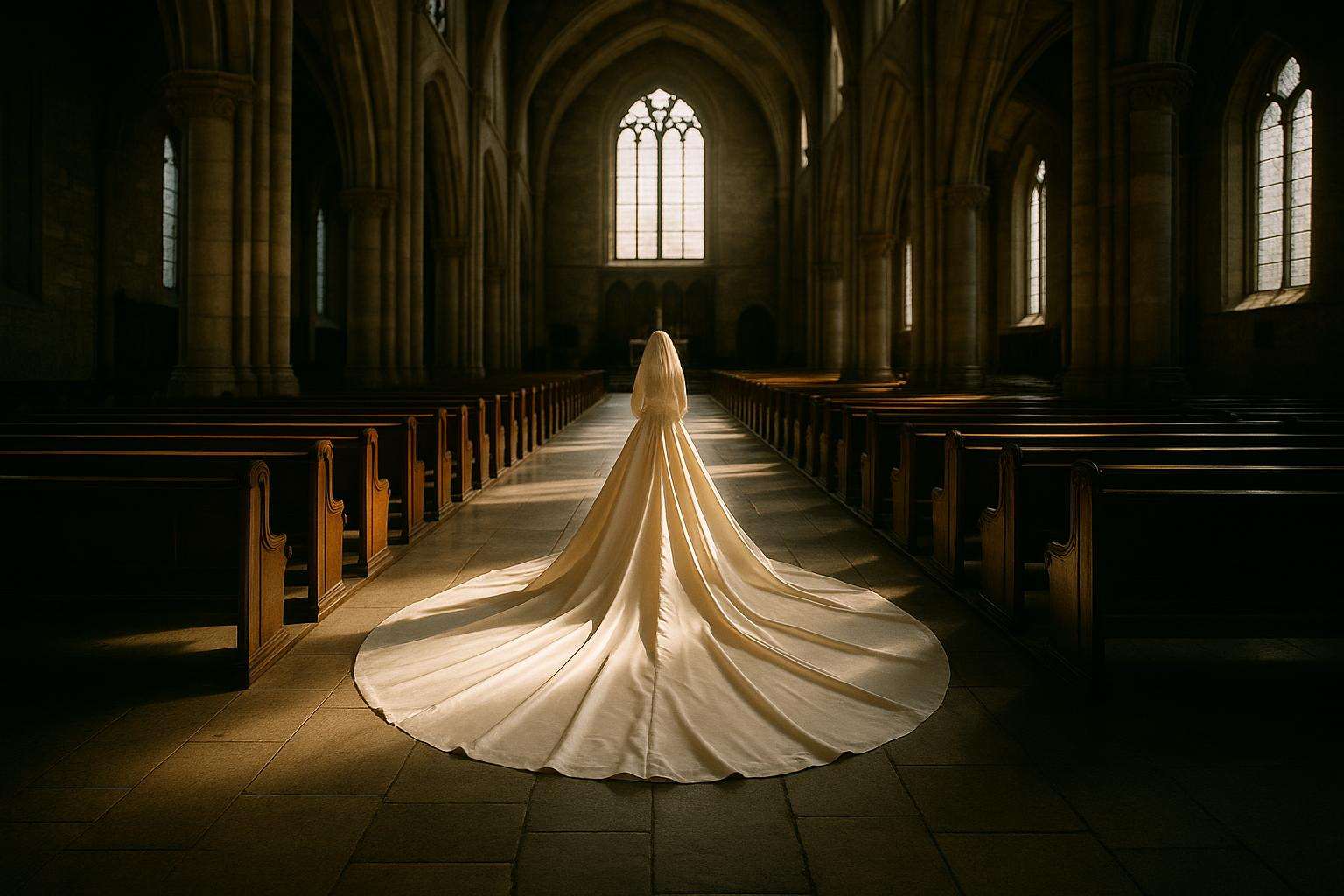
A wedding dress train is the fabric extending from the gown's back hem or waist — from a 6-inch sweep to a 10-foot-plus royal — and each length carries its own formality level, venue logic, and bustle requirement. Matching train to aisle, floor surface, and silhouette is one of the most consequential decisions in bridal dressing; getting it right makes every photograph and every step down the aisle effortlessly composed.
The train is the most theatrical element of the bridal gown. It announces the bride's entrance, fills a church aisle or ballroom floor with fabric, and lingers in memory — and in photographs — long after the ceremony ends. Yet for all its drama, train selection is a practical decision as much as an aesthetic one. The wrong length on the wrong floor at the wrong venue scale reads as mismatched rather than magnificent.
What follows is a complete reference guide to every standard wedding dress train type — exact measurements, the venues each was made for, how train length interacts with bustle conversion, and what real bridal designers and salons are offering at each tier in 2026.
How long is each wedding dress train? A complete measurement reference
The bridal industry measures all trains from the natural waistline — not from the floor — which is the standard used by salons including Kleinfeld Bridal and Moonlight Bridal. This matters: two gowns of different waist heights can have trains of identical yardage that read very differently at floor level.
| Train Type | Length from Waist | Formality Level | Best Venue | Bustle Needed? |
|---|---|---|---|---|
| Sweep (Brush) | 6–12 in. beyond hem | Casual to semi-formal | Beach, garden, outdoor, micro-venue | Rarely |
| Court | ~1–2.5 ft from waist | Semi-formal | Garden, intimate chapel, boutique hotel | Sometimes |
| Chapel | 3–4.5 ft (36–54 in.) | Formal | Church, ballroom, estate | Yes — 3–5 points |
| Semi-Cathedral | 4–5 ft (48–60 in.) | Formal to very formal | Grand ballroom, large church | Yes — 5–7 points |
| Cathedral | 6–7.5 ft (72–90 in.) | Very formal / black tie | Cathedral, grand estate, ballroom | Yes — 6–8+ points |
| Royal (Monarch) | 10 ft+ (120 in.+) | Ultra-formal / heritage | Cathedral, palace, historic church | Yes — 2+ attendants |
| Watteau | Shoulder-attached panel, variable | Romantic / ethereal | Garden, chateau, intimate church | Not usually — detachable |
Sweep train
The sweep — sometimes called a brush train — extends just 6 to 12 inches beyond the hem, grazing the floor as the bride walks. It is the most practical choice, requiring no bustle and no attendant, and it suits beach, outdoor, and destination weddings where longer trains collect sand, grass, and moisture. Its brevity is a deliberate stylistic statement: clean, confident, unencumbered.
Chapel train
The chapel train, extending 3 to 4.5 feet (36 to 54 inches) from the waist, is the most popular bridal train length and for sound reasons. It balances ceremony drama with real-world manageability — Darianna Bridal & Tuxedo describes it as the Goldilocks of wedding dress trains — and it suits the widest range of venues: traditional churches, ballrooms, and estates all wear it well. A skilled seamstress can bustle a chapel train with three to five attachment points, keeping the dance-floor silhouette clean and unencumbered.
Cathedral train
The cathedral train spans 6 to 7.5 feet (72 to 90 inches) from the waist, producing the dramatic processional entrance that defines the formal bridal imagination. Kleinfeld Bridal — whose New York flagship carries designers including Maggie Sottero, Martina Liana, Viktor & Rolf, and Hayley Paige — describes cathedral trains as creating a sense of grandeur that feels unmistakably bridal. Managing one in motion requires at least one dedicated attendant during the ceremony. Maggie Sottero gowns with cathedral trains are priced from approximately $2,000 to $3,500 at authorised retailers.
Royal (Monarch) train
The royal or monarch train extends 10 feet or more from the waist, placing it firmly in heritage-ceremony territory. Princess Diana's 1981 gown by David and Elizabeth Emanuel carried a 25-foot train as she entered St. Paul's Cathedral — the longest in modern royal wedding history. By contrast, Catherine Middleton's 2011 gown by Sarah Burton for Alexander McQueen was a more considered 9 feet, crafted from ivory silk tulle with hand-appliqued French Chantilly and English Cluny lace. Two or more dedicated attendants are standard for royal-length trains, and venue scale must be sufficient to appreciate — not merely contain — the length.
Watteau train
The Watteau train — named after the Rococo painter Jean-Antoine Watteau — is attached at the shoulders or upper back rather than the waist or hem. A separate panel of chiffon, organza, or silk tulle cascades down the back while the gown beneath remains floor length. It delivers visual drama and romantic movement without the structural management demands of a sewn-in train, and it rarely requires a bustle. Brides drawn to ethereal, art-historical aesthetics and A-line or empire silhouettes find it particularly sympathetic.
How does venue floor type affect which train to choose?
Floor surface is as decisive as aisle length in train selection. Belle Amour Bridal advises matching train length to aisle scale as well as floor type: a chapel train that fills a 20-foot intimate chapel completely will look truncated on a 100-foot cathedral nave, where a cathedral length would be architecturally proportionate. Equally, a cathedral train that glides beautifully on polished ballroom wood becomes a liability on beach sand.
- Polished wood (ballroom): Chapel or cathedral. Smooth surface allows the train to glide; cathedral reads beautifully in formal ballroom photography.
- Carpet (church aisle): Chapel or cathedral — but plan for the bustle. Carpet creates drag on heavier trains; a bustle is essential for reception movement.
- Stone (historic church, castle): Grand stone interiors suit cathedral or royal lengths, but rough or uneven stone risks snagging lace — inspect the surface before committing to delicate fabric trains.
- Outdoor grass or garden: Sweep, court, or detachable. Longer trains collect debris and moisture; a detachable style allows conversion after the aisle.
- Beach or sand: Sweep or floor-length only. Sand damages fabric and weighs down longer trains; sweep is the practical maximum.
- Barn or rustic plank: Chapel or semi-cathedral. Gaps between planks can catch lace edging; seamless trains in heavier fabric fare better than delicate applique.
What bustle style works best for each train length — and what does it cost?
A bustle is an alteration — sewn hooks, buttons, loops, ribbons, or a drawstring mechanism — that lifts and secures the train after the ceremony so the bride can move freely through the reception. Bustle style should be decided at the first alterations appointment, ideally several months before the wedding date, because it affects how the gown is cut and finished.
Most bridal shops charge $100–$350 for a standard bustle alteration, according to Alteration Specialists NYC. Complex cathedral or royal-trained gowns in beaded or layered fabric reach $400 or more in metropolitan markets. Some seamstresses charge per attachment point at approximately $25 each; others use a flat rate. The Austrian bustle — the most labour-intensive style — consistently runs $300–$400 or more.
American (Over) Bustle — $90–$150. The most common style: the train is lifted and fastened to the outside of the gown at or near the waistline, creating a cascading, layered effect at the back. Simple to attach on the day, and best for A-line, ball gown, and cathedral train silhouettes. The Knot rates it the most universally flattering bustle choice.
French (Under) Bustle — $150–$200. The train folds underneath the gown and is secured with colour-coded internal ribbons, producing a seamless two-layer hem with no visible fasteners. Moonlight Bridal's alteration guide recommends colour-coding the ties to speed attachment on the wedding day — a practical note that saves considerable time in a busy bridal suite. Preferred for mermaid and trumpet silhouettes where an over-bustle would add unwanted back-bulk.
Ballroom Bustle — $150–$275. Multiple attachment points fold the entire train underneath until it disappears completely, giving the illusion of a standard floor-length dress. Princess Bridals in Long Island notes this style works on virtually any silhouette because it conceals the train without altering the gown's exterior appearance — ideal for brides who want an entirely clean reception silhouette.
Austrian Bustle — $300–$400+. A drawstring mechanism sewn into the train creates elegant vertical ruffles when pulled, inspired by theatre curtain hardware. Moonlight Bridal rates this the most intricate style, best suited to chiffon, organza, or lightweight silk. A specialist seamstress is required; it is not appropriate for heavily structured or beaded trains.
Royal Bustle — $300–$400+. Multiple gathering points create stacked, voluminous folds reminiscent of historic formal gowns. Preferred for A-line and ball gown silhouettes at very formal receptions. Requires skilled execution and more attachment points than standard styles; discuss with your seamstress at the earliest possible fitting.
Wristlet — $50–$100. A soft loop is attached to the bride's wrist so she carries the train rather than fastening it to the gown. Low cost and easy to execute, but fatiguing over a long reception. Best for shorter, lighter trains where management is brief — a chapel train at a two-hour cocktail reception, for instance.
Which designers and retailers offer the widest range of train lengths?
Kleinfeld Bridal (New York City) operates a train-length filter across its entire dress-guide tool, spanning no-train through royal, and stocks cathedral train collections from Maggie Sottero, Martina Liana, Viktor & Rolf, Hayley Paige, and Verdin Bridal. It remains the most comprehensive single-destination reference for comparing train lengths across designer price points.
Maggie Sottero — authorised at Kleinfeld, Alexandra's Boutique, and The Bridal Collection Denver — offers cathedral train gowns from approximately $2,000 to $3,500, with the full brand range spanning $1,400 to $3,300. The label is one of the most widely stocked mid-luxury bridal designers in North America.
Hayley Paige (available at Kleinfeld and The Wedding Shoppe) includes several cathedral train ball gowns in her Twice Upon a Time collection, including Once I Was A Swan in ivory pintuck tulle and Silver Springs with a meteorite caviar-beaded skirt — both with cathedral trains suited to grand ballroom and church settings.
Winnie Couture — with ateliers in Atlanta, Dallas, and Beverly Hills — offers semi-cathedral and cathedral styles in its Diamond Label ($3,150–$6,850), including the Cornelia (Style 3520), a semi-cathedral design in the label's signature structured silhouette.
Moonlight Bridal publishes one of the most detailed train and bustle educational resources among US bridal manufacturers — a useful independent reference when comparing train types across appointments at different salons.
A note on timing: train length decisions interact directly with the alteration schedule. Cathedral and royal trains require more alteration time and more specialist attention; brides should book their first alterations appointment no later than three months before the wedding date, and communicate train and bustle style at that first session rather than the final fitting.
Considered Counsel
Frequently asked
How long is a chapel train on a wedding dress?
A chapel train extends approximately 3 to 4.5 feet — 36 to 54 inches — from the natural waistline of the gown, which is the industry-standard measurement point used by salons including Kleinfeld Bridal and Moonlight Bridal. It is the single most popular train length: long enough to trail beautifully down a church or ballroom aisle, refined enough to suit a semi-formal venue, and short enough to bustle with just three to five attachment points. Brides who want drama without the management demands of a cathedral train almost always settle here. Darianna Bridal & Tuxedo describes it as the Goldilocks of wedding dress trains, and that characterisation holds — it is neither fussy nor understated.
What is the difference between a cathedral train and a royal train?
A cathedral train extends 6 to 7.5 feet (72 to 90 inches) from the waistline and is the longest length commonly stocked by bridal retailers including Kleinfeld Bridal and Maggie Sottero. A royal — or monarch — train extends 10 feet or more, sometimes exceeding 12 feet, and is reserved for the grandest formal ceremonies. Princess Diana's 1981 gown by David and Elizabeth Emanuel carried a 25-foot royal train as she entered St. Paul's Cathedral; Catherine Middleton's 2011 gown by Sarah Burton for Alexander McQueen measured a comparatively restrained 9 feet. Cathedral trains require at least one attendant; royal trains typically need two or more and suit only the largest ecclesiastical or estate interiors.
What type of bustle is best for a cathedral train?
For a cathedral train, the American (over) bustle or the French (under) bustle are the most practical choices. The American bustle gathers the train upward and fastens it to the exterior of the gown near the waist, creating an elegant layered cascade at the back — a natural complement to the volume of a cathedral length. It costs $90 to $150 at most bridal shops. The French bustle folds the train underneath the gown using internal colour-coded ribbons, producing a seamless two-layer hem with no visible fasteners — preferred for mermaid and trumpet silhouettes where added back-bulk would distort the line. For very heavily beaded cathedral trains, a ballroom bustle hides the train entirely at a cost of $150 to $275.
How much does it cost to bustle a wedding dress?
Bustle alteration costs range from roughly $50 for a simple wristlet to $400 or more for a complex Austrian or royal bustle on a heavily beaded cathedral gown. Alteration Specialists NYC puts the typical range at $100 to $350 for most bridal shops in standard markets, with metropolitan and luxury salons reaching $400-plus for intricate work. The American over-bustle averages $90 to $150; the French under-bustle runs $150 to $200; the ballroom bustle costs $150 to $275; and the Austrian bustle — the most labour-intensive — runs $300 to $400 or more. Some seamstresses charge per attachment point at approximately $25 each; others use a flat rate. Discuss bustle style at your very first alterations appointment.
Which wedding dress train is best for an outdoor or beach wedding?
For an outdoor ceremony on grass, gravel, sand, or an uneven surface, a sweep train — extending just 6 to 12 inches beyond the hem — is the practical maximum. Longer trains collect debris, moisture, and grass stains that are difficult to reverse, particularly on silk, tulle, and lace. A detachable train is the elegant solution for brides who want ceremony drama and reception freedom: the long train attaches via hook-and-eye or snap tape for the processional and is removed entirely for dancing. Court trains (1 to 2.5 feet from the waist) also work well on manicured garden paths. Belle Amour Bridal advises matching train length to both floor type and aisle length so the train reads proportionate rather than truncated in photography.
What is a Watteau train on a wedding dress?
A Watteau train is attached at the shoulders or upper back of the gown rather than the waist or hem. It flows down the back as a separate panel of fabric — typically chiffon, organza, or silk tulle — while the dress itself remains floor length underneath. The effect is visual rather than structural: it adds drama and movement without the management demands of a sewn-in train. Watteau trains are most commonly seen on A-line and empire-waist silhouettes and suit romantic, ethereal aesthetics. They rarely require a bustle, as the panel is simply removed or floats freely, and they translate beautifully to garden, chateau, and intimate church settings.
How should train length be matched to aisle length and venue?
A helpful rule from Belle Amour Bridal: the train should fill, not overwhelm, the aisle. A chapel train (3 to 4.5 feet) that reads beautifully in a 20-foot intimate chapel will look almost non-existent on a 100-foot cathedral nave, where a cathedral train (6 to 7.5 feet) would be more proportionate. Venue floor type matters equally: polished wood ballroom floors allow trains to glide gracefully, while outdoor grass and sand surfaces trap and soil longer trains. Carpet church aisles create drag on heavier trains — a cathedral train is manageable on carpet during the ceremony but should be bustled immediately after for the reception. For grand stone interiors, cathedral or royal trains are architecturally proportionate; beach and garden venues call for sweep or court lengths, or a detachable train.