The Wedding Dress
Winter Wedding Dress: Warmth, Fabric & Coverage
Velvet, Mikado, long sleeves, capes, and faux-fur layering — how to build genuine warmth into a cold-season gown without losing an ounce of elegance.
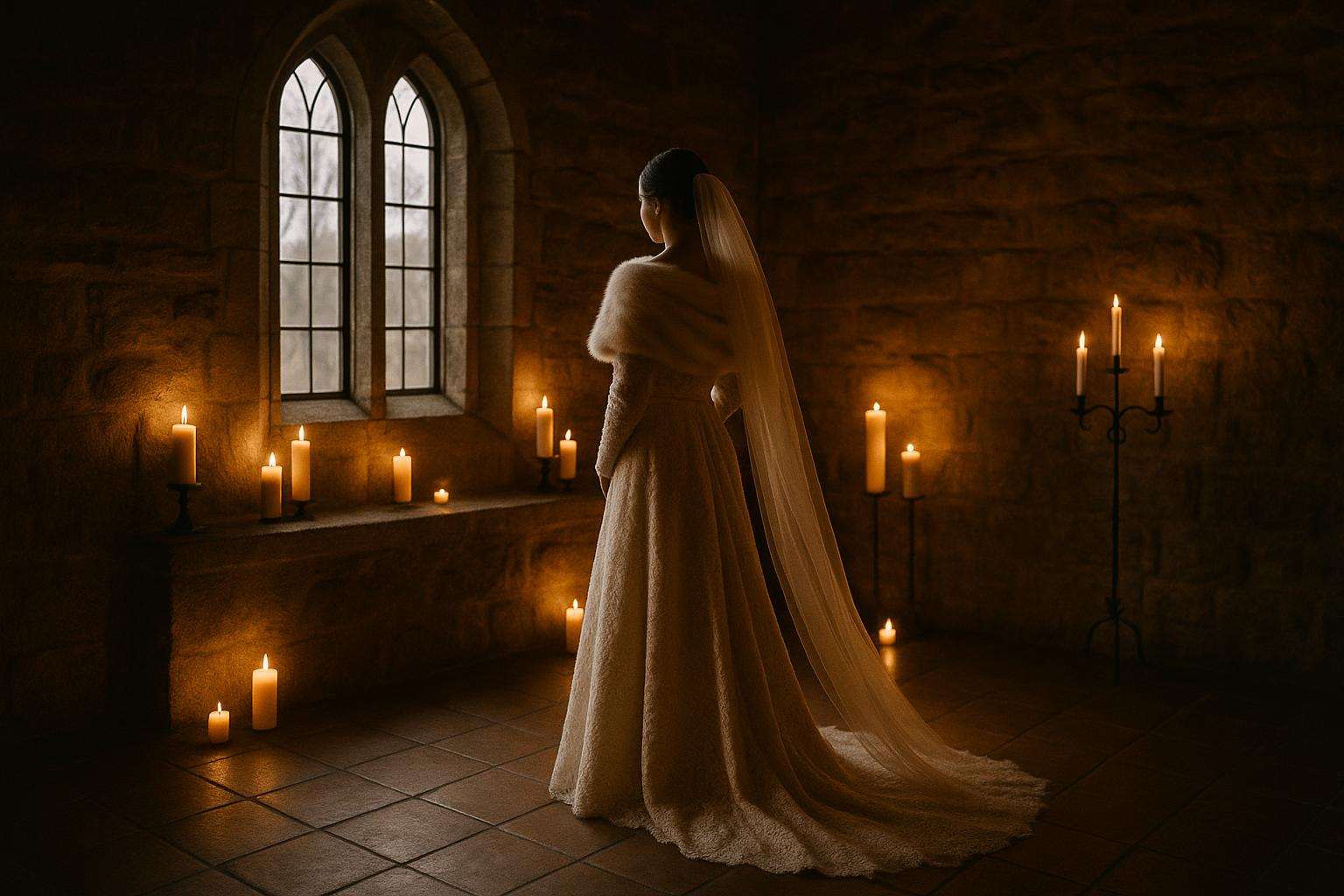
A winter wedding dress succeeds when fabric, silhouette, and cover-up are chosen as a system — velvet and Mikado for thermal weight and visual richness, long sleeves or a detachable cape for ceremony coverage, and a faux-fur stole or silk wrap for the transition outdoors. Real warmth and genuine elegance are not competing priorities; they are the same decision made well.
There is a particular quality of light in a December or January ceremony — low, golden, slightly dramatic — that rewards the brides who chose their gown with the cold in mind. Velvet deepens. Mikado gleams. A faux-fur stole at the shoulder reads less like a concession to weather and more like a deliberate reference to a glamour tradition that stretches back a century. The winter wedding dress is not a compromised version of a spring gown with a wrap thrown over it. It is its own category, with its own materials, its own silhouette logic, and its own considerable beauty.
In 2026, the market has caught up to that understanding. Bridal and Tuxedo Galleria describes a clear shift toward winter-specific construction in the new collections — "gowns that don't just tolerate the cold but were genuinely designed for it." Monique Lhuillier, Justin Alexander, Karen Willis Holmes, and Maggie Sottero have each released cold-weather-specific silhouettes, layering options, and Mikado constructions that would have been harder to find five years ago. This is the guide to making those choices well.
What Are the Best Fabrics for a Winter Wedding Dress?
Fabric choice is both an aesthetic and a functional decision for winter brides. Four fabrics dominate cold-weather bridal fashion, each with a distinct relationship to warmth, structure, and photographic quality.
Velvet is the warmest bridal fabric available. Its dense pile construction traps heat more effectively than any woven alternative, and its deep sheen photographs richly under the low light of winter venues. In 2026 collections, velvet appears in controlled, sculptural applications rather than head-to-toe coverage: velvet sleeves, corseted bodices, and detachable velvet overskirts are the leading formats. Monique Lhuillier's Fall 2025 collection incorporates 3D velvet bow details cascading over sculpted gowns — the most widely noted use of velvet in the current luxury bridal market — confirming that the fabric has returned to full runway credibility after years as a niche choice.
Mikado is a heavy silk-satin twill — firm enough to hold structured silhouettes yet soft enough to drape. Karen Willis Holmes (KWH Bridal), the Australian bridal label established in 2000 with boutiques in Sydney, Melbourne, Brisbane, and Perth, describes Mikado as "perfect for wedding dresses that have corsets, fit-and-flare silhouettes, and A-line skirts," citing its "slight satin glossiness and twill texture." Justin Alexander offers Mikado across three of its labels — Justin Alexander, Justin Alexander Signature, and Sincerity Bridal — with styles ranging from the long-sleeve stretch Mikado fit-and-flare with illusion lace sleeves to the Signature ball gown with a beaded plunging neckline. Maggie Sottero prices Mikado gowns at roughly $1,500–$3,500 at authorized retailers; the Sottero & Midgley sister label commands $1,700–$4,000 for couture-adjacent constructions.
Heavy lace layered over silk bases creates depth and visual warmth without physical heaviness. According to The Knot's Fashion & Attire Study, 46 percent of brides wore lace gowns in 2024 — the most popular bridal fabric overall. For winter specifically, Chantilly and Alençon lace over silk bases create the look of richness without the thermal weight of velvet. Bridal and Tuxedo Galleria notes a 2026 shift toward bold, intricate floral lace patterns — "statement-making blooms that look almost hand-painted onto the fabric" — that mirror the drama of winter landscapes and photograph with considerable impact against candlelight or tungsten venue lighting.
Crepe's matte finish absorbs winter venue light rather than reflecting it harshly, producing clean, minimal lines while maintaining structural integrity in the cold. Sareh Nouri — a Persian-American bridal designer working exclusively with imported Italian silk and French lace, hand-constructing gowns in the USA — deploys silk crepe in her Fall 2025 "Persian Muse" collection, producing structured sheath silhouettes suited to formal winter interiors. Heavier-weight crepe is the practical choice for outdoor winter portraits, where lightweight fabrics can look insubstantial against wind.
| Fabric | Warmth Level | Best Silhouettes | Photographic Quality | Typical Price Range |
|---|---|---|---|---|
| Velvet | Highest — dense pile insulates | Column, corseted bodice, A-line, ballgown | Deep, rich; exceptional under candlelight | $2,000–$5,000+ (designer RTW) |
| Mikado silk | High — heavy twill construction | Fit-and-flare, A-line, structured ballgown | Quiet sheen; photographs crisply indoors and out | $1,500–$4,000 (Maggie Sottero, Justin Alexander) |
| Duchess satin | Medium-high — smooth and dense | Ballgown, mermaid, structured column | Luminous; can read stiff in motion shots | $1,200–$3,500 |
| Heavy crepe | Medium — matte and substantial | Mermaid, sheath, minimal column | Matte; absorbs rather than reflects light | $1,200–$3,200 |
| Heavy lace over silk | Low-medium — coverage not insulation | A-line, sheath, overlay silhouettes | Intricate; exceptional in close and mid-range shots | $1,500–$4,500+ |
How Do You Layer Over a Winter Wedding Dress Without Ruining the Look?
The expert consensus is to treat the cover-up as a planned element of the look rather than an afterthought. Four categories dominate, each with a distinct silhouette profile and removal logic for the transition from ceremony to reception.
Bridal capes are what Bridal and Tuxedo Galleria calls "the signature of the 2026 winter wedding dress." A detachable cape worn over the shoulders flows like a second veil, providing arm and shoulder coverage without altering the dress silhouette underneath. Grace + Ivory's lace cape features a loop-button detail that mimics a high neckline at the collar — protective for outdoor ceremonies, removable in a single motion for reception dancing. David's Bridal's 2025 arrivals include chiffon bridal capes and dramatic satin capes at accessible price points. The critical advantage of a cape over built-in sleeves is noted by J. Majors Studio: a cape allows the bride to shed the warmth layer the instant she steps inside, restoring the original dress silhouette for reception photographs, which is precisely when the most images are typically taken.
Boleros and shrugs cover the arms and upper back while leaving the full dress silhouette visible. Justin Alexander's Sincerity Bridal label offers detachable off-the-shoulder long sleeves (Style 88480SL, sold separately) that pair with existing Mikado bodies — an elegant flexibility that serves brides who want ceremony coverage and reception freedom from a single gown investment. A velvet or lace bolero raises the formality register of any sleeveless bodice without interrupting the eye's travel down the dress.
Faux-fur stoles reference a glamour tradition dating to the early 1900s, when real fur shawls were wrapped across the shoulders and fastened with a brooch. The modern consensus favors faux fur on ethical and sustainability grounds; vintage or heirloom pieces remain an alternative for brides with access to them. Bella Mera Bridal stocks a dedicated category of wedding capelets and faux-fur pieces, available from standard through double extra-large sizing. Wedding Sparrow's editorial roundup of the 18 best bridal cover-ups includes soft-gradient white-brown faux fur stoles, classic long-pile faux fur shawls, and champagne-colored capelet styles that work across multiple body types and gown silhouettes.
Silk scarves and pashminas are the most discreet warmth solution. Grace + Ivory notes that a silk neck scarf "rose to the top of the trends list" for 2025 bridal, citing its versatility and ease of removal. A pashmina in ivory or off-white — or in a deliberate "something blue" shade — is the most packable layer and can be removed cleanly without disturbing the gown or any alteration work at the shoulder seam. For the bride who wants warmth available but not visible in photographs, a pashmina tucked into a bag or the arms of a trusted bridesmaid is the practical standard.
Which Winter Wedding Dress Designer Collections Stand Out in 2025–2026?
Monique Lhuillier offers the most fully realized cold-weather bridal vision in the current luxury market. The Fall 2025 collection features hammered crepe ivory sheaths, floral lace column gowns with exaggerated overskirts, and basque-waist silhouettes with "3D velvet bow details cascading over cameo sculpted gowns" — a construction detail that is explicitly seasonal and would be difficult to execute in lighter fabrics. The Fall 2026 collection, described by the house as "a celebration of romance through a modern lens," continues with silk white re-embroidered lace high-neck long-sleeve sheath gowns and silk Duchesse corseted ballgowns in ivory — both constructed with winter formality in mind.
Justin Alexander's Fall/Winter 2026 collection "L'Amour En Fleur" incorporates luxurious taffeta, all-over romantic lace, pearl accents, and art deco-inspired details alongside the label's established long-sleeve Mikado offerings. Vera Wang Bride and the Vera Wang Haute line offer long-sleeved styles, Mikado constructions, and mermaid silhouettes across their current collection, viewable at verawangbride.com.
Karen Willis Holmes maintains a dedicated winter collection page highlighting illusion lace long sleeves, velvet, satin, and lace, with retail pricing from AUD $2,190 (Wild Hearts collection) to AUD $13,000 (Bespoke). The KWH design philosophy — grounded in the specific properties of each fabric — makes their editorial a particularly useful resource for brides navigating fabric choice for the first time.
Pronovias and Sareh Nouri round out the designer tier: the Spanish label's 2025 collection offers structured silhouettes in luxurious fabrics suited to formal winter venues, while Sareh Nouri's silk crepe "Persian Muse" pieces represent the most refined minimal option in the cold-weather market.
How Does Venue Type — Indoor vs. Outdoor — Change What You Should Wear?
Indoor winter venues — ballrooms, historic houses, churches, hotel event spaces — remove thermal requirements from the fabric decision almost entirely, since climate control is reliable and the bride is indoors for the majority of the ceremony. Fabric choice then shifts to aesthetics alone: velvet or Mikado reads rich and deliberate under candlelight or tungsten venue lighting; heavy lace adds intimacy and depth without visual clutter; crepe produces the minimal, architectural lines that photograph cleanly in formal interior settings.
Outdoor winter ceremonies change the calculation. Bridal Creek, an Oklahoma outdoor wedding venue, notes that temperatures below 50–55°F require active warmth solutions for guests — heated tents, fire pits, warm-drink stations — and the same logic applies to the bride. For outdoor ceremonies, a practical layering sequence works better than any single choice:
- A lined gown or a seamless thermal bodysuit beneath a sleeveless dress as the invisible base layer.
- A detachable bridal cape or faux-fur stole worn for the outdoor ceremony and portrait session, removed for the indoor reception.
- Fleece-lined tights or opaque stockings under tea-length or midi silhouettes.
- Closed-toe shoes and hand warmers tucked into a stole pocket or bridal bag.
Circle D Farm, a Maryland outdoor winter venue, advises keeping outdoor bride-and-groom portrait sessions genuinely brief and building transition to heated indoor spaces directly into the shot list schedule. The most common error is an overly ambitious outdoor session that extends into uncomfortable cold — and the photographs taken when a bride is visibly cold rarely become the favorites regardless of the setting's beauty.
The winter wedding dress is, at its best, a gown that makes the cold irrelevant. Not by fighting it — not with so many layers that the original silhouette disappears — but by choosing the right fabric in the first appointment, planning the cover-up as part of the look from the beginning, and trusting that the velvet, the Mikado, the faux-fur stole, the long sleeve built into the bodice — all of it — was made for exactly this: a ceremony in December light, unhurried, warm, and entirely itself.
Considered Counsel
Frequently asked
What is the warmest fabric for a winter wedding dress?
Velvet is the warmest bridal fabric available — its dense pile construction traps heat more effectively than any woven alternative, and it photographs with a rich, deep sheen under the low, warm light that characterizes winter venues. For brides who want structure alongside warmth, Mikado silk (a heavy silk-satin twill) is the next best choice: firm enough to hold a fit-and-flare or A-line silhouette in cold conditions while providing real thermal weight. Duchess satin and heavy stretch crepe both sit one step below Mikado in warmth but excel at producing clean, architectural lines in chilly outdoor settings. Avoid lightweight chiffon, organza, or single-layer tulle for outdoor winter ceremonies — they offer essentially no insulation and can feel flimsy against wind. If you love a lighter fabric, the most practical solution is a thermal-lined version of your gown or a seamless thermal underlayer worn beneath a sleeveless style.
Can you wear a strapless wedding dress in winter?
Yes — with the right cover-up strategy and venue planning. Strapless gowns are perfectly appropriate for winter ceremonies held in climate-controlled indoor venues such as ballrooms, churches, historic houses, and hotel event spaces. For outdoor ceremonies or transitions, a well-chosen cover-up is essential: a detachable bridal cape in lace or velvet provides ceremony coverage without altering the gown's silhouette, and removes cleanly before reception dancing. A faux-fur stole draped across the shoulders is the most traditional cold-weather pairing for a strapless bodice — it references a glamour tradition dating to the early 1900s. Grace + Ivory also recommends a fitted velvet or lace bolero for brides who want a more structured alternative to a stole. The key is planning the cover-up as an intentional element of the look rather than an afterthought — not a compromise, but a second layer of dressing.
What is Mikado fabric and why is it ideal for a winter wedding dress?
Mikado is a heavy silk-satin twill distinguished by a subtle surface texture and a quiet, structured drape that holds silhouettes without boning. Karen Willis Holmes (KWH Bridal), the Australian bridal designer with boutiques in Sydney, Melbourne, Brisbane, and Perth, describes it as "perfect for wedding dresses that have corsets, fit-and-flare silhouettes, and A-line skirts," citing its "slight satin glossiness and twill texture" as design assets. For winter specifically, Mikado's weight provides physical warmth without the heavy look of velvet, and its smooth-but-textured surface catches candlelight and tungsten venue lighting in a way that photographs beautifully in December settings. Justin Alexander offers Mikado across three of its labels — Justin Alexander, Justin Alexander Signature, and Sincerity Bridal — with styles ranging from long-sleeve fit-and-flare silhouettes to statement ball gowns. Maggie Sottero prices Mikado gowns at approximately $1,500–$3,500 at authorized retailers; the Sottero & Midgley sister label commands $1,700–$4,000 for couture-adjacent constructions.
What is the best cover-up for a winter wedding dress?
The most versatile cover-up for a winter wedding dress is a detachable bridal cape — worn over the shoulders for the outdoor ceremony and photographs, then removed before reception dancing to reveal the gown's original silhouette. Bridal and Tuxedo Galleria calls the detachable cape "the signature of the 2026 winter wedding dress" for precisely this reason: it solves the warmth problem without locking the bride into a single look for the entire day. Grace + Ivory's lace cape features a loop-button collar detail that mimics a high neckline outdoors. David's Bridal stocks chiffon and satin bridal capes in its 2025 arrivals. Faux-fur stoles offer an equally elegant alternative — Wedding Sparrow's roundup of the 18 best bridal cover-ups includes white-brown gradient faux fur and champagne-colored capelet styles, all ethically sourced in synthetic pile. For brides who want to pack light, a silk pashmina in ivory or a subtle "something blue" shade is the most discreet warmth solution of all.
How do you stay warm at an outdoor winter wedding ceremony in your dress?
A layered approach works better than any single solution. Start with a thermal underlayer — a seamless thermal bodysuit or fleece-lined tights worn beneath the gown — so your warmth solution is invisible. Add a faux-fur stole or detachable bridal cape for the ceremony and outdoor portraits, then remove it cleanly before the reception. Closed-toe shoes and opaque stockings under tea-length or midi styles add meaningful warmth at the extremities. Grace + Ivory specifically recommends fleece-lined tights, hand warmers tucked into a faux-fur muff or stole pocket, and planning short outdoor portrait sessions followed by immediate transition to a heated interior. Circle D Farm, a Maryland outdoor winter venue, advises keeping outdoor bride-and-groom sessions brief and building the schedule around heated tent or indoor space transitions. Bridal Creek (Oklahoma) notes that for guests, and by extension the wedding party, temperatures below 50°F require active supplementation — heated tents, fire pits, and warm-drink stations — rather than layering alone.
Which designer wedding dress collections are best for winter brides in 2026?
Monique Lhuillier leads the 2026 winter bridal conversation with two standout collections. The Fall 2025 collection includes hammered crepe ivory sheaths, floral lace column gowns with exaggerated overskirts, and basque-waist silhouettes featuring 3D velvet bow details — the last being the most overtly winter-specific motif in the luxury market. The Fall 2026 collection continues with silk white re-embroidered lace high-neck long-sleeve sheath gowns and corseted Duchesse satin ballgowns, both explicitly cold-season in construction. Justin Alexander's Fall/Winter 2026 collection "L'Amour En Fleur" incorporates luxurious taffeta, all-over lace, and pearl accents alongside long-sleeve Mikado silhouettes. Karen Willis Holmes offers velvet, satin, and illusion lace winter styles with retail pricing from AUD $2,190 (Wild Hearts collection) to AUD $13,000 (Bespoke). Pronovias's 2025 collection offers structured silhouettes in luxurious fabrics suited to formal winter venues across its standard and Privée tiers.